
A French Word to Live By
How to Conjugate Orner in French
/ɔʁ.ne/
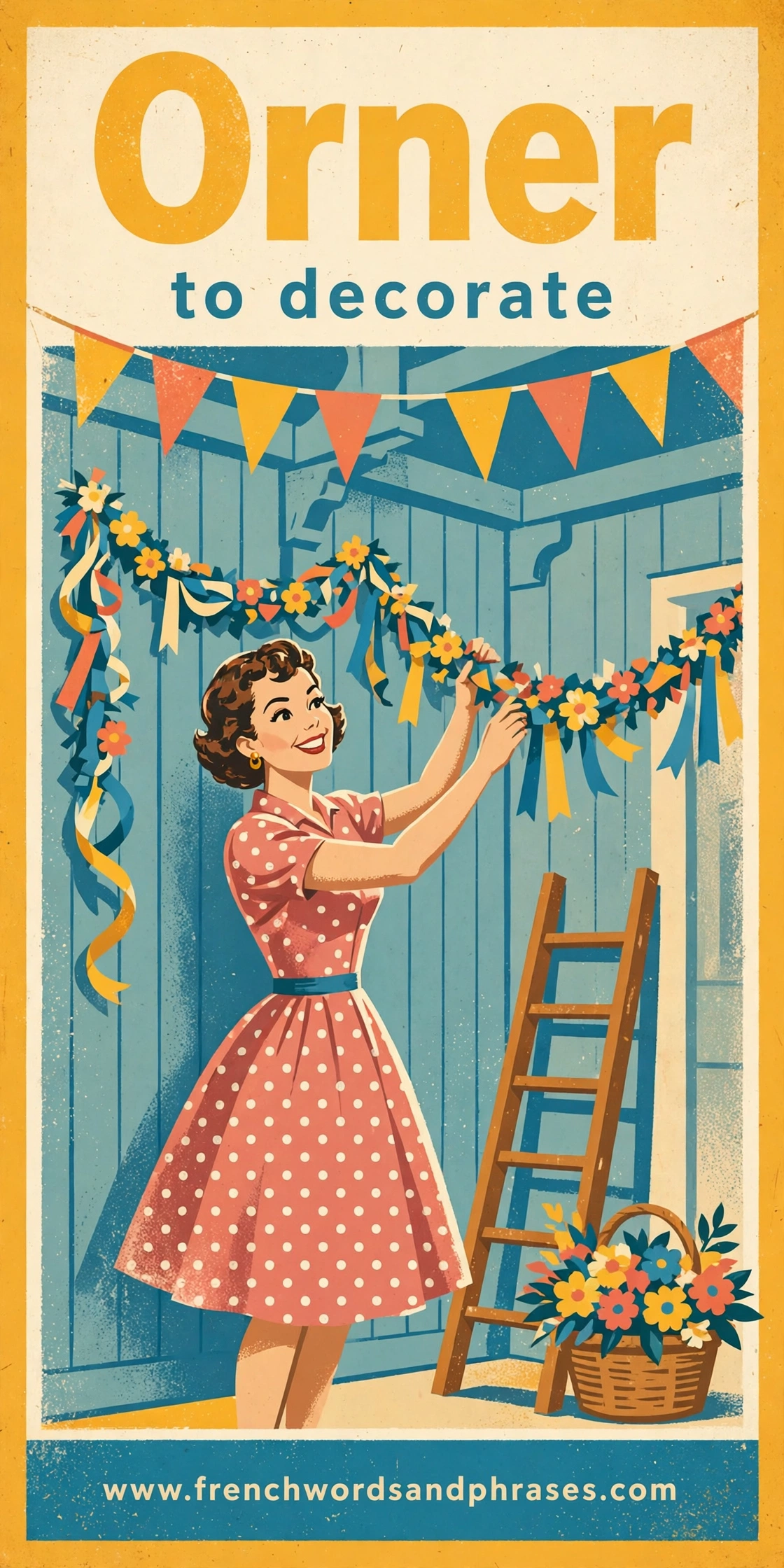
Orner means to decorate — to adorn a place or a thing with beautiful details.
Garlands over the doorway, candles along the table, flowers where bare walls were an hour ago — orner is the verb of the finishing touch, the moment a plain room puts on its jewellery.
In this guide, you’ll learn how to conjugate orner in all the major French tenses and moods. Explore complete conjugation tables, French examples, English translations, and practice quizzes.
Understanding the French Verb Orner
Orner is a regular French verb belonging to the first group of verbs, those ending in -er.
It means to decorate. It is commonly used for decorating rooms, churches, Christmas trees and cakes, and figuratively for speeches and texts dressed up with quotations, images and fine phrases.
Verb classification: First group (-er)
Auxiliary verb: Avoir
Past participle: orné
Present participle: ornant
English equivalents: To decorate, to adorn; orner de — to decorate with; orner le sapin — to decorate the Christmas tree; s’orner de — to adorn oneself with.
One important detail: orner takes the preposition de for whatever does the decorating: orner la salle de fleurs — to decorate the hall with flowers. Its family is elegant: un ornement is an ornament, and orné describes anything ornate — even a speech, where un style orné means a flowery, decorated style. Orner is a touch more literary than décorer: you décorez a flat, you ornez a chapel, a cake or a Christmas tree.
Experience the Word
Orner is decoration with intention — not clutter, but the garland placed exactly where the eye will land.
Imagine the village hall the night before a wedding. Chairs in rows, bare walls — then the aunts arrive with boxes of flowers, ribbons and candles, and by midnight the plain room has become a garden that happens to have a roof.
Nothing structural has changed. Everything has been orné — and the room is unrecognisable.
How to Conjugate Orner: Complete French Conjugation Guide
Let’s explore every major conjugation of orner, beginning with the indicative mood.
How to Conjugate Orner in the Indicative Mood
The indicative mood is used to express facts, observations, actions, and events.
How to Conjugate Orner in the Present Tense (Présent)
Used for actions happening now, habitual actions, and general truths.
| Subject | Conjugation |
|---|---|
| je | orne |
| tu | ornes |
| il / elle | orne |
| nous | ornons |
| vous | ornez |
| ils / elles | ornent |
Example
Elle orne la table de fleurs fraîches.
She decorates the table with fresh flowers.
Quick Quiz 1
Complete the sentence:
Nous ______ le sapin de guirlandes dorées.
Reveal the answer
ornons
Nous ornons le sapin de guirlandes dorées.
We decorate the tree with golden garlands.
How to Conjugate Orner in the Passé Composé
Used for completed actions in the past. Orner takes the auxiliary verb avoir.
| Subject | Conjugation |
|---|---|
| j’ | ai orné |
| tu | as orné |
| il / elle | a orné |
| nous | avons orné |
| vous | avez orné |
| ils / elles | ont orné |
Example
Nous avons orné le sapin de guirlandes dorées.
We decorated the tree with golden garlands.
How to Conjugate Orner in the Imparfait (Imperfect Tense)
Used for habitual past actions, descriptions, and ongoing situations in the past.
| Subject | Conjugation |
|---|---|
| je | ornais |
| tu | ornais |
| il / elle | ornait |
| nous | ornions |
| vous | orniez |
| ils / elles | ornaient |
Example
Chaque année, les enfants ornaient la salle de classe.
Every year, the children used to decorate the classroom.
Quick Quiz 2
Choose the correct form:
She decorated the house.
Elle ______ la maison. (a orné / est ornée)
Reveal the answer
a orné
Elle a orné la maison.
Orner takes avoir.
How to Conjugate Orner in the Plus-que-parfait
Used to describe an action that had already been completed before another past event.
| Subject | Conjugation |
|---|---|
| j’ | avais orné |
| tu | avais orné |
| il / elle | avait orné |
| nous | avions orné |
| vous | aviez orné |
| ils / elles | avaient orné |
Example
Il avait orné la façade de lampions avant la fête.
He had decorated the façade with paper lanterns before the party.
How to Conjugate Orner in the Passé Simple
Primarily used in formal writing, literature, and historical narratives. It is rarely used in everyday conversation.
| Subject | Conjugation |
|---|---|
| je | ornai |
| tu | ornas |
| il / elle | orna |
| nous | ornâmes |
| vous | ornâtes |
| ils / elles | ornèrent |
Example
On orna l’église de lys blancs pour le mariage.
They decorated the church with white lilies for the wedding.
How to Conjugate Orner in the Passé Antérieur
A literary tense used to express an action completed immediately before another past action, generally in the passé simple.
| Subject | Conjugation |
|---|---|
| j’ | eus orné |
| tu | eus orné |
| il / elle | eut orné |
| nous | eûmes orné |
| vous | eûtes orné |
| ils / elles | eurent orné |
Example
Quand ils eurent orné la salle, les invités arrivèrent.
When they had decorated the hall, the guests arrived.
How to Conjugate Orner in the Future Tense (Futur Simple)
Used to describe actions that will take place in the future.
| Subject | Conjugation |
|---|---|
| je | ornerai |
| tu | orneras |
| il / elle | ornera |
| nous | ornerons |
| vous | ornerez |
| ils / elles | orneront |
Example
Demain, j’ornerai la vitrine pour Noël.
Tomorrow, I will decorate the shop window for Christmas.
How to Conjugate Orner in the Futur Antérieur (Future Perfect)
Used for an action that will have been completed before a particular point in the future.
| Subject | Conjugation |
|---|---|
| j’ | aurai orné |
| tu | auras orné |
| il / elle | aura orné |
| nous | aurons orné |
| vous | aurez orné |
| ils / elles | auront orné |
Example
À midi, elle aura orné toutes les tables.
By noon, she will have decorated all the tables.
How to Conjugate Orner in the Near Future (Futur Proche)
Used to describe something that is going to happen soon. Formed with aller + infinitive.
| Subject | Conjugation |
|---|---|
| je | vais orner |
| tu | vas orner |
| il / elle | va orner |
| nous | allons orner |
| vous | allez orner |
| ils / elles | vont orner |
Example
Je vais orner le gâteau de fruits rouges.
I am going to decorate the cake with red berries.
How to Conjugate Orner in the Conditional Mood
The conditional mood expresses what would happen under certain circumstances. It is also frequently used to make polite requests or express wishes.
How to Conjugate Orner in the Present Conditional
| Subject | Conjugation |
|---|---|
| je | ornerais |
| tu | ornerais |
| il / elle | ornerait |
| nous | ornerions |
| vous | orneriez |
| ils / elles | orneraient |
Example
Avec plus de temps, nous ornerions la cour de guirlandes lumineuses.
With more time, we would decorate the courtyard with fairy lights.
How to Conjugate Orner in the Past Conditional
| Subject | Conjugation |
|---|---|
| j’ | aurais orné |
| tu | aurais orné |
| il / elle | aurait orné |
| nous | aurions orné |
| vous | auriez orné |
| ils / elles | auraient orné |
Example
Il aurait orné la scène si on lui avait demandé.
He would have decorated the stage if he had been asked.
Orner in the Literary Past Conditional Form
This less common literary form uses the imperfect subjunctive of avoir.
| Subject | Conjugation |
|---|---|
| j’ | eusse orné |
| tu | eusses orné |
| il / elle | eût orné |
| nous | eussions orné |
| vous | eussiez orné |
| ils / elles | eussent orné |
Example
Elle eût orné la salle de ses plus belles fleurs.
She would have decorated the hall with her finest flowers.
How to Conjugate Orner in the Subjunctive Mood
The subjunctive is used to express wishes, emotions, doubts, necessity, and uncertainty. It frequently follows expressions such as il faut que (it is necessary that) or bien que (although).
How to Conjugate Orner in the Present Subjunctive
| Subject | Conjugation |
|---|---|
| que je | orne |
| que tu | ornes |
| qu’il / qu’elle | orne |
| que nous | ornions |
| que vous | orniez |
| qu’ils / qu’elles | ornent |
Example
Il faut que tu ornes l’entrée avant ce soir.
You must decorate the entrance before this evening.
Quick Quiz 3
Complete the sentence using the subjunctive:
Il faut que tu ______ l’entrée avant ce soir.
Reveal the answer
ornes
Il faut que tu ornes l’entrée avant ce soir.
You must decorate the entrance before this evening.
How to Conjugate Orner in the Imperfect Subjunctive
A literary tense, rarely encountered in modern spoken French.
| Subject | Conjugation |
|---|---|
| que je | ornasse |
| que tu | ornasses |
| qu’il / qu’elle | ornât |
| que nous | ornassions |
| que vous | ornassiez |
| qu’ils / qu’elles | ornassent |
Example
Je voulais qu’il ornât le plafond de fresques.
I wanted him to decorate the ceiling with frescoes.
How to Conjugate Orner in the Pluperfect Subjunctive
A literary construction used to express an action completed before another past action.
| Subject | Conjugation |
|---|---|
| que j’ | eusse orné |
| que tu | eusses orné |
| qu’il / qu’elle | eût orné |
| que nous | eussions orné |
| que vous | eussiez orné |
| qu’ils / qu’elles | eussent orné |
Example
On admirait qu’elle eût orné la chapelle avec tant de goût.
People admired that she had decorated the chapel with such taste.
How to Conjugate Orner in the Past Subjunctive
| Subject | Conjugation |
|---|---|
| que j’ | aie orné |
| que tu | aies orné |
| qu’il / qu’elle | ait orné |
| que nous | ayons orné |
| que vous | ayez orné |
| qu’ils / qu’elles | aient orné |
Example
Je suis ravi que vous ayez orné la maison pour notre retour.
I am delighted that you decorated the house for our return.
How to Conjugate Orner in the Imperative
The imperative is used to give commands, instructions, invitations, or suggestions. Subject pronouns are omitted.
How to Conjugate Orner in the Present Imperative
| Person | Conjugation |
|---|---|
| (tu) | orne |
| (nous) | ornons |
| (vous) | ornez |
Example
Orne la table, les invités arrivent !
Decorate the table, the guests are coming!
Quick Quiz 4
How would you say Decorate the entrance with garlands (vous form)?
Reveal the answer
Ornez l’entrée de guirlandes !
French Participles of Orner
Participles are verb forms that can be used in compound tenses and other grammatical constructions.
Present Participle of Orner
ornant
En ornant le sapin, elle chantait doucement.
While decorating the tree, she sang softly.
Past Participle of Orner
orné
Ornée de fleurs, la salle semblait un jardin.
Decorated with flowers, the hall looked like a garden.
Orner in Everyday French: Real-Life Examples
Now that you know the conjugations, let’s see how orner appears in everyday French.
Example 1 — Present
J’orne le salon de bougies le soir.
I decorate the living room with candles in the evening.
Example 2 — Passé composé
Nous avons orné le sapin hier soir.
We decorated the tree last night.
Example 3 — Imparfait
Ma grand-mère ornait toujours la table de fleurs du jardin.
My grandmother always used to decorate the table with garden flowers.
Example 4 — Future
Ils orneront la place du village pour la fête.
They will decorate the village square for the festival.
Example 5 — Conditional
Tu ornerais bien la vitrine avec ces rubans.
You would decorate the window nicely with these ribbons.
Example 6 — Imperative
Ornez l’entrée de guirlandes !
Decorate the entrance with garlands!
Beyond Translation: The Meaning of Orner
English decorate does almost all the work; French keeps two registers — décorer for the everyday job and orner for the finer touch.
Orner is décorer with taste.
And it escapes the house: a speaker orne a speech with stories, a writer orne a page with images — anything embellished, not just furnished, can be orné.
How to Remember the French Verb Orner
Remember it this way: Orner is about adding ornaments — garlands, flowers and gold.
- Orner la salle de fleurs — the thing added comes after de.
- Un ornement — an ornament; orné — ornate, flowery (even of a style of writing).
- Regular -er: j’orne, nous ornons, past participle orné.
The key idea is adding ornaments — garlands, flowers and gold.
Test Your Knowledge of Orner
Let’s see how much you’ve learned. Try answering these questions before revealing the answers.
Question 1
How do you say to decorate the Christmas tree in French?
Reveal the answer
Orner le sapin.
Question 2
How do you say She decorates the table with fresh flowers in French?
Reveal the answer
Elle orne la table de fleurs fraîches.
Question 3
Translate: We decorated the tree last night.
Reveal the answer
Nous avons orné le sapin hier soir.
Question 4
What is the past participle of orner?
Reveal the answer
Orné.
Question 5
Complete the sentence:
Il faut que tu ______ l’entrée avant ce soir.
Reveal the answer
ornes
Il faut que tu ornes l’entrée avant ce soir.
You must decorate the entrance before this evening.
Your Final Challenge
Can You Use It?
How would you say this in French?
She decorates the old house with flowers, and suddenly the whole street smiles.
Reveal the answer
Elle orne la vieille maison de fleurs, et soudain la rue entière sourit.
She decorates the old house with flowers, and suddenly the whole street smiles.
A little French. A little curiosity. A richer everyday life.
LEARN FRENCH ONE WORD AT A TIME




