
A French Word to Live By
How to Conjugate Ombrager in French
/ɔ̃.bʁa.ʒe/
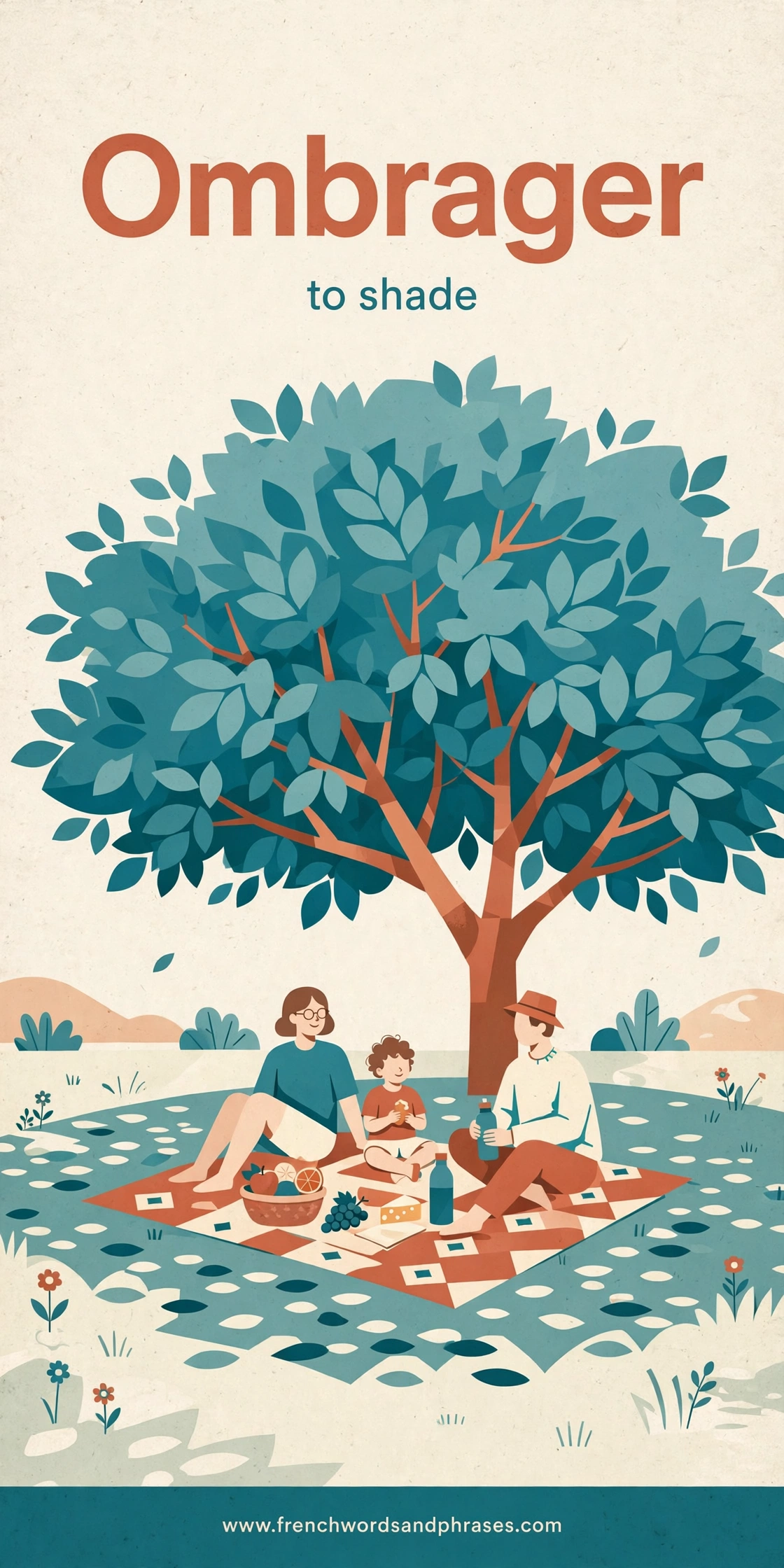
Ombrager means to shade — to spread a cool, protective shadow over a place.
High noon in a Provençal village: the plane trees lean over the square, the café tables sit in dappled green light, and nobody hurries — ombrager is the verb of the shade that makes summer bearable.
In this guide, you’ll learn how to conjugate ombrager in all the major French tenses and moods. Explore complete conjugation tables, French examples, English translations, and practice quizzes.
Understanding the French Verb Ombrager
Ombrager is a regular French verb belonging to the first group of verbs, those ending in -er.
It means to shade. It is commonly used for trees shading squares, gardens and terraces, for anything that casts a protective shadow over a place, and in its reflexive form for people sheltering from the sun under a tree, a wall or an awning.
Verb classification: First group (-er)
Auxiliary verb: Avoir
Past participle: ombragé
Present participle: ombrageant
English equivalents: To shade, to overshadow; ombrager une terrasse — to shade a terrace; s’ombrager de — to shelter from, to take shade under; un endroit ombragé — a shady spot.
One important detail: ombrager is a -ger verb, so it keeps an e after the g before a and o to keep the soft sound: nous ombrageons, j’ombrageais, en ombrageant. It is built on l’ombre, the shade or shadow, and its reflexive cousin s’ombrager de means to shelter from something — walkers s’ombragent d’un arbre, they take shade under a tree, on a burning afternoon.
Experience the Word
Ombrager is the verb of the cool half of summer — the half where lunch lasts two hours.
Imagine a farmhouse courtyard in July. The vine over the pergola has grown thick, and at midday it ombrage the whole table: the bread, the cheese and the sleepy cat all rest in its green shadow while the fields outside shimmer with heat.
Nothing here is dark or gloomy. It is simply shaded — ombragé — and life can slow down.
How to Conjugate Ombrager: Complete French Conjugation Guide
Let’s explore every major conjugation of ombrager, beginning with the indicative mood.
How to Conjugate Ombrager in the Indicative Mood
The indicative mood is used to express facts, observations, actions, and events.
How to Conjugate Ombrager in the Present Tense (Présent)
Used for actions happening now, habitual actions, and general truths.
| Subject | Conjugation |
|---|---|
| je | ombrage |
| tu | ombrages |
| il / elle | ombrage |
| nous | ombrageons |
| vous | ombragez |
| ils / elles | ombragent |
Example
Les grands platanes ombragent la place du village.
The tall plane trees shade the village square.
Quick Quiz 1
Complete the sentence:
Nous ______ la terrasse avec une pergola.
Reveal the answer
ombrageons
Nous ombrageons la terrasse avec une pergola.
We shade the terrace with a pergola — the e stays after the g.
How to Conjugate Ombrager in the Passé Composé
Used for completed actions in the past. Ombrager takes the auxiliary verb avoir.
| Subject | Conjugation |
|---|---|
| j’ | ai ombragé |
| tu | as ombragé |
| il / elle | a ombragé |
| nous | avons ombragé |
| vous | avez ombragé |
| ils / elles | ont ombragé |
Example
Le vieux chêne a ombragé notre terrasse tout l’été.
The old oak shaded our terrace all summer.
How to Conjugate Ombrager in the Imparfait (Imperfect Tense)
Used for habitual past actions, descriptions, and ongoing situations in the past.
| Subject | Conjugation |
|---|---|
| je | ombrageais |
| tu | ombrageais |
| il / elle | ombrageait |
| nous | ombragions |
| vous | ombragiez |
| ils / elles | ombrageaient |
Example
Les vignes ombrageaient la cour de la ferme.
The vines used to shade the farmyard.
Quick Quiz 2
Choose the correct form:
The oak shaded the garden.
Le chêne ______ le jardin. (a ombragé / est ombragé)
Reveal the answer
a ombragé
Le chêne a ombragé le jardin.
Ombrager takes avoir.
How to Conjugate Ombrager in the Plus-que-parfait
Used to describe an action that had already been completed before another past event.
| Subject | Conjugation |
|---|---|
| j’ | avais ombragé |
| tu | avais ombragé |
| il / elle | avait ombragé |
| nous | avions ombragé |
| vous | aviez ombragé |
| ils / elles | avaient ombragé |
Example
Ils avaient ombragé la serre avec des canisses.
They had shaded the greenhouse with reed screens.
How to Conjugate Ombrager in the Passé Simple
Primarily used in formal writing, literature, and historical narratives. It is rarely used in everyday conversation.
| Subject | Conjugation |
|---|---|
| je | ombrageai |
| tu | ombrageas |
| il / elle | ombragea |
| nous | ombrageâmes |
| vous | ombrageâtes |
| ils / elles | ombrageèrent |
Example
Un nuage ombragea un instant les collines.
A cloud shaded the hills for a moment.
How to Conjugate Ombrager in the Passé Antérieur
A literary tense used to express an action completed immediately before another past action, generally in the passé simple.
| Subject | Conjugation |
|---|---|
| j’ | eus ombragé |
| tu | eus ombragé |
| il / elle | eut ombragé |
| nous | eûmes ombragé |
| vous | eûtes ombragé |
| ils / elles | eurent ombragé |
Example
Quand le pin eut ombragé la terrasse, on y déjeuna enfin.
When the pine had shaded the terrace, we finally had lunch there.
How to Conjugate Ombrager in the Future Tense (Futur Simple)
Used to describe actions that will take place in the future.
| Subject | Conjugation |
|---|---|
| je | ombragerai |
| tu | ombrageras |
| il / elle | ombragera |
| nous | ombragerons |
| vous | ombragerez |
| ils / elles | ombrageront |
Example
Ces jeunes arbres ombrageront bientôt tout le jardin.
These young trees will soon shade the whole garden.
How to Conjugate Ombrager in the Futur Antérieur (Future Perfect)
Used for an action that will have been completed before a particular point in the future.
| Subject | Conjugation |
|---|---|
| j’ | aurai ombragé |
| tu | auras ombragé |
| il / elle | aura ombragé |
| nous | aurons ombragé |
| vous | aurez ombragé |
| ils / elles | auront ombragé |
Example
Au printemps, les tilleuls auront ombragé la moitié du parc.
By spring, the lime trees will have shaded half the park.
How to Conjugate Ombrager in the Near Future (Futur Proche)
Used to describe something that is going to happen soon. Formed with aller + infinitive.
| Subject | Conjugation |
|---|---|
| je | vais ombrager |
| tu | vas ombrager |
| il / elle | va ombrager |
| nous | allons ombrager |
| vous | allez ombrager |
| ils / elles | vont ombrager |
Example
Je vais ombrager la fenêtre avec un store enrouleur.
I am going to shade the window with a roller blind.
How to Conjugate Ombrager in the Conditional Mood
The conditional mood expresses what would happen under certain circumstances. It is also frequently used to make polite requests or express wishes.
How to Conjugate Ombrager in the Present Conditional
| Subject | Conjugation |
|---|---|
| je | ombragerais |
| tu | ombragerais |
| il / elle | ombragerait |
| nous | ombragerions |
| vous | ombrageriez |
| ils / elles | ombrageraient |
Example
Un auvent ombragerait agréablement la terrasse.
An awning would pleasantly shade the terrace.
How to Conjugate Ombrager in the Past Conditional
| Subject | Conjugation |
|---|---|
| j’ | aurais ombragé |
| tu | aurais ombragé |
| il / elle | aurait ombragé |
| nous | aurions ombragé |
| vous | auriez ombragé |
| ils / elles | auraient ombragé |
Example
La tonnelle aurait ombragé la table si on l’avait installée à temps.
The arbour would have shaded the table if we had put it up in time.
Ombrager in the Literary Past Conditional Form
This less common literary form uses the imperfect subjunctive of avoir.
| Subject | Conjugation |
|---|---|
| j’ | eusse ombragé |
| tu | eusses ombragé |
| il / elle | eût ombragé |
| nous | eussions ombragé |
| vous | eussiez ombragé |
| ils / elles | eussent ombragé |
Example
Le grand chêne eût ombragé toute la cour.
The great oak would have shaded the whole courtyard.
How to Conjugate Ombrager in the Subjunctive Mood
The subjunctive is used to express wishes, emotions, doubts, necessity, and uncertainty. It frequently follows expressions such as il faut que (it is necessary that) or bien que (although).
How to Conjugate Ombrager in the Present Subjunctive
| Subject | Conjugation |
|---|---|
| que je | ombrage |
| que tu | ombrages |
| qu’il / qu’elle | ombrage |
| que nous | ombragions |
| que vous | ombragiez |
| qu’ils / qu’elles | ombragent |
Example
Il faut que les arbres ombragent la cour des enfants.
The trees must shade the children’s playground.
Quick Quiz 3
Complete the sentence using the subjunctive:
Il faut que les arbres ______ la cour des enfants.
Reveal the answer
ombragent
Il faut que les arbres ombragent la cour des enfants.
The trees must shade the children’s playground.
How to Conjugate Ombrager in the Imperfect Subjunctive
A literary tense, rarely encountered in modern spoken French.
| Subject | Conjugation |
|---|---|
| que je | ombragasse |
| que tu | ombragasses |
| qu’il / qu’elle | ombragât |
| que nous | ombragassions |
| que vous | ombragassiez |
| qu’ils / qu’elles | ombragassent |
Example
Je souhaitais que le parasol ombrageât toute la table.
I wished the parasol would shade the whole table.
How to Conjugate Ombrager in the Pluperfect Subjunctive
A literary construction used to express an action completed before another past action.
| Subject | Conjugation |
|---|---|
| que j’ | eusse ombragé |
| que tu | eusses ombragé |
| qu’il / qu’elle | eût ombragé |
| que nous | eussions ombragé |
| que vous | eussiez ombragé |
| qu’ils / qu’elles | eussent ombragé |
Example
On craignait que la bâche n’eût ombragé les semis trop longtemps.
People feared the tarpaulin had shaded the seedlings for too long.
How to Conjugate Ombrager in the Past Subjunctive
| Subject | Conjugation |
|---|---|
| que j’ | aie ombragé |
| que tu | aies ombragé |
| qu’il / qu’elle | ait ombragé |
| que nous | ayons ombragé |
| que vous | ayez ombragé |
| qu’ils / qu’elles | aient ombragé |
Example
Je suis heureux que le chêne ait ombragé notre pique-nique.
I am glad the oak shaded our picnic.
How to Conjugate Ombrager in the Imperative
The imperative is used to give commands, instructions, invitations, or suggestions. Subject pronouns are omitted.
How to Conjugate Ombrager in the Present Imperative
| Person | Conjugation |
|---|---|
| (tu) | ombrage |
| (nous) | ombrageons |
| (vous) | ombragez |
Example
Ombrage un peu les jeunes plants, le soleil tape fort !
Shade the young plants a little, the sun is beating down!
Quick Quiz 4
How would you say Shade the young plants (tu form)?
Reveal the answer
Ombrage les jeunes plants !
French Participles of Ombrager
Participles are verb forms that can be used in compound tenses and other grammatical constructions.
Present Participle of Ombrager
ombrageant
En ombrageant la terrasse, les vignes la gardent fraîche.
By shading the terrace, the vines keep it cool.
Past Participle of Ombrager
ombragé
Ombragée par les platanes, la place reste fraîche même à midi.
Shaded by the plane trees, the square stays cool even at noon.
Ombrager in Everyday French: Real-Life Examples
Now that you know the conjugations, let’s see how ombrager appears in everyday French.
Example 1 — Present
Les platanes ombragent la place du village.
The plane trees shade the village square.
Example 2 — Passé composé
Le chêne a ombragé notre terrasse tout l’été.
The oak shaded our terrace all summer.
Example 3 — Imparfait
Les vignes ombrageaient la cour de la ferme.
The vines used to shade the farmyard.
Example 4 — Future
Ces arbres ombrageront bientôt le jardin.
These trees will soon shade the garden.
Example 5 — Conditional
Un auvent ombragerait agréablement la terrasse.
An awning would pleasantly shade the terrace.
Example 6 — Imperative
Ombrage les jeunes plants, le soleil tape fort !
Shade the young plants, the sun is beating down!
Beyond Translation: The Meaning of Ombrager
English to shade covers it, but French splits the job: ombrager shades a place with trees, vines and awnings, while ombrer is the artist’s shading of a drawing.
Both grow from l’ombre — shade, shadow, shelter.
And when people take that shelter themselves, the verb turns reflexive: s’ombrager d’un arbre, to take shade under a tree.
How to Remember the French Verb Ombrager
Remember it this way: Ombrager is about plane trees leaning over a village square at noon.
- L’ombre is shade or shadow; ombrager spreads it over a place.
- A -ger verb: keep the e before a and o — nous ombrageons, j’ombrageais.
- S’ombrager de — to shelter from the sun under a tree or an awning.
The key idea is plane trees leaning over a village square at noon.
Test Your Knowledge of Ombrager
Let’s see how much you’ve learned. Try answering these questions before revealing the answers.
Question 1
How do you say to shade a terrace in French?
Reveal the answer
Ombrager une terrasse.
Question 2
How do you say The plane trees shade the square in French?
Reveal the answer
Les platanes ombragent la place.
Question 3
Translate: The oak shaded our terrace all summer.
Reveal the answer
Le chêne a ombragé notre terrasse tout l’été.
Question 4
What is the past participle of ombrager?
Reveal the answer
Ombragé.
Question 5
Complete the sentence:
Nous ______ la cour avec de jeunes tilleuls.
Reveal the answer
ombrageons
Nous ombrageons la cour avec de jeunes tilleuls.
We shade the courtyard with young lime trees — note the e kept after the g.
Your Final Challenge
Can You Use It?
How would you say this in French?
The plane trees shade the square, and the whole village lunches slowly in the shade.
Reveal the answer
Les platanes ombragent la place, et tout le village déjeune lentement à l’ombre.
The plane trees shade the square, and the whole village lunches slowly in the shade.
A little French. A little curiosity. A richer everyday life.
LEARN FRENCH ONE WORD AT A TIME




