
A French Word to Live By
How to Conjugate Oiseler in French
/waz.le/
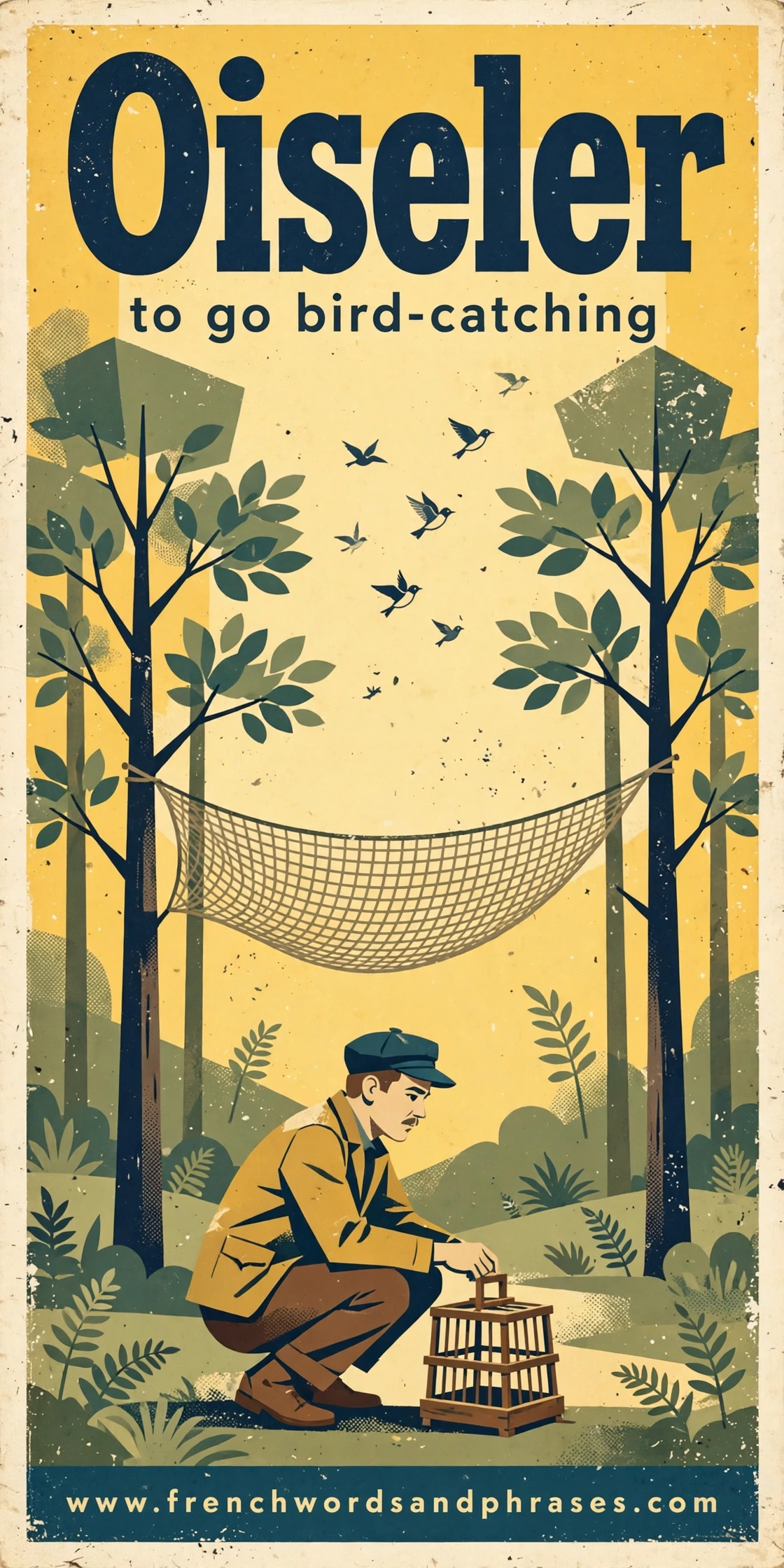
Oiseler means to go bird-catching — to hunt small birds with nets, traps and lime-twigs, as country people once did.
Dawn in the hedgerows, a boy with a net and a basket of twigs smeared with lime — oiseler is the verb of the old bird-catcher, a patience game played against the smallest and quickest of prey.
In this guide, you’ll learn how to conjugate oiseler in all the major French tenses and moods. Explore complete conjugation tables, French examples, English translations, and practice quizzes.
Understanding the French Verb Oiseler
Oiseler is a regular French verb belonging to the first group of verbs, those ending in -er.
It means to go bird-catching. It is commonly used in old stories, countryside history and hunting traditions for catching small birds with nets, snares and birdlime; today it survives mostly in literature, where it paints a vanished rural world in a single word.
Verb classification: First group (-er)
Auxiliary verb: Avoir
Past participle: oiselé
Present participle: oiselant
English equivalents: To go bird-catching, to catch birds; un oiseleur — a bird-catcher; un oiseau — a bird; la chasse aux oiseaux — bird hunting.
One important detail: oiseler is an -eler verb that doubles its l before a mute e: j’oiselle, tu oiselles, il oiselle, ils oisellent, and through the future and conditional, j’oisellerai; but the single l stays where the ending is sounded: nous oiselons, vous oiselez, j’oiselais. It begins with a vowel sound, so je becomes j’. The word is old-fashioned now — bird-catching with nets and lime belongs to the countryside of another century, and the verb carries that flavour.
Experience the Word
Oiseler is the verb of the patient trapper — still hands, held breath, and birds in the hedgerow.
Imagine a farm boy a hundred years ago, out before sunrise with his nets and his cage of decoy birds. He goes bird-catching until the mist lifts, hoping for two or three larks for the pot — and half the village’s grandfathers once did the same.
The nets are empty today and the hedges are protected. He went bird-catching — il a oiselé, as boys did for a thousand years.
How to Conjugate Oiseler: Complete French Conjugation Guide
Let’s explore every major conjugation of oiseler, beginning with the indicative mood.
How to Conjugate Oiseler in the Indicative Mood
The indicative mood is used to express facts, observations, actions, and events.
How to Conjugate Oiseler in the Present Tense (Présent)
Used for actions happening now, habitual actions, and general truths.
| Subject | Conjugation |
|---|---|
| je | oiselle |
| tu | oiselles |
| il / elle | oiselle |
| nous | oiselons |
| vous | oiselez |
| ils / elles | oisellent |
Example
Le vieil homme oiselle encore dans les haies au printemps.
The old man still goes bird-catching in the hedgerows in spring.
Quick Quiz 1
Complete the sentence:
Nous ______ dans les haies au printemps.
Reveal the answer
oiselons
Nous oiselons dans les haies au printemps.
We go bird-catching in the hedgerows in spring.
How to Conjugate Oiseler in the Passé Composé
Used for completed actions in the past. Oiseler takes the auxiliary verb avoir.
| Subject | Conjugation |
|---|---|
| j’ | ai oiselé |
| tu | as oiselé |
| il / elle | a oiselé |
| nous | avons oiselé |
| vous | avez oiselé |
| ils / elles | ont oiselé |
Example
Mon arrière-grand-père a oiselé toute sa jeunesse.
My great-grandfather went bird-catching throughout his youth.
How to Conjugate Oiseler in the Imparfait (Imperfect Tense)
Used for habitual past actions, descriptions, and ongoing situations in the past.
| Subject | Conjugation |
|---|---|
| je | oiselais |
| tu | oiselais |
| il / elle | oiselait |
| nous | oiselions |
| vous | oiseliez |
| ils / elles | oiselaient |
Example
Autrefois, les garçons oiselaient le dimanche matin.
In the old days, boys used to go bird-catching on Sunday mornings.
Quick Quiz 2
Choose the correct form:
He went bird-catching all his youth.
Il ______ toute sa jeunesse. (a oiselé / est oiselé)
Reveal the answer
a oiselé
Il a oiselé toute sa jeunesse.
Oiseler takes avoir.
How to Conjugate Oiseler in the Plus-que-parfait
Used to describe an action that had already been completed before another past event.
| Subject | Conjugation |
|---|---|
| j’ | avais oiselé |
| tu | avais oiselé |
| il / elle | avait oiselé |
| nous | avions oiselé |
| vous | aviez oiselé |
| ils / elles | avaient oiselé |
Example
Il avait oiselé dès l’aube sans rien prendre.
He had been bird-catching since dawn without catching anything.
How to Conjugate Oiseler in the Passé Simple
Primarily used in formal writing, literature, and historical narratives. It is rarely used in everyday conversation.
| Subject | Conjugation |
|---|---|
| je | oiselai |
| tu | oiselas |
| il / elle | oisela |
| nous | oiselâmes |
| vous | oiselâtes |
| ils / elles | oiselèrent |
Example
Le garçon oisela dans les haies jusqu’au soir.
The boy went bird-catching in the hedgerows until evening.
How to Conjugate Oiseler in the Passé Antérieur
A literary tense used to express an action completed immediately before another past action, generally in the passé simple.
| Subject | Conjugation |
|---|---|
| j’ | eus oiselé |
| tu | eus oiselé |
| il / elle | eut oiselé |
| nous | eûmes oiselé |
| vous | eûtes oiselé |
| ils / elles | eurent oiselé |
Example
Quand il eut oiselé toute la matinée, il rentra bredouille.
When he had spent the morning bird-catching, he came home empty-handed.
How to Conjugate Oiseler in the Future Tense (Futur Simple)
Used to describe actions that will take place in the future.
| Subject | Conjugation |
|---|---|
| je | oisellerai |
| tu | oiselleras |
| il / elle | oisellera |
| nous | oisellerons |
| vous | oisellerez |
| ils / elles | oiselleront |
Example
Demain, j’oisellerai près de la rivière.
Tomorrow, I will go bird-catching near the river.
How to Conjugate Oiseler in the Futur Antérieur (Future Perfect)
Used for an action that will have been completed before a particular point in the future.
| Subject | Conjugation |
|---|---|
| j’ | aurai oiselé |
| tu | auras oiselé |
| il / elle | aura oiselé |
| nous | aurons oiselé |
| vous | aurez oiselé |
| ils / elles | auront oiselé |
Example
À midi, ils auront oiselé dans toutes les haies du village.
By noon, they will have gone bird-catching in all the village hedgerows.
How to Conjugate Oiseler in the Near Future (Futur Proche)
Used to describe something that is going to happen soon. Formed with aller + infinitive.
| Subject | Conjugation |
|---|---|
| je | vais oiseler |
| tu | vas oiseler |
| il / elle | va oiseler |
| nous | allons oiseler |
| vous | allez oiseler |
| ils / elles | vont oiseler |
Example
Je vais oiseler dès l’aube, comme autrefois.
I am going to go bird-catching at dawn, as in the old days.
How to Conjugate Oiseler in the Conditional Mood
The conditional mood expresses what would happen under certain circumstances. It is also frequently used to make polite requests or express wishes.
How to Conjugate Oiseler in the Present Conditional
| Subject | Conjugation |
|---|---|
| je | oisellerais |
| tu | oisellerais |
| il / elle | oisellerait |
| nous | oisellerions |
| vous | oiselleriez |
| ils / elles | oiselleraient |
Example
Sans la loi qui protège les oiseaux, certains oiselleraient encore.
Without the law that protects birds, some people would still go bird-catching.
How to Conjugate Oiseler in the Past Conditional
| Subject | Conjugation |
|---|---|
| j’ | aurais oiselé |
| tu | aurais oiselé |
| il / elle | aurait oiselé |
| nous | aurions oiselé |
| vous | auriez oiselé |
| ils / elles | auraient oiselé |
Example
Il aurait oiselé ce matin si la pluie ne l’avait pas arrêté.
He would have gone bird-catching this morning if the rain had not stopped him.
Oiseler in the Literary Past Conditional Form
This less common literary form uses the imperfect subjunctive of avoir.
| Subject | Conjugation |
|---|---|
| j’ | eusse oiselé |
| tu | eusses oiselé |
| il / elle | eût oiselé |
| nous | eussions oiselé |
| vous | eussiez oiselé |
| ils / elles | eussent oiselé |
Example
Il eût oiselé dans les haies avant la messe.
He would have gone bird-catching in the hedgerows before mass.
How to Conjugate Oiseler in the Subjunctive Mood
The subjunctive is used to express wishes, emotions, doubts, necessity, and uncertainty. It frequently follows expressions such as il faut que (it is necessary that) or bien que (although).
How to Conjugate Oiseler in the Present Subjunctive
| Subject | Conjugation |
|---|---|
| que je | oiselle |
| que tu | oiselles |
| qu’il / qu’elle | oiselle |
| que nous | oiselions |
| que vous | oiseliez |
| qu’ils / qu’elles | oisellent |
Example
Il est rare qu’un enfant oiselle encore de nos jours.
It is rare for a child to still go bird-catching nowadays.
Quick Quiz 3
Complete the sentence using the subjunctive:
Il est rare qu’un enfant ______ encore.
Reveal the answer
oiselle
Il est rare qu’un enfant oiselle encore.
It is rare for a child to go bird-catching nowadays.
How to Conjugate Oiseler in the Imperfect Subjunctive
A literary tense, rarely encountered in modern spoken French.
| Subject | Conjugation |
|---|---|
| que je | oiselasse |
| que tu | oiselasses |
| qu’il / qu’elle | oiselât |
| que nous | oiselassions |
| que vous | oiselassiez |
| qu’ils / qu’elles | oiselassent |
Example
Son père ne voulait pas qu’il oiselât le dimanche.
His father did not want him to go bird-catching on Sundays.
How to Conjugate Oiseler in the Pluperfect Subjunctive
A literary construction used to express an action completed before another past action.
| Subject | Conjugation |
|---|---|
| que j’ | eusse oiselé |
| que tu | eusses oiselé |
| qu’il / qu’elle | eût oiselé |
| que nous | eussions oiselé |
| que vous | eussiez oiselé |
| qu’ils / qu’elles | eussent oiselé |
Example
Les anciens racontaient qu’on eût oiselé partout autrefois.
The old folks told how people had gone bird-catching everywhere in the old days.
How to Conjugate Oiseler in the Past Subjunctive
| Subject | Conjugation |
|---|---|
| que j’ | aie oiselé |
| que tu | aies oiselé |
| qu’il / qu’elle | ait oiselé |
| que nous | ayons oiselé |
| que vous | ayez oiselé |
| qu’ils / qu’elles | aient oiselé |
Example
Je suis surpris qu’il ait oiselé si longtemps.
I am surprised that he went bird-catching for so long.
How to Conjugate Oiseler in the Imperative
The imperative is used to give commands, instructions, invitations, or suggestions. Subject pronouns are omitted.
How to Conjugate Oiseler in the Present Imperative
| Person | Conjugation |
|---|---|
| (tu) | oiselle |
| (nous) | oiselons |
| (vous) | oiselez |
Example
Oiselle à l’aube, c’est le meilleur moment !
Go bird-catching at dawn, it is the best time!
Quick Quiz 4
How would you say Go bird-catching at dawn (tu form)?
Reveal the answer
Oiselle à l’aube !
French Participles of Oiseler
Participles are verb forms that can be used in compound tenses and other grammatical constructions.
Present Participle of Oiseler
oiselant
En oiselant, il a appris le nom de tous les oiseaux.
By going bird-catching, he learned the names of all the birds.
Past Participle of Oiseler
oiselé
Oiselés dans les haies, les petits oiseaux finissaient autrefois en pâté.
Caught in the hedgerows, the little birds used to end up in pies.
Oiseler in Everyday French: Real-Life Examples
Now that you know the conjugations, let’s see how oiseler appears in everyday French.
Example 1 — Present
Le vieil homme oiselle dans les haies au printemps.
The old man goes bird-catching in the hedgerows in spring.
Example 2 — Passé composé
Mon arrière-grand-père a oiselé toute sa jeunesse.
My great-grandfather went bird-catching throughout his youth.
Example 3 — Imparfait
Les garçons oiselaient le dimanche matin.
The boys used to go bird-catching on Sunday mornings.
Example 4 — Future
J’oisellerai près de la rivière demain.
I will go bird-catching near the river tomorrow.
Example 5 — Conditional
Certains oiselleraient encore sans la loi.
Some people would still go bird-catching without the law.
Example 6 — Imperative
Oiselez à l’aube, c’est le meilleur moment !
Go bird-catching at dawn, it is the best time!
Beyond Translation: The Meaning of Oiseler
English has to build a phrase — go bird-catching; French oiseler names the whole pursuit in one old, rustling word.
It is a verb from a vanished countryside.
Nets, snares and lime-twigs are gone and the birds are protected, but the verb survives in stories — whenever a grandfather in a French novel slips out at dawn, he goes bird-catching.
How to Remember the French Verb Oiseler
Remember it this way: Oiseler is about nets at dawn in the hedgerows — a vanished country pursuit.
- Un oiseau is a bird; oiseler is to go catching them, the old-fashioned way.
- The l doubles before a mute e: j’oiselle, ils oisellent, j’oisellerai — but nous oiselons.
- Regular pattern with the doubling twist: j’oiselle, nous oiselons, past participle oiselé.
The key idea is nets at dawn in the hedgerows — a vanished country pursuit.
Test Your Knowledge of Oiseler
Let’s see how much you’ve learned. Try answering these questions before revealing the answers.
Question 1
What does un oiseleur mean?
Reveal the answer
A bird-catcher — a man who goes bird-catching.
Question 2
How do you say The old man goes bird-catching in the hedgerows in French?
Reveal the answer
Le vieil homme oiselle dans les haies.
Question 3
Translate: The boys used to go bird-catching on Sunday mornings.
Reveal the answer
Les garçons oiselaient le dimanche matin.
Question 4
What is the past participle of oiseler?
Reveal the answer
Oiselé.
Question 5
Complete the sentence:
Demain, ______ près de la rivière.
Reveal the answer
j’oisellerai
Demain, j’oisellerai près de la rivière.
Tomorrow, I will go bird-catching near the river.
Your Final Challenge
Can You Use It?
How would you say this in French?
At dawn, the old man goes bird-catching one last time in the hedgerows of his childhood, then hangs his net on its nail for good.
Reveal the answer
À l’aube, le vieil homme oiselle une dernière fois dans les haies de son enfance, puis il accroche son filet au clou pour toujours.
At dawn, the old man goes bird-catching one last time in the hedgerows of his childhood, then hangs his net on its nail for good.
A little French. A little curiosity. A richer everyday life.
LEARN FRENCH ONE WORD AT A TIME




