
A French Word to Live By
How to Conjugate Octavier in French
/ɔk.ta.vje/
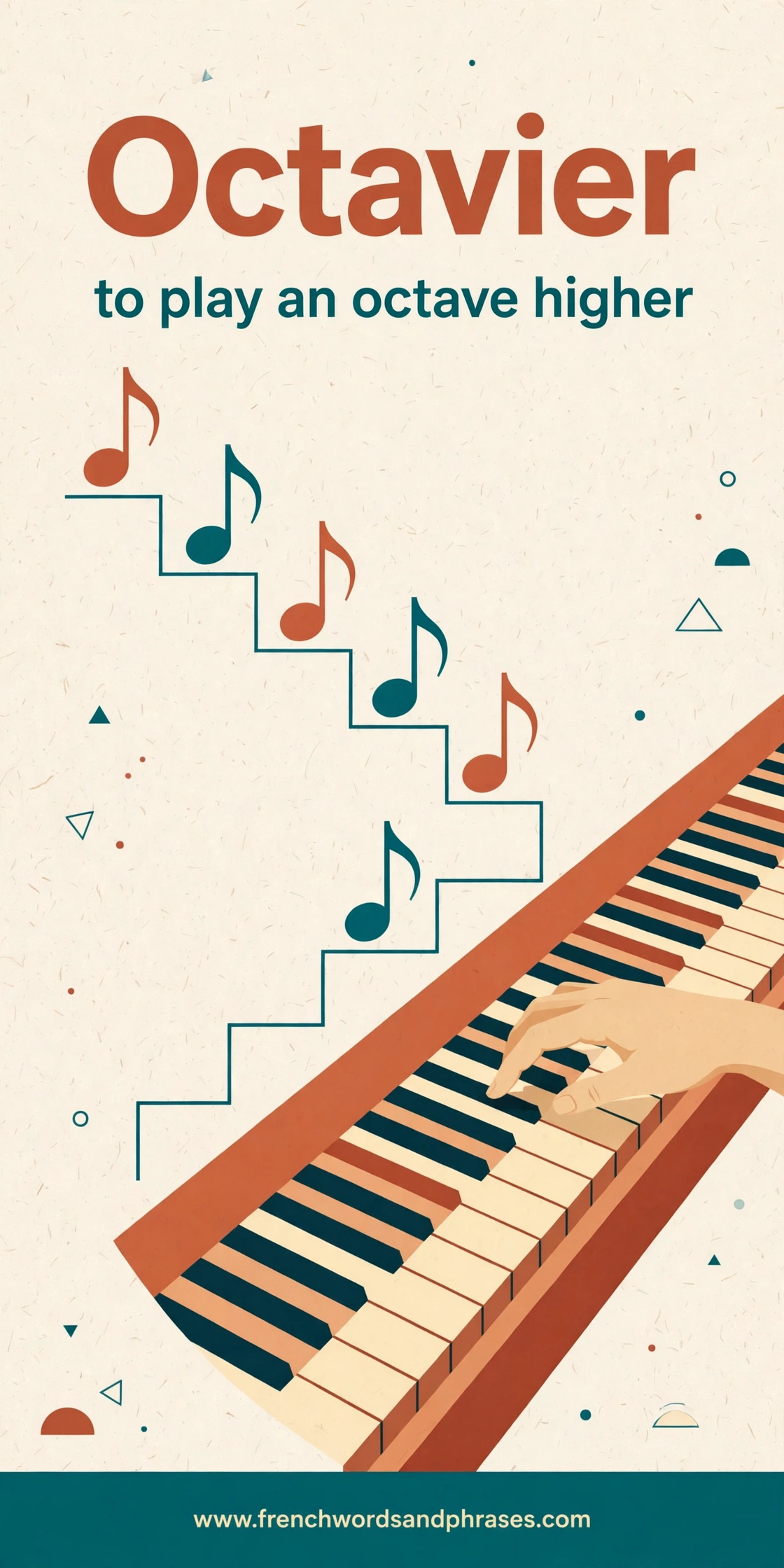
Octavier means to play an octave higher — to take a note, a passage or a whole melody up by eight notes, into the next octave.
The melody is pretty, but the singer lifts it a whole octave and suddenly it shines — octavier is the musician’s verb for taking a note, a phrase or a whole tune up eight steps.
In this guide, you’ll learn how to conjugate octavier in all the major French tenses and moods. Explore complete conjugation tables, French examples, English translations, and practice quizzes.
Understanding the French Verb Octavier
Octavier is a regular French verb belonging to the first group of verbs, those ending in -er.
It means to play an octave higher. It is commonly used by singers, choirs and instrumentalists when a passage sits too low or needs brilliance, and by arrangers who lift a line an octave to change its colour.
Verb classification: First group (-er)
Auxiliary verb: Avoir
Past participle: octavié
Present participle: octaviant
English equivalents: To play (or sing) an octave higher, to take up an octave; octavier un passage — to play a passage an octave higher; octavier la mélodie — to take the melody up an octave; une octave — an octave.
One important detail: octavier is an -ier verb, so the nous and vous forms of the imperfect and the present subjunctive double the i: nous octaviions, que vous octaviiez. It is a musicians’ word, at home in rehearsal rooms and choir stalls, and it is built on Latin octo — eight, the eight notes of the octave.
Experience the Word
Octavier is the same melody in a brighter light — nothing changes but the height, and everything changes.
Imagine a village choir rehearsing for the fête. The altos find the refrain heavy, the choirmaster raises a finger — « On octavie le refrain ! » — and the whole tune steps up into the sunlight, suddenly easy, suddenly joyful.
It is the same song the choir started with. But taken up an octave — octaviée — it flies.
How to Conjugate Octavier: Complete French Conjugation Guide
Let’s explore every major conjugation of octavier, beginning with the indicative mood.
How to Conjugate Octavier in the Indicative Mood
The indicative mood is used to express facts, observations, actions, and events.
How to Conjugate Octavier in the Present Tense (Présent)
Used for actions happening now, habitual actions, and general truths.
| Subject | Conjugation |
|---|---|
| je | octavie |
| tu | octavies |
| il / elle | octavie |
| nous | octavions |
| vous | octaviez |
| ils / elles | octavient |
Example
La chanteuse octavie la mélodie pour la rendre plus brillante.
The singer takes the melody up an octave to make it brighter.
Quick Quiz 1
Complete the sentence:
À la reprise, nous ______ la mélodie.
Reveal the answer
octavierons
À la reprise, nous octavierons la mélodie.
At the repeat, we will play the melody an octave higher.
How to Conjugate Octavier in the Passé Composé
Used for completed actions in the past. Octavier takes the auxiliary verb avoir.
| Subject | Conjugation |
|---|---|
| j’ | ai octavié |
| tu | as octavié |
| il / elle | a octavié |
| nous | avons octavié |
| vous | avez octavié |
| ils / elles | ont octavié |
Example
Le pianiste a octavié la main gauche tout le morceau.
The pianist played the left hand an octave higher through the whole piece.
How to Conjugate Octavier in the Imparfait (Imperfect Tense)
Used for habitual past actions, descriptions, and ongoing situations in the past.
| Subject | Conjugation |
|---|---|
| je | octaviais |
| tu | octaviais |
| il / elle | octaviait |
| nous | octaviions |
| vous | octaviiez |
| ils / elles | octaviaient |
Example
Au chœur, les enfants octaviaient toujours le refrain.
In the choir, the children always sang the chorus an octave higher.
Quick Quiz 2
Choose the correct form:
She took the theme up an octave.
Elle ______ le thème. (a octavié / est octaviée)
Reveal the answer
a octavié
Elle a octavié le thème.
Octavier takes avoir.
How to Conjugate Octavier in the Plus-que-parfait
Used to describe an action that had already been completed before another past event.
| Subject | Conjugation |
|---|---|
| j’ | avais octavié |
| tu | avais octavié |
| il / elle | avait octavié |
| nous | avions octavié |
| vous | aviez octavié |
| ils / elles | avaient octavié |
Example
Elle avait octavié la phrase avant l’entrée des violons.
She had taken the phrase up an octave before the violins came in.
How to Conjugate Octavier in the Passé Simple
Primarily used in formal writing, literature, and historical narratives. It is rarely used in everyday conversation.
| Subject | Conjugation |
|---|---|
| je | octaviai |
| tu | octavias |
| il / elle | octavia |
| nous | octaviâmes |
| vous | octaviâtes |
| ils / elles | octavièrent |
Example
Le soliste octavia le thème au dernier couplet.
The soloist took the theme up an octave at the last verse.
How to Conjugate Octavier in the Passé Antérieur
A literary tense used to express an action completed immediately before another past action, generally in the passé simple.
| Subject | Conjugation |
|---|---|
| j’ | eus octavié |
| tu | eus octavié |
| il / elle | eut octavié |
| nous | eûmes octavié |
| vous | eûtes octavié |
| ils / elles | eurent octavié |
Example
Quand il eut octavié le motif, la salle applaudit.
When he had taken the motif up an octave, the hall applauded.
How to Conjugate Octavier in the Future Tense (Futur Simple)
Used to describe actions that will take place in the future.
| Subject | Conjugation |
|---|---|
| je | octavierai |
| tu | octavieras |
| il / elle | octaviera |
| nous | octavierons |
| vous | octavierez |
| ils / elles | octavieront |
Example
À la reprise, tu octavieras la mélodie.
At the repeat, you will play the melody an octave higher.
How to Conjugate Octavier in the Futur Antérieur (Future Perfect)
Used for an action that will have been completed before a particular point in the future.
| Subject | Conjugation |
|---|---|
| j’ | aurai octavié |
| tu | auras octavié |
| il / elle | aura octavié |
| nous | aurons octavié |
| vous | aurez octavié |
| ils / elles | auront octavié |
Example
À la fin du morceau, ils auront octavié trois fois le refrain.
By the end of the piece, they will have taken the chorus up an octave three times.
How to Conjugate Octavier in the Near Future (Futur Proche)
Used to describe something that is going to happen soon. Formed with aller + infinitive.
| Subject | Conjugation |
|---|---|
| je | vais octavier |
| tu | vas octavier |
| il / elle | va octavier |
| nous | allons octavier |
| vous | allez octavier |
| ils / elles | vont octavier |
Example
Je vais octavier ce passage, écoute la différence.
I am going to play this passage an octave higher, listen to the difference.
How to Conjugate Octavier in the Conditional Mood
The conditional mood expresses what would happen under certain circumstances. It is also frequently used to make polite requests or express wishes.
How to Conjugate Octavier in the Present Conditional
| Subject | Conjugation |
|---|---|
| je | octavierais |
| tu | octavierais |
| il / elle | octavierait |
| nous | octavierions |
| vous | octavieriez |
| ils / elles | octavieraient |
Example
Avec une voix plus aiguë, elle octavierait sans effort.
With a higher voice, she would sing an octave up effortlessly.
How to Conjugate Octavier in the Past Conditional
| Subject | Conjugation |
|---|---|
| j’ | aurais octavié |
| tu | aurais octavié |
| il / elle | aurait octavié |
| nous | aurions octavié |
| vous | auriez octavié |
| ils / elles | auraient octavié |
Example
Il aurait octavié le refrain si le chef l’avait demandé.
He would have taken the chorus up an octave if the conductor had asked.
Octavier in the Literary Past Conditional Form
This less common literary form uses the imperfect subjunctive of avoir.
| Subject | Conjugation |
|---|---|
| j’ | eusse octavié |
| tu | eusses octavié |
| il / elle | eût octavié |
| nous | eussions octavié |
| vous | eussiez octavié |
| ils / elles | eussent octavié |
Example
Elle eût octavié la phrase pour clore le concert.
She would have taken the phrase up an octave to close the concert.
How to Conjugate Octavier in the Subjunctive Mood
The subjunctive is used to express wishes, emotions, doubts, necessity, and uncertainty. It frequently follows expressions such as il faut que (it is necessary that) or bien que (although).
How to Conjugate Octavier in the Present Subjunctive
| Subject | Conjugation |
|---|---|
| que je | octavie |
| que tu | octavies |
| qu’il / qu’elle | octavie |
| que nous | octaviions |
| que vous | octaviiez |
| qu’ils / qu’elles | octavient |
Example
Il faut que nous octaviions le refrain final.
We must sing the final chorus an octave higher.
Quick Quiz 3
Complete the sentence using the subjunctive:
Il faut que nous ______ le refrain final.
Reveal the answer
octaviions
Il faut que nous octaviions le refrain final.
We must take the final chorus up an octave.
How to Conjugate Octavier in the Imperfect Subjunctive
A literary tense, rarely encountered in modern spoken French.
| Subject | Conjugation |
|---|---|
| que je | octaviasse |
| que tu | octaviasses |
| qu’il / qu’elle | octaviât |
| que nous | octaviassions |
| que vous | octaviassiez |
| qu’ils / qu’elles | octaviassent |
Example
Le professeur voulait que l’élève octaviât la gamme.
The teacher wanted the pupil to play the scale an octave higher.
How to Conjugate Octavier in the Pluperfect Subjunctive
A literary construction used to express an action completed before another past action.
| Subject | Conjugation |
|---|---|
| que j’ | eusse octavié |
| que tu | eusses octavié |
| qu’il / qu’elle | eût octavié |
| que nous | eussions octavié |
| que vous | eussiez octavié |
| qu’ils / qu’elles | eussent octavié |
Example
On doutait qu’ils eussent octavié juste.
People doubted that they had taken it up an octave in tune.
How to Conjugate Octavier in the Past Subjunctive
| Subject | Conjugation |
|---|---|
| que j’ | aie octavié |
| que tu | aies octavié |
| qu’il / qu’elle | ait octavié |
| que nous | ayons octavié |
| que vous | ayez octavié |
| qu’ils / qu’elles | aient octavié |
Example
Je suis ravi que vous ayez octavié le thème avec tant de justesse.
I am delighted that you played the theme an octave higher so accurately.
How to Conjugate Octavier in the Imperative
The imperative is used to give commands, instructions, invitations, or suggestions. Subject pronouns are omitted.
How to Conjugate Octavier in the Present Imperative
| Person | Conjugation |
|---|---|
| (tu) | octavie |
| (nous) | octavions |
| (vous) | octaviez |
Example
Octaviez le refrain, pour plus d’éclat !
Take the chorus up an octave, for more brilliance!
Quick Quiz 4
How would you say Take the chorus up an octave (vous form)?
Reveal the answer
Octaviez le refrain !
French Participles of Octavier
Participles are verb forms that can be used in compound tenses and other grammatical constructions.
Present Participle of Octavier
octaviant
En octaviant la mélodie, elle lui donne un éclat nouveau.
By taking the melody up an octave, she gives it a new brilliance.
Past Participle of Octavier
octavié
Octaviée par le chœur, la mélodie semble monter au ciel.
Taken up an octave by the choir, the melody seems to rise to the sky.
Octavier in Everyday French: Real-Life Examples
Now that you know the conjugations, let’s see how octavier appears in everyday French.
Example 1 — Present
La chanteuse octavie la mélodie pour la rendre plus brillante.
The singer takes the melody up an octave to make it brighter.
Example 2 — Passé composé
Le pianiste a octavié la main gauche tout le morceau.
The pianist played the left hand an octave higher through the whole piece.
Example 3 — Imparfait
Les enfants octaviaient toujours le refrain.
The children always sang the chorus an octave higher.
Example 4 — Future
À la reprise, tu octavieras la mélodie.
At the repeat, you will play the melody an octave higher.
Example 5 — Conditional
Elle octavierait sans effort avec une voix plus aiguë.
She would sing an octave up effortlessly with a higher voice.
Example 6 — Imperative
Octaviez le refrain, pour plus d’éclat !
Take the chorus up an octave, for more brilliance!
Beyond Translation: The Meaning of Octavier
English has no everyday verb for this — musicians say take it up an octave or write 8va over the stave; French simply conjugates it: octavier.
Eight notes, one verb.
From Latin octo, eight — the same root as octobre, once the eighth month of the Roman year — the word carries its own little music lesson inside it.
How to Remember the French Verb Octavier
Remember it this way: Octavier is about the same melody, eight notes higher.
- Octavier = to play or sing something an octave (eight notes) higher.
- Musicians’ word: octavier un passage, octavier le refrain.
- -ier verb with double i: nous octaviions in the imperfect and the subjunctive.
The key idea is the same melody, eight notes higher.
Test Your Knowledge of Octavier
Let’s see how much you’ve learned. Try answering these questions before revealing the answers.
Question 1
How do you say to take a chorus up an octave in French?
Reveal the answer
Octavier un refrain.
Question 2
How do you say The singer takes the melody up an octave in French?
Reveal the answer
La chanteuse octavie la mélodie.
Question 3
Translate: The pianist played the left hand an octave higher.
Reveal the answer
Le pianiste a octavié la main gauche.
Question 4
What is the past participle of octavier?
Reveal the answer
Octavié.
Question 5
Complete the sentence:
Il faut que nous ______ le refrain final.
Reveal the answer
octaviions
Il faut que nous octaviions le refrain final.
We must sing the final chorus an octave higher.
Your Final Challenge
Can You Use It?
How would you say this in French?
At the last verse, the whole choir takes the chorus up an octave, and the hall rises to its feet.
Reveal the answer
Au dernier couplet, tout le chœur octavie le refrain, et la salle se lève.
At the last verse, the whole choir takes the chorus up an octave, and the hall rises to its feet.
A little French. A little curiosity. A richer everyday life.
LEARN FRENCH ONE WORD AT A TIME




