
A French Word to Live By
How to Conjugate Ocrer in French
/ɔ.kʁe/
Ocrer means to ochre — to colour something with ochre, the warm yellow-brown earth pigment.
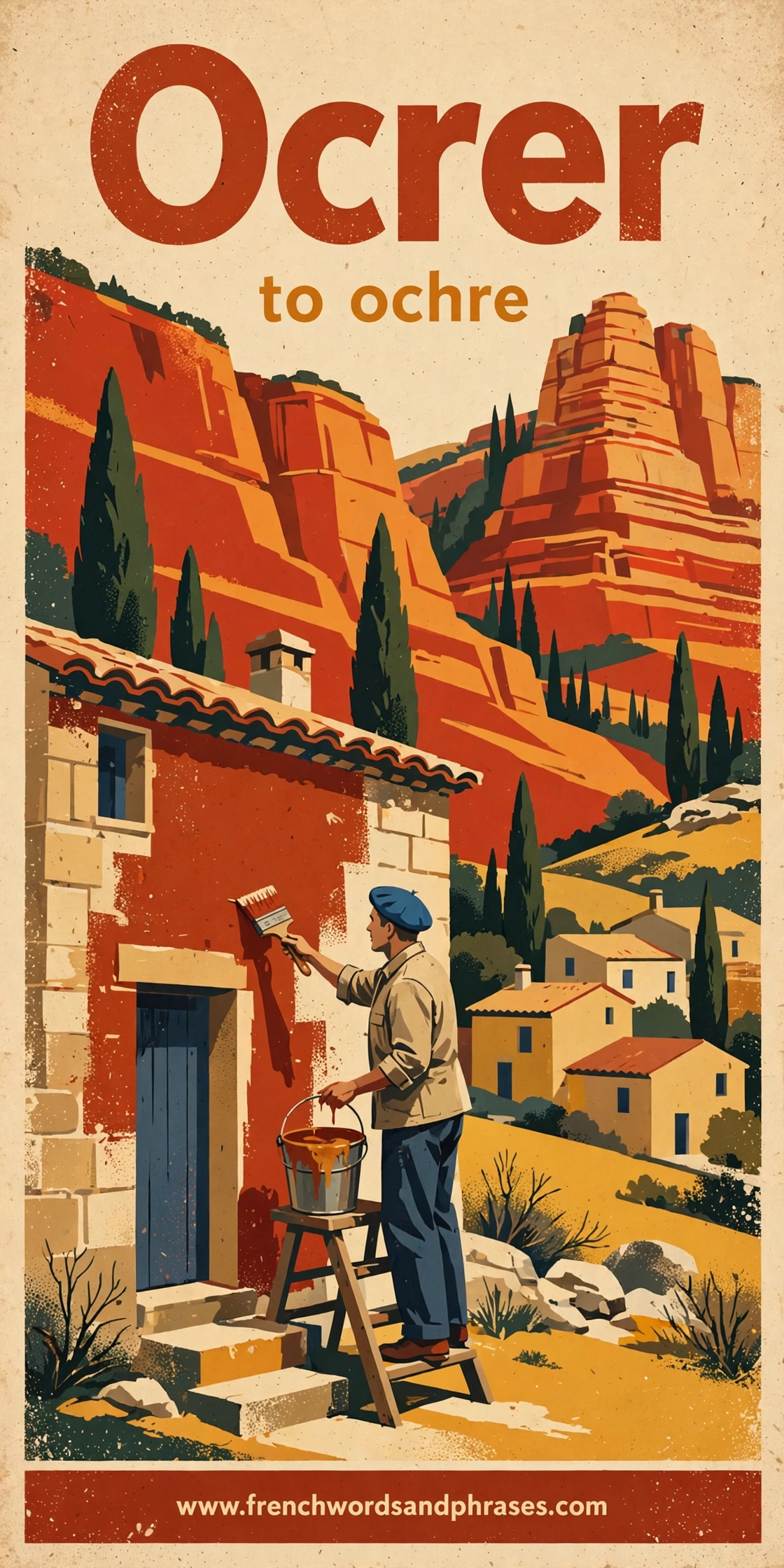
In the Luberon, whole villages glow the colour of the earth they stand on — ocrer is the verb of washing walls, cloth and canvas with ochre, the ancient yellow-brown pigment dug straight from the ground.
In this guide, you’ll learn how to conjugate ocrer in all the major French tenses and moods. Explore complete conjugation tables, French examples, English translations, and practice quizzes.
Understanding the French Verb Ocrer
Ocrer is a regular French verb belonging to the first group of verbs, those ending in -er.
It means to ochre. It is commonly used in building and decoration for colouring renders and façades in Provence, in art for pigments and painted grounds, and descriptively for sunsets and landscapes turning ochre.
Verb classification: First group (-er)
Auxiliary verb: Avoir
Past participle: ocré
Present participle: ocrant
English equivalents: To ochre, to colour with ochre; ocrer un mur — to ochre a wall; ocrer une façade — to ochre a façade; les ocres de Roussillon — the ochre quarries of Roussillon.
One important detail: ocrer is the verb of the noun l’ocre, the pigment itself, one of humanity’s oldest colours — prehistoric painters were already colouring cave walls with it. The verb is a perfectly regular -er verb with a short, earthy stem: j’ocre, nous ocrons, past participle ocré. In Roussillon, in Provence, the pigment was mined for centuries, and the village still wears it.
Experience the Word
Ocrer is painting with the earth itself — the colour comes out of the ground and goes back onto the walls.
Imagine a mason in Roussillon mixing his render the old way: sand, lime, and a scoop of local ochre, red as rust. He spreads it on the façade, and by evening the house has the exact colour of the cliffs behind it.
The house has not been painted so much as returned. It has been ochred — ocrée — with its own landscape.
How to Conjugate Ocrer: Complete French Conjugation Guide
Let’s explore every major conjugation of ocrer, beginning with the indicative mood.
How to Conjugate Ocrer in the Indicative Mood
The indicative mood is used to express facts, observations, actions, and events.
How to Conjugate Ocrer in the Present Tense (Présent)
Used for actions happening now, habitual actions, and general truths.
| Subject | Conjugation |
|---|---|
| je | ocre |
| tu | ocres |
| il / elle | ocre |
| nous | ocrons |
| vous | ocrez |
| ils / elles | ocrent |
Example
Le soleil ocre les façades du village.
The sun turns the façades of the village ochre.
Quick Quiz 1
Complete the sentence:
Le maçon ______ la façade à la mode provençale.
Reveal the answer
ocre
Le maçon ocre la façade à la mode provençale.
The builder ochres the façade in the Provençal style.
How to Conjugate Ocrer in the Passé Composé
Used for completed actions in the past. Ocrer takes the auxiliary verb avoir.
| Subject | Conjugation |
|---|---|
| j’ | ai ocré |
| tu | as ocré |
| il / elle | a ocré |
| nous | avons ocré |
| vous | avez ocré |
| ils / elles | ont ocré |
Example
Le peintre a ocré le mur avant de le patiner.
The painter ochred the wall before ageing it.
How to Conjugate Ocrer in the Imparfait (Imperfect Tense)
Used for habitual past actions, descriptions, and ongoing situations in the past.
| Subject | Conjugation |
|---|---|
| je | ocrais |
| tu | ocrais |
| il / elle | ocrait |
| nous | ocrions |
| vous | ocriez |
| ils / elles | ocraient |
Example
Autrefois, on ocrait les murs avec des pigments naturels.
In the old days, people used to ochre the walls with natural pigments.
Quick Quiz 2
Choose the correct form:
She ochred the canvas.
Elle ______ la toile. (a ocré / est ocrée)
Reveal the answer
a ocré
Elle a ocré la toile.
Ocrer takes avoir.
How to Conjugate Ocrer in the Plus-que-parfait
Used to describe an action that had already been completed before another past event.
| Subject | Conjugation |
|---|---|
| j’ | avais ocré |
| tu | avais ocré |
| il / elle | avait ocré |
| nous | avions ocré |
| vous | aviez ocré |
| ils / elles | avaient ocré |
Example
Elle avait ocré la toile avant d’y peindre le ciel.
She had ochred the canvas before painting the sky on it.
How to Conjugate Ocrer in the Passé Simple
Primarily used in formal writing, literature, and historical narratives. It is rarely used in everyday conversation.
| Subject | Conjugation |
|---|---|
| je | ocrai |
| tu | ocras |
| il / elle | ocra |
| nous | ocrâmes |
| vous | ocrâtes |
| ils / elles | ocrèrent |
Example
Le maçon ocra la façade à la mode provençale.
The builder ochred the façade in the Provençal style.
How to Conjugate Ocrer in the Passé Antérieur
A literary tense used to express an action completed immediately before another past action, generally in the passé simple.
| Subject | Conjugation |
|---|---|
| j’ | eus ocré |
| tu | eus ocré |
| il / elle | eut ocré |
| nous | eûmes ocré |
| vous | eûtes ocré |
| ils / elles | eurent ocré |
Example
Quand il eut ocré le crépi, la maison parut plus chaude.
When he had ochred the render, the house looked warmer.
How to Conjugate Ocrer in the Future Tense (Futur Simple)
Used to describe actions that will take place in the future.
| Subject | Conjugation |
|---|---|
| je | ocrerai |
| tu | ocreras |
| il / elle | ocrera |
| nous | ocrerons |
| vous | ocrerez |
| ils / elles | ocreront |
Example
Nous ocrerons les murs de la cour au printemps.
We will ochre the courtyard walls in spring.
How to Conjugate Ocrer in the Futur Antérieur (Future Perfect)
Used for an action that will have been completed before a particular point in the future.
| Subject | Conjugation |
|---|---|
| j’ | aurai ocré |
| tu | auras ocré |
| il / elle | aura ocré |
| nous | aurons ocré |
| vous | aurez ocré |
| ils / elles | auront ocré |
Example
À la fin du chantier, ils auront ocré toutes les façades.
By the end of the work, they will have ochred all the façades.
How to Conjugate Ocrer in the Near Future (Futur Proche)
Used to describe something that is going to happen soon. Formed with aller + infinitive.
| Subject | Conjugation |
|---|---|
| je | vais ocrer |
| tu | vas ocrer |
| il / elle | va ocrer |
| nous | allons ocrer |
| vous | allez ocrer |
| ils / elles | vont ocrer |
Example
Je vais ocrer cette poterie avant la cuisson.
I am going to ochre this pottery before firing.
How to Conjugate Ocrer in the Conditional Mood
The conditional mood expresses what would happen under certain circumstances. It is also frequently used to make polite requests or express wishes.
How to Conjugate Ocrer in the Present Conditional
| Subject | Conjugation |
|---|---|
| je | ocrerais |
| tu | ocrerais |
| il / elle | ocrerait |
| nous | ocrerions |
| vous | ocreriez |
| ils / elles | ocreraient |
Example
Avec plus de pigment, tu ocrerais le mur trop fort.
With more pigment, you would ochre the wall too strongly.
How to Conjugate Ocrer in the Past Conditional
| Subject | Conjugation |
|---|---|
| j’ | aurais ocré |
| tu | aurais ocré |
| il / elle | aurait ocré |
| nous | aurions ocré |
| vous | auriez ocré |
| ils / elles | auraient ocré |
Example
Il aurait ocré la façade si la pluie n’était pas arrivée.
He would have ochred the façade if the rain had not come.
Ocrer in the Literary Past Conditional Form
This less common literary form uses the imperfect subjunctive of avoir.
| Subject | Conjugation |
|---|---|
| j’ | eusse ocré |
| tu | eusses ocré |
| il / elle | eût ocré |
| nous | eussions ocré |
| vous | eussiez ocré |
| ils / elles | eussent ocré |
Example
Elle eût ocré les murs comme sa grand-mère autrefois.
She would have ochred the walls like her grandmother in the old days.
How to Conjugate Ocrer in the Subjunctive Mood
The subjunctive is used to express wishes, emotions, doubts, necessity, and uncertainty. It frequently follows expressions such as il faut que (it is necessary that) or bien que (although).
How to Conjugate Ocrer in the Present Subjunctive
| Subject | Conjugation |
|---|---|
| que je | ocre |
| que tu | ocres |
| qu’il / qu’elle | ocre |
| que nous | ocrions |
| que vous | ocriez |
| qu’ils / qu’elles | ocrent |
Example
Il faut que vous ocriez le crépi uniformément.
You must ochre the render evenly.
Quick Quiz 3
Complete the sentence using the subjunctive:
Je veux que tu ______ le mur en dégradé.
Reveal the answer
ocres
Je veux que tu ocres le mur en dégradé.
I want you to ochre the wall in a gradient.
How to Conjugate Ocrer in the Imperfect Subjunctive
A literary tense, rarely encountered in modern spoken French.
| Subject | Conjugation |
|---|---|
| que je | ocrasse |
| que tu | ocrasses |
| qu’il / qu’elle | ocrât |
| que nous | ocrassions |
| que vous | ocrassiez |
| qu’ils / qu’elles | ocrassent |
Example
Je voulais qu’il ocrât la toile en dégradé.
I wanted him to ochre the canvas in a gradient.
How to Conjugate Ocrer in the Pluperfect Subjunctive
A literary construction used to express an action completed before another past action.
| Subject | Conjugation |
|---|---|
| que j’ | eusse ocré |
| que tu | eusses ocré |
| qu’il / qu’elle | eût ocré |
| que nous | eussions ocré |
| que vous | eussiez ocré |
| qu’ils / qu’elles | eussent ocré |
Example
On racontait qu’ils eussent ocré les grottes avec des terres rouges.
People told how they had ochred the caves with red earths.
How to Conjugate Ocrer in the Past Subjunctive
| Subject | Conjugation |
|---|---|
| que j’ | aie ocré |
| que tu | aies ocré |
| qu’il / qu’elle | ait ocré |
| que nous | ayons ocré |
| que vous | ayez ocré |
| qu’ils / qu’elles | aient ocré |
Example
Je suis content que tu aies ocré le mur de cette teinte chaude.
I am glad you ochred the wall in this warm shade.
How to Conjugate Ocrer in the Imperative
The imperative is used to give commands, instructions, invitations, or suggestions. Subject pronouns are omitted.
How to Conjugate Ocrer in the Present Imperative
| Person | Conjugation |
|---|---|
| (tu) | ocre |
| (nous) | ocrons |
| (vous) | ocrez |
Example
Ocre doucement, en couches fines !
Ochre gently, in thin layers!
Quick Quiz 4
How would you say Ochre the walls (vous form)?
Reveal the answer
Ocrez les murs !
French Participles of Ocrer
Participles are verb forms that can be used in compound tenses and other grammatical constructions.
Present Participle of Ocrer
ocrant
En ocrant les façades, le village a retrouvé ses couleurs.
By ochring the façades, the village regained its colours.
Past Participle of Ocrer
ocré
Ocrées par le soleil couchant, les collines flamboient.
Ochred by the setting sun, the hills blaze.
Ocrer in Everyday French: Real-Life Examples
Now that you know the conjugations, let’s see how ocrer appears in everyday French.
Example 1 — Present
Le soleil ocre les façades du village.
The sun turns the village façades ochre.
Example 2 — Passé composé
Le peintre a ocré le mur avant de le patiner.
The painter ochred the wall before ageing it.
Example 3 — Imparfait
On ocrait les murs avec des pigments naturels.
People used to ochre the walls with natural pigments.
Example 4 — Future
Nous ocrerons les murs de la cour au printemps.
We will ochre the courtyard walls in spring.
Example 5 — Conditional
Tu ocrerais le mur trop fort avec plus de pigment.
You would ochre the wall too strongly with more pigment.
Example 6 — Imperative
Ocre doucement, en couches fines !
Ochre gently, in thin layers!
Beyond Translation: The Meaning of Ocrer
English ochre is mostly a noun and an adjective — a colour on a chart; French ocrer makes it an action, something a mason does with a trowel and a painter with a brush.
One of the oldest verbs of colour.
Ochre coloured cave walls thirty thousand years before it coloured Provençal façades — and in French, the same small verb still does both jobs.
How to Remember the French Verb Ocrer
Remember it this way: Ocrer is about painting with the earth itself.
- Ocrer = to colour with ochre, the warm earth pigment of Roussillon.
- L’ocre — the pigment; les ocres — the famous ochre cliffs and quarries.
- Regular -er: j’ocre, nous ocrons, past participle ocré.
The key idea is painting with the earth itself.
Test Your Knowledge of Ocrer
Let’s see how much you’ve learned. Try answering these questions before revealing the answers.
Question 1
How do you say to ochre a wall in French?
Reveal the answer
Ocrer un mur.
Question 2
How do you say The sun turns the façades ochre in French?
Reveal the answer
Le soleil ocre les façades.
Question 3
Translate: We will ochre the courtyard walls in spring.
Reveal the answer
Nous ocrerons les murs de la cour au printemps.
Question 4
What is the past participle of ocrer?
Reveal the answer
Ocré.
Question 5
Complete the sentence:
Il faut que vous ______ le crépi uniformément.
Reveal the answer
ocriez
Il faut que vous ocriez le crépi uniformément.
You must ochre the render evenly.
Your Final Challenge
Can You Use It?
How would you say this in French?
The builder ochres the last façade, and the whole village takes on the colour of the hills.
Reveal the answer
Le maçon ocre la dernière façade, et le village entier prend la couleur des collines.
The builder ochres the last façade, and the whole village takes on the colour of the hills.
A little French. A little curiosity. A richer everyday life.
LEARN FRENCH ONE WORD AT A TIME




