A French Word to Live By
Translate Traction to English
/tʁak.sjɔ̃/
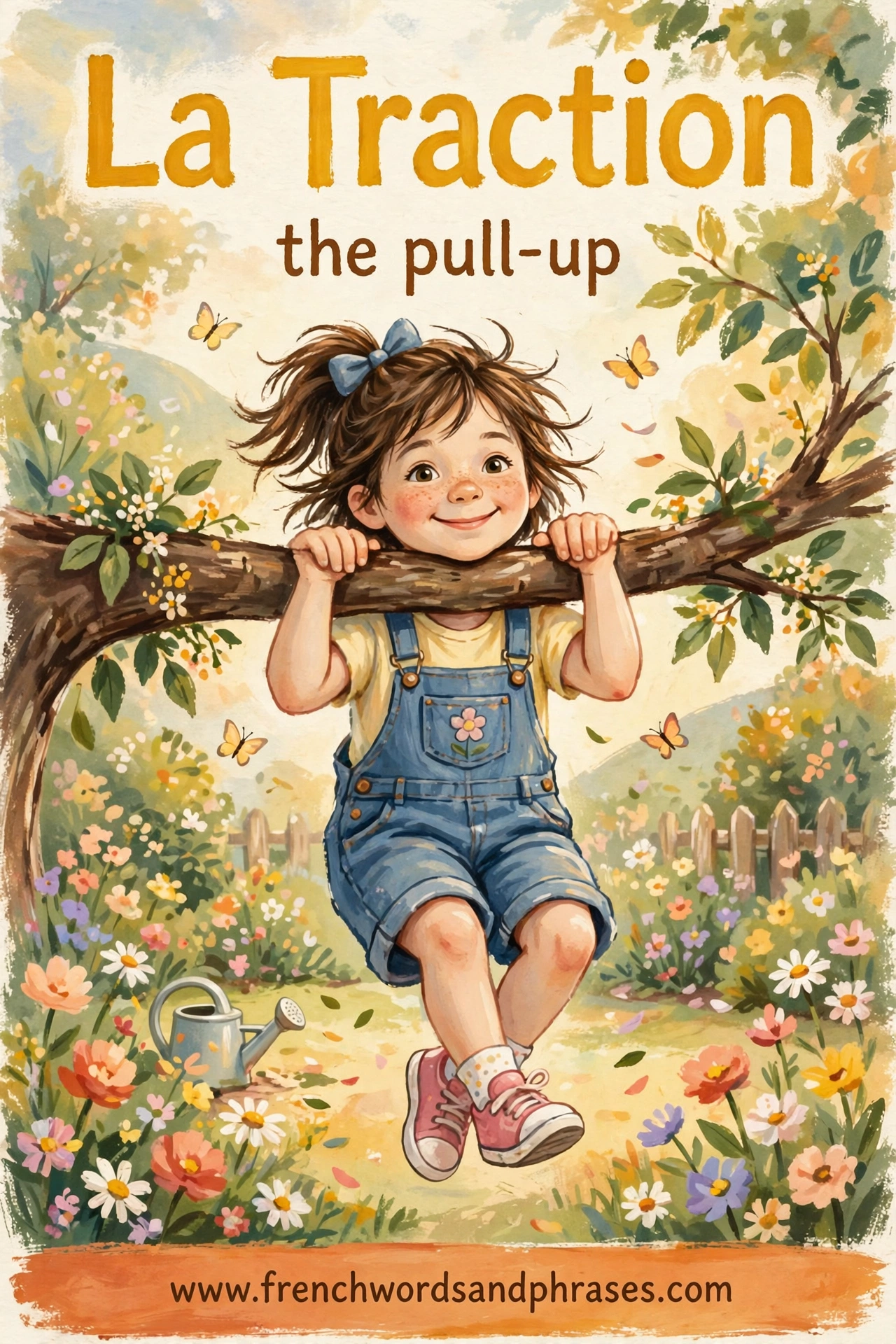
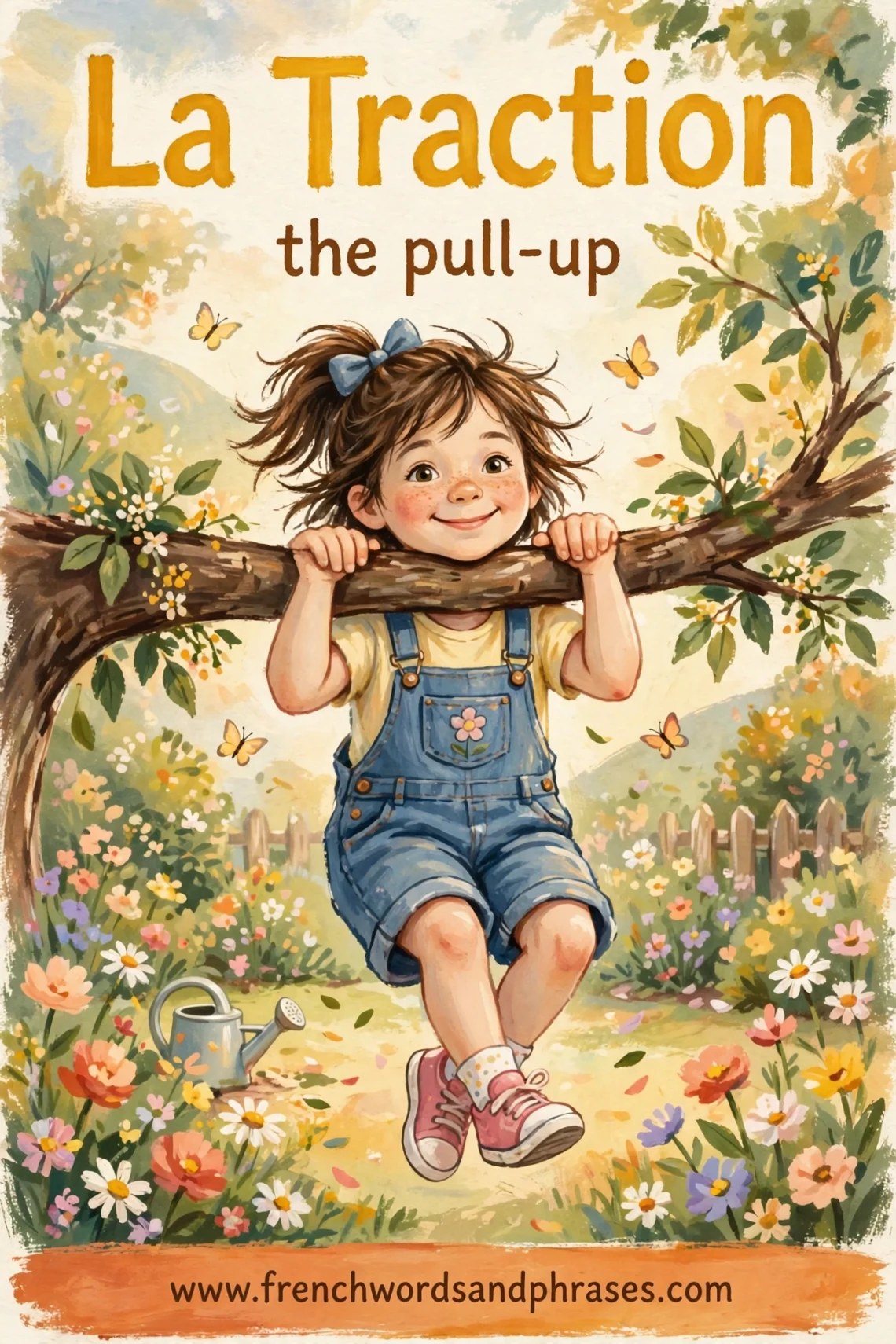
La traction means the pull-up.
At the outdoor gym by the canal, a climber hangs from the high bar, perfectly still — then rises until her chin clears the steel. One clean repetition: une traction, the pull-up.
In this guide, you’ll learn what traction means in English, how to use it with its articles, how to form its plural, and how it appears in everyday French. Explore French examples, English translations, and practice quizzes.
Understanding the French Noun Traction
Traction is a feminine French noun. It is learned together with its article: la traction, une traction. The word is the noun of tirer, to pull — a traction is a pull, and at the bar it is the purest pull of all: your whole body, lifted by your back and arms.
It means the pull-up — hanging from la barre fixe, the fixed bar, you pull yourself up until your chin passes the bar, then lower yourself down under control. Tractions build le dos, the back, and les biceps like nothing else, and the first strict one is a rite of passage in every gym.
Gender: Feminine
Definite article: la — la traction (the pull-up)
Indefinite article: une — une traction (a pull-up)
Plural: les tractions
English equivalents: The pull-up.
One important usage detail: tractions are named by the grip. Les tractions en pronation are palms facing away — the classic pull-up; les tractions en supination, palms facing you, work the biceps harder and are a little kinder to beginners. Too hard for now? La traction assistée, with a band or a machine, is how everyone starts.
Experience the Word
Traction is more than an exercise. It is the moment your own body stops being the load and becomes the proof.
Imagine your first strict repetition after months of trying: the bar, the still hang, the slow rise, and your chin — finally, unmistakably — above the steel.
You have not just pulled yourself up. You have lifted the only weight you carry everywhere.
How to Use Traction in French: Complete Guide
Let’s explore how traction works in French, beginning with its articles.
Traction with the Definite Article (La, Les)
Used for the pull-up everyone in the conversation knows — the test at the bar, the rite of passage.
| Number | French |
|---|---|
| Singular | la traction |
| Plural | les tractions |
Example
La traction est le meilleur exercice pour le dos.
The pull-up is the best exercise for the back.
Traction with the Indefinite Article (Une, Des)
Used for a pull-up in general — one repetition, one small victory.
| Number | French |
|---|---|
| Singular | une traction |
| Plural | des tractions |
Example
Elle réussit une traction stricte, sans élan.
She manages one strict pull-up, without swinging.
Traction with the Partitive Article (De la, Des)
After faire, French uses the partitive — in practice the plural: on fait des tractions.
| Number | French |
|---|---|
| Singular | de la traction |
| Plural | des tractions |
Example
Les grimpeurs font des tractions tous les jours.
Climbers do pull-ups every day.
Quick Quiz 1
What is the difference between tractions en pronation and en supination?
Reveal the answer
The grip — en pronation, palms face away from you (the classic pull-up); en supination, palms face toward you, and the biceps help more.
Les tractions en supination sont plus faciles pour commencer.
Palms-facing-you pull-ups are easier to start with.
The Plural of Traction
Traction adds an -s in the plural — les tractions, earned one at a time.
| Number | French |
|---|---|
| Singular | la traction |
| Plural | les tractions |
Example
Ses tractions sont propres, sans balancement.
His pull-ups are clean, without swinging.
Traction with Possessive Adjectives (Ma, Ta, Sa…)
Possessives agree with the noun, not with the owner — and traction is feminine, so it takes ma, ta, sa.
| Owner | French |
|---|---|
| my | ma traction |
| your (tu) | ta traction |
| his / her | sa traction |
| our | notre traction |
| your (vous) | votre traction |
| their | leur traction |
Example
Ma première traction a pris trois mois.
My first pull-up took three months.
Quick Quiz 2
Complete the sentence:
______ tractions sont plus belles que les miennes. (Your)
Reveal the answer
Tes
Tes tractions sont plus belles que les miennes.
Your pull-ups are prettier than mine — tractions is plural, so ta becomes tes.
Traction with Demonstrative Adjectives (Cette, Ces)
Used to point: this pull-up here, those pull-ups there.
| Number | French |
|---|---|
| Singular | cette traction |
| Plural | ces tractions |
Example
Cette traction compte, le menton est passé.
This pull-up counts, the chin went over.
Traction with Adjectives
Adjectives agree with traction, feminine — stricte, assistée, lestée.
| Adjective | With Traction |
|---|---|
| stricte (strict) | une traction stricte |
| assistée (assisted) | une traction assistée |
| lestée (weighted) | une traction lestée |
| large (wide-grip) | une traction large |
| parfaite (perfect) | une traction parfaite |
Example
La traction lestée est réservée aux avancés.
The weighted pull-up is reserved for advanced athletes.
Quick Quiz 3
Complete the sentence:
Pour commencer, essaie la traction ______ avec un élastique. (assisted)
Reveal the answer
assistée
Pour commencer, essaie la traction assistée avec un élastique.
To start, try the assisted pull-up with a band.
Everyday Expressions with Traction
Grips, chins and high bars — the pull-up phrases of the park and the gym.
| Expression | In English |
|---|---|
| faire des tractions | to do pull-ups |
| la barre de traction | the pull-up bar |
| les tractions en pronation | overhand-grip pull-ups |
| les tractions en supination | underhand-grip pull-ups |
| passer le menton au-dessus de la barre | to get the chin over the bar |
| la traction assistée | the assisted pull-up |
Example
Le menton doit passer au-dessus de la barre.
The chin must pass over the bar.
Words from the Same Family as Traction
Pulling, bars and backs — the words that travel with traction.
| French | In English |
|---|---|
| tirer | to pull |
| la barre fixe | the fixed bar, the high bar |
| le dos | the back |
| les biceps | the biceps |
| se hisser | to hoist oneself up |
| la prise | the grip |
Example
Il se hisse jusqu’à passer le menton.
He hoists himself up until his chin passes the bar.
Quick Quiz 4
Your coach says: « Le menton au-dessus de la barre, sinon ça ne compte pas ! » What is the rule?
Reveal the answer
The chin must pass over the bar — otherwise the repetition does not count as a full traction.
Encore un centimètre et le menton passe !
One more centimetre and the chin is over!
Traction in Everyday French: Real-Life Examples
Now that you know the word, let’s see how traction appears in everyday French.
Example 1 — At the park
La barre du parc est parfaite pour les tractions.
The park bar is perfect for pull-ups.
Example 2 — Climbers
Les grimpeurs font des tractions pour renforcer le dos.
Climbers do pull-ups to strengthen the back.
Example 3 — First success
Sa première traction stricte : trois mois de travail.
Her first strict pull-up: three months of work.
Example 4 — The grip
En supination, les tractions sont un peu plus faciles.
With an underhand grip, pull-ups are a little easier.
Example 5 — At home
Il a installé une barre de traction dans la porte.
He installed a pull-up bar in the doorway.
Example 6 — Counting
Dix tractions propres, sans élan, sans tricher.
Ten clean pull-ups, no swinging, no cheating.
See la traction in a story: Working Out: French Vocabulary (S’entraîner) — a first full session at the gym.
Beyond Translation: The Meaning of Traction
The pull-up is climbing’s gift to the gym: before it was an exercise, it was survival — getting your body up over a branch, a wall, a ledge. French keeps the physics honest in the name: une traction is simply a pull, measured against the heaviest load you own. Whole communities of grimpeurs and street-workout athletes in French parks are built around that one bar.
To say traction is to hang, pull, and rise.
It evokes chalked hands, a still hang, and the chin clearing the bar to a small cheer from friends.
How to Remember the French Noun Traction
Remember it this way: Traction is the pull-up — feminine, with la and une, named by the pull and judged by the chin.
- You hang and pull — la traction à la barre fixe, feminine with la.
- You choose the grip — en pronation classique, en supination plus douce.
- You pass the test — le menton au-dessus de la barre, sinon ça ne compte pas.
The key idea is la traction you pull — le menton above the bar.
Test Your Knowledge of Traction
Let’s see how much you’ve learned. Try answering these questions before revealing the answers.
Question 1
Is traction masculine or feminine?
Reveal the answer
Feminine — la traction, une traction.
Question 2
What makes a pull-up count?
Reveal the answer
The chin passing over the bar — le menton au-dessus de la barre.
Question 3
Translate: Climbers do pull-ups every day.
Reveal the answer
Les grimpeurs font des tractions tous les jours.
Question 4
What are les tractions en supination?
Reveal the answer
Underhand-grip pull-ups — palms facing you, with more help from the biceps.
Question 5
Complete the sentence:
Elle réussit ______ traction stricte, sans élan.
Reveal the answer
une
Elle réussit une traction stricte, sans élan.
She manages one strict pull-up, without swinging.
Your Final Challenge
Can You Use It?
How would you say this in French?
“Climbers do pull-ups every day.”
Reveal the answer
Les grimpeurs font des tractions tous les jours.
Climbers do pull-ups every day.
A little French. A little curiosity. A richer everyday life.
LEARN FRENCH ONE WORD AT A TIME