A French Word to Live By
Translate Cigale to English
/si.ɡal/
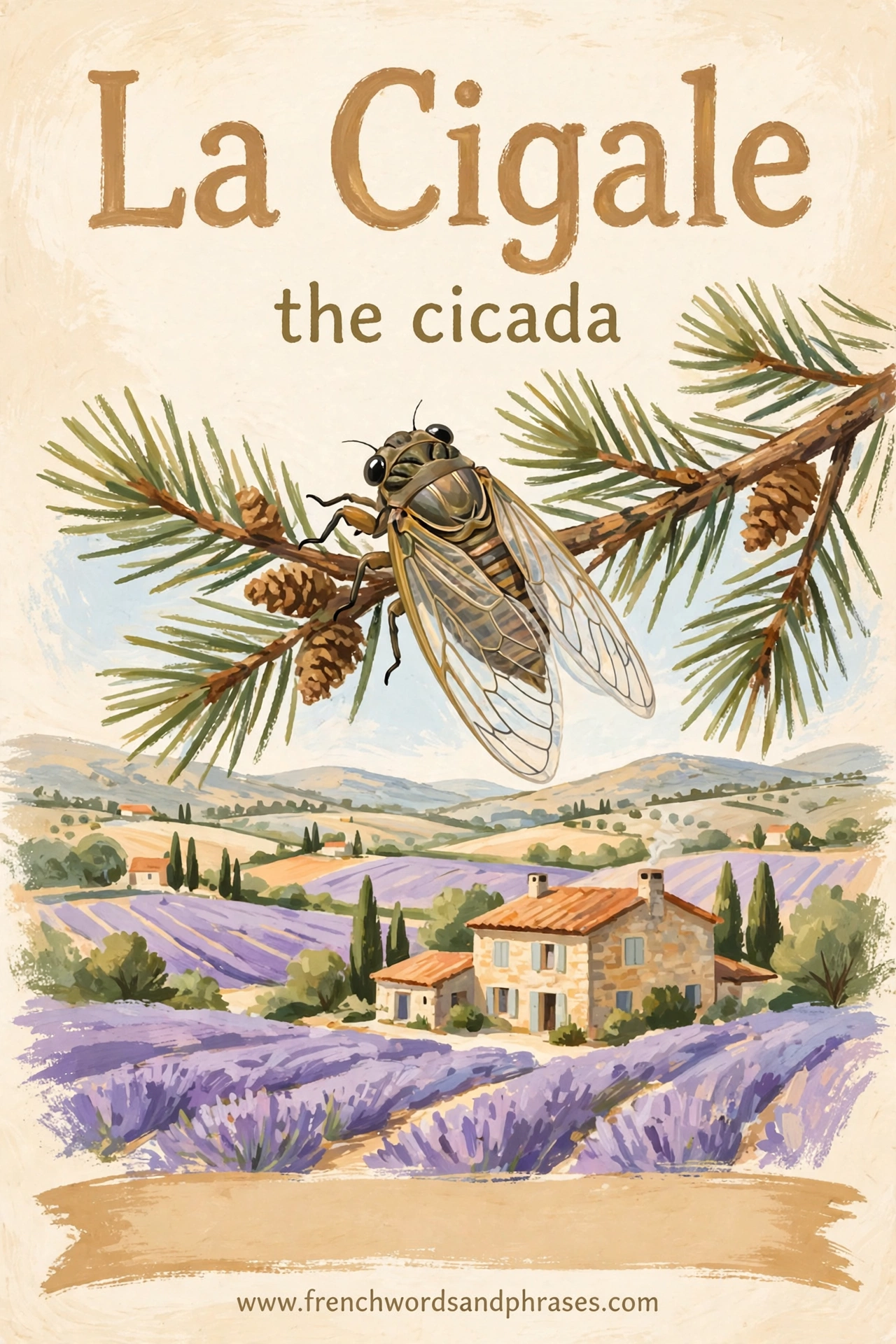
La cigale means the cicada.
Midday in Provence, the heat white and still, and from every pine tree comes the same endless metallic song, loud as a tambourine shaken all day — la cigale, the cicada, the voice of the southern summer itself.
In this guide, you’ll learn what cigale means in English, how to use it with its articles, how to form its plural, and how it appears in everyday French. Explore French examples, English translations, and practice quizzes.
Understanding the French Noun Cigale
Cigale is a feminine French noun. It is learned together with its article: la cigale, une cigale. It names the big sun-loving insect whose males sing from the pines all summer — and it is one of the most literary insects in French, thanks to a fable every French child learns by heart.
It means the cicada — the insect of the Mediterranean summer, invisible in the bark, deafening in chorus, whose song, le chant des cigales, is the very sound of heat. In Provence the cigale is an emblem, moulded in clay and printed on tablecloths. But in the north she is famous for the opposite of work: La Fontaine’s fable La Cigale et la Fourmi, where she sang all summer and came begging when winter arrived.
Gender: Feminine
Definite article: la — la cigale (the cicada)
Indefinite article: une — une cigale (a cicada)
Plural: les cigales
English equivalents: The cicada.
One important usage detail: in French, only the male sings — le mâle chante pour attirer la femelle — yet the noun stays feminine for every cigale. And the name is never far from the fable: call someone une cigale and you gently accuse them of singing through the summer without a thought for winter, the opposite of la fourmi, the ant, who worked and stored.
Experience the Word
Cigale is more than an insect. She is the soundtrack of the south — when the cigales stop at sunset, the sudden silence is so complete that visitors look up from their glasses, startled.
Imagine the terrace under the pines at two in the afternoon: nothing moves, the shutters are closed against the heat, and the whole hillside vibrates with that one bright, endless song.
You have not just heard an insect. You have heard summer itself, at full volume.
How to Use Cigale in French: Complete Guide
Let’s explore how cigale works in French, beginning with its articles.
Cigale with the Definite Article (La, Les)
Used for the cicada everyone in the conversation knows — the one in the pine, the ones filling the valley with song.
| Number | French |
|---|---|
| Singular | la cigale |
| Plural | les cigales |
Example
La cigale chante dans le pin depuis ce matin.
The cicada has been singing in the pine since this morning.
Cigale with the Indefinite Article (Une, Des)
Used for a cicada in general — the one on the wall, the ones in every tree.
| Number | French |
|---|---|
| Singular | une cigale |
| Plural | des cigales |
Example
Une cigale s’est posée sur le mur chaud.
A cicada has landed on the warm wall.
The Cigale of Provence
Song, heat and one famous fable — the words that travel with cigale.
| French | In English |
|---|---|
| le chant des cigales | the song of the cicadas |
| la fourmi | the ant, her partner in the fable |
| le pin | the pine tree |
| chanter tout l’été | to sing all summer (like the fable) |
| la chaleur | the heat |
| le symbole de la Provence | the symbol of Provence |
Example
Le chant des cigales couvre tous les bruits du village.
The song of the cicadas covers every sound in the village.
Quick Quiz 1
In La Fontaine’s fable, who visits the ant when winter comes?
Reveal the answer
La cigale — she sang all summer and stored nothing, so she comes to beg from la fourmi, the ant, who worked.
La cigale, ayant chanté tout l’été, se trouva fort dépourvue.
The cicada, having sung all summer, found herself quite destitute.
The Plural of Cigale
Cigale adds an -s in the plural — les cigales, a whole hillside in chorus.
| Number | French |
|---|---|
| Singular | la cigale |
| Plural | les cigales |
Example
Les cigales chantent dès que le soleil chauffe.
The cicadas sing as soon as the sun warms up.
Cigale with Possessive Adjectives (Ma, Ta, Sa…)
Possessives agree with the noun, not with the owner — and cigale is feminine, so it takes ma, ta, sa.
| Owner | French |
|---|---|
| my | ma cigale |
| your (tu) | ta cigale |
| his / her | sa cigale |
| our | notre cigale |
| your (vous) | votre cigale |
| their | leur cigale |
Example
Le provençal garde sa cigale en faïence sur la cheminée.
The Provençal man keeps his earthenware cicada on the mantelpiece.
Quick Quiz 2
Complete the sentence:
______ cigales chantent dans tous les pins. (The)
Reveal the answer
Les
Les cigales chantent dans tous les pins.
The cicadas are singing in all the pines.
Cigale with Demonstrative Adjectives (Cette, Ces)
Used to point: this cicada here, those cicadas there.
| Number | French |
|---|---|
| Singular | cette cigale |
| Plural | ces cigales |
Example
Cette cigale chante plus fort que toutes les autres.
This cicada sings louder than all the others.
Cigale with Adjectives
Adjectives agree with cigale, feminine — bruyante, provençale, invisible.
| Adjective | With Cigale |
|---|---|
| bruyante (noisy) | une cigale bruyante |
| provençale (Provençal) | une cigale provençale |
| invisible (invisible) | une cigale invisible |
| infatigable (tireless) | une cigale infatigable |
| dorée (golden) | une cigale dorée |
Example
Une cigale infatigable chante du matin au soir.
A tireless cicada sings from morning to night.
Quick Quiz 3
Complete the sentence:
La cigale est ______ : on l’entend, on ne la voit jamais. (invisible)
Reveal the answer
invisible
La cigale est invisible : on l’entend, on ne la voit jamais.
The cicada is invisible: you hear her, you never see her.
Everyday Expressions with Cigale
Fables, songs and symbols — the cigale phrases of daily life.
| Expression | In English |
|---|---|
| le chant des cigales | the song of the cicadas |
| La Cigale et la Fourmi | The Cicada and the Ant (La Fontaine’s fable) |
| être une cigale | to be a carefree singer who never saves (gentle teasing) |
| être une fourmi | to be a hard-working saver, the opposite |
| les cigales chantent, il va faire chaud | the cicadas are singing, it is going to be hot |
| une cigale en faïence | an earthenware cicada, the Provençal good-luck ornament |
Example
Tu es une vraie cigale : tu dépenses tout et tu ne gardes rien.
You are a real cicada: you spend everything and keep nothing.
Words from the Same Family as Cigale
Song, summer and fables — the words that travel with cigale.
| French | In English |
|---|---|
| chanter | to sing |
| la fourmi | the ant |
| la fable | the fable |
| La Fontaine | La Fontaine, the fabulist |
| le pin | the pine |
| le Midi | the South of France |
Example
La Fontaine a rendu la cigale célèbre dans le monde entier.
La Fontaine made the cicada famous throughout the world.
Quick Quiz 4
A friend teases you: « Toi, tu es une cigale, pas une fourmi ! » What is he saying?
Reveal the answer
That you enjoy life without saving for winter — like the fable’s cigale who sang all summer, unlike the hard-working fourmi.
La fourmi travaille, la cigale chante.
The ant works, the cicada sings.
Cigale in Everyday French: Real-Life Examples
Now that you know the word, let’s see how cigale appears in everyday French.
Example 1 — In Provence
Les cigales chantent dans les pins dès le matin.
The cicadas sing in the pines from the morning on.
Example 2 — The heat sign
Quand les cigales chantent, la journée sera chaude.
When the cicadas sing, the day will be hot.
Example 3 — The fable
À l’école, les enfants apprennent La Cigale et la Fourmi.
At school, the children learn The Cicada and the Ant.
Example 4 — On the wall
Une cigale en faïence porte bonheur à la maison.
An earthenware cicada brings luck to the house.
Example 5 — At sunset
Le soir, les cigales se taisent d’un coup.
In the evening, the cicadas fall silent all at once.
Example 6 — The teasing line
Ne fais pas ta cigale, pense un peu à l’hiver.
Do not be such a cicada, think a little about winter.
See la cigale in a story: Insects: French Vocabulary (Les Insectes) — a summer day in a grandmother’s garden.
Beyond Translation: The Meaning of Cigale
No insect in French lives two lives so completely. In the Midi she is beloved — the emblem of Provence, cast in clay, hung by the door for luck, her song the very definition of a summer afternoon. In the schoolroom she is the warning: La Fontaine’s singer, charming and empty-handed, knocking at the ant’s door in the first cold wind. France adores her and quotes her against herself, which is perhaps the most French fate of all.
To say cigale is to hear the pines of Provence — and remember winter.
It evokes white heat and closed shutters, a hillside of song, and a fable three and a half centuries old that children still recite by heart.
How to Remember the French Noun Cigale
Remember it this way: Cigale is the cicada — feminine, with la and une, the singer of Provence and the star of La Fontaine’s fable.
- You hear her first — la cigale chante dans les pins, feminine with la.
- You learn the fable — La Cigale et la Fourmi, the singer and the saver.
- You take the tease — être une cigale, carefree, with nothing stored for winter.
The key idea is la cigale sings — la fourmi saves.
Test Your Knowledge of Cigale
Let’s see how much you’ve learned. Try answering these questions before revealing the answers.
Question 1
Is cigale masculine or feminine?
Reveal the answer
Feminine — la cigale, une cigale.
Question 2
What does être une cigale mean?
Reveal the answer
To be carefree like the fable’s cicada — singing through summer without saving for winter.
Question 3
Translate: The cicadas sing in the pines.
Reveal the answer
Les cigales chantent dans les pins.
Question 4
In the fable, who worked all summer while the cigale sang?
Reveal the answer
La fourmi — the ant.
Question 5
Complete the sentence:
______ cigale chante dans le pin. (The)
Reveal the answer
La
La cigale chante dans le pin.
The cicada is singing in the pine.
Your Final Challenge
Can You Use It?
How would you say this in French?
“At school, the children learn The Cicada and the Ant.”
Reveal the answer
À l’école, les enfants apprennent La Cigale et la Fourmi.
At school, the children learn The Cicada and the Ant.
A little French. A little curiosity. A richer everyday life.
LEARN FRENCH ONE WORD AT A TIME