A French Word to Live By
Translate Fourmi to English
/fuʁ.mi/
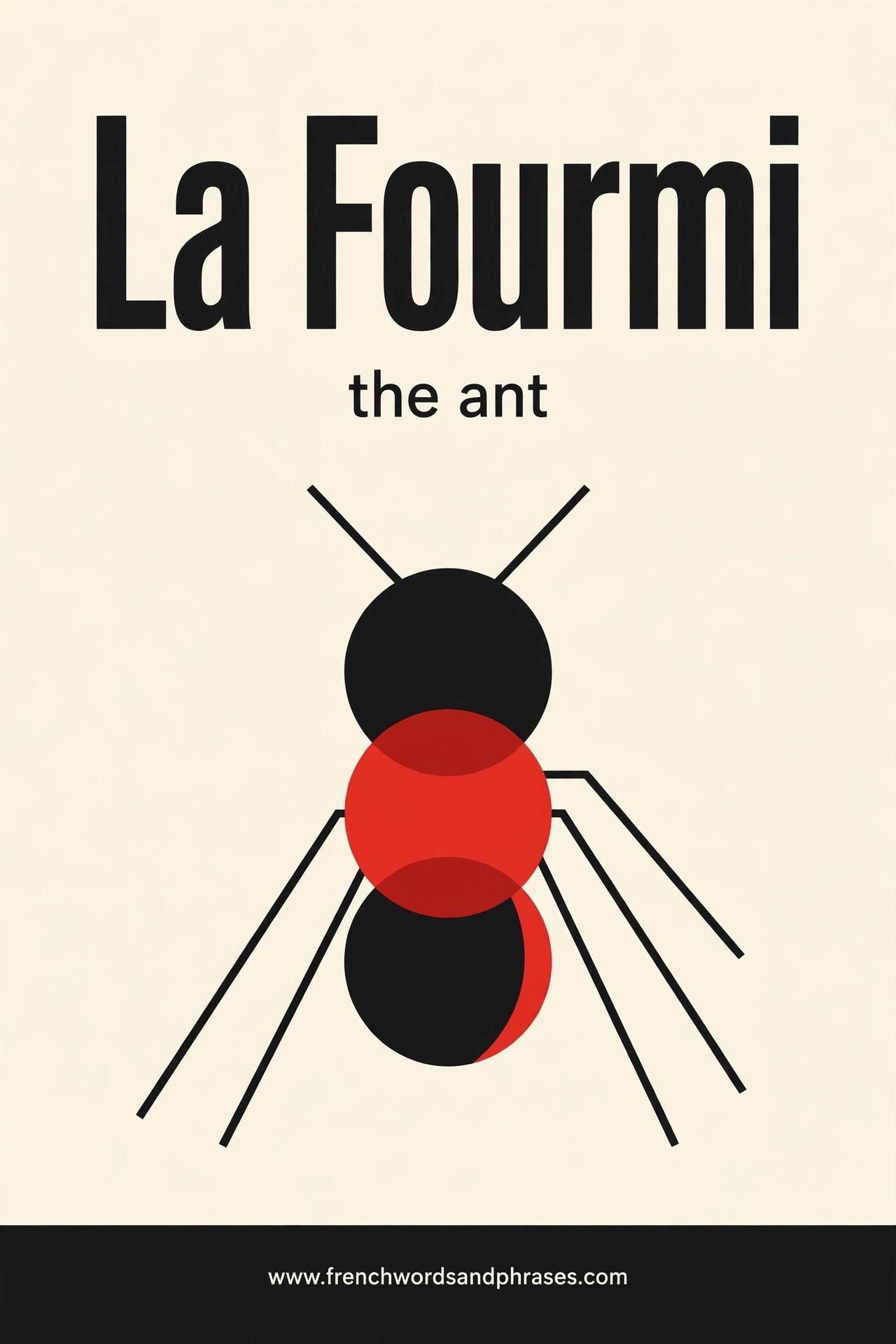
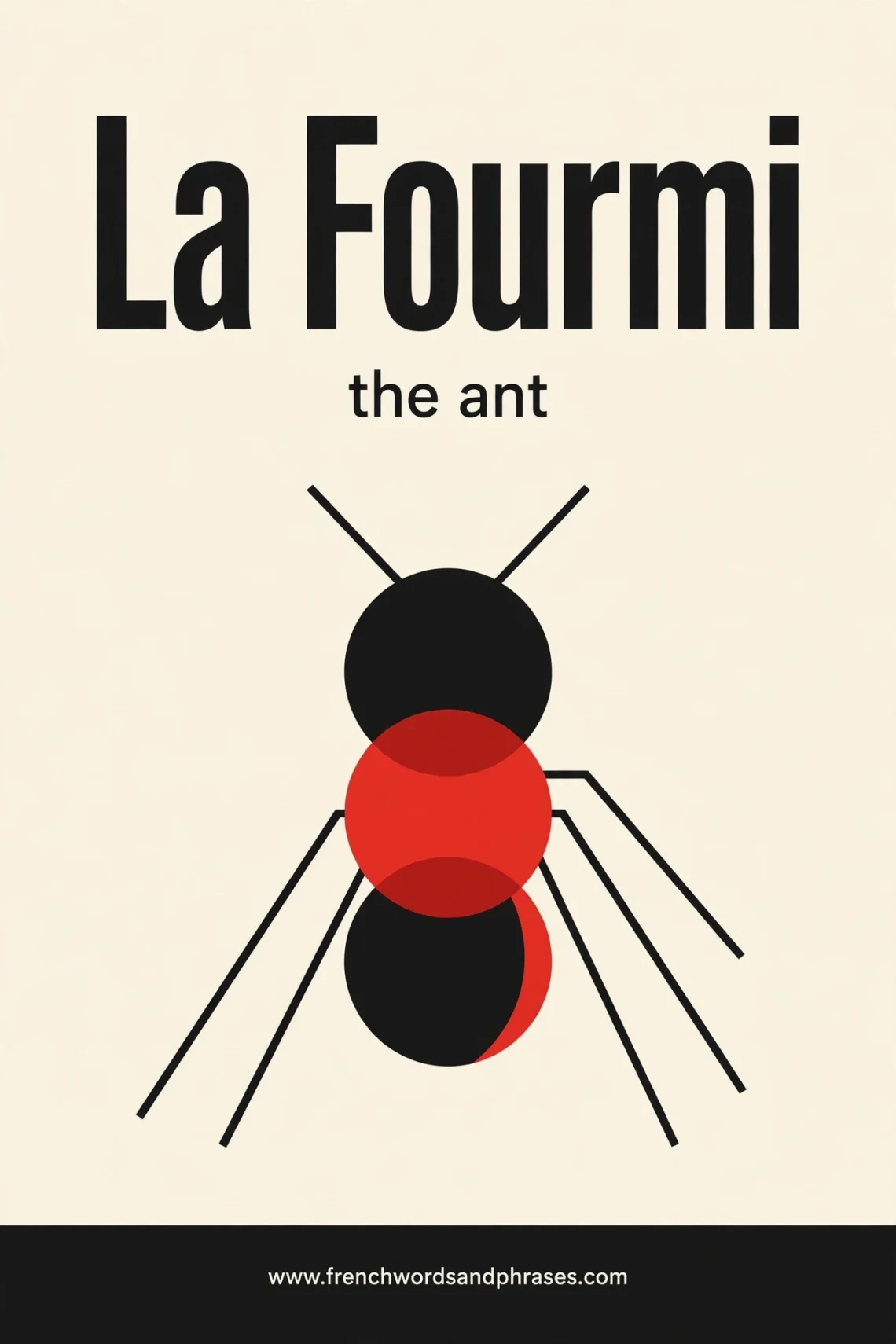
La fourmi means the ant.
On the warm stones of the terrace, a black line is on the march: each tiny worker carries a crumb twice her size, and the line never stops — la fourmi, the ant, the smallest labourer in France.
In this guide, you’ll learn what fourmi means in English, how to use it with its articles, how to form its plural, and how it appears in everyday French. Explore French examples, English translations, and practice quizzes.
Understanding the French Noun Fourmi
Fourmi is a feminine French noun. It is learned together with its article: la fourmi, une fourmi. It names the tiny social insect of la fourmilière, the anthill — and thanks to La Fontaine, she is also the most famous worker in French literature.
It means the ant — the minute, tireless insect that lives in colonies of thousands, follows scent trails in perfect single file, and can carry many times her own weight. In French the fourmi stands for foresight and hard work: while others sing through summer, she stores up for winter.
Gender: Feminine
Definite article: la — la fourmi (the ant)
Indefinite article: une — une fourmi (an ant)
Plural: les fourmis
English equivalents: The ant.
One important usage detail: avoir des fourmis dans les jambes — literally, to have ants in your legs — is the everyday French for pins and needles. Je suis resté assis trop longtemps, j’ai des fourmis dans les jambes: I sat too long, I have pins and needles. Shake the leg, and the ants march away.
Experience the Word
Fourmi is more than an insect. It is the fable made real — proof that the smallest creature in the garden may be the hardest-working one there.
Imagine following the line with your eyes: over the stone, under the leaf, down into the dark door of the fourmilière, each ant carrying her crumb home like a tiny removal van.
You have not just seen an insect. You have watched an entire city at work, one crumb at a time.
How to Use Fourmi in French: Complete Guide
Let’s explore how fourmi works in French, beginning with its articles.
Fourmi with the Definite Article (La, Les)
Used for the ant everyone in the conversation knows — the one on the crumb, the ones in the line.
| Number | French |
|---|---|
| Singular | la fourmi |
| Plural | les fourmis |
Example
La fourmi porte une miette énorme.
The ant is carrying an enormous crumb.
Fourmi with the Indefinite Article (Une, Des)
Used for an ant in general — the one in the kitchen, the ones on the terrace.
| Number | French |
|---|---|
| Singular | une fourmi |
| Plural | des fourmis |
Example
Une fourmi explore la table du pique-nique.
An ant explores the picnic table.
Fourmi with the Partitive Article (De — Quantities and Negatives)
Ants are counted in lines and colonies, so the partitive appears as de after negatives and quantity words — no ants in the sugar, hundreds on the path.
| Meaning | French |
|---|---|
| no ants (after a negative) | pas de fourmis |
| a lot of ants | beaucoup de fourmis |
| too many ants | trop de fourmis |
Example
Il y a beaucoup de fourmis près de la fourmilière.
There are a lot of ants near the anthill.
Quick Quiz 1
What is une fourmilière?
Reveal the answer
An anthill — the ants’ city, a maze of tunnels under a small mound of earth and pine needles.
La fourmilière se trouve au pied du pin.
The anthill is at the foot of the pine tree.
The Plural of Fourmi
Fourmi adds an -s in the plural — les fourmis, and with ants the plural is nearly always the point.
| Number | French |
|---|---|
| Singular | la fourmi |
| Plural | les fourmis |
Example
Les fourmis marchent en file vers la cuisine.
The ants march in single file towards the kitchen.
Fourmi with Possessive Adjectives (Ma, Ta, Sa…)
Possessives agree with the noun, not with the owner — and fourmi is feminine, so it takes ma, ta, sa.
| Owner | French |
|---|---|
| my | ma fourmi |
| your (tu) | ta fourmi |
| his / her | sa fourmi |
| our | notre fourmi |
| your (vous) | votre fourmi |
| their | leur fourmi |
Example
L’enfant observe sa fourmi avec une loupe.
The child watches his ant with a magnifying glass.
Quick Quiz 2
Complete the sentence:
______ fourmi porte la plus grosse miette. (Their)
Reveal the answer
Leur
Leur fourmi porte la plus grosse miette.
Their ant is carrying the biggest crumb.
Fourmi with Demonstrative Adjectives (Cette, Ces)
Used to point: this ant here, those ants there.
| Number | French |
|---|---|
| Singular | cette fourmi |
| Plural | ces fourmis |
Example
Ces fourmis ont trouvé le sucre, vite, ferme le bocal !
These ants have found the sugar, quick, close the jar!
Fourmi with Adjectives
Adjectives agree with fourmi, feminine — petite, forte, travailleuse.
| Adjective | With Fourmi |
|---|---|
| petite (small) | une petite fourmi |
| forte (strong) | une fourmi forte |
| travailleuse (hard-working) | une fourmi travailleuse |
| organisée (organised) | une fourmi organisée |
| minuscule (tiny) | une fourmi minuscule |
Example
Une fourmi minuscule mais forte soulève un grain énorme.
A tiny but strong ant lifts an enormous grain.
Quick Quiz 3
Complete the sentence:
Je vois une fourmi très ______. (hard-working)
Reveal the answer
travailleuse
Je vois une fourmi très travailleuse.
I see a very hard-working ant.
Everyday Expressions with Fourmi
Pins and needles, single file and La Fontaine — the fourmi phrases of daily life.
| Expression | In English |
|---|---|
| avoir des fourmis dans les jambes | to have pins and needles |
| une file de fourmis | a line of ants |
| travailler comme une fourmi | to work like an ant, steadily and without fuss |
| marcher en file | to walk in single file |
| la fourmilière | the anthill |
| minuscule mais forte | tiny but strong |
Example
Après le long voyage en voiture, j’ai des fourmis dans les jambes.
After the long car journey, I have pins and needles.
Words from the Same Family as Fourmi
Anthills, queens and crumbs — the words that travel with fourmi.
| French | In English |
|---|---|
| la fourmilière | the anthill |
| la reine | the queen |
| une ouvrière | a worker ant |
| une miette | a crumb |
| transporter | to carry, to transport |
| la cigale | the cicada, her partner in La Fontaine’s fable |
Example
Les ouvrières transportent des miettes toute la journée.
The worker ants carry crumbs all day long.
Quick Quiz 4
Your friend stands up, stamps her foot and says: « J’ai des fourmis dans les jambes ! » Are there really ants?
Reveal the answer
No — she has pins and needles. Avoir des fourmis dans les jambes is the everyday French for that tingling feeling after sitting too long.
Secoue la jambe, les fourmis vont partir.
Shake your leg, the ants will go away.
Fourmi in Everyday French: Real-Life Examples
Now that you know the word, let’s see how fourmi appears in everyday French.
Example 1 — On the terrace
Les fourmis marchent en file sur les pierres chaudes.
The ants march in single file over the warm stones.
Example 2 — At the picnic
Une fourmi a trouvé notre gâteau, les autres arrivent.
An ant has found our cake, the others are coming.
Example 3 — Pins and needles
Je ne peux plus bouger, j’ai des fourmis dans le pied.
I can’t move any more, I have pins and needles in my foot.
Example 4 — The fable
À l’école, nous lisons La Cigale et la Fourmi.
At school, we read The Cicada and the Ant.
Example 5 — In the kitchen
Ferme le sucre, sinon les fourmis vont revenir.
Close the sugar, or the ants will come back.
Example 6 — Heavy lifting
Regarde, cette fourmi porte une graine énorme.
Look, this ant is carrying an enormous seed.
See la fourmi in a story: Insects: French Vocabulary (Les Insectes) — a summer day in a grandmother’s garden.
Beyond Translation: The Meaning of Fourmi
Every French schoolchild meets la fourmi in La Fontaine’s fable La Cigale et la Fourmi — the grasshopper sings all summer while the ant works, and when winter comes the fable’s sympathy quietly sides with the storeroom over the song. Three centuries later the fourmi still stands in French for steady, unglamorous, essential work — and for the pins and needles in your legs.
To say fourmi is to honour the smallest worker in the garden.
It evokes the black line on the terrace stones, the crumb carried home, and a fable every French adult can recite.
How to Remember the French Noun Fourmi
Remember it this way: Fourmi is the ant — feminine, with la and une, La Fontaine’s worker and the tenant of your legs when they fall asleep.
- You follow the line — une file de fourmis, feminine with la.
- You feel them without seeing them — des fourmis dans les jambes, pins and needles.
- You know her story — la Fourmi of the fable works while the Cigale sings.
The key idea is la fourmi at work — des fourmis dans les jambes at rest.
Test Your Knowledge of Fourmi
Let’s see how much you’ve learned. Try answering these questions before revealing the answers.
Question 1
Is fourmi masculine or feminine?
Reveal the answer
Feminine — la fourmi, une fourmi.
Question 2
What does avoir des fourmis dans les jambes mean?
Reveal the answer
To have pins and needles — literally, to have ants in your legs.
Question 3
Translate: The ants march in single file towards the kitchen.
Reveal the answer
Les fourmis marchent en file vers la cuisine.
Question 4
What is une fourmilière?
Reveal the answer
An anthill — the ants’ underground city.
Question 5
Complete the sentence:
______ fourmi porte une miette énorme. (The)
Reveal the answer
La
La fourmi porte une miette énorme.
The ant is carrying an enormous crumb.
Your Final Challenge
Can You Use It?
How would you say this in French?
“The ants carry seeds back to the anthill.”
Reveal the answer
Les fourmis transportent des graines jusqu’à la fourmilière.
The ants carry seeds back to the anthill.
A little French. A little curiosity. A richer everyday life.
LEARN FRENCH ONE WORD AT A TIME