A French Word to Live By
Translate Papillon to English
/pa.pi.jɔ̃/
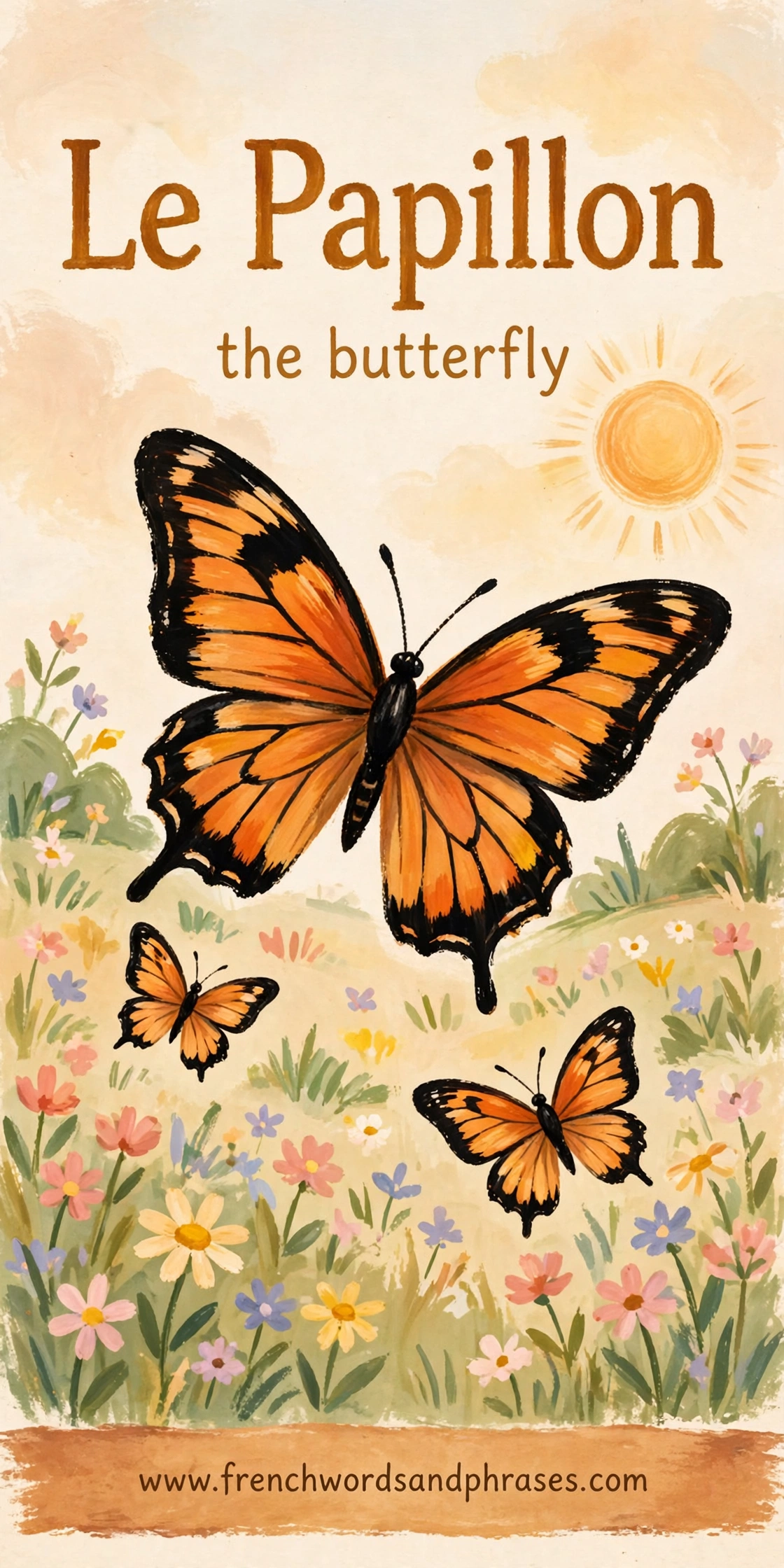
Le papillon means the butterfly.
A summer garden in full flower: something orange and black lifts off the lavender, drifts over the hedge, and settles again two metres further on — le papillon, the butterfly, the garden’s most beautiful visitor.
In this guide, you’ll learn what papillon means in English, how to use it with its articles, how to form its plural, and how it appears in everyday French. Explore French examples, English translations, and practice quizzes.
Understanding the French Noun Papillon
Papillon is a masculine French noun. It is learned together with its article: le papillon, un papillon. It names the winged insect that begins life as une chenille, a caterpillar — and its night-time cousin, le papillon de nuit, is the moth.
It means the butterfly — the bright-winged insect of gardens and meadows, sipping nectar from flower to flower through the warm months. Few creatures carry more poetry in French: the papillon stands for lightness, for brief beauty, and even, in one famous modern expression, for tiny causes with enormous effects.
Gender: Masculine
Definite article: le — le papillon (the butterfly)
Indefinite article: un — un papillon (a butterfly)
Plural: les papillons
English equivalents: The butterfly; un papillon de nuit, a moth.
One important usage detail: l’effet papillon — the butterfly effect — is the famous idea that a butterfly beating its wings on one side of the world can change the weather on the other. And at the table of everyday speech, avoir des papillons dans le ventre — butterflies in your stomach — is exactly the flutter of nerves or excitement you feel before a big moment.
Experience the Word
Papillon is more than an insect. It is the signature of summer — colour on the move, beauty that never sits still for long.
Imagine the meadow at noon: a child creeping forward with a net, the butterfly rising at the last second, floating just out of reach, and the whole chase beginning again in laughter.
You have not just seen an insect. You have watched summer showing off.
How to Use Papillon in French: Complete Guide
Let’s explore how papillon works in French, beginning with its articles.
Papillon with the Definite Article (Le, Les)
Used for the butterfly everyone in the conversation knows — the one on the lavender, the one that comes back every day.
| Number | French |
|---|---|
| Singular | le papillon |
| Plural | les papillons |
Example
Le papillon se pose sur la lavande.
The butterfly lands on the lavender.
Papillon with the Indefinite Article (Un, Des)
Used for a butterfly in general — the one crossing the garden, the ones over the meadow.
| Number | French |
|---|---|
| Singular | un papillon |
| Plural | des papillons |
Example
Un papillon jaune traverse le jardin.
A yellow butterfly crosses the garden.
Papillon with the Partitive Article (De — Quantities and Negatives)
Butterflies are creatures you count one by one, so the partitive appears as de after negatives and quantity words — no butterflies, lots of butterflies.
| Meaning | French |
|---|---|
| no butterflies (after a negative) | pas de papillons |
| a lot of butterflies | beaucoup de papillons |
| a few butterflies | quelques papillons |
Example
Il y a beaucoup de papillons près des fleurs.
There are a lot of butterflies near the flowers.
Quick Quiz 1
What is un papillon de nuit?
Reveal the answer
A moth — literally a butterfly of the night. The day belongs to le papillon; the lamp at midnight belongs to le papillon de nuit.
Un papillon de nuit tourne autour de la lampe.
A moth circles around the lamp.
The Plural of Papillon
Papillon adds an -s in the plural — les papillons, the whole meadow full of them.
| Number | French |
|---|---|
| Singular | le papillon |
| Plural | les papillons |
Example
Les papillons arrivent avec le printemps.
The butterflies arrive with spring.
Papillon with Possessive Adjectives (Mon, Ton, Son…)
Possessives agree with the noun, not with the owner — and papillon is masculine, so it takes mon, ton, son.
| Owner | French |
|---|---|
| my | mon papillon |
| your (tu) | ton papillon |
| his / her | son papillon |
| our | notre papillon |
| your (vous) | votre papillon |
| their | leur papillon |
Example
Son papillon préféré est bleu et noir.
His favourite butterfly is blue and black.
Quick Quiz 2
Complete the sentence:
Elle regarde ______ papillon préféré sur la photo. (her)
Reveal the answer
son
Elle regarde son papillon préféré sur la photo.
She is looking at her favourite butterfly in the photo — son, because papillon is masculine.
Papillon with Demonstrative Adjectives (Ce, Ces)
Used to point: this butterfly here, those butterflies there.
| Number | French |
|---|---|
| Singular | ce papillon |
| Plural | ces papillons |
Example
Ce papillon revient tous les jours sur la même fleur.
This butterfly comes back to the same flower every day.
Papillon with Adjectives
Adjectives agree with papillon, masculine — coloré, léger, fragile.
| Adjective | With Papillon |
|---|---|
| coloré (colourful) | un papillon coloré |
| léger (light) | un papillon léger |
| fragile (fragile) | un papillon fragile |
| bleu (blue) | un papillon bleu |
| éphémère (short-lived) | un papillon éphémère |
Example
Un papillon léger et coloré danse au-dessus des fleurs.
A light, colourful butterfly dances above the flowers.
Quick Quiz 3
Complete the sentence:
Un papillon ______ traverse le jardin. (colourful)
Reveal the answer
coloré
Un papillon coloré traverse le jardin.
A colourful butterfly crosses the garden.
Everyday Expressions with Papillon
Nerves, bow ties and world-changing wings — the papillon phrases of daily life.
| Expression | In English |
|---|---|
| l’effet papillon | the butterfly effect |
| avoir des papillons dans le ventre | to have butterflies in your stomach |
| un papillon de nuit | a moth |
| un nœud papillon | a bow tie |
| chasser les papillons | to chase butterflies |
| une minute, papillon ! | just a minute! (playful, asking someone to slow down) |
Example
Avant l’entretien, elle a des papillons dans le ventre.
Before the interview, she has butterflies in her stomach.
Words from the Same Family as Papillon
Caterpillars, wings and metamorphosis — the words that travel with papillon.
| French | In English |
|---|---|
| la chenille | the caterpillar |
| la chrysalide | the chrysalis |
| une aile | a wing |
| une antenne | an antenna |
| voler | to fly |
| la lavande | lavender |
Example
La chenille devient un papillon au printemps.
The caterpillar becomes a butterfly in spring.
Quick Quiz 4
Your friend whispers before her exam: « J’ai des papillons dans le ventre ! » Is she talking about insects?
Reveal the answer
No — she is nervous and excited. Avoir des papillons dans le ventre is the French twin of the English butterflies in your stomach.
Avant le spectacle, tous les enfants ont des papillons dans le ventre.
Before the show, all the children have butterflies in their stomachs.
Papillon in Everyday French: Real-Life Examples
Now that you know the word, let’s see how papillon appears in everyday French.
Example 1 — In the garden
Un papillon se pose sur les roses.
A butterfly lands on the roses.
Example 2 — The chase
Les enfants chassent les papillons dans le pré.
The children chase butterflies in the meadow.
Example 3 — At night
Un papillon de nuit entre par la fenêtre ouverte.
A moth comes in through the open window.
Example 4 — Getting dressed
Il porte un nœud papillon pour le mariage.
He is wearing a bow tie for the wedding.
Example 5 — Nerves
Avant de chanter, j’ai toujours des papillons dans le ventre.
Before singing, I always have butterflies in my stomach.
Example 6 — Spring
Les premiers papillons annoncent le printemps.
The first butterflies announce spring.
See le papillon in a story: Insects: French Vocabulary (Les Insectes) — a summer day in a grandmother’s garden.
Beyond Translation: The Meaning of Papillon
The papillon has always been France’s emblem of beautiful, brief things: poets compare souls and summers to it, and children learn its life story — chenille, chrysalide, papillon — as their first lesson in transformation. Modern French borrowed it back for science, too: l’effet papillon is now the standard name for the butterfly effect around the world.
To say papillon is to hold summer between two fingers — gently, because it will not stay.
It evokes the meadow chase, the moth at the lamp, and the flutter in your stomach before the moment that matters.
How to Remember the French Noun Papillon
Remember it this way: Papillon is the butterfly — masculine, with le and un, born from a caterpillar and famous from the garden to the weather forecast.
- You chase one — un papillon dans le pré, masculine with le.
- You feel them before a big moment — des papillons dans le ventre.
- You dress up — un nœud papillon, the bow tie, is a butterfly at your neck.
The key idea is le papillon you chase — les papillons you feel in your stomach.
Test Your Knowledge of Papillon
Let’s see how much you’ve learned. Try answering these questions before revealing the answers.
Question 1
Is papillon masculine or feminine?
Reveal the answer
Masculine — le papillon, un papillon.
Question 2
What does avoir des papillons dans le ventre mean?
Reveal the answer
To have butterflies in your stomach — to feel nervous or excited before something important.
Question 3
Translate: A yellow butterfly crosses the garden.
Reveal the answer
Un papillon jaune traverse le jardin.
Question 4
What is un papillon de nuit?
Reveal the answer
A moth — literally, a butterfly of the night.
Question 5
Complete the sentence:
______ papillon se pose sur la lavande. (The)
Reveal the answer
Le
Le papillon se pose sur la lavande.
The butterfly lands on the lavender.
Your Final Challenge
Can You Use It?
How would you say this in French?
“In spring, the butterflies return to the garden.”
Reveal the answer
Au printemps, les papillons reviennent dans le jardin.
In spring, the butterflies return to the garden.
A little French. A little curiosity. A richer everyday life.
LEARN FRENCH ONE WORD AT A TIME