A French Word to Live By
How to Conjugate Radicaliser in French
/ʁa.di.ka.li.ze/
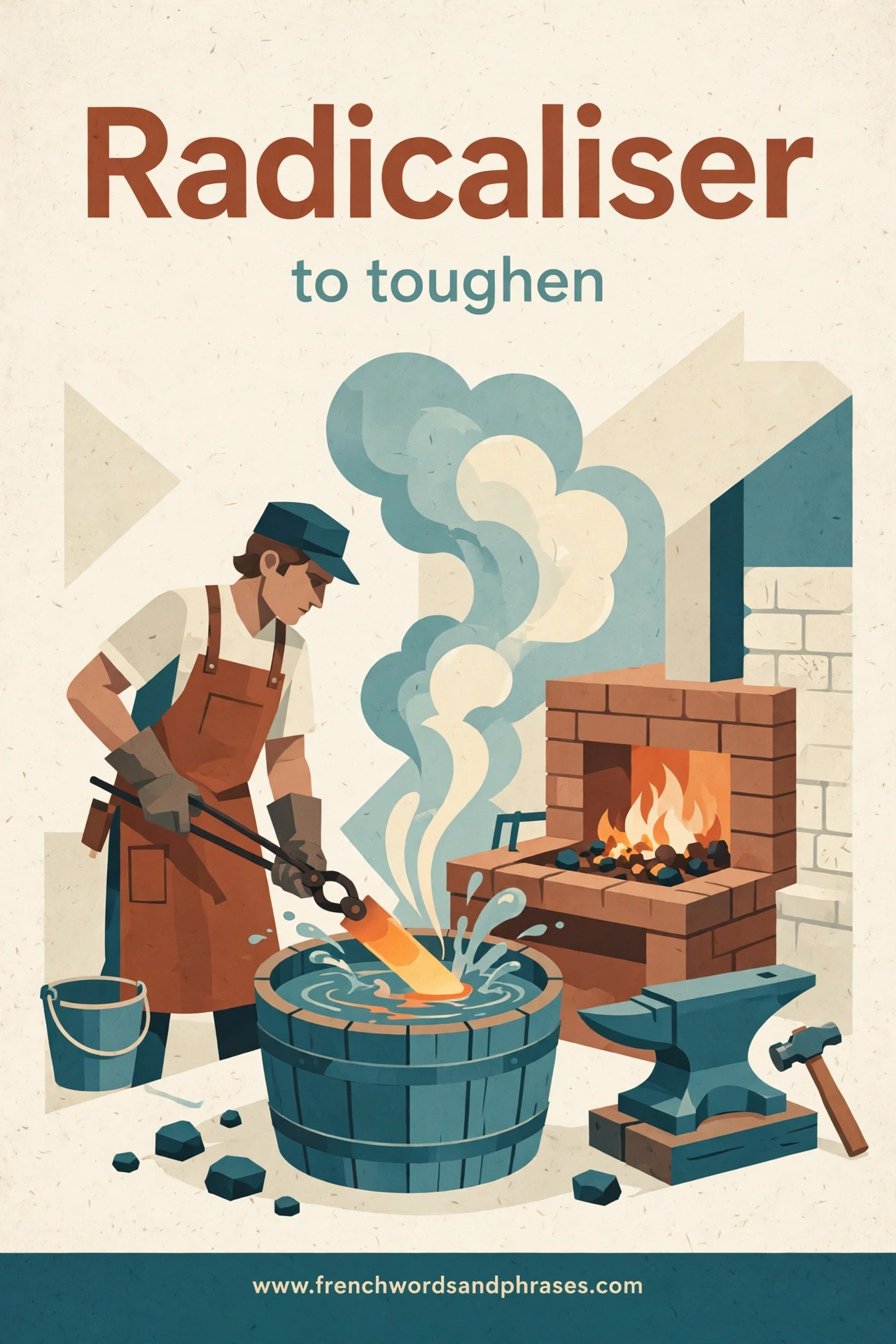
Radicaliser means to toughen — to harden, to radicalize.
A negotiation that stops smiling, a movement whose slogans sharpen month by month, a debate where nobody gives an inch — radicaliser is the verb of positions toughening, of opinions hardening into lines that will not move.
In this guide, you’ll learn how to conjugate radicaliser in all the major French tenses and moods. Explore complete conjugation tables, French examples, English translations, and practice quizzes.
Understanding the French Verb Radicaliser
Radicaliser is a regular French verb belonging to the first group of verbs, those ending in -er.
It means to toughen. It is commonly used for movements, parties and unions toughening their line, for strikes and protests hardening as talks fail, for individuals becoming radicalized, and in commentary on debates and demands that grow less flexible week by week.
Verb classification: First group (-er)
Auxiliary verb: Avoir
Past participle: radicalisé
Present participle: radicalisant
English equivalents: To toughen, to harden, to radicalize; se radicaliser — to become radicalized, to harden one’s stance; la radicalisation — radicalization.
One important detail: radicaliser grows from radical — going to the root, radix in Latin — and in modern French its home ground is politics and conflict: radicaliser un mouvement, to push a movement toward its hard line; radicaliser ses positions, to toughen one’s demands. The reflexive is the one the newspapers use daily: se radicaliser, to become radicalized, to harden. Journalists also speak of un discours qui se radicalise, talk that toughens — the verb measures how far from compromise a room has travelled.
Experience the Word
Radicaliser is the verb of the closing door — positions that once had give in them set hard, and negotiation turns to confrontation.
Imagine a factory dispute in its third month. At first there were jokes at the gate and coffee for the journalists; now the banners are shorter, the speeches angrier — le mouvement s’est radicalisé, and both sides know the easy ending has gone.
The demands have not changed on paper. They have toughened — radicalisés, hardened past the point of easy return.
How to Conjugate Radicaliser: Complete French Conjugation Guide
Let’s explore every major conjugation of radicaliser, beginning with the indicative mood.
How to Conjugate Radicaliser in the Indicative Mood
The indicative mood is used to express facts, observations, actions, and events.
How to Conjugate Radicaliser in the Present Tense (Présent)
Used for actions happening now, habitual actions, and general truths.
| Subject | Conjugation |
|---|---|
| je | radicalise |
| tu | radicalises |
| il / elle | radicalise |
| nous | radicalisons |
| vous | radicalisez |
| ils / elles | radicalisent |
Example
L’échec des négociations radicalise le mouvement.
The failure of the talks is toughening the movement.
Quick Quiz 1
Complete the sentence:
Nous ______ nos positions après ce refus.
Reveal the answer
radicalisons
Nous radicalisons nos positions après ce refus.
We toughen our positions after this refusal.
How to Conjugate Radicaliser in the Passé Composé
Used for completed actions in the past. Radicaliser takes the auxiliary verb avoir.
| Subject | Conjugation |
|---|---|
| j’ | ai radicalisé |
| tu | as radicalisé |
| il / elle | a radicalisé |
| nous | avons radicalisé |
| vous | avez radicalisé |
| ils / elles | ont radicalisé |
Example
La crise a radicalisé les positions des deux camps.
The crisis hardened the positions of both camps.
How to Conjugate Radicaliser in the Imparfait (Imperfect Tense)
Used for habitual past actions, descriptions, and ongoing situations in the past.
| Subject | Conjugation |
|---|---|
| je | radicalisais |
| tu | radicalisais |
| il / elle | radicalisait |
| nous | radicalisions |
| vous | radicalisiez |
| ils / elles | radicalisaient |
Example
Chaque semaine de silence radicalisait les grévistes.
Each week of silence toughened the strikers.
Quick Quiz 2
Choose the correct form:
The crisis hardened the debate.
La crise ______ le débat. (a radicalisé / est radicalisée)
Reveal the answer
a radicalisé
La crise a radicalisé le débat.
Radicaliser takes avoir.
How to Conjugate Radicaliser in the Plus-que-parfait
Used to describe an action that had already been completed before another past event.
| Subject | Conjugation |
|---|---|
| j’ | avais radicalisé |
| tu | avais radicalisé |
| il / elle | avait radicalisé |
| nous | avions radicalisé |
| vous | aviez radicalisé |
| ils / elles | avaient radicalisé |
Example
Les années de mépris avaient radicalisé toute une génération.
Years of contempt had radicalized a whole generation.
How to Conjugate Radicaliser in the Passé Simple
Primarily used in formal writing, literature, and historical narratives. It is rarely used in everyday conversation.
| Subject | Conjugation |
|---|---|
| je | radicalisai |
| tu | radicalisas |
| il / elle | radicalisa |
| nous | radicalisâmes |
| vous | radicalisâtes |
| ils / elles | radicalisèrent |
Example
L’annonce du plan radicalisa le débat en une soirée.
The announcement of the plan hardened the debate in a single evening.
How to Conjugate Radicaliser in the Passé Antérieur
A literary tense used to express an action completed immediately before another past action, generally in the passé simple.
| Subject | Conjugation |
|---|---|
| j’ | eus radicalisé |
| tu | eus radicalisé |
| il / elle | eut radicalisé |
| nous | eûmes radicalisé |
| vous | eûtes radicalisé |
| ils / elles | eurent radicalisé |
Example
Quand la direction eut radicalisé son ton, les syndicats quittèrent la table.
When management had hardened its tone, the unions left the table.
How to Conjugate Radicaliser in the Future Tense (Futur Simple)
Used to describe actions that will take place in the future.
| Subject | Conjugation |
|---|---|
| je | radicaliserai |
| tu | radicaliseras |
| il / elle | radicalisera |
| nous | radicaliserons |
| vous | radicaliserez |
| ils / elles | radicaliseront |
Example
Ce refus radicalisera les plus modérés du groupe.
This refusal will toughen even the most moderate members of the group.
How to Conjugate Radicaliser in the Futur Antérieur (Future Perfect)
Used for an action that will have been completed before a particular point in the future.
| Subject | Conjugation |
|---|---|
| j’ | aurai radicalisé |
| tu | auras radicalisé |
| il / elle | aura radicalisé |
| nous | aurons radicalisé |
| vous | aurez radicalisé |
| ils / elles | auront radicalisé |
Example
À la fin du mois, le conflit aura radicalisé tout le secteur.
By the end of the month, the conflict will have hardened the whole sector.
How to Conjugate Radicaliser in the Near Future (Futur Proche)
Used to describe something that is going to happen soon. Formed with aller + infinitive.
| Subject | Conjugation |
|---|---|
| je | vais radicaliser |
| tu | vas radicaliser |
| il / elle | va radicaliser |
| nous | allons radicaliser |
| vous | allez radicaliser |
| ils / elles | vont radicaliser |
Example
Attention, ce discours va radicaliser l’assemblée.
Careful, that speech is going to radicalize the assembly.
How to Conjugate Radicaliser in the Conditional Mood
The conditional mood expresses what would happen under certain circumstances. It is also frequently used to make polite requests or express wishes.
How to Conjugate Radicaliser in the Present Conditional
| Subject | Conjugation |
|---|---|
| je | radicaliserais |
| tu | radicaliserais |
| il / elle | radicaliserait |
| nous | radicaliserions |
| vous | radicaliseriez |
| ils / elles | radicaliseraient |
Example
Un geste d’ouverture ne radicaliserait personne.
A gesture of openness would toughen nobody.
How to Conjugate Radicaliser in the Past Conditional
| Subject | Conjugation |
|---|---|
| j’ | aurais radicalisé |
| tu | aurais radicalisé |
| il / elle | aurait radicalisé |
| nous | aurions radicalisé |
| vous | auriez radicalisé |
| ils / elles | auraient radicalisé |
Example
Sans ces images, le mouvement ne se serait pas radicalisé si vite.
Without those images, the movement would not have radicalized so quickly.
Radicaliser in the Literary Past Conditional Form
This less common literary form uses the imperfect subjunctive of avoir.
| Subject | Conjugation |
|---|---|
| j’ | eusse radicalisé |
| tu | eusses radicalisé |
| il / elle | eût radicalisé |
| nous | eussions radicalisé |
| vous | eussiez radicalisé |
| ils / elles | eussent radicalisé |
Example
La défaite eût radicalisé les derniers hésitants.
The defeat would have hardened the last waverers.
How to Conjugate Radicaliser in the Subjunctive Mood
The subjunctive is used to express wishes, emotions, doubts, necessity, and uncertainty. It frequently follows expressions such as il faut que (it is necessary that) or bien que (although).
How to Conjugate Radicaliser in the Present Subjunctive
| Subject | Conjugation |
|---|---|
| que je | radicalise |
| que tu | radicalises |
| qu’il / qu’elle | radicalise |
| que nous | radicalisions |
| que vous | radicalisiez |
| qu’ils / qu’elles | radicalisent |
Example
Il ne faut pas que ce conflit radicalise tout le pays.
This conflict must not radicalize the whole country.
Quick Quiz 3
Complete the sentence using the subjunctive:
Il ne faut pas que vous ______ le ton.
Reveal the answer
radicalisiez
Il ne faut pas que vous radicalisiez le ton.
You must not harden the tone.
How to Conjugate Radicaliser in the Imperfect Subjunctive
A literary tense, rarely encountered in modern spoken French.
| Subject | Conjugation |
|---|---|
| que je | radicalisasse |
| que tu | radicalisasses |
| qu’il / qu’elle | radicalisât |
| que nous | radicalisassions |
| que vous | radicalisassiez |
| qu’ils / qu’elles | radicalisassent |
Example
On craignait que la répression radicalisât la jeunesse des quartiers.
People feared repression might radicalize the youth of the districts.
How to Conjugate Radicaliser in the Pluperfect Subjunctive
A literary construction used to express an action completed before another past action.
| Subject | Conjugation |
|---|---|
| que j’ | eusse radicalisé |
| que tu | eusses radicalisé |
| qu’il / qu’elle | eût radicalisé |
| que nous | eussions radicalisé |
| que vous | eussiez radicalisé |
| qu’ils / qu’elles | eussent radicalisé |
Example
Les historiens expliquent comment la guerre eût radicalisé les esprits.
Historians explain how the war had hardened minds.
How to Conjugate Radicaliser in the Past Subjunctive
| Subject | Conjugation |
|---|---|
| que j’ | aie radicalisé |
| que tu | aies radicalisé |
| qu’il / qu’elle | ait radicalisé |
| que nous | ayons radicalisé |
| que vous | ayez radicalisé |
| qu’ils / qu’elles | aient radicalisé |
Example
Je regrette que le débat se soit radicalisé si vite.
I regret that the debate toughened so quickly.
How to Conjugate Radicaliser in the Imperative
The imperative is used to give commands, instructions, invitations, or suggestions. Subject pronouns are omitted.
How to Conjugate Radicaliser in the Present Imperative
| Person | Conjugation |
|---|---|
| (tu) | radicalise |
| (nous) | radicalisons |
| (vous) | radicalisez |
Example
Ne radicalisez pas le débat, écoutez d’abord !
Do not harden the debate, listen first!
Quick Quiz 4
How would you say Do not harden the discussion (tu form)?
Reveal the answer
Ne radicalise pas la discussion !
French Participles of Radicaliser
Participles are verb forms that can be used in compound tenses and other grammatical constructions.
Present Participle of Radicaliser
radicalisant
En radicalisant ses demandes, le syndicat a perdu des alliés.
By toughening its demands, the union lost allies.
Past Participle of Radicaliser
radicalisé
Radicalisés par des mois d’attente, les grévistes ne croyaient plus aux promesses.
Hardened by months of waiting, the strikers no longer believed the promises.
Radicaliser in Everyday French: Real-Life Examples
Now that you know the conjugations, let’s see how radicaliser appears in everyday French.
Example 1 — Present
Le ton se radicalise dans les débats télévisés.
The tone is hardening in televised debates.
Example 2 — Passé composé
Le mouvement s’est radicalisé après le refus.
The movement toughened after the refusal.
Example 3 — Imparfait
Le conflit radicalisait les positions chaque semaine.
The conflict toughened the positions every week.
Example 4 — Future
Ils se radicaliseront si personne ne les écoute.
They will harden if nobody listens to them.
Example 5 — Conditional
Tu radicaliserais le débat avec de tels propos.
You would harden the debate with talk like that.
Example 6 — Imperative
Ne radicalise pas la discussion, cherchons un accord !
Do not harden the discussion, let us look for an agreement!
Beyond Translation: The Meaning of Radicaliser
English radicalize sounds like a laboratory word; French radicaliser is everyday news French, used of strikes, debates and dinner-table arguments alike.
Se radicaliser is a journey the news follows daily.
A person, a movement, a tone of voice — French watches them harden with this one verb, and the reflexive tells you the hardening is happening from inside.
How to Remember the French Verb Radicaliser
Remember it this way: Radicaliser is about positions setting hard — the closing door of a debate.
- Radical — going to the root: radicaliser pushes a position to its hard root.
- Se radicaliser — to become radicalized, to harden one’s stance; la radicalisation — the process.
- Regular -er: je radicalise, nous radicalisons, past participle radicalisé.
The key idea is positions setting hard — the closing door of a debate.
Test Your Knowledge of Radicaliser
Let’s see how much you’ve learned. Try answering these questions before revealing the answers.
Question 1
What does se radicaliser mean?
Reveal the answer
To become radicalized — to harden one’s stance, from inside.
Question 2
How do you say The movement toughened after the refusal in French?
Reveal the answer
Le mouvement s’est radicalisé après le refus.
Question 3
Translate: The crisis hardened the positions of both camps.
Reveal the answer
La crise a radicalisé les positions des deux camps.
Question 4
What is the past participle of radicaliser?
Reveal the answer
Radicalisé.
Question 5
Complete the sentence:
Il ne faut pas que ce conflit ______ tout le pays.
Reveal the answer
radicalise
Il ne faut pas que ce conflit radicalise tout le pays.
This conflict must not radicalize the whole country.
Your Final Challenge
Can You Use It?
How would you say this in French?
The debate is hardening on television, but at home, people talk calmly.
Reveal the answer
Le débat se radicalise à la télévision, mais à la maison, on discute calmement.
The debate is hardening on television, but at home, people talk calmly.
A little French. A little curiosity. A richer everyday life.
LEARN FRENCH ONE WORD AT A TIME