A French Word to Live By
How to Conjugate Raciner in French
/ʁa.si.ne/
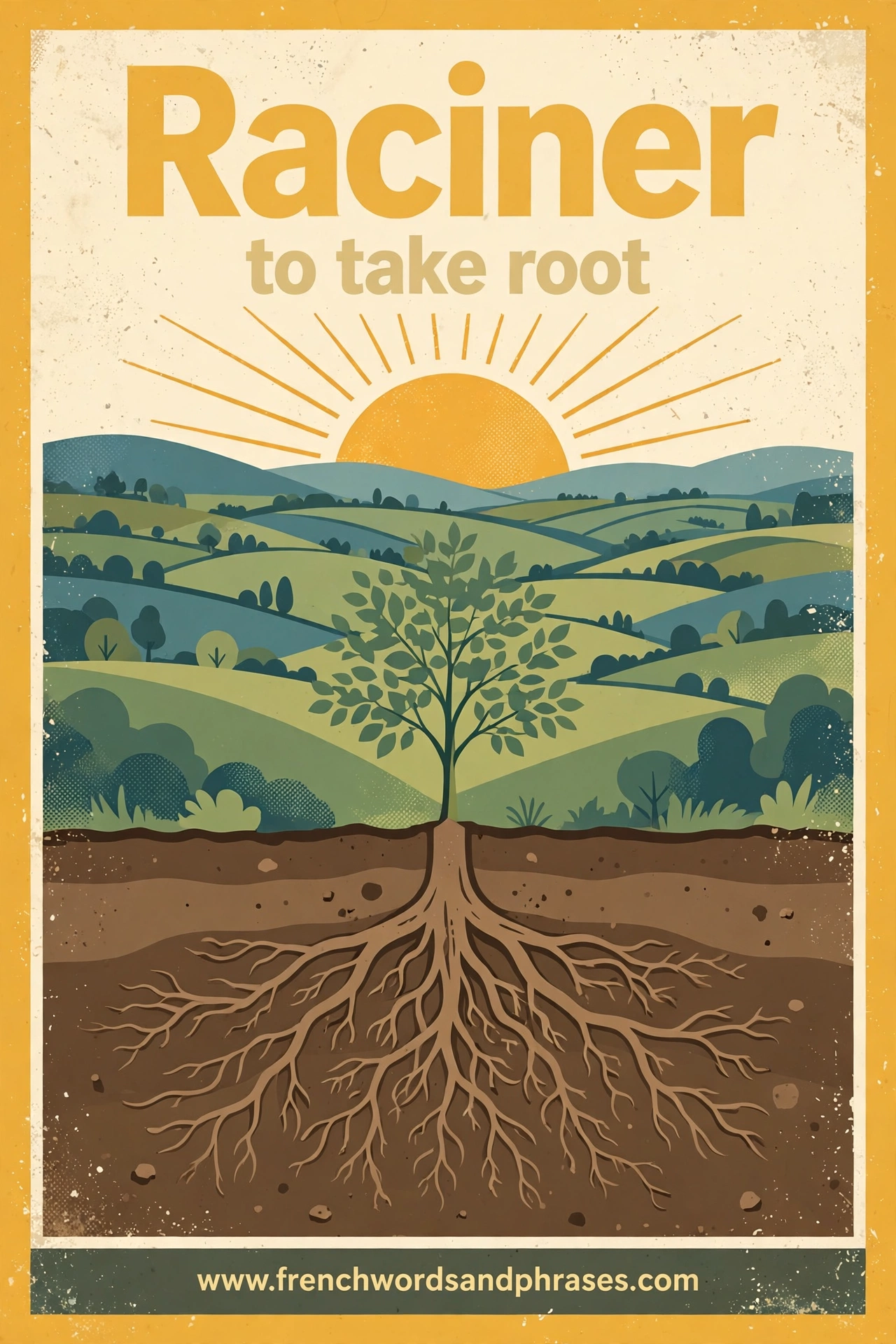
Raciner means to take root.
A cutting standing in a jar of water on the windowsill, fine white threads reaching down week after week — raciner is the quiet verb of a plant deciding to stay, of roots forming where there were none.
In this guide, you’ll learn how to conjugate raciner in all the major French tenses and moods. Explore complete conjugation tables, French examples, English translations, and practice quizzes.
Understanding the French Verb Raciner
Raciner is a regular French verb belonging to the first group of verbs, those ending in -er.
It means to take root. It is commonly used for cuttings rooting in a jar of water, for young plants establishing themselves in new soil, for shrubs and vines settling into a garden bed, and in gardening advice — laisser raciner, let it take root before you plant it out.
Verb classification: First group (-er)
Auxiliary verb: Avoir
Past participle: raciné
Present participle: racinant
English equivalents: To take root, to root (of a plant or cutting); faire raciner — to get a cutting to root.
One important detail: raciner is built on une racine, a root — the same word French uses for the root of a tooth, of a word, and of a family. The verb itself belongs mostly to the garden: it is what a cutting does in water or soil, la bouture racine, the cutting takes root. Gardeners often use it with faire: faire raciner une bouture dans l’eau, to root a cutting in water. For ideas and customs taking root, everyday French more often says prendre racine or s’enraciner — raciner keeps its feet in the soil.
Experience the Word
Raciner is the verb of patience rewarded — nothing seems to happen for weeks, and then, threads of white in the water, everything has changed.
Imagine a kitchen windowsill in March. A sprig of mint stands in a jam jar, and a grandmother checks it every morning with her coffee, until one day she smiles: ça racine — it is taking root, there will be a new plant.
The cutting has not flowered or fruited. It has rooted — anchored itself, ready to grow.
How to Conjugate Raciner: Complete French Conjugation Guide
Let’s explore every major conjugation of raciner, beginning with the indicative mood.
How to Conjugate Raciner in the Indicative Mood
The indicative mood is used to express facts, observations, actions, and events.
How to Conjugate Raciner in the Present Tense (Présent)
Used for actions happening now, habitual actions, and general truths.
| Subject | Conjugation |
|---|---|
| je | racine |
| tu | racines |
| il / elle | racine |
| nous | racinons |
| vous | racinez |
| ils / elles | racinent |
Example
La bouture de menthe racine dans un verre d’eau.
The mint cutting is taking root in a glass of water.
Quick Quiz 1
Complete the sentence:
Nous laissons ______ les boutures dans l’eau.
Reveal the answer
raciner
Nous laissons raciner les boutures dans l’eau.
We let the cuttings take root in water.
How to Conjugate Raciner in the Passé Composé
Used for completed actions in the past. Raciner takes the auxiliary verb avoir.
| Subject | Conjugation |
|---|---|
| j’ | ai raciné |
| tu | as raciné |
| il / elle | a raciné |
| nous | avons raciné |
| vous | avez raciné |
| ils / elles | ont raciné |
Example
Les rosiers ont raciné dès le premier mois.
The rose bushes took root within the first month.
How to Conjugate Raciner in the Imparfait (Imperfect Tense)
Used for habitual past actions, descriptions, and ongoing situations in the past.
| Subject | Conjugation |
|---|---|
| je | racinais |
| tu | racinais |
| il / elle | racinait |
| nous | racinions |
| vous | raciniez |
| ils / elles | racinaient |
Example
Autrefois, les boutures racinaient lentement, sans produits spéciaux.
In the old days, cuttings used to take root slowly, without special products.
Quick Quiz 2
Choose the correct form:
The plants took root.
Les plants ______ en trois semaines. (ont raciné / sont racinés)
Reveal the answer
ont raciné
Les plants ont raciné en trois semaines.
Raciner takes avoir.
How to Conjugate Raciner in the Plus-que-parfait
Used to describe an action that had already been completed before another past event.
| Subject | Conjugation |
|---|---|
| j’ | avais raciné |
| tu | avais raciné |
| il / elle | avait raciné |
| nous | avions raciné |
| vous | aviez raciné |
| ils / elles | avaient raciné |
Example
Le figuier avait raciné avant même l’arrivée de l’hiver.
The fig tree had taken root even before winter arrived.
How to Conjugate Raciner in the Passé Simple
Primarily used in formal writing, literature, and historical narratives. It is rarely used in everyday conversation.
| Subject | Conjugation |
|---|---|
| je | racinai |
| tu | racinas |
| il / elle | racina |
| nous | racinâmes |
| vous | racinâtes |
| ils / elles | racinèrent |
Example
La vigne racina profondément dans la terre sèche.
The vine took root deep in the dry soil.
How to Conjugate Raciner in the Passé Antérieur
A literary tense used to express an action completed immediately before another past action, generally in the passé simple.
| Subject | Conjugation |
|---|---|
| j’ | eus raciné |
| tu | eus raciné |
| il / elle | eut raciné |
| nous | eûmes raciné |
| vous | eûtes raciné |
| ils / elles | eurent raciné |
Example
Quand les plants eurent raciné, le jardinier les mit en pleine terre.
When the plants had taken root, the gardener put them in the open ground.
How to Conjugate Raciner in the Future Tense (Futur Simple)
Used to describe actions that will take place in the future.
| Subject | Conjugation |
|---|---|
| je | racinerai |
| tu | racineras |
| il / elle | racinera |
| nous | racinerons |
| vous | racinerez |
| ils / elles | racineront |
Example
Cette bouture racinera si tu changes l’eau chaque semaine.
This cutting will take root if you change the water every week.
How to Conjugate Raciner in the Futur Antérieur (Future Perfect)
Used for an action that will have been completed before a particular point in the future.
| Subject | Conjugation |
|---|---|
| j’ | aurai raciné |
| tu | auras raciné |
| il / elle | aura raciné |
| nous | aurons raciné |
| vous | aurez raciné |
| ils / elles | auront raciné |
Example
Au printemps, les jeunes plants auront raciné dans tout le jardin.
By spring, the young plants will have taken root all over the garden.
How to Conjugate Raciner in the Near Future (Futur Proche)
Used to describe something that is going to happen soon. Formed with aller + infinitive.
| Subject | Conjugation |
|---|---|
| je | vais raciner |
| tu | vas raciner |
| il / elle | va raciner |
| nous | allons raciner |
| vous | allez raciner |
| ils / elles | vont raciner |
Example
Regarde ces petites racines : la bouture va raciner.
Look at these little roots: the cutting is going to take root.
How to Conjugate Raciner in the Conditional Mood
The conditional mood expresses what would happen under certain circumstances. It is also frequently used to make polite requests or express wishes.
How to Conjugate Raciner in the Present Conditional
| Subject | Conjugation |
|---|---|
| je | racinerais |
| tu | racinerais |
| il / elle | racinerait |
| nous | racinerions |
| vous | racineriez |
| ils / elles | racineraient |
Example
Avec plus de lumière, les boutures racineraient plus vite.
With more light, the cuttings would take root faster.
How to Conjugate Raciner in the Past Conditional
| Subject | Conjugation |
|---|---|
| j’ | aurais raciné |
| tu | aurais raciné |
| il / elle | aurait raciné |
| nous | aurions raciné |
| vous | auriez raciné |
| ils / elles | auraient raciné |
Example
Le rosier aurait raciné si le sol avait été moins sec.
The rose bush would have taken root if the soil had been less dry.
Raciner in the Literary Past Conditional Form
This less common literary form uses the imperfect subjunctive of avoir.
| Subject | Conjugation |
|---|---|
| j’ | eusse raciné |
| tu | eusses raciné |
| il / elle | eût raciné |
| nous | eussions raciné |
| vous | eussiez raciné |
| ils / elles | eussent raciné |
Example
La vigne eût raciné même dans cette terre ingrate.
The vine would have taken root even in that thankless soil.
How to Conjugate Raciner in the Subjunctive Mood
The subjunctive is used to express wishes, emotions, doubts, necessity, and uncertainty. It frequently follows expressions such as il faut que (it is necessary that) or bien que (although).
How to Conjugate Raciner in the Present Subjunctive
| Subject | Conjugation |
|---|---|
| que je | racine |
| que tu | racines |
| qu’il / qu’elle | racine |
| que nous | racinions |
| que vous | raciniez |
| qu’ils / qu’elles | racinent |
Example
Il faut que la bouture racine avant les grands froids.
The cutting must take root before the hard frosts.
Quick Quiz 3
Complete the sentence using the subjunctive:
Il faut que vous laissiez la bouture ______.
Reveal the answer
raciner
Il faut que vous laissiez la bouture raciner.
You must let the cutting take root.
How to Conjugate Raciner in the Imperfect Subjunctive
A literary tense, rarely encountered in modern spoken French.
| Subject | Conjugation |
|---|---|
| que je | racinasse |
| que tu | racinasses |
| qu’il / qu’elle | racinât |
| que nous | racinassions |
| que vous | racinassiez |
| qu’ils / qu’elles | racinassent |
Example
Le jardinier espérait que le figuier racinât malgré la sécheresse.
The gardener hoped the fig tree would take root despite the drought.
How to Conjugate Raciner in the Pluperfect Subjunctive
A literary construction used to express an action completed before another past action.
| Subject | Conjugation |
|---|---|
| que j’ | eusse raciné |
| que tu | eusses raciné |
| qu’il / qu’elle | eût raciné |
| que nous | eussions raciné |
| que vous | eussiez raciné |
| qu’ils / qu’elles | eussent raciné |
Example
Elle doutait que les plants eussent raciné si vite.
She doubted the plants had taken root so quickly.
How to Conjugate Raciner in the Past Subjunctive
| Subject | Conjugation |
|---|---|
| que j’ | aie raciné |
| que tu | aies raciné |
| qu’il / qu’elle | ait raciné |
| que nous | ayons raciné |
| que vous | ayez raciné |
| qu’ils / qu’elles | aient raciné |
Example
Je suis ravi que les rosiers aient raciné chez toi.
I am delighted the rose bushes took root at your place.
How to Conjugate Raciner in the Imperative
The imperative is used to give commands, instructions, invitations, or suggestions. Subject pronouns are omitted.
How to Conjugate Raciner in the Present Imperative
| Person | Conjugation |
|---|---|
| (tu) | racine |
| (nous) | racinons |
| (vous) | racinez |
Example
Laisse raciner la bouture avant de la planter !
Let the cutting take root before planting it!
Quick Quiz 4
How would you say Let the cutting take root (tu form)?
Reveal the answer
Laisse raciner la bouture !
French Participles of Raciner
Participles are verb forms that can be used in compound tenses and other grammatical constructions.
Present Participle of Raciner
racinant
En racinant dans l’eau, la menthe prépare sa nouvelle vie.
By taking root in water, the mint is preparing its new life.
Past Participle of Raciner
raciné
Bien raciné, le jeune arbre affronte son premier hiver.
Well rooted, the young tree faces its first winter.
Raciner in Everyday French: Real-Life Examples
Now that you know the conjugations, let’s see how raciner appears in everyday French.
Example 1 — Present
La bouture racine déjà dans le verre.
The cutting is already taking root in the glass.
Example 2 — Passé composé
Les plants ont raciné en trois semaines.
The plants took root in three weeks.
Example 3 — Imparfait
Les vignes racinaient vite dans cette terre.
The vines used to take root quickly in this soil.
Example 4 — Future
Ton rosier racinera au printemps.
Your rose bush will take root in spring.
Example 5 — Conditional
Ça racinerait mieux à l’ombre.
It would take root better in the shade.
Example 6 — Imperative
Fais raciner les boutures dans l’eau !
Get the cuttings to root in water!
Beyond Translation: The Meaning of Raciner
English to root wanders off to cheer at matches and rummage in drawers; French raciner stays faithful to the plant and its slow decision.
Une racine is never just botany in French.
Roots are family (ses racines — where someone comes from), language (la racine d’un mot) and stubbornness — and raciner is the small green verb at the bottom of them all.
How to Remember the French Verb Raciner
Remember it this way: Raciner is about the cutting in the jar — white threads, a plant deciding to stay.
- Une racine — a root: raciner is what a cutting does when roots appear.
- Faire raciner une bouture — to root a cutting, the gardener’s phrase.
- Regular -er: je racine, nous racinons, past participle raciné.
The key idea is the cutting in the jar — white threads, a plant deciding to stay.
Test Your Knowledge of Raciner
Let’s see how much you’ve learned. Try answering these questions before revealing the answers.
Question 1
What does a cutting do when it racine?
Reveal the answer
It takes root — fine roots grow, and it can be planted out.
Question 2
How do you say to root a cutting in water in French?
Reveal the answer
Faire raciner une bouture dans l’eau.
Question 3
Translate: The rose bushes took root within the first month.
Reveal the answer
Les rosiers ont raciné dès le premier mois.
Question 4
What is the past participle of raciner?
Reveal the answer
Raciné.
Question 5
Complete the sentence:
Il faut que la bouture ______ avant les grands froids.
Reveal the answer
racine
Il faut que la bouture racine avant les grands froids.
The cutting must take root before the hard frosts.
Your Final Challenge
Can You Use It?
How would you say this in French?
The cutting takes root in its glass of water, and the kitchen becomes a little greenhouse.
Reveal the answer
La bouture racine dans son verre d’eau, et la cuisine devient une petite serre.
The cutting takes root in its glass of water, and the kitchen becomes a little greenhouse.
A little French. A little curiosity. A richer everyday life.
LEARN FRENCH ONE WORD AT A TIME