A French Word to Live By
How to Conjugate Puer in French
/pɥe/
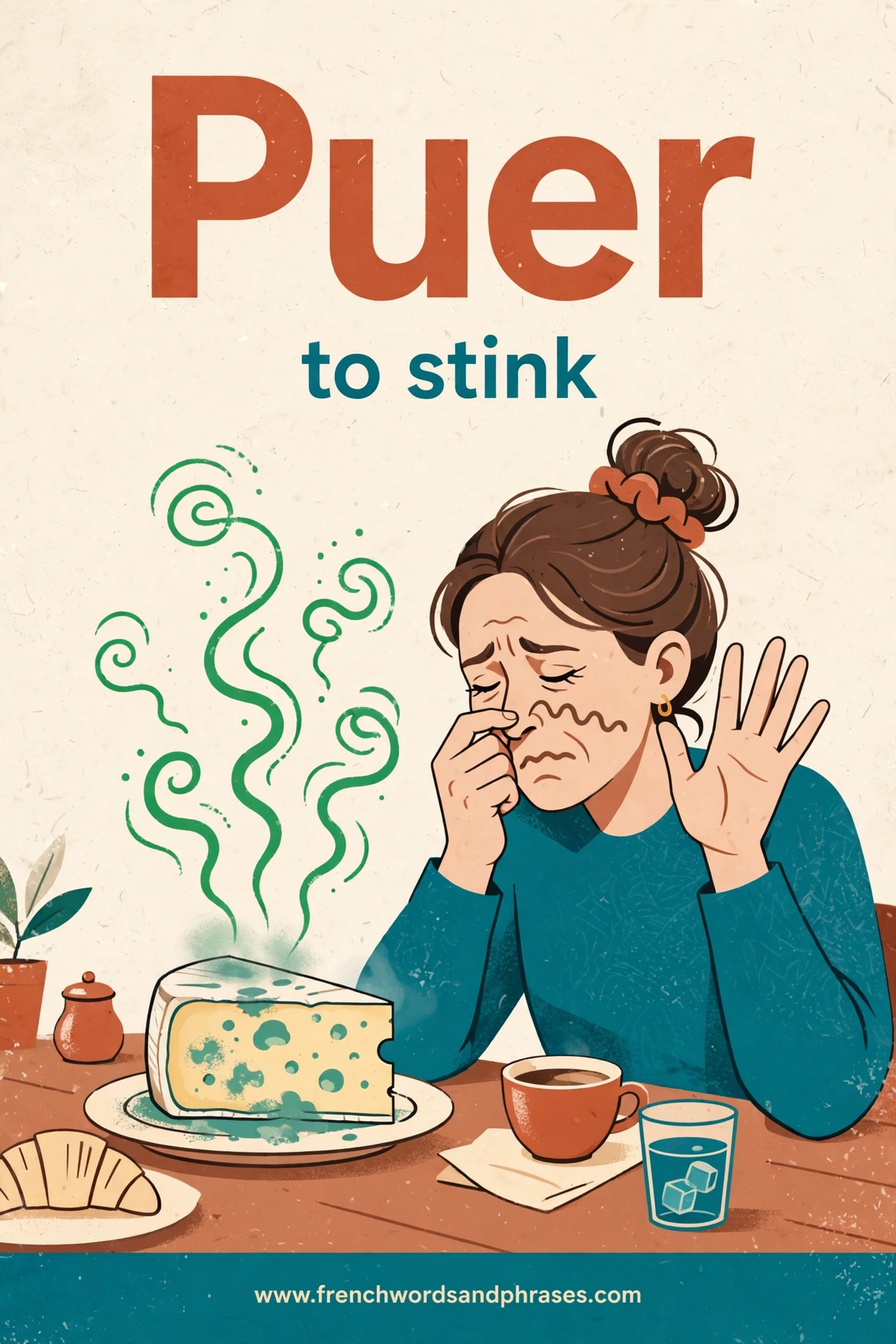
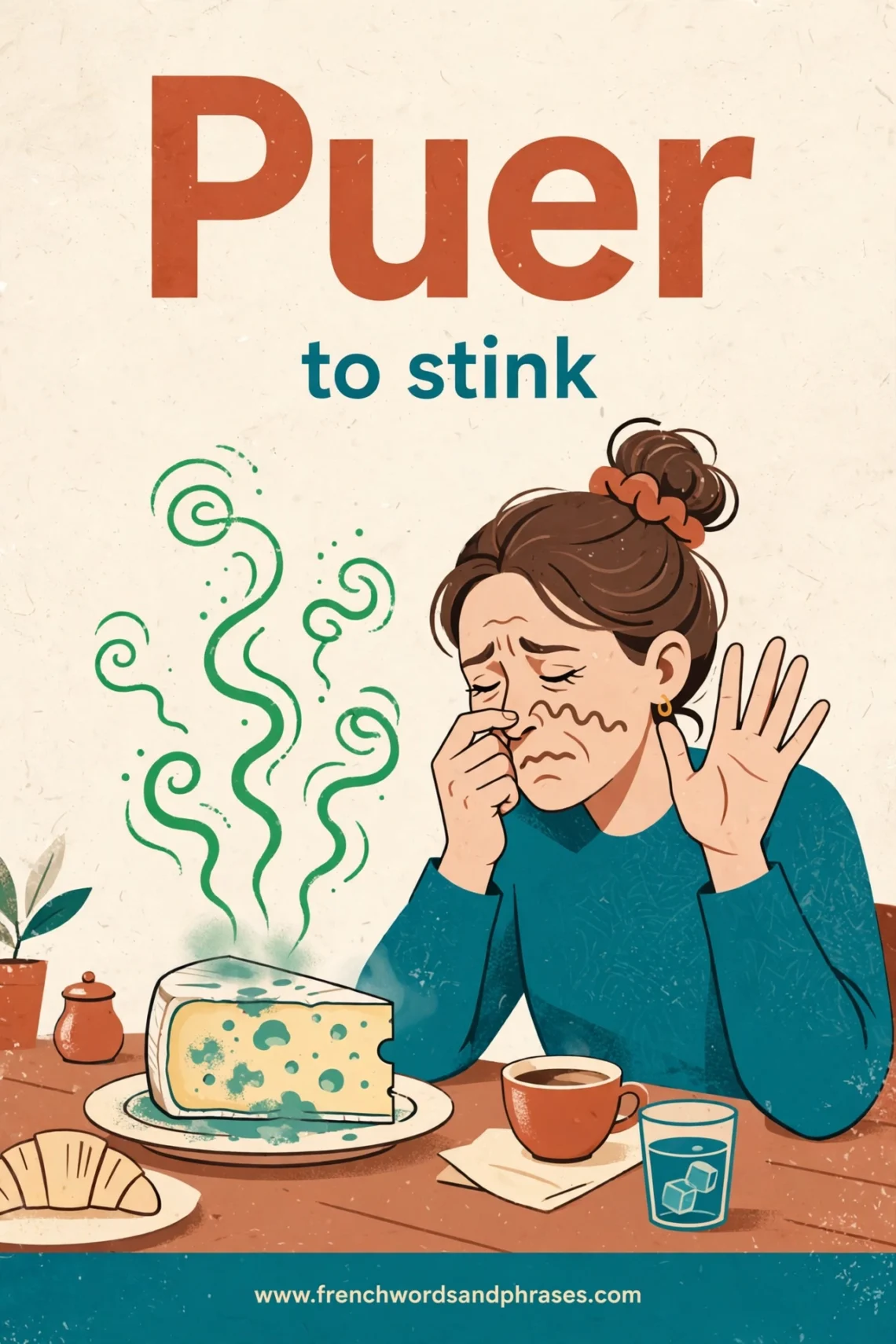
Puer means to stink.
A dustbin in August, a cheese that announces itself from the doorway, drains after a storm — puer is French’s blunt little verb for stinking, the word behind the cry every French child knows: ça pue !
In this guide, you’ll learn how to conjugate puer in all the major French tenses and moods. Explore complete conjugation tables, French examples, English translations, and practice quizzes.
Understanding the French Verb Puer
Puer is a regular French verb belonging to the first group of verbs, those ending in -er.
It means to stink. It is commonly used for bins, drains and cellars in hot weather, for strong cheeses and spoiled food, for breath and clothes that reek of garlic, tobacco or sweat — and as the all-purpose complaint ça pue, it stinks, about a place or a room; figuratively it even judges suspicious deals: ça pue l’arnaque, it smells like a scam.
Verb classification: First group (-er)
Auxiliary verb: Avoir
Past participle: pué
Present participle: puant
English equivalents: To stink, to reek; puer quelque chose — to reek of something; ça pue — it stinks.
One important detail: puer is short, blunt and a little familiar — ça pue ! is the cry in every schoolyard the moment a bad smell hits. With a direct object it means to reek of that thing: il pue l’ail, he reeks of garlic; elle pue la sueur après le match, she reeks of sweat after the match. The noun for the smell itself is la puanteur, a stench. Politer company prefers sentir mauvais, but puer is the word French actually reaches for.
Experience the Word
Puer is the verb of the nose’s alarm — no analysis, no politeness, just the verdict: it stinks.
Imagine opening a farmhouse fridge in August. At the back, forgotten in a corner, a camembert has been ripening for weeks — and the moment the door opens, the whole kitchen knows. Ça pue, et tout le monde recule d’un pas.
Nothing needs to be said twice. It stank — puait — and the verdict was unanimous.
How to Conjugate Puer: Complete French Conjugation Guide
Let’s explore every major conjugation of puer, beginning with the indicative mood.
How to Conjugate Puer in the Indicative Mood
The indicative mood is used to express facts, observations, actions, and events.
How to Conjugate Puer in the Present Tense (Présent)
Used for actions happening now, habitual actions, and general truths.
| Subject | Conjugation |
|---|---|
| je | pue |
| tu | pues |
| il / elle | pue |
| nous | puons |
| vous | puez |
| ils / elles | puent |
Example
Les égouts puent après la pluie.
The drains stink after the rain.
Quick Quiz 1
Complete the sentence:
Les poubelles ______ en été.
Reveal the answer
puent
Les poubelles puent en été.
The bins stink in summer.
How to Conjugate Puer in the Passé Composé
Used for completed actions in the past. Puer takes the auxiliary verb avoir.
| Subject | Conjugation |
|---|---|
| j’ | ai pué |
| tu | as pué |
| il / elle | a pué |
| nous | avons pué |
| vous | avez pué |
| ils / elles | ont pué |
Example
La poubelle a pué toute la semaine.
The dustbin stank all week.
How to Conjugate Puer in the Imparfait (Imperfect Tense)
Used for habitual past actions, descriptions, and ongoing situations in the past.
| Subject | Conjugation |
|---|---|
| je | puais |
| tu | puais |
| il / elle | puait |
| nous | puions |
| vous | puiez |
| ils / elles | puaient |
Example
Le vieux port puait le poisson et le goudron.
The old harbour used to stink of fish and tar.
Quick Quiz 2
Choose the correct form:
The milk stank.
Le lait ______. (a pué / est pué)
Reveal the answer
a pué
Le lait a pué.
Puer takes avoir.
How to Conjugate Puer in the Plus-que-parfait
Used to describe an action that had already been completed before another past event.
| Subject | Conjugation |
|---|---|
| j’ | avais pué |
| tu | avais pué |
| il / elle | avait pué |
| nous | avions pué |
| vous | aviez pué |
| ils / elles | avaient pué |
Example
La cave avait pué le moisi pendant des mois.
The cellar had stunk of mould for months.
How to Conjugate Puer in the Passé Simple
Primarily used in formal writing, literature, and historical narratives. It is rarely used in everyday conversation.
| Subject | Conjugation |
|---|---|
| je | puai |
| tu | puas |
| il / elle | pua |
| nous | puâmes |
| vous | puâtes |
| ils / elles | puèrent |
Example
Le marais pua dès les premières chaleurs.
The marsh stank from the first warm days.
How to Conjugate Puer in the Passé Antérieur
A literary tense used to express an action completed immediately before another past action, generally in the passé simple.
| Subject | Conjugation |
|---|---|
| j’ | eus pué |
| tu | eus pué |
| il / elle | eut pué |
| nous | eûmes pué |
| vous | eûtes pué |
| ils / elles | eurent pué |
Example
Quand le fromage eut pué dans tout le frigo, elle le jeta enfin.
When the cheese had stunk out the whole fridge, she finally threw it away.
How to Conjugate Puer in the Future Tense (Futur Simple)
Used to describe actions that will take place in the future.
| Subject | Conjugation |
|---|---|
| je | puerai |
| tu | pueras |
| il / elle | puera |
| nous | puerons |
| vous | puerez |
| ils / elles | pueront |
Example
Si tu laisses ce poisson ici, il puera demain.
If you leave this fish here, it will stink tomorrow.
How to Conjugate Puer in the Futur Antérieur (Future Perfect)
Used for an action that will have been completed before a particular point in the future.
| Subject | Conjugation |
|---|---|
| j’ | aurai pué |
| tu | auras pué |
| il / elle | aura pué |
| nous | aurons pué |
| vous | aurez pué |
| ils / elles | auront pué |
Example
À midi, la poubelle aura pué dans toute la cuisine.
By noon, the dustbin will have stunk up the whole kitchen.
How to Conjugate Puer in the Near Future (Futur Proche)
Used to describe something that is going to happen soon. Formed with aller + infinitive.
| Subject | Conjugation |
|---|---|
| je | vais puer |
| tu | vas puer |
| il / elle | va puer |
| nous | allons puer |
| vous | allez puer |
| ils / elles | vont puer |
Example
Ce lait va puer si tu ne le mets pas au frais.
This milk is going to stink if you do not put it in the fridge.
How to Conjugate Puer in the Conditional Mood
The conditional mood expresses what would happen under certain circumstances. It is also frequently used to make polite requests or express wishes.
How to Conjugate Puer in the Present Conditional
| Subject | Conjugation |
|---|---|
| je | puerais |
| tu | puerais |
| il / elle | puerait |
| nous | puerions |
| vous | pueriez |
| ils / elles | pueraient |
Example
Sans aération, la cave puerait encore plus.
Without ventilation, the cellar would stink even more.
How to Conjugate Puer in the Past Conditional
| Subject | Conjugation |
|---|---|
| j’ | aurais pué |
| tu | aurais pué |
| il / elle | aurait pué |
| nous | aurions pué |
| vous | auriez pué |
| ils / elles | auraient pué |
Example
Le poisson aurait pué moins vite au réfrigérateur.
The fish would have stunk less quickly in the fridge.
Puer in the Literary Past Conditional Form
This less common literary form uses the imperfect subjunctive of avoir.
| Subject | Conjugation |
|---|---|
| j’ | eusse pué |
| tu | eusses pué |
| il / elle | eût pué |
| nous | eussions pué |
| vous | eussiez pué |
| ils / elles | eussent pué |
Example
Le cloaque eût pué jusqu’aux remparts.
The cesspool would have stunk as far as the ramparts.
How to Conjugate Puer in the Subjunctive Mood
The subjunctive is used to express wishes, emotions, doubts, necessity, and uncertainty. It frequently follows expressions such as il faut que (it is necessary that) or bien que (although).
How to Conjugate Puer in the Present Subjunctive
| Subject | Conjugation |
|---|---|
| que je | pue |
| que tu | pues |
| qu’il / qu’elle | pue |
| que nous | puions |
| que vous | puiez |
| qu’ils / qu’elles | puent |
Example
Il est possible que ce fromage pue déjà.
It is possible this cheese already stinks.
Quick Quiz 3
Complete the sentence using the subjunctive:
Je doute que ce lait ______ déjà.
Reveal the answer
pue
Je doute que ce lait pue déjà.
I doubt this milk stinks already.
How to Conjugate Puer in the Imperfect Subjunctive
A literary tense, rarely encountered in modern spoken French.
| Subject | Conjugation |
|---|---|
| que je | puasse |
| que tu | puasses |
| qu’il / qu’elle | puât |
| que nous | puassions |
| que vous | puassiez |
| qu’ils / qu’elles | puassent |
Example
On ouvrait les fenêtres de peur que la soupe puât.
People opened the windows for fear the soup might stink.
How to Conjugate Puer in the Pluperfect Subjunctive
A literary construction used to express an action completed before another past action.
| Subject | Conjugation |
|---|---|
| que j’ | eusse pué |
| que tu | eusses pué |
| qu’il / qu’elle | eût pué |
| que nous | eussions pué |
| que vous | eussiez pué |
| qu’ils / qu’elles | eussent pué |
Example
Il regretta que les ordures eussent pué devant sa porte.
He regretted that the rubbish had stunk in front of his door.
How to Conjugate Puer in the Past Subjunctive
| Subject | Conjugation |
|---|---|
| que j’ | aie pué |
| que tu | aies pué |
| qu’il / qu’elle | ait pué |
| que nous | ayons pué |
| que vous | ayez pué |
| qu’ils / qu’elles | aient pué |
Example
Je suis étonné que le lait ait pué si vite.
I am surprised the milk stank so quickly.
How to Conjugate Puer in the Imperative
The imperative is used to give commands, instructions, invitations, or suggestions. Subject pronouns are omitted.
How to Conjugate Puer in the Present Imperative
| Person | Conjugation |
|---|---|
| (tu) | pue |
| (nous) | puons |
| (vous) | puez |
Example
Ne pue pas comme ça, va te laver !
Do not stink like that, go and wash!
Quick Quiz 4
How would you say It stinks in here, open the window (tu form)?
Reveal the answer
Ça pue ici, ouvre la fenêtre !
French Participles of Puer
Participles are verb forms that can be used in compound tenses and other grammatical constructions.
Present Participle of Puer
puant
En puant le moisi, la cave décourageait les visiteurs.
Stinking of mould, the cellar put off visitors.
Past Participle of Puer
pué
Son haleine a pué l’ail après le repas.
His breath stank of garlic after the meal.
Puer in Everyday French: Real-Life Examples
Now that you know the conjugations, let’s see how puer appears in everyday French.
Example 1 — Present
Ça pue ici, ouvre la fenêtre !
It stinks in here, open the window!
Example 2 — Passé composé
Le lait a pué dès le matin.
The milk stank from the morning on.
Example 3 — Imparfait
Les égouts puaient après l’orage.
The drains used to stink after the storm.
Example 4 — Future
Ce poisson puera demain si tu le laisses là.
This fish will stink tomorrow if you leave it there.
Example 5 — Conditional
Sans poubelle fermée, la cuisine puerait tout l’été.
Without a lidded bin, the kitchen would stink all summer.
Example 6 — Imperative
Ne pue pas l’ail comme ça, brosse-toi les dents !
Do not reek of garlic like that, brush your teeth!
Beyond Translation: The Meaning of Puer
English stink is blunt, but French puer is blunter still — one syllable of disgust that doubles as a detective’s tool.
Ça pue is a judgment, not just a smell.
Ça pue l’arnaque — it reeks of a scam — shows the nose at work on ideas: in French, when something is wrong, it literally stinks.
How to Remember the French Verb Puer
Remember it this way: Puer is about the nose’s alarm — ça pue, it stinks.
- Ça pue ! — the schoolyard verdict: it stinks!
- Puer l’ail, puer la sueur — to reek of garlic, of sweat (puer + direct object).
- Regular -er: je pue, nous puons, past participle pué; la puanteur — the stench.
The key idea is the nose’s alarm — ça pue, it stinks.
Test Your Knowledge of Puer
Let’s see how much you’ve learned. Try answering these questions before revealing the answers.
Question 1
How do you say It stinks! in French?
Reveal the answer
Ça pue !
Question 2
How do you say He reeks of garlic in French?
Reveal the answer
Il pue l’ail.
Question 3
Translate: The drains stink after the rain.
Reveal the answer
Les égouts puent après la pluie.
Question 4
What is the past participle of puer?
Reveal the answer
Pué.
Question 5
Complete the sentence:
Il est possible que ce fromage ______ déjà.
Reveal the answer
pue
Il est possible que ce fromage pue déjà.
It is possible this cheese already stinks.
Your Final Challenge
Can You Use It?
How would you say this in French?
The camembert stinks out the whole fridge, and nobody dares go near it.
Reveal the answer
Le camembert pue dans tout le frigo, et personne n’ose l’approcher.
The camembert stinks out the whole fridge, and nobody dares go near it.
A little French. A little curiosity. A richer everyday life.
LEARN FRENCH ONE WORD AT A TIME