
A French Word to Live By
How to Conjugate Édenter in French
/e.dɑ̃.te/
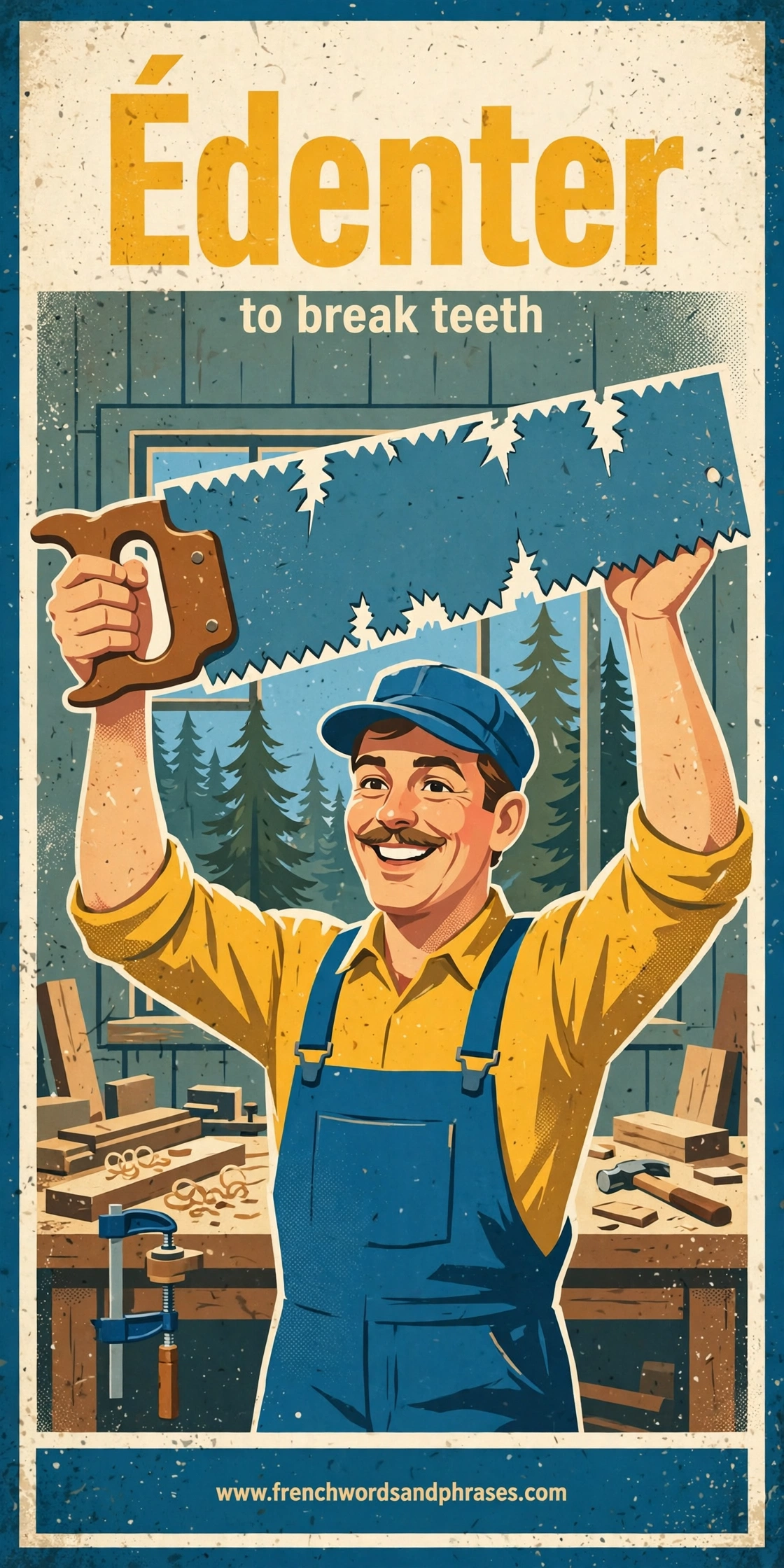
Édenter means to break the teeth of something — or someone.
A gear wheel missing three teeth, an old comb with gaps in its smile, a grandfather grinning without a tooth left — édenter is the verb of teeth lost and broken, for machines and for people alike.
In this guide, you’ll learn how to conjugate édenter in all the major French tenses and moods. Explore complete conjugation tables, French examples, English translations, and practice quizzes.
Understanding the French Verb Édenter
Édenter is a regular French verb belonging to the first group of verbs, those ending in -er.
It means to break teeth. It is commonly used in workshops for gears, saws and combs whose teeth have snapped, in dentistry and family talk for people losing or breaking teeth — il s’est édenté en tombant — and in descriptions where édenté, toothless, paints age or ruin in a single word.
Verb classification: First group (-er)
Auxiliary verb: Avoir
Past participle: édenté
Present participle: édentant
English equivalents: To break the teeth of; s’édenter — to lose one’s teeth, to break one’s own teeth; édenté — toothless, broken-toothed.
One important detail: édenter is built on une dent, a tooth, with the privative é- of écroûter and éculer — it takes teeth away. Mechanics use it literally: édenter une roue, to break the teeth of a gear, and a comb or a saw can be édenté, gap-toothed. For people, the reflexive does the everyday work: s’édenter, to lose one’s teeth — and the adjective édenté describes the result, a toothless old man or a broken comb.
Experience the Word
Édenter is the verb of the gap — something that once bit, cut or chewed now shows an empty space where a tooth used to be.
Imagine an old miller opening the great mechanism of his mill. He runs a finger along the wooden gear and stops at a gap: two teeth gone in the winter, and until the wheel is repaired, the whole mill limps.
The wheel still turns, after a fashion. It has been édentée — its teeth broken, its bite incomplete.
How to Conjugate Édenter: Complete French Conjugation Guide
Let’s explore every major conjugation of édenter, beginning with the indicative mood.
How to Conjugate Édenter in the Indicative Mood
The indicative mood is used to express facts, observations, actions, and events.
How to Conjugate Édenter in the Present Tense (Présent)
Used for actions happening now, habitual actions, and general truths.
| Subject | Conjugation |
|---|---|
| je | édente |
| tu | édentes |
| il / elle | édente |
| nous | édentons |
| vous | édentez |
| ils / elles | édentent |
Example
Ce choc édente la roue à chaque passage.
This jolt breaks the gear’s teeth at every pass.
Quick Quiz 1
Complete the sentence:
Nous ______ la roue si le choc se répète.
Reveal the answer
édenterons
Nous édenterons la roue si le choc se répète.
We will break the gear’s teeth if the jolt happens again.
How to Conjugate Édenter in the Passé Composé
Used for completed actions in the past. Édenter takes the auxiliary verb avoir.
| Subject | Conjugation |
|---|---|
| j’ | ai édenté |
| tu | as édenté |
| il / elle | a édenté |
| nous | avons édenté |
| vous | avez édenté |
| ils / elles | ont édenté |
Example
Il s’est édenté en tombant de vélo.
He broke his teeth falling off his bike.
How to Conjugate Édenter in the Imparfait (Imperfect Tense)
Used for habitual past actions, descriptions, and ongoing situations in the past.
| Subject | Conjugation |
|---|---|
| je | édentais |
| tu | édentais |
| il / elle | édentait |
| nous | édentions |
| vous | édentiez |
| ils / elles | édentaient |
Example
Le temps édentait lentement le vieil engrenage.
Time was slowly breaking the teeth of the old gearing.
Quick Quiz 2
Choose the correct form:
She broke a tooth on an olive stone.
Elle ______ sur une olive. (s’est édentée / a édentée)
Reveal the answer
s’est édentée
Elle s’est édentée sur une olive.
For one’s own teeth, French uses the reflexive s’édenter, with être.
How to Conjugate Édenter in the Plus-que-parfait
Used to describe an action that had already been completed before another past event.
| Subject | Conjugation |
|---|---|
| j’ | avais édenté |
| tu | avais édenté |
| il / elle | avait édenté |
| nous | avions édenté |
| vous | aviez édenté |
| ils / elles | avaient édenté |
Example
La chute avait édenté la scie sur trois dents.
The fall had broken three teeth of the saw.
How to Conjugate Édenter in the Passé Simple
Primarily used in formal writing, literature, and historical narratives. It is rarely used in everyday conversation.
| Subject | Conjugation |
|---|---|
| je | édentai |
| tu | édentas |
| il / elle | édenta |
| nous | édentâmes |
| vous | édentâtes |
| ils / elles | édentèrent |
Example
La pierre édenta la lame du couteau.
The stone broke the teeth of the knife blade.
How to Conjugate Édenter in the Passé Antérieur
A literary tense used to express an action completed immediately before another past action, generally in the passé simple.
| Subject | Conjugation |
|---|---|
| j’ | eus édenté |
| tu | eus édenté |
| il / elle | eut édenté |
| nous | eûmes édenté |
| vous | eûtes édenté |
| ils / elles | eurent édenté |
Example
Quand le choc eut édenté la roue, la machine s’arrêta.
When the jolt had broken the gear’s teeth, the machine stopped.
How to Conjugate Édenter in the Future Tense (Futur Simple)
Used to describe actions that will take place in the future.
| Subject | Conjugation |
|---|---|
| je | édenterai |
| tu | édenteras |
| il / elle | édentera |
| nous | édenterons |
| vous | édenterez |
| ils / elles | édenteront |
Example
Attention, ce gravier édentera tes dents si tu tombes.
Careful, that gravel will break your teeth if you fall.
How to Conjugate Édenter in the Futur Antérieur (Future Perfect)
Used for an action that will have been completed before a particular point in the future.
| Subject | Conjugation |
|---|---|
| j’ | aurai édenté |
| tu | auras édenté |
| il / elle | aura édenté |
| nous | aurons édenté |
| vous | aurez édenté |
| ils / elles | auront édenté |
Example
À force d’usage, le peigne se sera édenté partout.
With use, the comb will have lost teeth everywhere.
How to Conjugate Édenter in the Near Future (Futur Proche)
Used to describe something that is going to happen soon. Formed with aller + infinitive.
| Subject | Conjugation |
|---|---|
| je | vais édenter |
| tu | vas édenter |
| il / elle | va édenter |
| nous | allons édenter |
| vous | allez édenter |
| ils / elles | vont édenter |
Example
Ne croque pas ce bonbon dur, tu vas t’édenter.
Do not bite that hard sweet, you will break your teeth.
How to Conjugate Édenter in the Conditional Mood
The conditional mood expresses what would happen under certain circumstances. It is also frequently used to make polite requests or express wishes.
How to Conjugate Édenter in the Present Conditional
| Subject | Conjugation |
|---|---|
| je | édenterais |
| tu | édenterais |
| il / elle | édenterait |
| nous | édenterions |
| vous | édenteriez |
| ils / elles | édenteraient |
Example
Un choc plus fort édenterait complètement la roue.
A harder jolt would break the gear’s teeth completely.
How to Conjugate Édenter in the Past Conditional
| Subject | Conjugation |
|---|---|
| j’ | aurais édenté |
| tu | aurais édenté |
| il / elle | aurait édenté |
| nous | aurions édenté |
| vous | auriez édenté |
| ils / elles | auraient édenté |
Example
Il se serait édenté si le guidon ne l’avait pas retenu.
He would have broken his teeth if the handlebars had not held him.
Édenter in the Literary Past Conditional Form
This less common literary form uses the imperfect subjunctive of avoir.
| Subject | Conjugation |
|---|---|
| j’ | eusse édenté |
| tu | eusses édenté |
| il / elle | eût édenté |
| nous | eussions édenté |
| vous | eussiez édenté |
| ils / elles | eussent édenté |
Example
La meule eût édenté l’engrenage de bois en un hiver.
The millstone would have broken the wooden gearing’s teeth in one winter.
How to Conjugate Édenter in the Subjunctive Mood
The subjunctive is used to express wishes, emotions, doubts, necessity, and uncertainty. It frequently follows expressions such as il faut que (it is necessary that) or bien que (although).
How to Conjugate Édenter in the Present Subjunctive
| Subject | Conjugation |
|---|---|
| que je | édente |
| que tu | édentes |
| qu’il / qu’elle | édente |
| que nous | édentions |
| que vous | édentiez |
| qu’ils / qu’elles | édentent |
Example
Je crains que ce choc édente la scie.
I fear this jolt may break the saw’s teeth.
Quick Quiz 3
Complete the sentence using the subjunctive:
Je crains que vous ______ la scie.
Reveal the answer
édentiez
Je crains que vous édentiez la scie.
I fear you may break the saw’s teeth.
How to Conjugate Édenter in the Imperfect Subjunctive
A literary tense, rarely encountered in modern spoken French.
| Subject | Conjugation |
|---|---|
| que je | édentasse |
| que tu | édentasses |
| qu’il / qu’elle | édentât |
| que nous | édentassions |
| que vous | édentassiez |
| qu’ils / qu’elles | édentassent |
Example
Il fallait éviter que la roue s’édentât davantage.
It was necessary to stop the wheel losing more teeth.
How to Conjugate Édenter in the Pluperfect Subjunctive
A literary construction used to express an action completed before another past action.
| Subject | Conjugation |
|---|---|
| que j’ | eusse édenté |
| que tu | eusses édenté |
| qu’il / qu’elle | eût édenté |
| que nous | eussions édenté |
| que vous | eussiez édenté |
| qu’ils / qu’elles | eussent édenté |
Example
On voyait qu’il se fût édenté dans sa chute.
You could see he had broken his teeth in his fall.
How to Conjugate Édenter in the Past Subjunctive
| Subject | Conjugation |
|---|---|
| que j’ | aie édenté |
| que tu | aies édenté |
| qu’il / qu’elle | ait édenté |
| que nous | ayons édenté |
| que vous | ayez édenté |
| qu’ils / qu’elles | aient édenté |
Example
Je suis désolé que tu te sois édenté.
I am sorry you broke your teeth.
How to Conjugate Édenter in the Imperative
The imperative is used to give commands, instructions, invitations, or suggestions. Subject pronouns are omitted.
How to Conjugate Édenter in the Present Imperative
| Person | Conjugation |
|---|---|
| (tu) | édente |
| (nous) | édentons |
| (vous) | édentez |
Example
N’édente pas ce peigne, prête-moi l’autre !
Do not break the teeth of this comb, lend me the other one!
Quick Quiz 4
How would you say Do not break the saw’s teeth (tu form)?
Reveal the answer
N’édente pas la scie !
French Participles of Édenter
Participles are verb forms that can be used in compound tenses and other grammatical constructions.
Present Participle of Édenter
édentant
En édentant la roue, la pierre a bloqué tout le mécanisme.
By breaking the gear’s teeth, the stone jammed the whole mechanism.
Past Participle of Édenter
édenté
Édenté par les ans, le vieil homme souriait sans une dent.
Toothless from age, the old man smiled without a single tooth.
Édenter in Everyday French: Real-Life Examples
Now that you know the conjugations, let’s see how édenter appears in everyday French.
Example 1 — Present
Il s’édente petit à petit avec l’âge.
He is losing his teeth little by little with age.
Example 2 — Passé composé
Elle s’est édentée sur une olive cachée.
She broke a tooth on a hidden olive stone.
Example 3 — Imparfait
Le vieux peigne s’édentait de semaine en semaine.
The old comb was losing teeth week by week.
Example 4 — Future
Ce bonbon édentera quelqu’un, j’en suis sûr.
That sweet will break someone’s tooth, I am sure of it.
Example 5 — Conditional
La roue s’édenterait si le choc se répétait.
The gear would lose its teeth if the jolt happened again.
Example 6 — Imperative
N’édentez pas la scie sur ce clou !
Do not break the saw’s teeth on that nail!
Beyond Translation: The Meaning of Édenter
English separates the two worlds — gears strip, people lose teeth; French édenter keeps them in one family, because both are about dents, teeth.
A toothless comb and a toothless grandfather share one adjective: édenté.
It is a slightly old-fashioned, tender word for people — un sourire édenté, a toothless smile, carries affection where English might only see a gap.
How to Remember the French Verb Édenter
Remember it this way: Édenter is about the gap where a tooth was — gears, combs and grandfathers.
- Une dent — a tooth; édenter takes teeth away, from gears and from smiles.
- S’édenter — to lose or break one’s own teeth; édenté — toothless.
- Regular -er: j’édente, nous édentons, past participle édenté.
The key idea is the gap where a tooth was — gears, combs and grandfathers.
Test Your Knowledge of Édenter
Let’s see how much you’ve learned. Try answering these questions before revealing the answers.
Question 1
What does un sourire édenté mean?
Reveal the answer
A toothless smile — édenté describes what édenter has done.
Question 2
How do you say He broke his teeth falling off his bike in French?
Reveal the answer
Il s’est édenté en tombant de vélo.
Question 3
Translate: The fall had broken three teeth of the saw.
Reveal the answer
La chute avait édenté la scie sur trois dents.
Question 4
What is the past participle of édenter?
Reveal the answer
Édenté.
Question 5
Complete the sentence:
Je crains que ce choc ______ la scie.
Reveal the answer
édente
Je crains que ce choc édente la scie.
I fear this jolt may break the saw’s teeth.
Your Final Challenge
Can You Use It?
How would you say this in French?
The old comb has lost its teeth with the years, but it keeps all the family memories.
Reveal the answer
Le vieux peigne s’est édenté avec les ans, mais il garde tous les souvenirs de famille.
The old comb has lost its teeth with the years, but it keeps all the family memories.
A little French. A little curiosity. A richer everyday life.
LEARN FRENCH ONE WORD AT A TIME




