
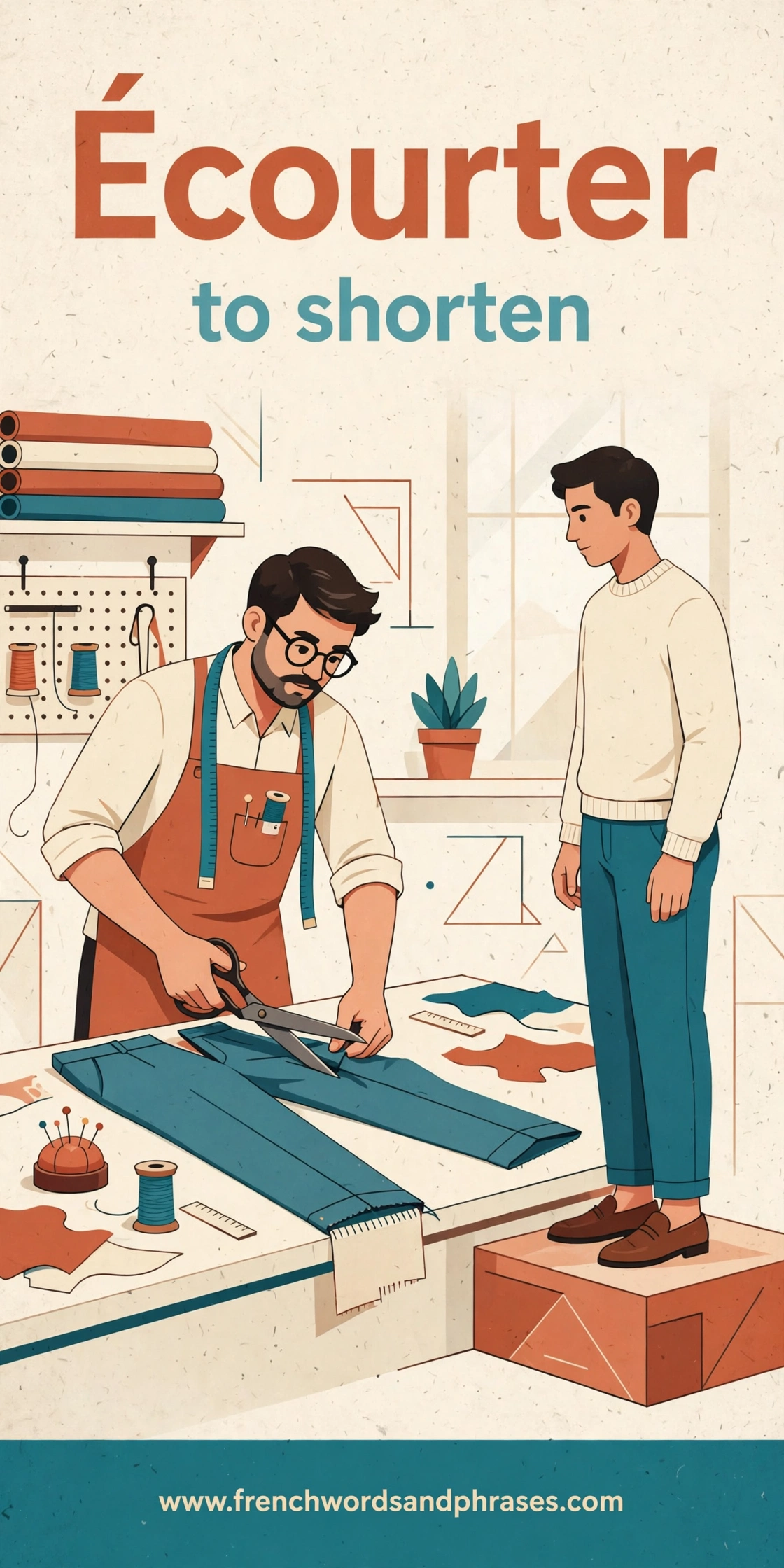
A French Word to Live By
How to Conjugate Écourter in French
/e.kuʁ.te/
Écourter means to shorten — to cut something short before its natural end.
A speech trimmed of its last page, a holiday cut by two days, a visit ended while the coffee is still warm — écourter is the verb of cutting short, of bringing things to an earlier close than planned.
In this guide, you’ll learn how to conjugate écourter in all the major French tenses and moods. Explore complete conjugation tables, French examples, English translations, and practice quizzes.
Understanding the French Verb Écourter
Écourter is a regular French verb belonging to the first group of verbs, those ending in -er.
It means to shorten. It is commonly used for cutting short visits, speeches, meetings and stays (écourter une visite, un séjour, des vacances), for trimming texts and ceremonies, and whenever something pleasant or tedious ends earlier than expected.
Verb classification: First group (-er)
Auxiliary verb: Avoir
Past participle: écourté
Present participle: écourtant
English equivalents: To shorten, to cut short; écourter une visite — to cut a visit short; écourter ses vacances — to cut one’s holiday short.
One important detail: écourter is built on court, short — and it is not the same as its cousin raccourcir. Raccourcir makes a thing physically shorter (a dress, a road, a rope); écourter cuts an event or a stretch of time short before its planned end: écourter un discours, écourter une réunion, écourter son séjour. Older French also used it at the farm — écourter un chien, to dock a dog’s tail or ears — the literal cut that gave the verb its edge.
Experience the Word
Écourter is the verb of the early ending — the clock wins, and the thing stops before it meant to.
Imagine a village wedding feast under the chestnut trees. The speeches have reached the fifth uncle, the light is failing, and the mayor, smiling, écourte the programme: two toasts skipped, straight to the dancing — and nobody complains.
The feast has not been cancelled. It has been cut short — trimmed to its best part.
How to Conjugate Écourter: Complete French Conjugation Guide
Let’s explore every major conjugation of écourter, beginning with the indicative mood.
How to Conjugate Écourter in the Indicative Mood
The indicative mood is used to express facts, observations, actions, and events.
How to Conjugate Écourter in the Present Tense (Présent)
Used for actions happening now, habitual actions, and general truths.
| Subject | Conjugation |
|---|---|
| je | écourte |
| tu | écourtes |
| il / elle | écourte |
| nous | écourtons |
| vous | écourtez |
| ils / elles | écourtent |
Example
La pluie écourte notre promenade cet après-midi.
The rain is cutting our walk short this afternoon.
Quick Quiz 1
Complete the sentence:
Nous ______ la réunion à cinq heures.
Reveal the answer
écourtons
Nous écourtons la réunion à cinq heures.
We cut the meeting short at five o’clock.
How to Conjugate Écourter in the Passé Composé
Used for completed actions in the past. Écourter takes the auxiliary verb avoir.
| Subject | Conjugation |
|---|---|
| j’ | ai écourté |
| tu | as écourté |
| il / elle | a écourté |
| nous | avons écourté |
| vous | avez écourté |
| ils / elles | ont écourté |
Example
Ils ont écourté leurs vacances à cause du travail.
They cut their holiday short because of work.
How to Conjugate Écourter in the Imparfait (Imperfect Tense)
Used for habitual past actions, descriptions, and ongoing situations in the past.
| Subject | Conjugation |
|---|---|
| je | écourtais |
| tu | écourtais |
| il / elle | écourtait |
| nous | écourtions |
| vous | écourtiez |
| ils / elles | écourtaient |
Example
Le directeur écourtait toujours les réunions du vendredi.
The manager always used to cut the Friday meetings short.
Quick Quiz 2
Choose the correct form:
She cut her stay short.
Elle ______ son séjour. (a écourté / est écourtée)
Reveal the answer
a écourté
Elle a écourté son séjour.
Écourter takes avoir.
How to Conjugate Écourter in the Plus-que-parfait
Used to describe an action that had already been completed before another past event.
| Subject | Conjugation |
|---|---|
| j’ | avais écourté |
| tu | avais écourté |
| il / elle | avait écourté |
| nous | avions écourté |
| vous | aviez écourté |
| ils / elles | avaient écourté |
Example
Elle avait écourté son séjour pour rentrer plus tôt.
She had cut her stay short to come home earlier.
How to Conjugate Écourter in the Passé Simple
Primarily used in formal writing, literature, and historical narratives. It is rarely used in everyday conversation.
| Subject | Conjugation |
|---|---|
| je | écourtai |
| tu | écourtas |
| il / elle | écourta |
| nous | écourtâmes |
| vous | écourtâtes |
| ils / elles | écourtèrent |
Example
L’orateur écourta son discours devant l’orage qui montait.
The speaker cut his speech short as the storm approached.
How to Conjugate Écourter in the Passé Antérieur
A literary tense used to express an action completed immediately before another past action, generally in the passé simple.
| Subject | Conjugation |
|---|---|
| j’ | eus écourté |
| tu | eus écourté |
| il / elle | eut écourté |
| nous | eûmes écourté |
| vous | eûtes écourté |
| ils / elles | eurent écourté |
Example
Quand ils eurent écourté la cérémonie, les invités applaudirent.
When they had cut the ceremony short, the guests applauded.
How to Conjugate Écourter in the Future Tense (Futur Simple)
Used to describe actions that will take place in the future.
| Subject | Conjugation |
|---|---|
| je | écourterai |
| tu | écourteras |
| il / elle | écourtera |
| nous | écourterons |
| vous | écourterez |
| ils / elles | écourteront |
Example
Nous écourterons la visite, le train part à six heures.
We will cut the visit short, the train leaves at six.
How to Conjugate Écourter in the Futur Antérieur (Future Perfect)
Used for an action that will have been completed before a particular point in the future.
| Subject | Conjugation |
|---|---|
| j’ | aurai écourté |
| tu | auras écourté |
| il / elle | aura écourté |
| nous | aurons écourté |
| vous | aurez écourté |
| ils / elles | auront écourté |
Example
À ce rythme, il aura écourté son discours de moitié.
At this rate, he will have cut his speech by half.
How to Conjugate Écourter in the Near Future (Futur Proche)
Used to describe something that is going to happen soon. Formed with aller + infinitive.
| Subject | Conjugation |
|---|---|
| je | vais écourter |
| tu | vas écourter |
| il / elle | va écourter |
| nous | allons écourter |
| vous | allez écourter |
| ils / elles | vont écourter |
Example
Je vais écourter cette réunion, tout le monde est fatigué.
I am going to cut this meeting short, everyone is tired.
How to Conjugate Écourter in the Conditional Mood
The conditional mood expresses what would happen under certain circumstances. It is also frequently used to make polite requests or express wishes.
How to Conjugate Écourter in the Present Conditional
| Subject | Conjugation |
|---|---|
| je | écourterais |
| tu | écourterais |
| il / elle | écourterait |
| nous | écourterions |
| vous | écourteriez |
| ils / elles | écourteraient |
Example
Sans la pluie, on n’écourterait pas la fête.
Without the rain, we would not cut the party short.
How to Conjugate Écourter in the Past Conditional
| Subject | Conjugation |
|---|---|
| j’ | aurais écourté |
| tu | aurais écourté |
| il / elle | aurait écourté |
| nous | aurions écourté |
| vous | auriez écourté |
| ils / elles | auraient écourté |
Example
Elle aurait écourté son voyage si elle avait su.
She would have cut her trip short if she had known.
Écourter in the Literary Past Conditional Form
This less common literary form uses the imperfect subjunctive of avoir.
| Subject | Conjugation |
|---|---|
| j’ | eusse écourté |
| tu | eusses écourté |
| il / elle | eût écourté |
| nous | eussions écourté |
| vous | eussiez écourté |
| ils / elles | eussent écourté |
Example
Le roi eût écourté l’audience devant tant d’ennui.
The king would have cut the audience short, faced with such boredom.
How to Conjugate Écourter in the Subjunctive Mood
The subjunctive is used to express wishes, emotions, doubts, necessity, and uncertainty. It frequently follows expressions such as il faut que (it is necessary that) or bien que (although).
How to Conjugate Écourter in the Present Subjunctive
| Subject | Conjugation |
|---|---|
| que je | écourte |
| que tu | écourtes |
| qu’il / qu’elle | écourte |
| que nous | écourtions |
| que vous | écourtiez |
| qu’ils / qu’elles | écourtent |
Example
Il faut que tu écourtes ton texte de deux pages.
You must shorten your text by two pages.
Quick Quiz 3
Complete the sentence using the subjunctive:
Il faut que vous ______ votre discours.
Reveal the answer
écourtiez
Il faut que vous écourtiez votre discours.
You must cut your speech short.
How to Conjugate Écourter in the Imperfect Subjunctive
A literary tense, rarely encountered in modern spoken French.
| Subject | Conjugation |
|---|---|
| que je | écourtasse |
| que tu | écourtasses |
| qu’il / qu’elle | écourtât |
| que nous | écourtassions |
| que vous | écourtassiez |
| qu’ils / qu’elles | écourtassent |
Example
Le public souhaitait que l’orateur écourtât son discours.
The audience wished the speaker would cut his speech short.
How to Conjugate Écourter in the Pluperfect Subjunctive
A literary construction used to express an action completed before another past action.
| Subject | Conjugation |
|---|---|
| que j’ | eusse écourté |
| que tu | eusses écourté |
| qu’il / qu’elle | eût écourté |
| que nous | eussions écourté |
| que vous | eussiez écourté |
| qu’ils / qu’elles | eussent écourté |
Example
On regrettait qu’elle eût écourté ses vacances.
People regretted that she had cut her holiday short.
How to Conjugate Écourter in the Past Subjunctive
| Subject | Conjugation |
|---|---|
| que j’ | aie écourté |
| que tu | aies écourté |
| qu’il / qu’elle | ait écourté |
| que nous | ayons écourté |
| que vous | ayez écourté |
| qu’ils / qu’elles | aient écourté |
Example
Je suis content que vous ayez écourté la réunion.
I am glad you cut the meeting short.
How to Conjugate Écourter in the Imperative
The imperative is used to give commands, instructions, invitations, or suggestions. Subject pronouns are omitted.
How to Conjugate Écourter in the Present Imperative
| Person | Conjugation |
|---|---|
| (tu) | écourte |
| (nous) | écourtons |
| (vous) | écourtez |
Example
Écourte ton discours, l’assemblée s’endort !
Cut your speech short, the audience is falling asleep!
Quick Quiz 4
How would you say Cut your speech short (tu form)?
Reveal the answer
Écourte ton discours !
French Participles of Écourter
Participles are verb forms that can be used in compound tenses and other grammatical constructions.
Present Participle of Écourter
écourtant
En écourtant la visite, ils ont pu prendre le dernier train.
By cutting the visit short, they were able to catch the last train.
Past Participle of Écourter
écourté
Écourtée par la neige, la randonnée s’est terminée au refuge.
Cut short by the snow, the hike ended at the refuge.
Écourter in Everyday French: Real-Life Examples
Now that you know the conjugations, let’s see how écourter appears in everyday French.
Example 1 — Present
Le mauvais temps écourte la fête du village.
The bad weather is cutting the village festival short.
Example 2 — Passé composé
Nous avons écourté notre séjour à la mer.
We cut our stay at the seaside short.
Example 3 — Imparfait
Il écourtait ses discours pour garder l’attention.
He used to cut his speeches short to keep people’s attention.
Example 4 — Future
Tu écourteras ton texte pour l’édition de demain.
You will shorten your text for tomorrow’s edition.
Example 5 — Conditional
On écourterait bien la réunion d’une heure.
We would gladly cut the meeting by an hour.
Example 6 — Imperative
Écourtez la cérémonie, les enfants s’impatientent !
Cut the ceremony short, the children are getting restless!
Beyond Translation: The Meaning of Écourter
English shorten serves for hems and holidays alike; French écourter reserves itself for endings that arrive early — events, visits, speeches, stays.
It is about time, not length.
A raccourci dress is shorter; an écourtée holiday is over sooner — and French keeps the two regrets in two different verbs.
How to Remember the French Verb Écourter
Remember it this way: Écourter is about the early ending — visits, speeches and holidays cut short.
- Court — short: écourter is making an event end sooner, cutting it short.
- Écourter une visite, un discours, des vacances — time and events, not hems.
- Regular -er: j’écourte, nous écourtons, past participle écourté.
The key idea is the early ending — visits, speeches and holidays cut short.
Test Your Knowledge of Écourter
Let’s see how much you’ve learned. Try answering these questions before revealing the answers.
Question 1
What is the difference between écourter and raccourcir?
Reveal the answer
Écourter cuts an event or time short; raccourcir makes a thing physically shorter.
Question 2
How do you say They cut their holiday short in French?
Reveal the answer
Ils ont écourté leurs vacances.
Question 3
Translate: The rain is cutting our walk short.
Reveal the answer
La pluie écourte notre promenade.
Question 4
What is the past participle of écourter?
Reveal the answer
Écourté.
Question 5
Complete the sentence:
Il faut que tu ______ ton texte de deux pages.
Reveal the answer
écourtes
Il faut que tu écourtes ton texte de deux pages.
You must shorten your text by two pages.
Your Final Challenge
Can You Use It?
How would you say this in French?
The rain cuts the festival short, but everyone goes home laughing under the umbrellas.
Reveal the answer
La pluie écourte la fête, mais tout le monde rentre en riant sous les parapluies.
The rain cuts the festival short, but everyone goes home laughing under the umbrellas.
A little French. A little curiosity. A richer everyday life.
LEARN FRENCH ONE WORD AT A TIME




