
A French Word to Live By
How to Conjugate Écouvillonner in French
/e.ku.vi.jɔ.ne/
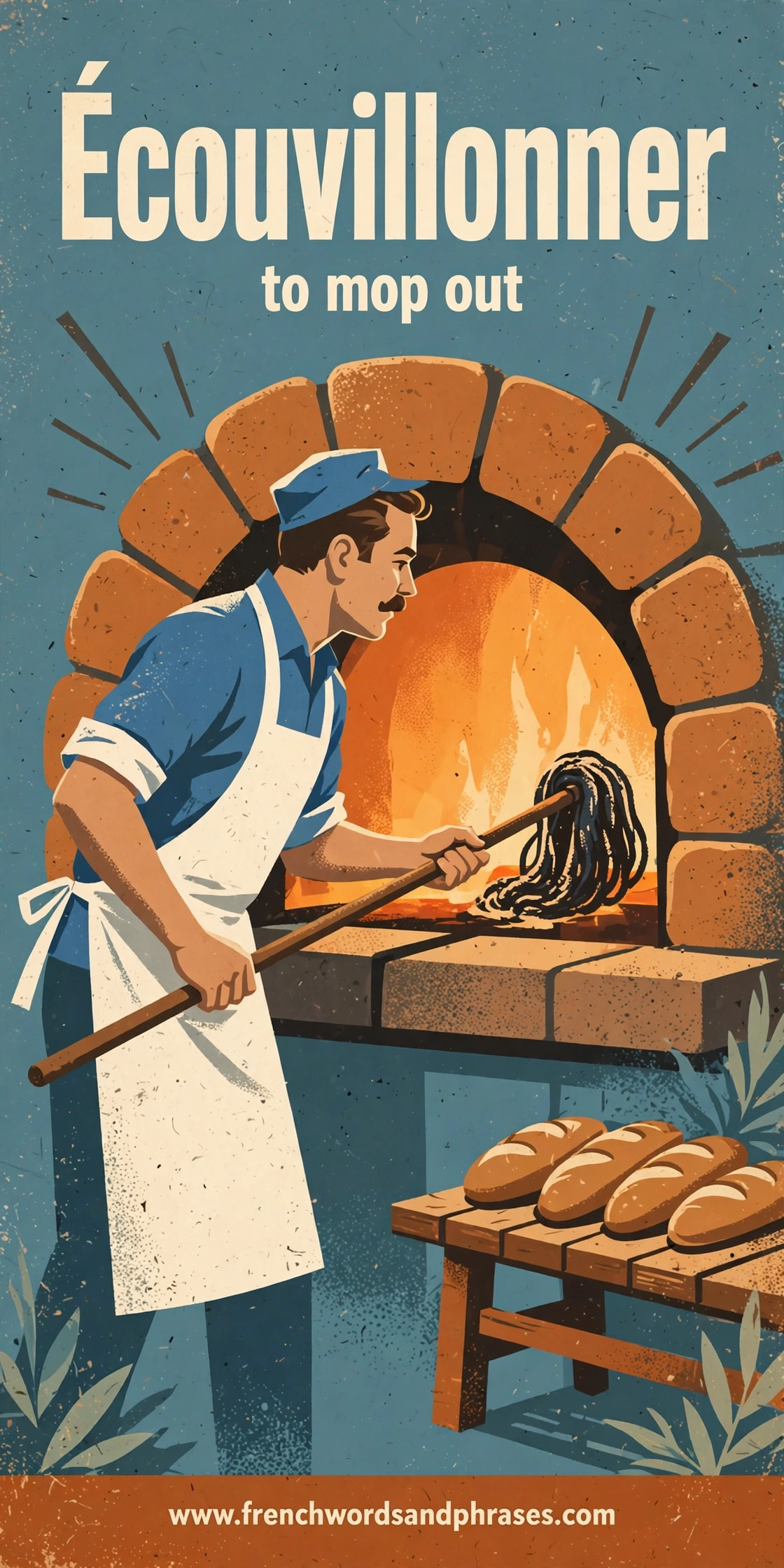
Écouvillonner means to mop out — to swab the inside of something with a brush.
A long brush twisted inside a bottle, a swab drawn through a rifle barrel, foam rising out of a barrel’s neck — écouvillonner is the verb of cleaning tubes and bottles from the inside, with the twisty brush French calls un écouvillon.
In this guide, you’ll learn how to conjugate écouvillonner in all the major French tenses and moods. Explore complete conjugation tables, French examples, English translations, and practice quizzes.
Understanding the French Verb Écouvillonner
Écouvillonner is a regular French verb belonging to the first group of verbs, those ending in -er.
It means to mop out. It is commonly used for swabbing out bottles and barrels in cellars and breweries, for cleaning the barrels of firearms, and in laboratories and medicine wherever a tube, a neck or a bore must be mopped out with a brush on a stem.
Verb classification: First group (-er)
Auxiliary verb: Avoir
Past participle: écouvillonné
Present participle: écouvillonnant
English equivalents: To swab out, to mop out with a brush; un écouvillon — a bottle brush, a swab (including the medical swab of test fame).
One important detail: écouvillonner is the verb of un écouvillon — a long, twisty brush or swab made for insides: bottles, barrels, chimneys of lamps, and the barrels of rifles and cannon, which soldiers écouvillonnaient after every shot. The word became unexpectedly famous in 2020, when l’écouvillon turned out to be the name of the long swab used for nose-and-throat tests — the same humble brush, promoted to the evening news.
Experience the Word
Écouvillonner is the verb of the inside job — no cloth on a finger reaches where the écouvillon goes.
Imagine a cooper’s cellar in Champagne. Rows of bottles stand neck-down in racks, and the cellar hand écouvillonne each one before filling — twist, rinse, shake — the brush dancing in and out like a chimney sweep in miniature.
The bottle has not just been washed. It has been mopped out — brushed clean on the inside, where it matters.
How to Conjugate Écouvillonner: Complete French Conjugation Guide
Let’s explore every major conjugation of écouvillonner, beginning with the indicative mood.
How to Conjugate Écouvillonner in the Indicative Mood
The indicative mood is used to express facts, observations, actions, and events.
How to Conjugate Écouvillonner in the Present Tense (Présent)
Used for actions happening now, habitual actions, and general truths.
| Subject | Conjugation |
|---|---|
| je | écouvillonne |
| tu | écouvillonnes |
| il / elle | écouvillonne |
| nous | écouvillonnons |
| vous | écouvillonnez |
| ils / elles | écouvillonnent |
Example
Le caviste écouvillonne les bouteilles avant le remplissage.
The cellarman swabs out the bottles before filling.
Quick Quiz 1
Complete the sentence:
Nous ______ les tonneaux de la cave.
Reveal the answer
écouvillonnons
Nous écouvillonnons les tonneaux de la cave.
We mop out the casks in the cellar.
How to Conjugate Écouvillonner in the Passé Composé
Used for completed actions in the past. Écouvillonner takes the auxiliary verb avoir.
| Subject | Conjugation |
|---|---|
| j’ | ai écouvillonné |
| tu | as écouvillonné |
| il / elle | a écouvillonné |
| nous | avons écouvillonné |
| vous | avez écouvillonné |
| ils / elles | ont écouvillonné |
Example
Le soldat a écouvillonné le canon de son fusil.
The soldier swabbed out the barrel of his rifle.
How to Conjugate Écouvillonner in the Imparfait (Imperfect Tense)
Used for habitual past actions, descriptions, and ongoing situations in the past.
| Subject | Conjugation |
|---|---|
| je | écouvillonnais |
| tu | écouvillonnais |
| il / elle | écouvillonnait |
| nous | écouvillonnions |
| vous | écouvillonniez |
| ils / elles | écouvillonnaient |
Example
Autrefois, on écouvillonnait les barriques à la main.
In the old days, people used to mop out the barrels by hand.
Quick Quiz 2
Choose the correct form:
He swabbed out the bottles.
Il ______ les bouteilles. (a écouvillonné / est écouvillonné)
Reveal the answer
a écouvillonné
Il a écouvillonné les bouteilles.
Écouvillonner takes avoir.
How to Conjugate Écouvillonner in the Plus-que-parfait
Used to describe an action that had already been completed before another past event.
| Subject | Conjugation |
|---|---|
| j’ | avais écouvillonné |
| tu | avais écouvillonné |
| il / elle | avait écouvillonné |
| nous | avions écouvillonné |
| vous | aviez écouvillonné |
| ils / elles | avaient écouvillonné |
Example
Ils avaient écouvillonné les bouteilles avant l’arrivée du vin nouveau.
They had swabbed out the bottles before the new wine arrived.
How to Conjugate Écouvillonner in the Passé Simple
Primarily used in formal writing, literature, and historical narratives. It is rarely used in everyday conversation.
| Subject | Conjugation |
|---|---|
| je | écouvillonnai |
| tu | écouvillonnas |
| il / elle | écouvillonna |
| nous | écouvillonnâmes |
| vous | écouvillonnâtes |
| ils / elles | écouvillonnèrent |
Example
L’artilleur écouvillonna la pièce après chaque coup.
The gunner swabbed out the cannon after every shot.
How to Conjugate Écouvillonner in the Passé Antérieur
A literary tense used to express an action completed immediately before another past action, generally in the passé simple.
| Subject | Conjugation |
|---|---|
| j’ | eus écouvillonné |
| tu | eus écouvillonné |
| il / elle | eut écouvillonné |
| nous | eûmes écouvillonné |
| vous | eûtes écouvillonné |
| ils / elles | eurent écouvillonné |
Example
Quand elle eut écouvillonné les flacons, elle les rangea sur l’étagère.
When she had mopped out the flasks, she put them away on the shelf.
How to Conjugate Écouvillonner in the Future Tense (Futur Simple)
Used to describe actions that will take place in the future.
| Subject | Conjugation |
|---|---|
| je | écouvillonnerai |
| tu | écouvillonneras |
| il / elle | écouvillonnera |
| nous | écouvillonnerons |
| vous | écouvillonnerez |
| ils / elles | écouvillonneront |
Example
Demain, nous écouvillonnerons les tonneaux de la cave.
Tomorrow, we will mop out the casks in the cellar.
How to Conjugate Écouvillonner in the Futur Antérieur (Future Perfect)
Used for an action that will have been completed before a particular point in the future.
| Subject | Conjugation |
|---|---|
| j’ | aurai écouvillonné |
| tu | auras écouvillonné |
| il / elle | aura écouvillonné |
| nous | aurons écouvillonné |
| vous | aurez écouvillonné |
| ils / elles | auront écouvillonné |
Example
À la fin du jour, il aura écouvillonné deux cents bouteilles.
By the end of the day, he will have swabbed out two hundred bottles.
How to Conjugate Écouvillonner in the Near Future (Futur Proche)
Used to describe something that is going to happen soon. Formed with aller + infinitive.
| Subject | Conjugation |
|---|---|
| je | vais écouvillonner |
| tu | vas écouvillonner |
| il / elle | va écouvillonner |
| nous | allons écouvillonner |
| vous | allez écouvillonner |
| ils / elles | vont écouvillonner |
Example
Je vais écouvillonner cette bouteille, elle sent le vinaigre.
I am going to swab out this bottle, it smells of vinegar.
How to Conjugate Écouvillonner in the Conditional Mood
The conditional mood expresses what would happen under certain circumstances. It is also frequently used to make polite requests or express wishes.
How to Conjugate Écouvillonner in the Present Conditional
| Subject | Conjugation |
|---|---|
| je | écouvillonnerais |
| tu | écouvillonnerais |
| il / elle | écouvillonnerait |
| nous | écouvillonnerions |
| vous | écouvillonneriez |
| ils / elles | écouvillonneraient |
Example
Avec une machine, on écouvillonnerait les bouteilles en quelques secondes.
With a machine, we would swab out the bottles in a few seconds.
How to Conjugate Écouvillonner in the Past Conditional
| Subject | Conjugation |
|---|---|
| j’ | aurais écouvillonné |
| tu | aurais écouvillonné |
| il / elle | aurait écouvillonné |
| nous | aurions écouvillonné |
| vous | auriez écouvillonné |
| ils / elles | auraient écouvillonné |
Example
Elle aurait écouvillonné les flacons si elle avait trouvé la brosse.
She would have mopped out the flasks if she had found the brush.
Écouvillonner in the Literary Past Conditional Form
This less common literary form uses the imperfect subjunctive of avoir.
| Subject | Conjugation |
|---|---|
| j’ | eusse écouvillonné |
| tu | eusses écouvillonné |
| il / elle | eût écouvillonné |
| nous | eussions écouvillonné |
| vous | eussiez écouvillonné |
| ils / elles | eussent écouvillonné |
Example
Le canonnier eût écouvillonné sa pièce avant l’aube.
The gunner would have swabbed out his cannon before dawn.
How to Conjugate Écouvillonner in the Subjunctive Mood
The subjunctive is used to express wishes, emotions, doubts, necessity, and uncertainty. It frequently follows expressions such as il faut que (it is necessary that) or bien que (although).
How to Conjugate Écouvillonner in the Present Subjunctive
| Subject | Conjugation |
|---|---|
| que je | écouvillonne |
| que tu | écouvillonnes |
| qu’il / qu’elle | écouvillonne |
| que nous | écouvillonnions |
| que vous | écouvillonniez |
| qu’ils / qu’elles | écouvillonnent |
Example
Il faut que tu écouvillonnes le canon après le tir.
You must swab out the barrel after firing.
Quick Quiz 3
Complete the sentence using the subjunctive:
Il faut que vous ______ les flacons.
Reveal the answer
écouvillonniez
Il faut que vous écouvillonniez les flacons.
You must mop out the flasks.
How to Conjugate Écouvillonner in the Imperfect Subjunctive
A literary tense, rarely encountered in modern spoken French.
| Subject | Conjugation |
|---|---|
| que je | écouvillonnasse |
| que tu | écouvillonnasses |
| qu’il / qu’elle | écouvillonnât |
| que nous | écouvillonnassions |
| que vous | écouvillonnassiez |
| qu’ils / qu’elles | écouvillonnassent |
Example
Le capitaine exigeait que l’on écouvillonnât les fusils chaque soir.
The captain demanded that the rifles be swabbed out every evening.
How to Conjugate Écouvillonner in the Pluperfect Subjunctive
A literary construction used to express an action completed before another past action.
| Subject | Conjugation |
|---|---|
| que j’ | eusse écouvillonné |
| que tu | eusses écouvillonné |
| qu’il / qu’elle | eût écouvillonné |
| que nous | eussions écouvillonné |
| que vous | eussiez écouvillonné |
| qu’ils / qu’elles | eussent écouvillonné |
Example
On vérifia qu’ils eussent écouvillonné toutes les bouteilles.
They checked that they had swabbed out all the bottles.
How to Conjugate Écouvillonner in the Past Subjunctive
| Subject | Conjugation |
|---|---|
| que j’ | aie écouvillonné |
| que tu | aies écouvillonné |
| qu’il / qu’elle | ait écouvillonné |
| que nous | ayons écouvillonné |
| que vous | ayez écouvillonné |
| qu’ils / qu’elles | aient écouvillonné |
Example
Je suis content que vous ayez écouvillonné les tonneaux.
I am glad you mopped out the casks.
How to Conjugate Écouvillonner in the Imperative
The imperative is used to give commands, instructions, invitations, or suggestions. Subject pronouns are omitted.
How to Conjugate Écouvillonner in the Present Imperative
| Person | Conjugation |
|---|---|
| (tu) | écouvillonne |
| (nous) | écouvillonnons |
| (vous) | écouvillonnez |
Example
Écouvillonne bien cette bouteille avant de la remplir !
Swab this bottle out well before filling it!
Quick Quiz 4
How would you say Swab this bottle out well (tu form)?
Reveal the answer
Écouvillonne bien cette bouteille !
French Participles of Écouvillonner
Participles are verb forms that can be used in compound tenses and other grammatical constructions.
Present Participle of Écouvillonner
écouvillonnant
En écouvillonnant le canon, le soldat chantonnait.
While swabbing out the barrel, the soldier hummed.
Past Participle of Écouvillonner
écouvillonné
Écouvillonnées avec soin, les bouteilles brillent au soleil.
Swabbed out with care, the bottles shine in the sun.
Écouvillonner in Everyday French: Real-Life Examples
Now that you know the conjugations, let’s see how écouvillonner appears in everyday French.
Example 1 — Present
On écouvillonne les bouteilles avant la mise en bouteille.
We swab out the bottles before bottling.
Example 2 — Passé composé
Il a écouvillonné le canon de son fusil après l’exercice.
He swabbed out his rifle barrel after the exercise.
Example 3 — Imparfait
Les brasseurs écouvillonnaient les fûts chaque semaine.
The brewers used to mop out the kegs every week.
Example 4 — Future
Nous écouvillonnerons les flacons demain matin.
We will mop out the flasks tomorrow morning.
Example 5 — Conditional
Tu écouvillonnerais cette bouteille pour moi ?
Would you swab out this bottle for me?
Example 6 — Imperative
Écouvillonnez les bouteilles avant de les remplir !
Swab out the bottles before filling them!
Beyond Translation: The Meaning of Écouvillonner
English needs a phrase — swab out, mop out, brush out; French écouvillonner names the tool and the action in a single word.
Un écouvillon is any brush built for insides.
Bottle brush, barrel swab, surgeon’s swab — once you know the noun, the verb follows it everywhere, from the Champagne cellar to the testing tent.
How to Remember the French Verb Écouvillonner
Remember it this way: Écouvillonner is about the inside job — bottles and barrels brushed clean from within.
- Un écouvillon — the long twisty brush or swab; écouvillonner is putting it to work.
- Bottles, barrels and gun barrels: if it is hollow, on l’écouvillonne.
- Regular -er: j’écouvillonne, nous écouvillonnons, past participle écouvillonné.
The key idea is the inside job — bottles and barrels brushed clean from within.
Test Your Knowledge of Écouvillonner
Let’s see how much you’ve learned. Try answering these questions before revealing the answers.
Question 1
What is un écouvillon?
Reveal the answer
A long brush or swab made for cleaning insides — bottles, barrels, bores — and the famous test swab.
Question 2
How do you say The cellarman swabs out the bottles in French?
Reveal the answer
Le caviste écouvillonne les bouteilles.
Question 3
Translate: The soldier swabbed out the barrel of his rifle.
Reveal the answer
Le soldat a écouvillonné le canon de son fusil.
Question 4
What is the past participle of écouvillonner?
Reveal the answer
Écouvillonné.
Question 5
Complete the sentence:
Il faut que tu ______ le canon après le tir.
Reveal the answer
écouvillonnes
Il faut que tu écouvillonnes le canon après le tir.
You must swab out the barrel after firing.
Your Final Challenge
Can You Use It?
How would you say this in French?
The cellarman swabs out every bottle, and the cellar smells of clean wine and cool stone.
Reveal the answer
Le caviste écouvillonne chaque bouteille, et la cave sent le vin propre et la pierre fraîche.
The cellarman swabs out every bottle, and the cellar smells of clean wine and cool stone.
A little French. A little curiosity. A richer everyday life.
LEARN FRENCH ONE WORD AT A TIME




