
A French Word to Live By
How to Conjugate Écorner in French
/e.kɔʁ.ne/
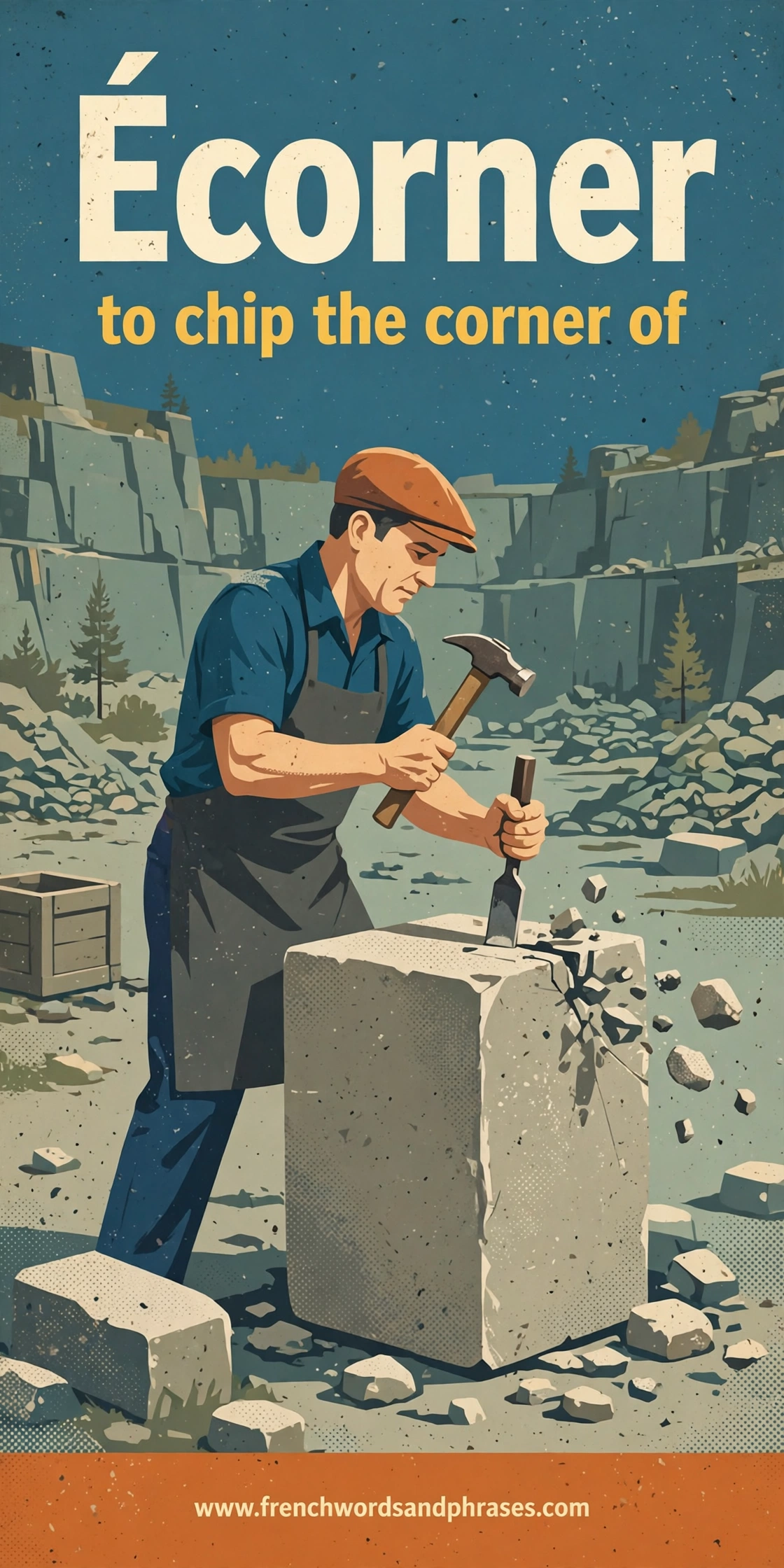
Écorner means to chip the corner of something — to knock a corner off.
A photograph with one corner bent white, a beloved book whose pages fold at the tips, a stone step with a bite taken out of it — écorner is the verb of damaged corners, and of the small dents we make in fortunes and savings.
In this guide, you’ll learn how to conjugate écorner in all the major French tenses and moods. Explore complete conjugation tables, French examples, English translations, and practice quizzes.
Understanding the French Verb Écorner
Écorner is a regular French verb belonging to the first group of verbs, those ending in -er.
It means to chip the corner of. It is commonly used for books, photographs, cards and furniture whose corners get knocked, folded or worn, for tiles and stone steps chipped at the edge, and figuratively for savings, budgets and fortunes that take a noticeable dent — a wedding, a repair, a tax bill that écornes the pile.
Verb classification: First group (-er)
Auxiliary verb: Avoir
Past participle: écorné
Present participle: écornant
English equivalents: To chip the corner of, to knock a corner off; (pages) écornées — dog-eared; écorner ses économies — to make a dent in one’s savings.
One important detail: écorner is built on un coin, a corner, with the removing prefix é- — the same é- as in écorcer. Its favourite territory is the book: des pages écornées are dog-eared pages, folded or worn at the corner, and librarians use écorner un livre for that small crime against a binding. From there the verb walks into money: écorner une fortune, écorner ses économies — to chip a corner off a fortune, to make a dent in one’s savings, spending that leaves the pile visibly smaller.
Experience the Word
Écorner is the verb of the small, visible loss — nothing is destroyed, but the corner is gone and everyone can see it.
Imagine a much-loved atlas in a school library. Fifty years of thumbs have folded its page corners — écornées, every one — and the librarian sighs: the book is intact, but its corners tell its whole history.
Nothing is ruined. It has been chipped at the corner — écorné, and worn with love.
How to Conjugate Écorner: Complete French Conjugation Guide
Let’s explore every major conjugation of écorner, beginning with the indicative mood.
How to Conjugate Écorner in the Indicative Mood
The indicative mood is used to express facts, observations, actions, and events.
How to Conjugate Écorner in the Present Tense (Présent)
Used for actions happening now, habitual actions, and general truths.
| Subject | Conjugation |
|---|---|
| je | écorne |
| tu | écornes |
| il / elle | écorne |
| nous | écornons |
| vous | écornez |
| ils / elles | écornent |
Example
Les enfants écornent les pages de ce vieil album.
The children are dog-earing the pages of this old album.
Quick Quiz 1
Complete the sentence:
Nous ______ le budget avec ce voyage.
Reveal the answer
écornons
Nous écornons le budget avec ce voyage.
We are denting the budget with this trip.
How to Conjugate Écorner in the Passé Composé
Used for completed actions in the past. Écorner takes the auxiliary verb avoir.
| Subject | Conjugation |
|---|---|
| j’ | ai écorné |
| tu | as écorné |
| il / elle | a écorné |
| nous | avons écorné |
| vous | avez écorné |
| ils / elles | ont écorné |
Example
La réparation a écorné toutes nos économies.
The repair made a dent in all our savings.
How to Conjugate Écorner in the Imparfait (Imperfect Tense)
Used for habitual past actions, descriptions, and ongoing situations in the past.
| Subject | Conjugation |
|---|---|
| je | écornais |
| tu | écornais |
| il / elle | écornait |
| nous | écornions |
| vous | écorniez |
| ils / elles | écornaient |
Example
Ce cartable écornéait tous les livres qu’on y glissait.
That satchel used to chip the corners of every book slipped into it.
Quick Quiz 2
Choose the correct form:
Taxes dented our savings.
Les impôts ______ nos économies. (ont écorné / sont écornés)
Reveal the answer
ont écorné
Les impôts ont écorné nos économies.
Écorner takes avoir.
How to Conjugate Écorner in the Plus-que-parfait
Used to describe an action that had already been completed before another past event.
| Subject | Conjugation |
|---|---|
| j’ | avais écorné |
| tu | avais écorné |
| il / elle | avait écorné |
| nous | avions écorné |
| vous | aviez écorné |
| ils / elles | avaient écorné |
Example
Ils avaient écorné leur capital avant même de commencer.
They had already made a dent in their capital before even starting.
How to Conjugate Écorner in the Passé Simple
Primarily used in formal writing, literature, and historical narratives. It is rarely used in everyday conversation.
| Subject | Conjugation |
|---|---|
| je | écornai |
| tu | écornas |
| il / elle | écorna |
| nous | écornâmes |
| vous | écornâtes |
| ils / elles | écornèrent |
Example
Le déménageur écorna le coin de la commode dans l’escalier.
The removal man chipped the corner of the dresser on the stairs.
How to Conjugate Écorner in the Passé Antérieur
A literary tense used to express an action completed immediately before another past action, generally in the passé simple.
| Subject | Conjugation |
|---|---|
| j’ | eus écorné |
| tu | eus écorné |
| il / elle | eut écorné |
| nous | eûmes écorné |
| vous | eûtes écorné |
| ils / elles | eurent écorné |
Example
Quand le choc eut écorné la marche, le maçon la répara.
When the blow had chipped the step, the mason repaired it.
How to Conjugate Écorner in the Future Tense (Futur Simple)
Used to describe actions that will take place in the future.
| Subject | Conjugation |
|---|---|
| je | écornerai |
| tu | écorneras |
| il / elle | écornera |
| nous | écornerons |
| vous | écornerez |
| ils / elles | écorneront |
Example
Ce voyage écornera sérieusement notre budget.
This trip will seriously dent our budget.
How to Conjugate Écorner in the Futur Antérieur (Future Perfect)
Used for an action that will have been completed before a particular point in the future.
| Subject | Conjugation |
|---|---|
| j’ | aurai écorné |
| tu | auras écorné |
| il / elle | aura écorné |
| nous | aurons écorné |
| vous | aurez écorné |
| ils / elles | auront écorné |
Example
À la fin des travaux, ils auront écorné la moitié de leur fortune.
By the end of the works, they will have chipped away half their fortune.
How to Conjugate Écorner in the Near Future (Futur Proche)
Used to describe something that is going to happen soon. Formed with aller + infinitive.
| Subject | Conjugation |
|---|---|
| je | vais écorner |
| tu | vas écorner |
| il / elle | va écorner |
| nous | allons écorner |
| vous | allez écorner |
| ils / elles | vont écorner |
Example
Attention, tu vas écorner la photo en la rangeant ainsi.
Careful, you are going to chip the corner of the photo putting it away like that.
How to Conjugate Écorner in the Conditional Mood
The conditional mood expresses what would happen under certain circumstances. It is also frequently used to make polite requests or express wishes.
How to Conjugate Écorner in the Present Conditional
| Subject | Conjugation |
|---|---|
| je | écornerais |
| tu | écornerais |
| il / elle | écornerait |
| nous | écornerions |
| vous | écorneriez |
| ils / elles | écorneraient |
Example
Un tel achat écornerait nos économies pour des mois.
Such a purchase would dent our savings for months.
How to Conjugate Écorner in the Past Conditional
| Subject | Conjugation |
|---|---|
| j’ | aurais écorné |
| tu | aurais écorné |
| il / elle | aurait écorné |
| nous | aurions écorné |
| vous | auriez écorné |
| ils / elles | auraient écorné |
Example
La tempête aurait écorné le toit sans ces tuiles neuves.
The storm would have chipped the roof without those new tiles.
Écorner in the Literary Past Conditional Form
This less common literary form uses the imperfect subjunctive of avoir.
| Subject | Conjugation |
|---|---|
| j’ | eusse écorné |
| tu | eusses écorné |
| il / elle | eût écorné |
| nous | eussions écorné |
| vous | eussiez écorné |
| ils / elles | eussent écorné |
Example
Le temps eût écorné les pierres du vieux château.
Time would have chipped the stones of the old castle.
How to Conjugate Écorner in the Subjunctive Mood
The subjunctive is used to express wishes, emotions, doubts, necessity, and uncertainty. It frequently follows expressions such as il faut que (it is necessary that) or bien que (although).
How to Conjugate Écorner in the Present Subjunctive
| Subject | Conjugation |
|---|---|
| que je | écorne |
| que tu | écornes |
| qu’il / qu’elle | écorne |
| que nous | écornions |
| que vous | écorniez |
| qu’ils / qu’elles | écornent |
Example
Je ne veux pas que tu écornes ce livre rare.
I do not want you to dog-ear this rare book.
Quick Quiz 3
Complete the sentence using the subjunctive:
Je ne veux pas que vous ______ ce livre.
Reveal the answer
écorniez
Je ne veux pas que vous écorniez ce livre.
I do not want you to dog-ear this book.
How to Conjugate Écorner in the Imperfect Subjunctive
A literary tense, rarely encountered in modern spoken French.
| Subject | Conjugation |
|---|---|
| que je | écornasse |
| que tu | écornasses |
| qu’il / qu’elle | écornât |
| que nous | écornassions |
| que vous | écornassiez |
| qu’ils / qu’elles | écornassent |
Example
Elle craignait que le cadre écornât la toile du maître.
She feared the frame might chip the master’s canvas.
How to Conjugate Écorner in the Pluperfect Subjunctive
A literary construction used to express an action completed before another past action.
| Subject | Conjugation |
|---|---|
| que j’ | eusse écorné |
| que tu | eusses écorné |
| qu’il / qu’elle | eût écorné |
| que nous | eussions écorné |
| que vous | eussiez écorné |
| qu’ils / qu’elles | eussent écorné |
Example
On regretta qu’ils eussent écorné leur héritage si vite.
People regretted that they had dented their inheritance so quickly.
How to Conjugate Écorner in the Past Subjunctive
| Subject | Conjugation |
|---|---|
| que j’ | aie écorné |
| que tu | aies écorné |
| qu’il / qu’elle | ait écorné |
| que nous | ayons écorné |
| que vous | ayez écorné |
| qu’ils / qu’elles | aient écorné |
Example
Je suis fâché que vous ayez écorné cette édition ancienne.
I am annoyed that you dog-eared this old edition.
How to Conjugate Écorner in the Imperative
The imperative is used to give commands, instructions, invitations, or suggestions. Subject pronouns are omitted.
How to Conjugate Écorner in the Present Imperative
| Person | Conjugation |
|---|---|
| (tu) | écorne |
| (nous) | écornons |
| (vous) | écornez |
Example
N’écorne pas les pages, utilise un marque-page !
Do not dog-ear the pages, use a bookmark!
Quick Quiz 4
How would you say Do not dog-ear the pages (tu form)?
Reveal the answer
N’écorne pas les pages !
French Participles of Écorner
Participles are verb forms that can be used in compound tenses and other grammatical constructions.
Present Participle of Écorner
écornant
En écornant le budget dès janvier, ils ont dû se serrer la ceinture.
By denting the budget in January, they had to tighten their belts.
Past Participle of Écorner
écorné
Écorné à tous les coins, le vieux livre restait précieux.
Chipped at every corner, the old book was still precious.
Écorner in Everyday French: Real-Life Examples
Now that you know the conjugations, let’s see how écorner appears in everyday French.
Example 1 — Present
Cette étagère écorne tous mes livres.
This shelf chips the corners of all my books.
Example 2 — Passé composé
Les impôts ont écorné nos économies cette année.
Taxes dented our savings this year.
Example 3 — Imparfait
Les élèves écornaient les pages de leurs manuels.
The pupils used to dog-ear their textbook pages.
Example 4 — Future
Ce mariage écornera le budget de la famille.
This wedding will dent the family’s budget.
Example 5 — Conditional
Tu écornerais la table en la traînant ainsi.
You would chip the table dragging it like that.
Example 6 — Imperative
N’écornez pas les cartes, elles sont fragiles !
Do not chip the cards, they are fragile!
Beyond Translation: The Meaning of Écorner
English needs chip, dent and dog-ear for what French does with one verb; écorner simply follows the corner wherever it suffers.
From book corners to bank accounts.
A chipped step, a dog-eared page, a fortune with a corner missing — écorner measures loss the French way: not total, not tragic, just visibly, permanently smaller.
How to Remember the French Verb Écorner
Remember it this way: Écorner is about the corner verb — chipped books, dented savings.
- Un coin — a corner; écorner is to knock or chip the corner off.
- Des pages écornées — dog-eared pages; écorner ses économies — to dent one’s savings.
- Regular -er: j’écorne, nous écornons, past participle écorné.
The key idea is the corner verb — chipped books, dented savings.
Test Your Knowledge of Écorner
Let’s see how much you’ve learned. Try answering these questions before revealing the answers.
Question 1
What are des pages écornées?
Reveal the answer
Dog-eared pages — pages folded or worn at the corner.
Question 2
How do you say The repair dented our savings in French?
Reveal the answer
La réparation a écorné nos économies.
Question 3
Translate: The children are dog-earing the pages of this old album.
Reveal the answer
Les enfants écornent les pages de ce vieil album.
Question 4
What is the past participle of écorner?
Reveal the answer
Écorné.
Question 5
Complete the sentence:
Je ne veux pas que tu ______ ce livre rare.
Reveal the answer
écornes
Je ne veux pas que tu écornes ce livre rare.
I do not want you to dog-ear this rare book.
Your Final Challenge
Can You Use It?
How would you say this in French?
Time chips the pages of the old atlas, but the maps remain beautiful.
Reveal the answer
Le temps écorne les pages du vieil atlas, mais les cartes restent belles.
Time chips the pages of the old atlas, but the maps remain beautiful.
A little French. A little curiosity. A richer everyday life.
LEARN FRENCH ONE WORD AT A TIME




