
A French Word to Live By
How to Conjugate Écorcer in French
/e.kɔʁ.se/
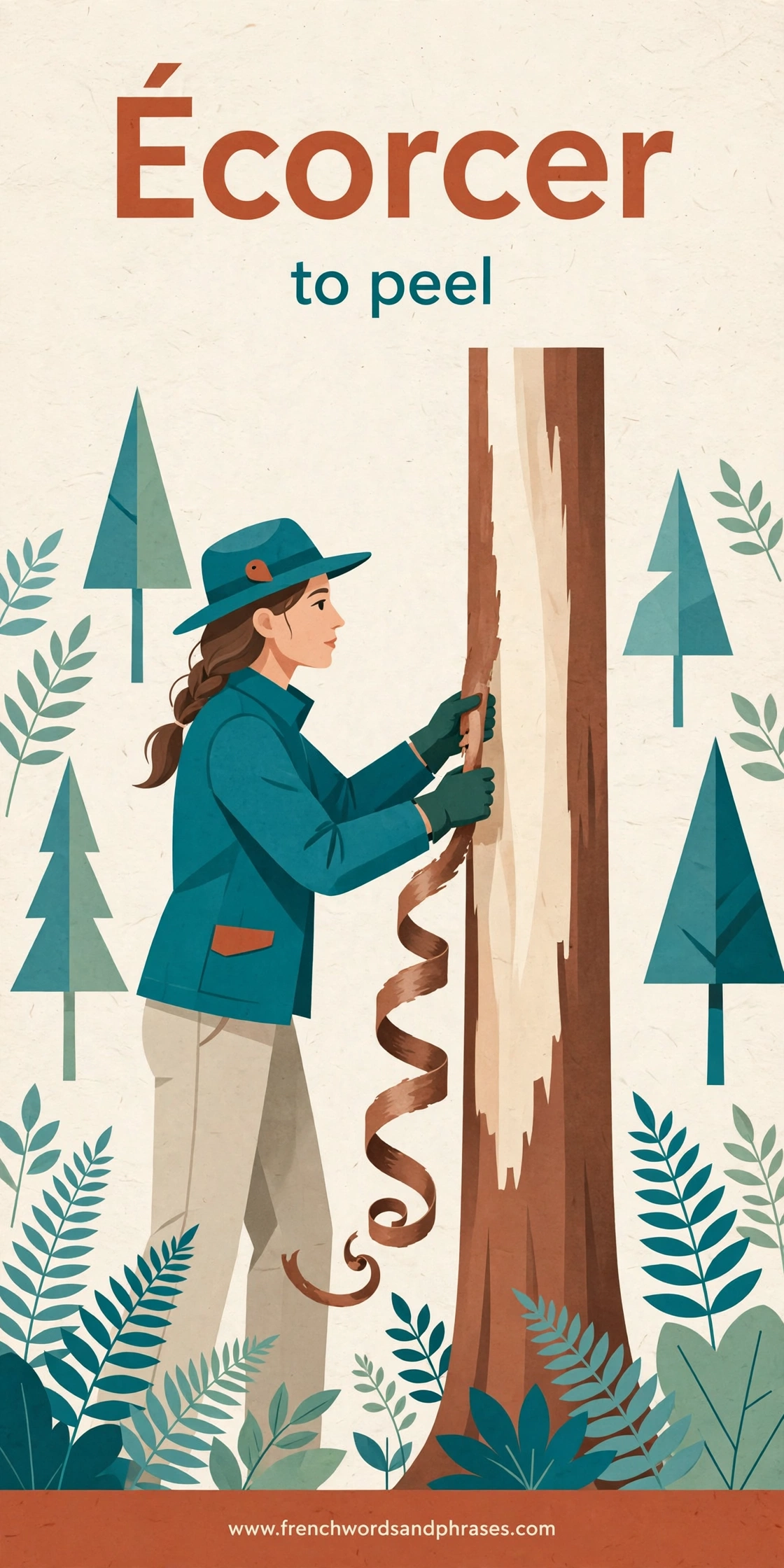
Écorcer means to peel — to strip the bark or rind off something.
A forester’s knife sliding under oak bark, the thick rind coming away from a cheese, an orange stripped in one long spiral — écorcer is the verb of taking the outer skin off trees, fruit and rind, cleanly and in pieces.
In this guide, you’ll learn how to conjugate écorcer in all the major French tenses and moods. Explore complete conjugation tables, French examples, English translations, and practice quizzes.
Understanding the French Verb Écorcer
Écorcer is a regular French verb belonging to the first group of verbs, those ending in -er.
It means to peel. It is commonly used in forestry for stripping bark from oak and cork trees (écorcer un chêne-liège), in the kitchen for peeling thick-skinned fruit and vegetables, and in cheese-making for the rind that comes away — anywhere an outer layer is deliberately taken off.
Verb classification: First group (-er)
Auxiliary verb: Avoir
Past participle: écorcé
Present participle: écorçant
English equivalents: To peel, to bark (a tree), to strip the rind; une écorce — bark, rind, peel, crust.
One important detail: écorcer is a -cer verb, so the c softens to ç before a and o: nous écorçons, j’écorçais, en écorçant — but j’écorce and vous écorcez keep the plain c. The noun is the treasure here: une écorce is bark on a tree, rind on a cheese or an orange (écorce d’orange), and even the crust of the earth itself — l’écorce terrestre. To écorcer is simply to remove that écorce.
Experience the Word
Écorcer is the verb of the outer layer — the tree, the fruit and the cheese all wear an écorce, and this verb takes it off.
Imagine a cork oak in Provence in high summer. The harvester scores the trunk with practised cuts and eases the thick bark away in great curved sheets, and the tree stands red-brown and bare, already growing its next coat.
The tree has not been harmed. It has been peeled — écorcé, its bark lifted away in sheets.
How to Conjugate Écorcer: Complete French Conjugation Guide
Let’s explore every major conjugation of écorcer, beginning with the indicative mood.
How to Conjugate Écorcer in the Indicative Mood
The indicative mood is used to express facts, observations, actions, and events.
How to Conjugate Écorcer in the Present Tense (Présent)
Used for actions happening now, habitual actions, and general truths.
| Subject | Conjugation |
|---|---|
| je | écorce |
| tu | écorces |
| il / elle | écorce |
| nous | écorçons |
| vous | écorcez |
| ils / elles | écorcent |
Example
Le bûcheron écorce les troncs avant de les scier.
The woodcutter peels the trunks before sawing them.
Quick Quiz 1
Complete the sentence:
Nous ______ les troncs avant l’hiver.
Reveal the answer
écorçons
Nous écorçons les troncs avant l’hiver.
We peel the trunks before winter.
How to Conjugate Écorcer in the Passé Composé
Used for completed actions in the past. Écorcer takes the auxiliary verb avoir.
| Subject | Conjugation |
|---|---|
| j’ | ai écorcé |
| tu | as écorcé |
| il / elle | a écorcé |
| nous | avons écorcé |
| vous | avez écorcé |
| ils / elles | ont écorcé |
Example
Nous avons écorcé les chênes-lièges en juillet.
We stripped the cork oaks in July.
How to Conjugate Écorcer in the Imparfait (Imperfect Tense)
Used for habitual past actions, descriptions, and ongoing situations in the past.
| Subject | Conjugation |
|---|---|
| je | écorçais |
| tu | écorçais |
| il / elle | écorçait |
| nous | écorcions |
| vous | écorciez |
| ils / elles | écorçaient |
Example
Autrefois, on écorçait les arbres à la main, au printemps.
In the old days, people used to peel the trees by hand, in spring.
Quick Quiz 2
Choose the correct form:
She peeled two oranges.
Elle ______ deux oranges. (a écorcé / est écorcée)
Reveal the answer
a écorcé
Elle a écorcé deux oranges.
Écorcer takes avoir.
How to Conjugate Écorcer in the Plus-que-parfait
Used to describe an action that had already been completed before another past event.
| Subject | Conjugation |
|---|---|
| j’ | avais écorcé |
| tu | avais écorcé |
| il / elle | avait écorcé |
| nous | avions écorcé |
| vous | aviez écorcé |
| ils / elles | avaient écorcé |
Example
Ils avaient écorcé tout le bois avant l’hiver.
They had peeled all the wood before winter.
How to Conjugate Écorcer in the Passé Simple
Primarily used in formal writing, literature, and historical narratives. It is rarely used in everyday conversation.
| Subject | Conjugation |
|---|---|
| je | écorçai |
| tu | écorças |
| il / elle | écorça |
| nous | écorçâmes |
| vous | écorçâtes |
| ils / elles | écorçèrent |
Example
Le forestier écorça le tronc en quelques minutes.
The forester peeled the trunk in a few minutes.
How to Conjugate Écorcer in the Passé Antérieur
A literary tense used to express an action completed immediately before another past action, generally in the passé simple.
| Subject | Conjugation |
|---|---|
| j’ | eus écorcé |
| tu | eus écorcé |
| il / elle | eut écorcé |
| nous | eûmes écorcé |
| vous | eûtes écorcé |
| ils / elles | eurent écorcé |
Example
Quand il eut écorcé la bille, il la marqua au fer.
When he had peeled the log, he marked it with the iron.
How to Conjugate Écorcer in the Future Tense (Futur Simple)
Used to describe actions that will take place in the future.
| Subject | Conjugation |
|---|---|
| je | écorcerai |
| tu | écorceras |
| il / elle | écorcera |
| nous | écorcerons |
| vous | écorcerez |
| ils / elles | écorceront |
Example
Demain, nous écorcerons les oranges pour la confiture.
Tomorrow, we will peel the oranges for the jam.
How to Conjugate Écorcer in the Futur Antérieur (Future Perfect)
Used for an action that will have been completed before a particular point in the future.
| Subject | Conjugation |
|---|---|
| j’ | aurai écorcé |
| tu | auras écorcé |
| il / elle | aura écorcé |
| nous | aurons écorcé |
| vous | aurez écorcé |
| ils / elles | auront écorcé |
Example
À la fin du mois, l’équipe aura écorcé deux cents troncs.
By the end of the month, the team will have peeled two hundred trunks.
How to Conjugate Écorcer in the Near Future (Futur Proche)
Used to describe something that is going to happen soon. Formed with aller + infinitive.
| Subject | Conjugation |
|---|---|
| je | vais écorcer |
| tu | vas écorcer |
| il / elle | va écorcer |
| nous | allons écorcer |
| vous | allez écorcer |
| ils / elles | vont écorcer |
Example
Je vais écorcer ce fromage, la croûte est trop dure.
I am going to peel this cheese, the rind is too hard.
How to Conjugate Écorcer in the Conditional Mood
The conditional mood expresses what would happen under certain circumstances. It is also frequently used to make polite requests or express wishes.
How to Conjugate Écorcer in the Present Conditional
| Subject | Conjugation |
|---|---|
| je | écorcerais |
| tu | écorcerais |
| il / elle | écorcerait |
| nous | écorcerions |
| vous | écorceriez |
| ils / elles | écorceraient |
Example
Avec un meilleur outil, on écorcerait sans abîmer le bois.
With a better tool, we would peel without damaging the wood.
How to Conjugate Écorcer in the Past Conditional
| Subject | Conjugation |
|---|---|
| j’ | aurais écorcé |
| tu | aurais écorcé |
| il / elle | aurait écorcé |
| nous | aurions écorcé |
| vous | auriez écorcé |
| ils / elles | auraient écorcé |
Example
Elle aurait écorcé les citrons si le couteau avait été aiguisé.
She would have peeled the lemons if the knife had been sharp.
Écorcer in the Literary Past Conditional Form
This less common literary form uses the imperfect subjunctive of avoir.
| Subject | Conjugation |
|---|---|
| j’ | eusse écorcé |
| tu | eusses écorcé |
| il / elle | eût écorcé |
| nous | eussions écorcé |
| vous | eussiez écorcé |
| ils / elles | eussent écorcé |
Example
Le bûcheron eût écorcé le vieux chêne avant l’orage.
The woodcutter would have peeled the old oak before the storm.
How to Conjugate Écorcer in the Subjunctive Mood
The subjunctive is used to express wishes, emotions, doubts, necessity, and uncertainty. It frequently follows expressions such as il faut que (it is necessary that) or bien que (although).
How to Conjugate Écorcer in the Present Subjunctive
| Subject | Conjugation |
|---|---|
| que je | écorce |
| que tu | écorces |
| qu’il / qu’elle | écorce |
| que nous | écorcions |
| que vous | écorciez |
| qu’ils / qu’elles | écorcent |
Example
Il faut que vous écorciez les troncs avant le transport.
You must peel the trunks before transport.
Quick Quiz 3
Complete the sentence using the subjunctive:
Il faut que tu ______ ce tronc doucement.
Reveal the answer
écorces
Il faut que tu écorces ce tronc doucement.
You must peel this trunk gently.
How to Conjugate Écorcer in the Imperfect Subjunctive
A literary tense, rarely encountered in modern spoken French.
| Subject | Conjugation |
|---|---|
| que je | écorcasse |
| que tu | écorcasses |
| qu’il / qu’elle | écorcât |
| que nous | écorcassions |
| que vous | écorcassiez |
| qu’ils / qu’elles | écorcassent |
Example
Le maître voulait que l’apprenti écorçât sans entailler le bois.
The master wanted the apprentice to peel without nicking the wood.
How to Conjugate Écorcer in the Pluperfect Subjunctive
A literary construction used to express an action completed before another past action.
| Subject | Conjugation |
|---|---|
| que j’ | eusse écorcé |
| que tu | eusses écorcé |
| qu’il / qu’elle | eût écorcé |
| que nous | eussions écorcé |
| que vous | eussiez écorcé |
| qu’ils / qu’elles | eussent écorcé |
Example
On vérifia qu’ils eussent écorcé les billes correctement.
They checked that they had peeled the logs properly.
How to Conjugate Écorcer in the Past Subjunctive
| Subject | Conjugation |
|---|---|
| que j’ | aie écorcé |
| que tu | aies écorcé |
| qu’il / qu’elle | ait écorcé |
| que nous | ayons écorcé |
| que vous | ayez écorcé |
| qu’ils / qu’elles | aient écorcé |
Example
Je suis content que vous ayez écorcé les chênes à temps.
I am glad you stripped the oaks in time.
How to Conjugate Écorcer in the Imperative
The imperative is used to give commands, instructions, invitations, or suggestions. Subject pronouns are omitted.
How to Conjugate Écorcer in the Present Imperative
| Person | Conjugation |
|---|---|
| (tu) | écorce |
| (nous) | écorçons |
| (vous) | écorcez |
Example
Écorce ce tronc doucement, sans blesser l’arbre !
Peel this trunk gently, without wounding the tree!
Quick Quiz 4
How would you say Peel this cheese (tu form)?
Reveal the answer
Écorce ce fromage !
French Participles of Écorcer
Participles are verb forms that can be used in compound tenses and other grammatical constructions.
Present Participle of Écorcer
écorçant
En écorçant le liège, il chantait des chansons anciennes.
While peeling the cork, he sang old songs.
Past Participle of Écorcer
écorcé
Écorcé au printemps, le tronc sèche plus vite.
Peeled in spring, the trunk dries faster.
Écorcer in Everyday French: Real-Life Examples
Now that you know the conjugations, let’s see how écorcer appears in everyday French.
Example 1 — Present
On écorce les chênes-lièges tous les neuf ans.
The cork oaks are stripped every nine years.
Example 2 — Passé composé
Elle a écorcé deux oranges pour le dessert.
She peeled two oranges for dessert.
Example 3 — Imparfait
Les ouvriers écorçaient le bois dès l’aube.
The workers used to peel the wood from dawn.
Example 4 — Future
Nous écorcerons les troncs demain matin.
We will peel the trunks tomorrow morning.
Example 5 — Conditional
Tu écorcerais ce fromage pour moi ?
Would you peel this cheese for me?
Example 6 — Imperative
Écorcez les citrons en gardant la peau entière !
Peel the lemons keeping the skin in one piece!
Beyond Translation: The Meaning of Écorcer
English splits this work between peel, bark and strip; French écorcer follows the noun écorce wherever it goes.
One word for every outer skin.
Bark, rind, peel, the crust of the earth — take any of them off, and you have écorcé. The verb is the noun, in action.
How to Remember the French Verb Écorcer
Remember it this way: Écorcer is about the bark-and-rind verb — taking the outer skin off.
- Une écorce — bark, rind, peel, crust; écorcer is to take the écorce off.
- The c becomes ç before a and o: nous écorçons, en écorçant.
- Regular -er: j’écorce, nous écorçons, past participle écorcé.
The key idea is the bark-and-rind verb — taking the outer skin off.
Test Your Knowledge of Écorcer
Let’s see how much you’ve learned. Try answering these questions before revealing the answers.
Question 1
What is une écorce?
Reveal the answer
Bark, rind or peel — the outer layer that écorcer removes.
Question 2
How do you say We stripped the cork oaks in July in French?
Reveal the answer
Nous avons écorcé les chênes-lièges en juillet.
Question 3
Translate: The woodcutter peels the trunks before sawing them.
Reveal the answer
Le bûcheron écorce les troncs avant de les scier.
Question 4
What is the past participle of écorcer?
Reveal the answer
Écorcé.
Question 5
Complete the sentence:
Il faut que vous ______ les troncs avant le transport.
Reveal the answer
écorciez
Il faut que vous écorciez les troncs avant le transport.
You must peel the trunks before transport.
Your Final Challenge
Can You Use It?
How would you say this in French?
The woodcutter peels the cork oak, and the forest keeps its summer scent.
Reveal the answer
Le bûcheron écorce le chêne-liège, et la forêt garde son parfum d’été.
The woodcutter peels the cork oak, and the forest keeps its summer scent.
A little French. A little curiosity. A richer everyday life.
LEARN FRENCH ONE WORD AT A TIME




