A French Word to Live By
How to Conjugate Éclater in French
/e.kla.te/
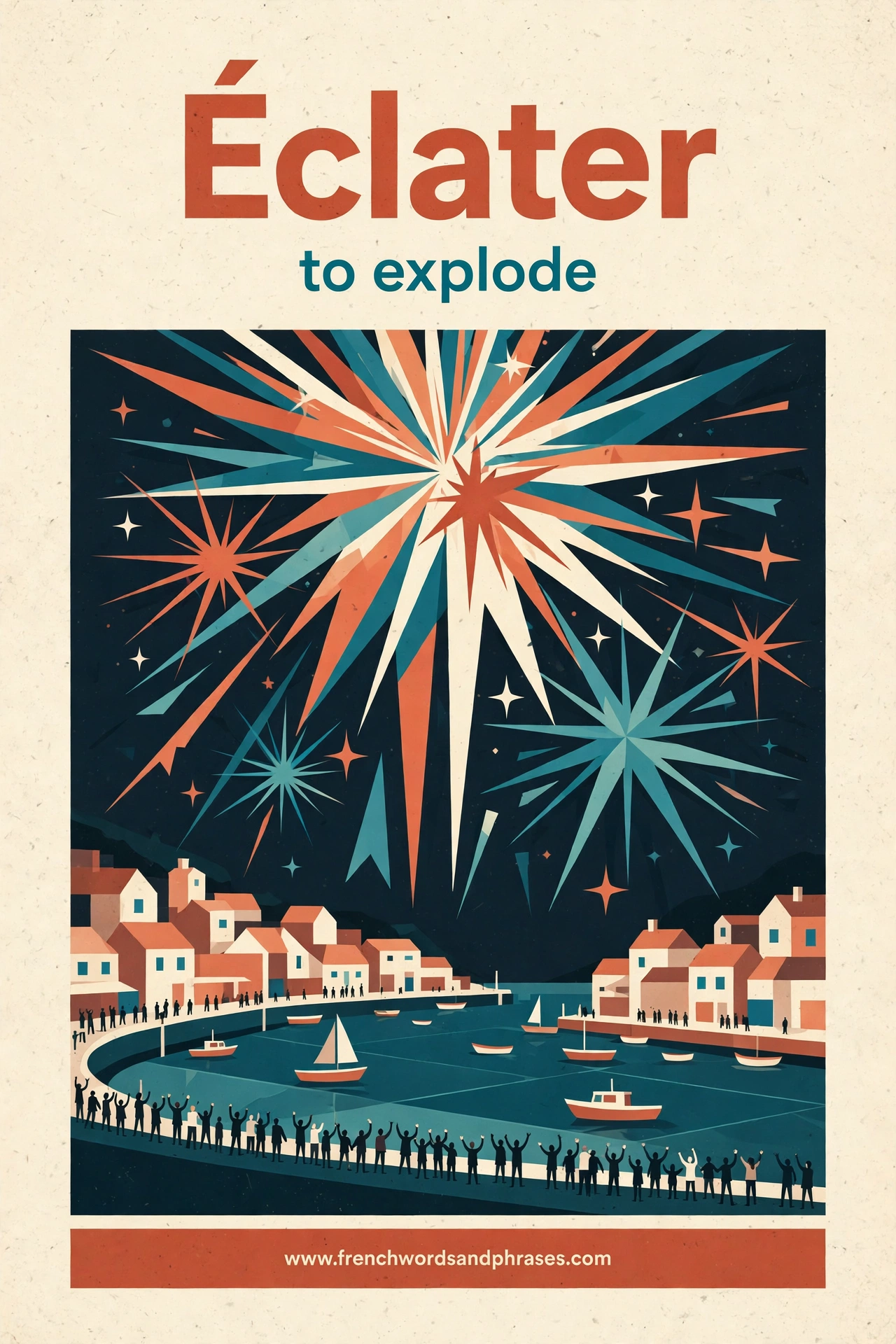
Éclater means to explode.
A tyre on the motorway, a champagne cork, a secret that cannot be kept one second longer — éclater is the verb of sudden bursting, of pressure that wins in the end.
In this guide, you’ll learn how to conjugate éclater in all the major French tenses and moods. Explore complete conjugation tables, French examples, English translations, and practice quizzes.
Understanding the French Verb Éclater
Éclater is a regular French verb belonging to the first group of verbs, those ending in -er.
It means to explode. It is commonly used for bombs, balloons and tyres bursting, for storms, wars and scandals breaking out, for laughter that cannot be held back, and in the reflexive, in familiar speech, for having the time of your life.
Verb classification: First group (-er)
Auxiliary verb: Avoir
Past participle: éclaté
Present participle: éclatant
English equivalents: To explode, to burst, to break out; s’éclater — (familiar) to have a fantastic time; un éclat — a burst, a splinter, a blaze.
One important detail: éclater covers far more than bombs. Éclater de rire is to burst out laughing; la guerre éclate, war breaks out; un pneu éclate, a tyre bursts; la vérité éclate, the truth finally comes out. And in familiar French the reflexive turns the explosion into pure joy: s’éclater is to have an amazing time — les enfants se sont éclatés au parc. The noun un éclat is a splinter, a burst (un éclat de rire) or a blaze of light.
Experience the Word
Éclater is the verb of the held breath released — whatever was pressing inside finally comes out, all at once.
Imagine a wedding speech going wrong. The best man reaches the forbidden story, the groom turns red, the whole table holds its breath — and then, at the worst possible line, everyone éclate de rire, and the disaster becomes the legend of the day.
Nothing was planned or polite. It burst out — éclaté — laughter first, and the tension with it.
How to Conjugate Éclater: Complete French Conjugation Guide
Let’s explore every major conjugation of éclater, beginning with the indicative mood.
How to Conjugate Éclater in the Indicative Mood
The indicative mood is used to express facts, observations, actions, and events.
How to Conjugate Éclater in the Present Tense (Présent)
Used for actions happening now, habitual actions, and general truths.
| Subject | Conjugation |
|---|---|
| je | éclate |
| tu | éclates |
| il / elle | éclate |
| nous | éclatons |
| vous | éclatez |
| ils / elles | éclatent |
Example
Les bulles éclatent à la surface de l’eau.
The bubbles burst on the surface of the water.
Quick Quiz 1
Complete the sentence:
Nous ______ de rire à son histoire.
Reveal the answer
éclatons
Nous éclatons de rire à son histoire.
We burst out laughing at his story.
How to Conjugate Éclater in the Passé Composé
Used for completed actions in the past. Éclater takes the auxiliary verb avoir.
| Subject | Conjugation |
|---|---|
| j’ | ai éclaté |
| tu | as éclaté |
| il / elle | a éclaté |
| nous | avons éclaté |
| vous | avez éclaté |
| ils / elles | ont éclaté |
Example
Le pneu a éclaté sur l’autoroute.
The tyre burst on the motorway.
How to Conjugate Éclater in the Imparfait (Imperfect Tense)
Used for habitual past actions, descriptions, and ongoing situations in the past.
| Subject | Conjugation |
|---|---|
| je | éclatais |
| tu | éclatais |
| il / elle | éclatait |
| nous | éclations |
| vous | éclatiez |
| ils / elles | éclataient |
Example
Chaque été, les orages éclataient en fin de journée.
Every summer, storms used to break out at the end of the day.
Quick Quiz 2
Choose the correct form:
The balloon burst.
Le ballon ______. (a éclaté / est éclaté)
Reveal the answer
a éclaté
Le ballon a éclaté.
Éclater takes avoir.
How to Conjugate Éclater in the Plus-que-parfait
Used to describe an action that had already been completed before another past event.
| Subject | Conjugation |
|---|---|
| j’ | avais éclaté |
| tu | avais éclaté |
| il / elle | avait éclaté |
| nous | avions éclaté |
| vous | aviez éclaté |
| ils / elles | avaient éclaté |
Example
La bombe avait éclaté avant l’arrivée des secours.
The bomb had exploded before help arrived.
How to Conjugate Éclater in the Passé Simple
Primarily used in formal writing, literature, and historical narratives. It is rarely used in everyday conversation.
| Subject | Conjugation |
|---|---|
| je | éclatai |
| tu | éclatas |
| il / elle | éclata |
| nous | éclatâmes |
| vous | éclatâtes |
| ils / elles | éclatèrent |
Example
Soudain, la tempête éclata sur la côte.
Suddenly, the storm broke over the coast.
How to Conjugate Éclater in the Passé Antérieur
A literary tense used to express an action completed immediately before another past action, generally in the passé simple.
| Subject | Conjugation |
|---|---|
| j’ | eus éclaté |
| tu | eus éclaté |
| il / elle | eut éclaté |
| nous | eûmes éclaté |
| vous | eûtes éclaté |
| ils / elles | eurent éclaté |
Example
Quand le tonnerre eut éclaté, les enfants coururent à la maison.
When the thunder had cracked, the children ran home.
How to Conjugate Éclater in the Future Tense (Futur Simple)
Used to describe actions that will take place in the future.
| Subject | Conjugation |
|---|---|
| je | éclaterai |
| tu | éclateras |
| il / elle | éclatera |
| nous | éclaterons |
| vous | éclaterez |
| ils / elles | éclateront |
Example
Si tu gonfles trop ce ballon, il éclatera.
If you blow up that balloon too much, it will burst.
How to Conjugate Éclater in the Futur Antérieur (Future Perfect)
Used for an action that will have been completed before a particular point in the future.
| Subject | Conjugation |
|---|---|
| j’ | aurai éclaté |
| tu | auras éclaté |
| il / elle | aura éclaté |
| nous | aurons éclaté |
| vous | aurez éclaté |
| ils / elles | auront éclaté |
Example
À la fin du spectacle, les feux d’artifice auront éclaté dans le ciel.
By the end of the show, the fireworks will have burst in the sky.
How to Conjugate Éclater in the Near Future (Futur Proche)
Used to describe something that is going to happen soon. Formed with aller + infinitive.
| Subject | Conjugation |
|---|---|
| je | vais éclater |
| tu | vas éclater |
| il / elle | va éclater |
| nous | allons éclater |
| vous | allez éclater |
| ils / elles | vont éclater |
Example
Regarde ce nuage, l’orage va éclater.
Look at that cloud, the storm is going to break.
How to Conjugate Éclater in the Conditional Mood
The conditional mood expresses what would happen under certain circumstances. It is also frequently used to make polite requests or express wishes.
How to Conjugate Éclater in the Present Conditional
| Subject | Conjugation |
|---|---|
| je | éclaterais |
| tu | éclaterais |
| il / elle | éclaterait |
| nous | éclaterions |
| vous | éclateriez |
| ils / elles | éclateraient |
Example
Sans la soupape, la chaudière éclaterait.
Without the valve, the boiler would burst.
How to Conjugate Éclater in the Past Conditional
| Subject | Conjugation |
|---|---|
| j’ | aurais éclaté |
| tu | aurais éclaté |
| il / elle | aurait éclaté |
| nous | aurions éclaté |
| vous | auriez éclaté |
| ils / elles | auraient éclaté |
Example
Le ballon aurait éclaté si tu avais continué à souffler.
The balloon would have burst if you had kept blowing.
Éclater in the Literary Past Conditional Form
This less common literary form uses the imperfect subjunctive of avoir.
| Subject | Conjugation |
|---|---|
| j’ | eusse éclaté |
| tu | eusses éclaté |
| il / elle | eût éclaté |
| nous | eussions éclaté |
| vous | eussiez éclaté |
| ils / elles | eussent éclaté |
Example
La révolte eût éclaté sans les promesses du roi.
The revolt would have broken out without the king’s promises.
How to Conjugate Éclater in the Subjunctive Mood
The subjunctive is used to express wishes, emotions, doubts, necessity, and uncertainty. It frequently follows expressions such as il faut que (it is necessary that) or bien que (although).
How to Conjugate Éclater in the Present Subjunctive
| Subject | Conjugation |
|---|---|
| que je | éclate |
| que tu | éclates |
| qu’il / qu’elle | éclate |
| que nous | éclations |
| que vous | éclatiez |
| qu’ils / qu’elles | éclatent |
Example
Je crains que le tuyau éclate cet hiver.
I fear the pipe may burst this winter.
Quick Quiz 3
Complete the sentence using the subjunctive:
Il ne faut pas que le scandale ______ avant les élections.
Reveal the answer
éclate
Il ne faut pas que le scandale éclate avant les élections.
The scandal must not break before the elections.
How to Conjugate Éclater in the Imperfect Subjunctive
A literary tense, rarely encountered in modern spoken French.
| Subject | Conjugation |
|---|---|
| que je | éclatasse |
| que tu | éclatasses |
| qu’il / qu’elle | éclatât |
| que nous | éclatassions |
| que vous | éclatassiez |
| qu’ils / qu’elles | éclatassent |
Example
On redoutait que la guerre éclatât.
People feared war might break out.
How to Conjugate Éclater in the Pluperfect Subjunctive
A literary construction used to express an action completed before another past action.
| Subject | Conjugation |
|---|---|
| que j’ | eusse éclaté |
| que tu | eusses éclaté |
| qu’il / qu’elle | eût éclaté |
| que nous | eussions éclaté |
| que vous | eussiez éclaté |
| qu’ils / qu’elles | eussent éclaté |
Example
Le rapport dit qu’une bombe eût éclaté près de la gare.
The report says a bomb had exploded near the station.
How to Conjugate Éclater in the Past Subjunctive
| Subject | Conjugation |
|---|---|
| que j’ | aie éclaté |
| que tu | aies éclaté |
| qu’il / qu’elle | ait éclaté |
| que nous | ayons éclaté |
| que vous | ayez éclaté |
| qu’ils / qu’elles | aient éclaté |
Example
Je suis content que la vérité ait enfin éclaté.
I am glad the truth has finally come out.
How to Conjugate Éclater in the Imperative
The imperative is used to give commands, instructions, invitations, or suggestions. Subject pronouns are omitted.
How to Conjugate Éclater in the Present Imperative
| Person | Conjugation |
|---|---|
| (tu) | éclate |
| (nous) | éclatons |
| (vous) | éclatez |
Example
N’éclate pas de rire pendant la cérémonie !
Do not burst out laughing during the ceremony!
Quick Quiz 4
How would you say Have a great time (tu form, familiar)?
Reveal the answer
Éclate-toi bien !
French Participles of Éclater
Participles are verb forms that can be used in compound tenses and other grammatical constructions.
Present Participle of Éclater
éclatant
En éclatant, le pétard a fait sursauter tout le monde.
By exploding, the firecracker made everyone jump.
Past Participle of Éclater
éclaté
Éclaté en mille morceaux, le vase était irrécupérable.
Burst into a thousand pieces, the vase was beyond repair.
Éclater in Everyday French: Real-Life Examples
Now that you know the conjugations, let’s see how éclater appears in everyday French.
Example 1 — Present
Il éclate de rire à chaque blague.
He bursts out laughing at every joke.
Example 2 — Passé composé
Les enfants se sont éclatés à la fête.
The children had a fantastic time at the party.
Example 3 — Imparfait
Les orages éclataient souvent le soir.
Storms often used to break out in the evening.
Example 4 — Future
La vérité éclatera un jour ou l’autre.
The truth will come out one day or another.
Example 5 — Conditional
Ce ballon éclaterait si on le gonflait trop.
That balloon would burst if it were blown up too much.
Example 6 — Imperative
Éclate-toi bien à la fête !
Have a great time at the party!
Beyond Translation: The Meaning of Éclater
English needs explode, burst and break out for what French does with one verb; éclater keeps a single violent little image — a thing flying into éclats, splinters — and applies it to wars, storms, laughter and truth.
Then slang turns it inside out.
S’éclater is to explode with fun: the same bursting, but the pressure released is joy. Few verbs travel so far from the bomb to the birthday party.
How to Remember the French Verb Éclater
Remember it this way: Éclater is about the sudden burst — tyres, storms, laughter and truth.
- Éclater de rire — to burst out laughing; la guerre éclate — war breaks out.
- S’éclater (familiar) — to have an amazing time: on s’est éclatés !
- Regular -er: j’éclate, nous éclatons, past participle éclaté.
The key idea is the sudden burst — tyres, storms, laughter and truth.
Test Your Knowledge of Éclater
Let’s see how much you’ve learned. Try answering these questions before revealing the answers.
Question 1
How do you say to burst out laughing in French?
Reveal the answer
Éclater de rire.
Question 2
What does s’éclater mean in familiar French?
Reveal the answer
To have an amazing time — to explode with fun.
Question 3
Translate: The tyre burst on the motorway.
Reveal the answer
Le pneu a éclaté sur l’autoroute.
Question 4
What is the past participle of éclater?
Reveal the answer
Éclaté.
Question 5
Complete the sentence:
Je crains que le tuyau ______ cet hiver.
Reveal the answer
éclate
Je crains que le tuyau éclate cet hiver.
I fear the pipe may burst this winter.
Your Final Challenge
Can You Use It?
How would you say this in French?
The storm breaks, the children burst out laughing, and everyone has a wonderful time.
Reveal the answer
L’orage éclate, les enfants éclatent de rire, et tout le monde s’éclate.
The storm breaks, the children burst out laughing, and everyone has a wonderful time.
A little French. A little curiosity. A richer everyday life.
LEARN FRENCH ONE WORD AT A TIME