A French Word to Live By
How to Conjugate Éclairer in French
/e.kle.ʁe/
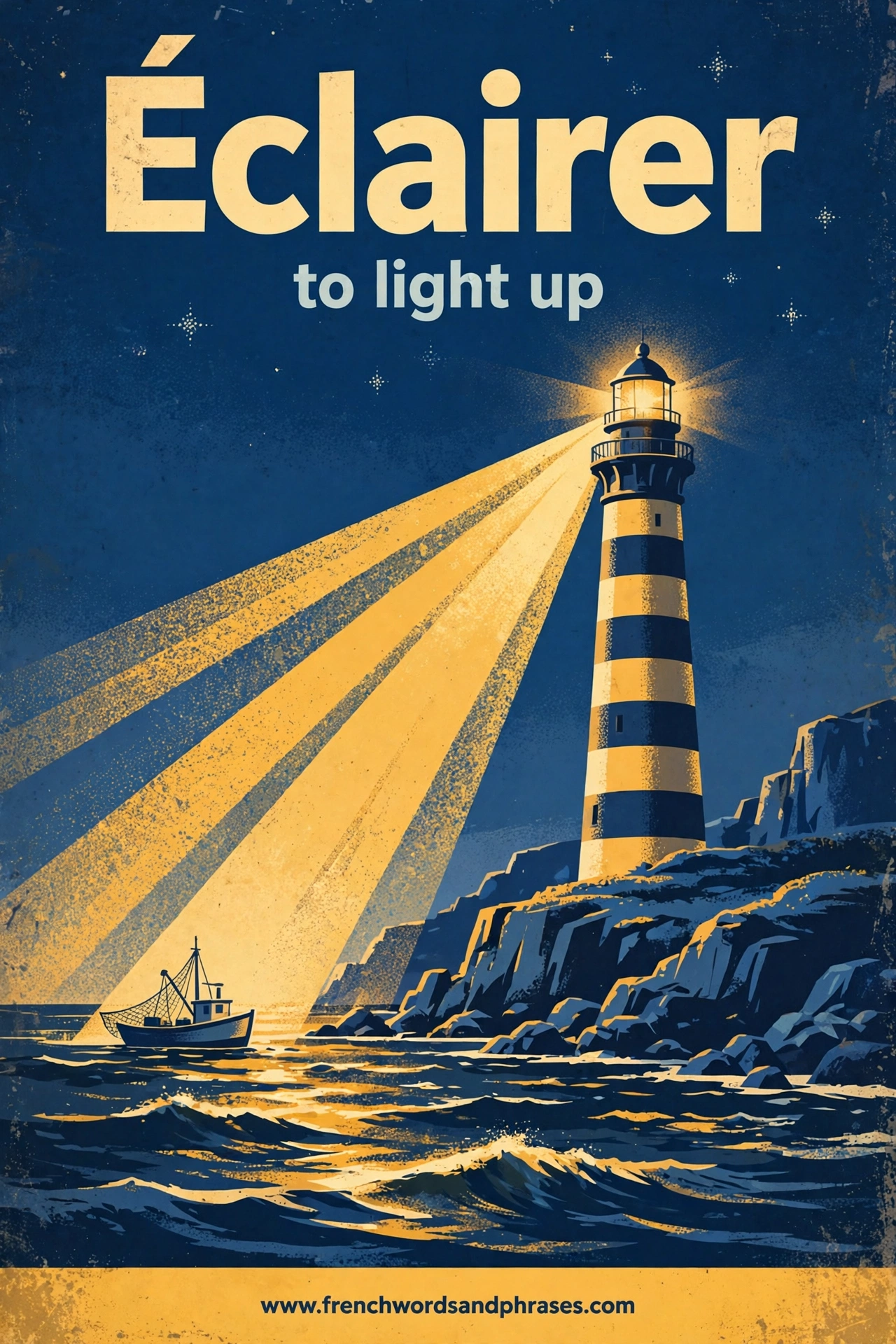
Éclairer means to light up.
A lantern carried down a dark lane, a teacher’s sentence that suddenly makes everything obvious — éclairer is the verb of light arriving, on streets and in minds alike.
In this guide, you’ll learn how to conjugate éclairer in all the major French tenses and moods. Explore complete conjugation tables, French examples, English translations, and practice quizzes.
Understanding the French Verb Éclairer
Éclairer is a regular French verb belonging to the first group of verbs, those ending in -er.
It means to light up. It is commonly used for lamps, streets and monuments lit at night, for candles and torches carried through the dark, for teachers and books that enlighten, and in the reflexive for faces lighting up with joy or sudden understanding.
Verb classification: First group (-er)
Auxiliary verb: Avoir
Past participle: éclairé
Present participle: éclairant
English equivalents: To light up, to illuminate, to enlighten; s’éclairer — to light one’s way, (of a face) to light up; un éclairage — lighting.
One important detail: do not confuse éclairer with éclaircir. Éclairer gives light or understanding: éclairer une rue, to light a street; éclairer quelqu’un sur un sujet, to enlighten someone about a subject. The reflexive s’éclairer is to light your own way — il s’éclaire à la bougie, he lights his way by candle — and of a face: son visage s’éclaire, her face lights up. The noun is un éclairage: street lighting, stage lighting — and remember that the Enlightenment itself is les Lumières, the Lights.
Experience the Word
Éclairer is the verb of darkness losing — a room, a road or an idea, lit one corner at a time.
Imagine a village fête after sunset. One by one the lanterns come on along the square, the band tunes up in a pool of gold, and every face that enters the light seems to switch on with it — son visage s’éclaire.
The square has not moved an inch. It has been lit — éclairé — and so has everyone in it.
How to Conjugate Éclairer: Complete French Conjugation Guide
Let’s explore every major conjugation of éclairer, beginning with the indicative mood.
How to Conjugate Éclairer in the Indicative Mood
The indicative mood is used to express facts, observations, actions, and events.
How to Conjugate Éclairer in the Present Tense (Présent)
Used for actions happening now, habitual actions, and general truths.
| Subject | Conjugation |
|---|---|
| je | éclaire |
| tu | éclaires |
| il / elle | éclaire |
| nous | éclairons |
| vous | éclairez |
| ils / elles | éclairent |
Example
Les lampadaires éclairent la place dès la tombée de la nuit.
The street lamps light up the square from nightfall.
Quick Quiz 1
Complete the sentence:
Nous ______ la place avec des lanternes.
Reveal the answer
éclairons
Nous éclairons la place avec des lanternes.
We light up the square with lanterns.
How to Conjugate Éclairer in the Passé Composé
Used for completed actions in the past. Éclairer takes the auxiliary verb avoir.
| Subject | Conjugation |
|---|---|
| j’ | ai éclairé |
| tu | as éclairé |
| il / elle | a éclairé |
| nous | avons éclairé |
| vous | avez éclairé |
| ils / elles | ont éclairé |
Example
Une seule bougie a éclairé toute la pièce.
A single candle lit up the whole room.
How to Conjugate Éclairer in the Imparfait (Imperfect Tense)
Used for habitual past actions, descriptions, and ongoing situations in the past.
| Subject | Conjugation |
|---|---|
| je | éclairais |
| tu | éclairais |
| il / elle | éclairait |
| nous | éclairions |
| vous | éclairiez |
| ils / elles | éclairaient |
Example
Autrefois, on éclairait les rues au gaz.
In the old days, streets were lit by gas.
Quick Quiz 2
Choose the correct form:
The candle lit the room.
La bougie ______ la pièce. (a éclairé / est éclairée)
Reveal the answer
a éclairé
La bougie a éclairé la pièce.
Éclairer takes avoir.
How to Conjugate Éclairer in the Plus-que-parfait
Used to describe an action that had already been completed before another past event.
| Subject | Conjugation |
|---|---|
| j’ | avais éclairé |
| tu | avais éclairé |
| il / elle | avait éclairé |
| nous | avions éclairé |
| vous | aviez éclairé |
| ils / elles | avaient éclairé |
Example
Elle avait éclairé le chemin avec sa lampe de poche.
She had lit the path with her torch.
How to Conjugate Éclairer in the Passé Simple
Primarily used in formal writing, literature, and historical narratives. It is rarely used in everyday conversation.
| Subject | Conjugation |
|---|---|
| je | éclairai |
| tu | éclairas |
| il / elle | éclaira |
| nous | éclairâmes |
| vous | éclairâtes |
| ils / elles | éclairèrent |
Example
Le phare éclaira la côte pendant toute la tempête.
The lighthouse lit up the coast throughout the storm.
How to Conjugate Éclairer in the Passé Antérieur
A literary tense used to express an action completed immediately before another past action, generally in the passé simple.
| Subject | Conjugation |
|---|---|
| j’ | eus éclairé |
| tu | eus éclairé |
| il / elle | eut éclairé |
| nous | eûmes éclairé |
| vous | eûtes éclairé |
| ils / elles | eurent éclairé |
Example
Quand il eut éclairé l’escalier, les invités montèrent.
When he had lit the staircase, the guests went up.
How to Conjugate Éclairer in the Future Tense (Futur Simple)
Used to describe actions that will take place in the future.
| Subject | Conjugation |
|---|---|
| je | éclairerai |
| tu | éclaireras |
| il / elle | éclairera |
| nous | éclairerons |
| vous | éclairerez |
| ils / elles | éclaireront |
Example
La pleine lune éclairera le jardin ce soir.
The full moon will light up the garden this evening.
How to Conjugate Éclairer in the Futur Antérieur (Future Perfect)
Used for an action that will have been completed before a particular point in the future.
| Subject | Conjugation |
|---|---|
| j’ | aurai éclairé |
| tu | auras éclairé |
| il / elle | aura éclairé |
| nous | aurons éclairé |
| vous | aurez éclairé |
| ils / elles | auront éclairé |
Example
À minuit, les projecteurs auront éclairé toute la scène.
By midnight, the spotlights will have lit the whole stage.
How to Conjugate Éclairer in the Near Future (Futur Proche)
Used to describe something that is going to happen soon. Formed with aller + infinitive.
| Subject | Conjugation |
|---|---|
| je | vais éclairer |
| tu | vas éclairer |
| il / elle | va éclairer |
| nous | allons éclairer |
| vous | allez éclairer |
| ils / elles | vont éclairer |
Example
Je vais éclairer le couloir, attends-moi.
I am going to light the corridor, wait for me.
How to Conjugate Éclairer in the Conditional Mood
The conditional mood expresses what would happen under certain circumstances. It is also frequently used to make polite requests or express wishes.
How to Conjugate Éclairer in the Present Conditional
| Subject | Conjugation |
|---|---|
| je | éclairerais |
| tu | éclairerais |
| il / elle | éclairerait |
| nous | éclairerions |
| vous | éclaireriez |
| ils / elles | éclaireraient |
Example
Quelques bougies éclaireraient mieux cette table.
A few candles would light this table better.
How to Conjugate Éclairer in the Past Conditional
| Subject | Conjugation |
|---|---|
| j’ | aurais éclairé |
| tu | aurais éclairé |
| il / elle | aurait éclairé |
| nous | aurions éclairé |
| vous | auriez éclairé |
| ils / elles | auraient éclairé |
Example
Sans ta lampe, je n’aurais pas éclairé la cave.
Without your lamp, I would not have lit the cellar.
Éclairer in the Literary Past Conditional Form
This less common literary form uses the imperfect subjunctive of avoir.
| Subject | Conjugation |
|---|---|
| j’ | eusse éclairé |
| tu | eusses éclairé |
| il / elle | eût éclairé |
| nous | eussions éclairé |
| vous | eussiez éclairé |
| ils / elles | eussent éclairé |
Example
Les torches eussent éclairé la procession jusqu’à l’église.
The torches would have lit the procession as far as the church.
How to Conjugate Éclairer in the Subjunctive Mood
The subjunctive is used to express wishes, emotions, doubts, necessity, and uncertainty. It frequently follows expressions such as il faut que (it is necessary that) or bien que (although).
How to Conjugate Éclairer in the Present Subjunctive
| Subject | Conjugation |
|---|---|
| que je | éclaire |
| que tu | éclaires |
| qu’il / qu’elle | éclaire |
| que nous | éclairions |
| que vous | éclairiez |
| qu’ils / qu’elles | éclairent |
Example
Il faut qu’une lampe éclaire l’entrée.
A lamp must light the entrance.
Quick Quiz 3
Complete the sentence using the subjunctive:
Il faut que vous ______ l’escalier.
Reveal the answer
éclairiez
Il faut que vous éclairiez l’escalier.
You must light the staircase.
How to Conjugate Éclairer in the Imperfect Subjunctive
A literary tense, rarely encountered in modern spoken French.
| Subject | Conjugation |
|---|---|
| que je | éclairasse |
| que tu | éclairasses |
| qu’il / qu’elle | éclairât |
| que nous | éclairassions |
| que vous | éclairassiez |
| qu’ils / qu’elles | éclairassent |
Example
On souhaitait que la lune éclairât leur route.
They hoped the moon would light their road.
How to Conjugate Éclairer in the Pluperfect Subjunctive
A literary construction used to express an action completed before another past action.
| Subject | Conjugation |
|---|---|
| que j’ | eusse éclairé |
| que tu | eusses éclairé |
| qu’il / qu’elle | eût éclairé |
| que nous | eussions éclairé |
| que vous | eussiez éclairé |
| qu’ils / qu’elles | eussent éclairé |
Example
Le guide regretta qu’on n’eût pas éclairé le sentier.
The guide regretted that they had not lit the path.
How to Conjugate Éclairer in the Past Subjunctive
| Subject | Conjugation |
|---|---|
| que j’ | aie éclairé |
| que tu | aies éclairé |
| qu’il / qu’elle | ait éclairé |
| que nous | ayons éclairé |
| que vous | ayez éclairé |
| qu’ils / qu’elles | aient éclairé |
Example
Je suis content que ce livre t’ait éclairé sur la question.
I am glad this book enlightened you on the question.
How to Conjugate Éclairer in the Imperative
The imperative is used to give commands, instructions, invitations, or suggestions. Subject pronouns are omitted.
How to Conjugate Éclairer in the Present Imperative
| Person | Conjugation |
|---|---|
| (tu) | éclaire |
| (nous) | éclairons |
| (vous) | éclairez |
Example
Éclaire-moi avec ton téléphone, je cherche mes clés !
Shine a light for me with your phone, I am looking for my keys!
Quick Quiz 4
How would you say Light the entrance (tu form)?
Reveal the answer
Éclaire l’entrée !
French Participles of Éclairer
Participles are verb forms that can be used in compound tenses and other grammatical constructions.
Present Participle of Éclairer
éclairant
En éclairant la carte, il trouva le raccourci.
By shining a light on the map, he found the shortcut.
Past Participle of Éclairer
éclairé
Éclairée par la lune, la vallée semblait d’argent.
Lit by the moon, the valley seemed made of silver.
Éclairer in Everyday French: Real-Life Examples
Now that you know the conjugations, let’s see how éclairer appears in everyday French.
Example 1 — Present
Son visage s’éclaire quand elle te voit.
Her face lights up when she sees you.
Example 2 — Passé composé
Ce professeur m’a éclairé sur beaucoup de choses.
That teacher enlightened me about many things.
Example 3 — Imparfait
On s’éclairait à la bougie pendant les coupures de courant.
We used to light our way by candle during power cuts.
Example 4 — Future
La lune éclairera le chemin du retour.
The moon will light the way back.
Example 5 — Conditional
Une deuxième lampe éclairerait mieux le bureau.
A second lamp would light the desk better.
Example 6 — Imperative
Éclairez l’entrée pour les invités !
Light the entrance for the guests!
Beyond Translation: The Meaning of Éclairer
English light up splits into lamps and faces; French éclairer does both and adds a third kingdom: the mind.
Éclairer quelqu’un, c’est lui donner de la lumière.
To enlighten someone is still, in French, to hand them a lamp — which is why the century of reason is called le siècle des Lumières, the century of the Lights.
How to Remember the French Verb Éclairer
Remember it this way: Éclairer is about light arriving — streets, faces and minds.
- Éclairer gives light or understanding; éclaircir makes things lighter, thinner or clearer.
- Son visage s’éclaire — her face lights up; s’éclairer à la bougie — to light your way by candle.
- Regular -er: j’éclaire, nous éclairons, past participle éclairé.
The key idea is light arriving — streets, faces and minds.
Test Your Knowledge of Éclairer
Let’s see how much you’ve learned. Try answering these questions before revealing the answers.
Question 1
What is the difference between éclairer and éclaircir?
Reveal the answer
Éclairer gives light or enlightens; éclaircir makes something lighter, thinner or clearer.
Question 2
How do you say Her face lights up in French?
Reveal the answer
Son visage s’éclaire.
Question 3
Translate: A single candle lit up the whole room.
Reveal the answer
Une seule bougie a éclairé toute la pièce.
Question 4
What is the past participle of éclairer?
Reveal the answer
Éclairé.
Question 5
Complete the sentence:
Il faut qu’une lampe ______ l’entrée.
Reveal the answer
éclaire
Il faut qu’une lampe éclaire l’entrée.
A lamp must light the entrance.
Your Final Challenge
Can You Use It?
How would you say this in French?
The moon lights up the garden, and her face lights up as she watches it.
Reveal the answer
La lune éclaire le jardin, et son visage s’éclaire en la regardant.
The moon lights up the garden, and her face lights up as she watches it.
A little French. A little curiosity. A richer everyday life.
LEARN FRENCH ONE WORD AT A TIME