A French Word to Live By
How to Conjugate Éclabousser in French
/e.kla.bu.se/
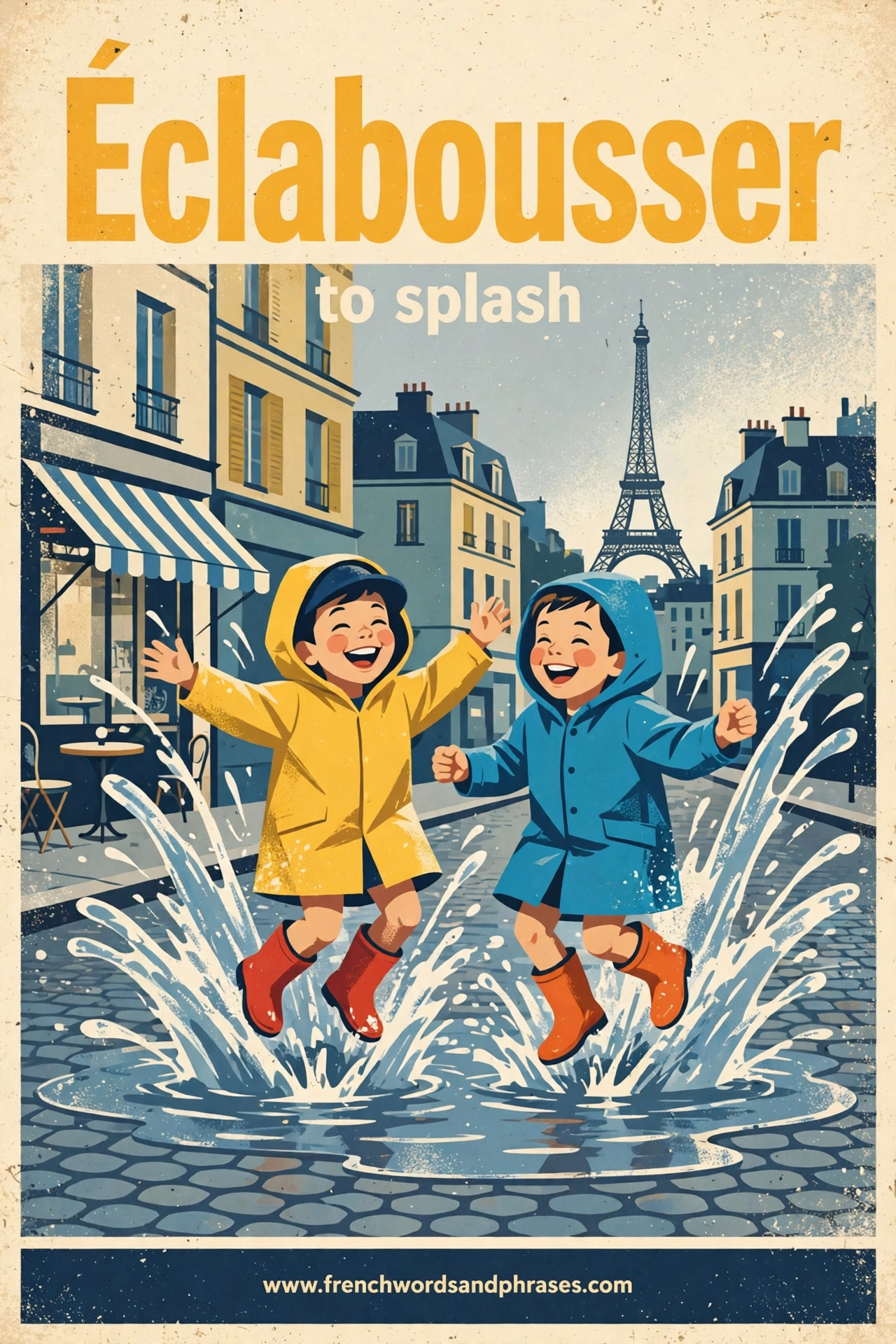
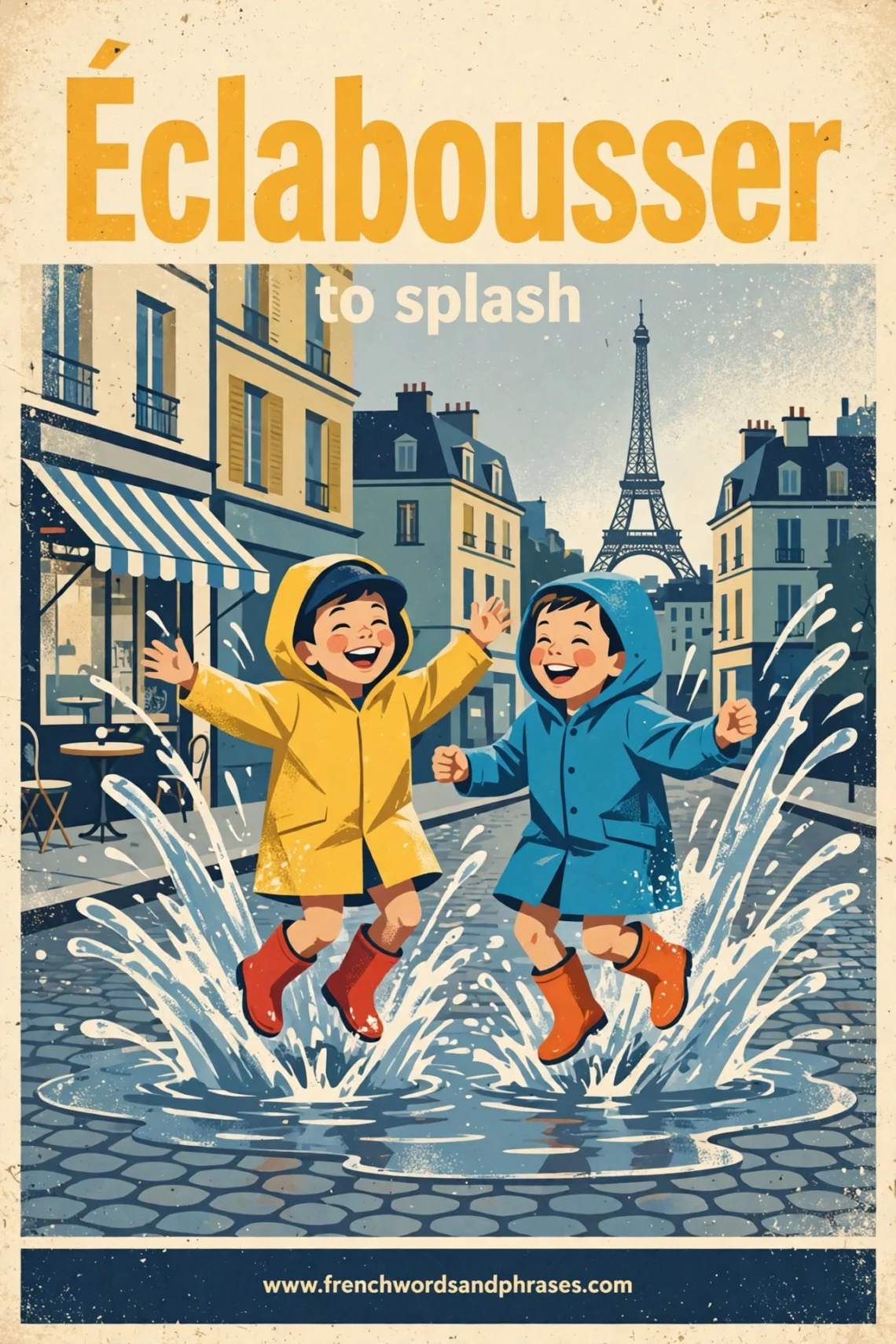
Éclabousser means to splash.
A bus hits a puddle and the whole pavement jumps; a toddler discovers both hands in the bath — éclabousser is the verb of water and mud on the move, splashing where it was never invited.
In this guide, you’ll learn how to conjugate éclabousser in all the major French tenses and moods. Explore complete conjugation tables, French examples, English translations, and practice quizzes.
Understanding the French Verb Éclabousser
Éclabousser is a regular French verb belonging to the first group of verbs, those ending in -er.
It means to splash. It is commonly used for cars splashing passers-by in the rain, for children in baths and swimmers in pools, for mud and paint spattered on clothes and walls, and in the newspapers for scandals whose fallout splashes everyone nearby.
Verb classification: First group (-er)
Auxiliary verb: Avoir
Past participle: éclaboussé
Present participle: éclaboussant
English equivalents: To splash, to spatter, to splatter; une éclaboussure — a splash, a spatter, the mark left behind.
One important detail: éclabousser throws liquid onto things — cars éclaboussent pedestrians, children éclaboussent the bathroom — and the trace it leaves is une éclaboussure, a splash mark on trousers, walls or paintwork. French also uses the verb figuratively, and this is where it earns its keep: le scandale a éclaboussé le ministre — the scandal splashed the minister, spattering his reputation exactly like mud on a coat.
Experience the Word
Éclabousser is the verb of liquid with no manners — it never lands only where it was aimed.
Imagine a rainy evening at a bus stop. Everyone stands well back from the kerb, coats already imagined ruined, each car judged by the size of the wave it carries — and still, one passes too fast, and the whole row jumps as the éclaboussure arrives.
The rain itself soaked nobody. It was the splashing — éclaboussé from the road — that did the damage.
How to Conjugate Éclabousser: Complete French Conjugation Guide
Let’s explore every major conjugation of éclabousser, beginning with the indicative mood.
How to Conjugate Éclabousser in the Indicative Mood
The indicative mood is used to express facts, observations, actions, and events.
How to Conjugate Éclabousser in the Present Tense (Présent)
Used for actions happening now, habitual actions, and general truths.
| Subject | Conjugation |
|---|---|
| je | éclabousse |
| tu | éclabousses |
| il / elle | éclabousse |
| nous | éclaboussons |
| vous | éclaboussez |
| ils / elles | éclaboussent |
Example
La voiture éclabousse les passants en roulant dans les flaques.
The car splashes the passers-by as it drives through the puddles.
Quick Quiz 1
Complete the sentence:
Nous ______ les passants sans le vouloir.
Reveal the answer
éclaboussons
Nous éclaboussons les passants sans le vouloir.
We splash the passers-by without meaning to.
How to Conjugate Éclabousser in the Passé Composé
Used for completed actions in the past. Éclabousser takes the auxiliary verb avoir.
| Subject | Conjugation |
|---|---|
| j’ | ai éclaboussé |
| tu | as éclaboussé |
| il / elle | a éclaboussé |
| nous | avons éclaboussé |
| vous | avez éclaboussé |
| ils / elles | ont éclaboussé |
Example
Le camion a éclaboussé mon manteau neuf de boue.
The lorry splashed my new coat with mud.
How to Conjugate Éclabousser in the Imparfait (Imperfect Tense)
Used for habitual past actions, descriptions, and ongoing situations in the past.
| Subject | Conjugation |
|---|---|
| je | éclaboussais |
| tu | éclaboussais |
| il / elle | éclaboussait |
| nous | éclaboussions |
| vous | éclaboussiez |
| ils / elles | éclaboussaient |
Example
Les enfants éclaboussaient partout dans la baignoire.
The children were splashing everywhere in the bath.
Quick Quiz 2
Choose the correct form:
She splashed my coat.
Elle ______ mon manteau. (a éclaboussé / est éclaboussée)
Reveal the answer
a éclaboussé
Elle a éclaboussé mon manteau.
Éclabousser takes avoir.
How to Conjugate Éclabousser in the Plus-que-parfait
Used to describe an action that had already been completed before another past event.
| Subject | Conjugation |
|---|---|
| j’ | avais éclaboussé |
| tu | avais éclaboussé |
| il / elle | avait éclaboussé |
| nous | avions éclaboussé |
| vous | aviez éclaboussé |
| ils / elles | avaient éclaboussé |
Example
Il avait éclaboussé le mur en ouvrant la bouteille.
He had splashed the wall when opening the bottle.
How to Conjugate Éclabousser in the Passé Simple
Primarily used in formal writing, literature, and historical narratives. It is rarely used in everyday conversation.
| Subject | Conjugation |
|---|---|
| je | éclaboussai |
| tu | éclaboussas |
| il / elle | éclaboussa |
| nous | éclaboussâmes |
| vous | éclaboussâtes |
| ils / elles | éclaboussèrent |
Example
La vague éclaboussa les rochers et les promeneurs.
The wave splashed the rocks and the walkers.
How to Conjugate Éclabousser in the Passé Antérieur
A literary tense used to express an action completed immediately before another past action, generally in the passé simple.
| Subject | Conjugation |
|---|---|
| j’ | eus éclaboussé |
| tu | eus éclaboussé |
| il / elle | eut éclaboussé |
| nous | eûmes éclaboussé |
| vous | eûtes éclaboussé |
| ils / elles | eurent éclaboussé |
Example
Quand la fontaine eut éclaboussé la place, les pigeons s’envolèrent.
When the fountain had splashed the square, the pigeons flew off.
How to Conjugate Éclabousser in the Future Tense (Futur Simple)
Used to describe actions that will take place in the future.
| Subject | Conjugation |
|---|---|
| je | éclabousserai |
| tu | éclabousseras |
| il / elle | éclaboussera |
| nous | éclabousserons |
| vous | éclabousserez |
| ils / elles | éclabousseront |
Example
Attention, ce robinet éclaboussera si tu l’ouvres trop fort.
Careful, that tap will splash if you turn it on too hard.
How to Conjugate Éclabousser in the Futur Antérieur (Future Perfect)
Used for an action that will have been completed before a particular point in the future.
| Subject | Conjugation |
|---|---|
| j’ | aurai éclaboussé |
| tu | auras éclaboussé |
| il / elle | aura éclaboussé |
| nous | aurons éclaboussé |
| vous | aurez éclaboussé |
| ils / elles | auront éclaboussé |
Example
À la fin de la course, les coureurs auront éclaboussé tout le chemin.
By the end of the race, the runners will have splashed the whole path.
How to Conjugate Éclabousser in the Near Future (Futur Proche)
Used to describe something that is going to happen soon. Formed with aller + infinitive.
| Subject | Conjugation |
|---|---|
| je | vais éclabousser |
| tu | vas éclabousser |
| il / elle | va éclabousser |
| nous | allons éclabousser |
| vous | allez éclabousser |
| ils / elles | vont éclabousser |
Example
Ne reste pas là, la voiture va t’éclabousser.
Do not stand there, the car is going to splash you.
How to Conjugate Éclabousser in the Conditional Mood
The conditional mood expresses what would happen under certain circumstances. It is also frequently used to make polite requests or express wishes.
How to Conjugate Éclabousser in the Present Conditional
| Subject | Conjugation |
|---|---|
| je | éclabousserais |
| tu | éclabousserais |
| il / elle | éclabousserait |
| nous | éclabousserions |
| vous | éclabousseriez |
| ils / elles | éclabousseraient |
Example
Sans ce rebord, la fontaine éclabousserait les tables du café.
Without that rim, the fountain would splash the café tables.
How to Conjugate Éclabousser in the Past Conditional
| Subject | Conjugation |
|---|---|
| j’ | aurais éclaboussé |
| tu | aurais éclaboussé |
| il / elle | aurait éclaboussé |
| nous | aurions éclaboussé |
| vous | auriez éclaboussé |
| ils / elles | auraient éclaboussé |
Example
Il aurait éclaboussé tout le monde en tombant dans la piscine.
He would have splashed everyone by falling into the pool.
Éclabousser in the Literary Past Conditional Form
This less common literary form uses the imperfect subjunctive of avoir.
| Subject | Conjugation |
|---|---|
| j’ | eusse éclaboussé |
| tu | eusses éclaboussé |
| il / elle | eût éclaboussé |
| nous | eussions éclaboussé |
| vous | eussiez éclaboussé |
| ils / elles | eussent éclaboussé |
Example
La mer eût éclaboussé les falaises toute la nuit.
The sea would have splashed the cliffs all night.
How to Conjugate Éclabousser in the Subjunctive Mood
The subjunctive is used to express wishes, emotions, doubts, necessity, and uncertainty. It frequently follows expressions such as il faut que (it is necessary that) or bien que (although).
How to Conjugate Éclabousser in the Present Subjunctive
| Subject | Conjugation |
|---|---|
| que je | éclabousse |
| que tu | éclabousses |
| qu’il / qu’elle | éclabousse |
| que nous | éclaboussions |
| que vous | éclaboussiez |
| qu’ils / qu’elles | éclaboussent |
Example
Je crains que la boue éclabousse tes chaussures neuves.
I fear the mud may splash your new shoes.
Quick Quiz 3
Complete the sentence using the subjunctive:
Il ne faut pas que tu ______ ton frère.
Reveal the answer
éclabousses
Il ne faut pas que tu éclabousses ton frère.
You must not splash your brother.
How to Conjugate Éclabousser in the Imperfect Subjunctive
A literary tense, rarely encountered in modern spoken French.
| Subject | Conjugation |
|---|---|
| que je | éclaboussasse |
| que tu | éclaboussasses |
| qu’il / qu’elle | éclaboussât |
| que nous | éclaboussassions |
| que vous | éclaboussassiez |
| qu’ils / qu’elles | éclaboussassent |
Example
Il fallait éviter que l’eau éclaboussât les tableaux.
They had to prevent the water from splashing the paintings.
How to Conjugate Éclabousser in the Pluperfect Subjunctive
A literary construction used to express an action completed before another past action.
| Subject | Conjugation |
|---|---|
| que j’ | eusse éclaboussé |
| que tu | eusses éclaboussé |
| qu’il / qu’elle | eût éclaboussé |
| que nous | eussions éclaboussé |
| que vous | eussiez éclaboussé |
| qu’ils / qu’elles | eussent éclaboussé |
Example
On rit encore qu’il eût éclaboussé le directeur en ouvrant le champagne.
People still laugh that he had splashed the director when opening the champagne.
How to Conjugate Éclabousser in the Past Subjunctive
| Subject | Conjugation |
|---|---|
| que j’ | aie éclaboussé |
| que tu | aies éclaboussé |
| qu’il / qu’elle | ait éclaboussé |
| que nous | ayons éclaboussé |
| que vous | ayez éclaboussé |
| qu’ils / qu’elles | aient éclaboussé |
Example
Je suis désolé que la voiture t’ait éclaboussé.
I am sorry the car splashed you.
How to Conjugate Éclabousser in the Imperative
The imperative is used to give commands, instructions, invitations, or suggestions. Subject pronouns are omitted.
How to Conjugate Éclabousser in the Present Imperative
| Person | Conjugation |
|---|---|
| (tu) | éclabousse |
| (nous) | éclaboussons |
| (vous) | éclaboussez |
Example
N’éclabousse pas ton frère, l’eau est froide !
Do not splash your brother, the water is cold!
Quick Quiz 4
How would you say Do not splash me (tu form)?
Reveal the answer
Ne m’éclabousse pas !
French Participles of Éclabousser
Participles are verb forms that can be used in compound tenses and other grammatical constructions.
Present Participle of Éclabousser
éclaboussant
En éclaboussant partout, le chien a trempé le tapis.
By splashing everywhere, the dog soaked the carpet.
Past Participle of Éclabousser
éclaboussé
Éclaboussé de la tête aux pieds, il riait quand même.
Splashed from head to toe, he was laughing all the same.
Éclabousser in Everyday French: Real-Life Examples
Now that you know the conjugations, let’s see how éclabousser appears in everyday French.
Example 1 — Present
Les voitures éclaboussent les piétons quand il pleut.
Cars splash pedestrians when it rains.
Example 2 — Passé composé
Tu m’as éclaboussé avec la lance d’arrosage !
You splashed me with the garden hose!
Example 3 — Imparfait
Le chien éclaboussait tout le monde en sortant de la rivière.
The dog used to splash everyone coming out of the river.
Example 4 — Future
Les vagues éclabousseront la digue ce soir.
The waves will splash the sea wall this evening.
Example 5 — Conditional
On éclabousserait toute la cuisine en lavant ce plat.
We would splash the whole kitchen washing that dish.
Example 6 — Imperative
Éclabousse-moi encore et tu verras !
Splash me again and you will see!
Beyond Translation: The Meaning of Éclabousser
English separates splash (water flying) from spatter (the marks it leaves); French éclabousser does both, then walks into politics.
A scandal éclabousse.
When a French newspaper writes that a minister has been éclaboussé by an affair, every reader pictures the mud on the coat — the damage was not aimed at him, but he stood too close to the puddle.
How to Remember the French Verb Éclabousser
Remember it this way: Éclabousser is about water and mud on the move — puddles, baths and scandals.
- Une éclaboussure — the splash itself and the mark it leaves, on trousers or on reputations.
- Le scandale éclabousse — a scandal splashes everyone standing near it.
- Regular -er: j’éclabousse, nous éclaboussons, past participle éclaboussé.
The key idea is water and mud on the move — puddles, baths and scandals.
Test Your Knowledge of Éclabousser
Let’s see how much you’ve learned. Try answering these questions before revealing the answers.
Question 1
How do you say The car splashed the passers-by in French?
Reveal the answer
La voiture a éclaboussé les passants.
Question 2
What is une éclaboussure?
Reveal the answer
A splash or spatter — and the mark the liquid leaves behind.
Question 3
Translate: Do not splash your brother!
Reveal the answer
N’éclabousse pas ton frère !
Question 4
What is the past participle of éclabousser?
Reveal the answer
Éclaboussé.
Question 5
Complete the sentence:
Je crains que la boue ______ tes chaussures neuves.
Reveal the answer
éclabousse
Je crains que la boue éclabousse tes chaussures neuves.
I fear the mud may splash your new shoes.
Your Final Challenge
Can You Use It?
How would you say this in French?
The car drives through the puddle and splashes the whole pavement.
Reveal the answer
La voiture passe dans la flaque et éclabousse tout le trottoir.
The car drives through the puddle and splashes the whole pavement.
A little French. A little curiosity. A richer everyday life.
LEARN FRENCH ONE WORD AT A TIME