A French Word to Live By
How to Conjugate S’ébrouer in French
/se.bʁu.e/
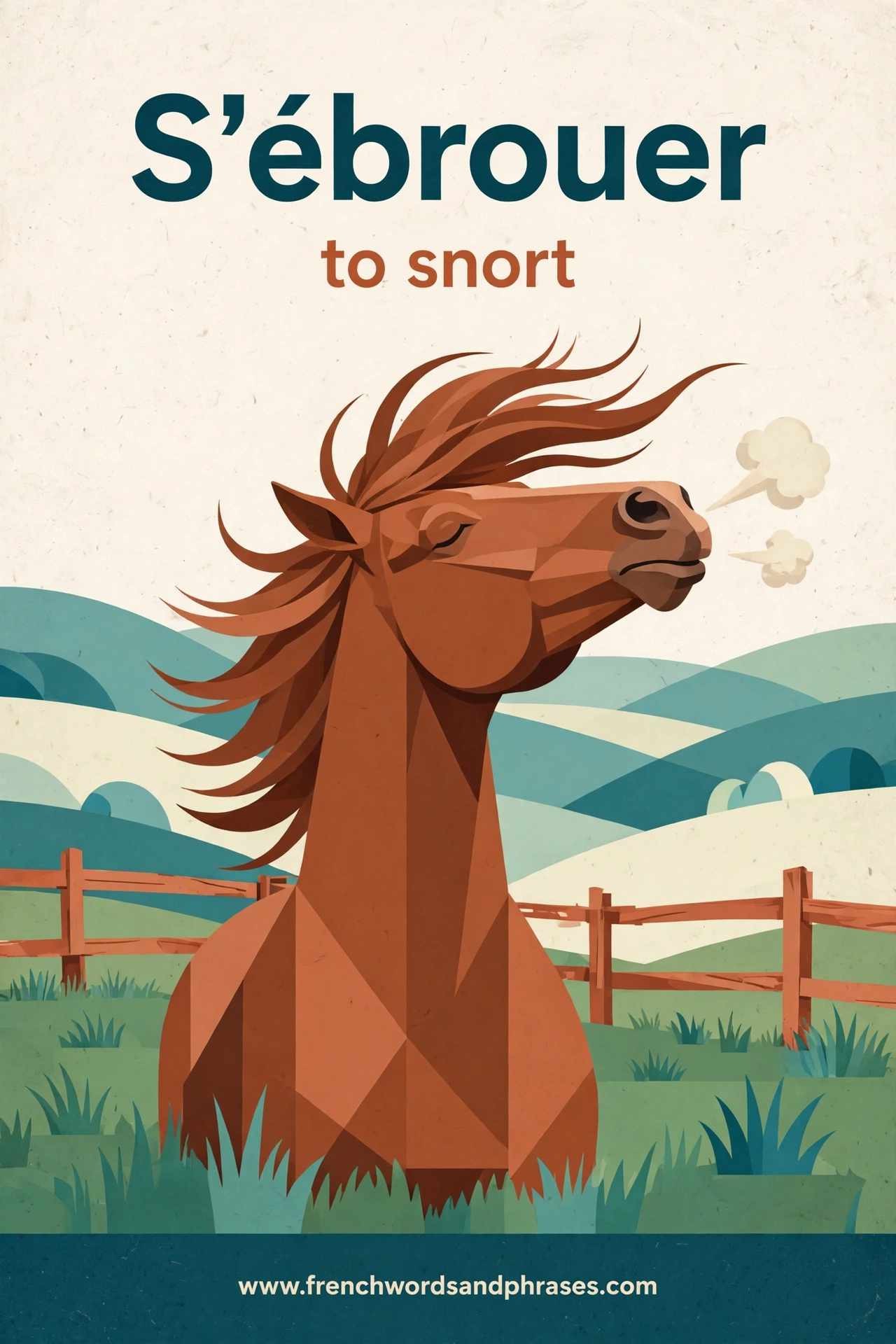
S’ébrouer means to snort — to blow air noisily through the nostrils, as a horse does.
A horse coming out of a river, blowing hard through its nostrils and shaking its wet head; a dog fresh from its bath; a swimmer surfacing from cold water — s’ébrouer is the snort of an animal shaking off water, dust or surprise.
In this guide, you’ll learn how to conjugate s’ébrouer in all the major French tenses and moods. Explore complete conjugation tables, French examples, English translations, and practice quizzes.
Understanding the French Verb S’ébrouer
S’ébrouer is a regular French verb belonging to the first group of verbs, those ending in -er.
It means to snort. It is commonly used of horses snorting after effort, water or fright, of dogs snorting and shaking after a bath, and in playful descriptions of people emerging from a cold sea or a shower, snorting and dripping.
Verb classification: First group (-er), reflexive
Auxiliary verb: Être
Past participle: ébroué
Present participle: ébrouant
English equivalents: To snort (of a horse), to blow through the nostrils; by extension, of dogs and of bathers shaking off the water.
One important detail: s’ébrouer lives almost only in its reflexive form — there is no everyday non-reflexive ébrouer. It is first of all the horse’s verb: after drinking, crossing a river or a fright, the horse blows out hard through its nostrils, often tossing its head. Being reflexive, it takes être and the participle agrees: le cheval s’est ébroué, la jument s’est ébrouée. Writers lend it to dogs after a bath, and playfully to swimmers coming out of cold water.
Experience the Word
S’ébrouer is the verb of the joyful snort — breath blown out all at once, water flying, the body announcing it is alive and well.
Imagine a ford on a summer road. The horse comes up out of the river streaming, plants its feet on the bank, and s’ébroue — one great snort, a shake of the mane, droplets everywhere. The rider laughs; the journey can go on.
Nothing is wrong and nothing is said. The snort says it all — water off, breath back, ready.
How to Conjugate S’ébrouer: Complete French Conjugation Guide
Let’s explore every major conjugation of s’ébrouer, beginning with the indicative mood.
How to Conjugate S’ébrouer in the Indicative Mood
The indicative mood is used to express facts, observations, actions, and events.
How to Conjugate S’ébrouer in the Present Tense (Présent)
Used for actions happening now, habitual actions, and general truths.
| Subject | Conjugation |
|---|---|
| je | m’ébroue |
| tu | t’ébroues |
| il / elle | s’ébroue |
| nous | nous ébrouons |
| vous | vous ébrouez |
| ils / elles | s’ébrouent |
Example
Le cheval s’ébroue en sortant de la rivière.
The horse snorts as it comes out of the river.
Quick Quiz 1
Complete the sentence:
Nous nous ______ en sortant de l’eau froide.
Reveal the answer
ébrouons
Nous nous ébrouons en sortant de l’eau froide.
We snort as we come out of the cold water.
How to Conjugate S’ébrouer in the Passé Composé
Used for completed actions in the past. S’ébrouer takes the auxiliary verb être.
| Subject | Conjugation |
|---|---|
| je | me suis ébroué / me suis ébrouée |
| tu | t’es ébroué / t’es ébrouée |
| il / elle | s’est ébroué / s’est ébrouée |
| nous | nous sommes ébroués / nous sommes ébrouées |
| vous | vous êtes ébroués / vous êtes ébrouées / vous êtes ébroué / vous êtes ébrouée |
| ils / elles | se sont ébroués / se sont ébrouées |
Example
Après la course, le cheval s’est ébroué longuement.
After the race, the horse snorted at length.
How to Conjugate S’ébrouer in the Imparfait (Imperfect Tense)
Used for habitual past actions, descriptions, and ongoing situations in the past.
| Subject | Conjugation |
|---|---|
| je | m’ébrouais |
| tu | t’ébrouais |
| il / elle | s’ébrouait |
| nous | nous ébrouions |
| vous | vous ébrouiez |
| ils / elles | s’ébrouaient |
Example
Les chevaux s’ébrouaient dans la cour de la ferme.
The horses used to snort in the farmyard.
Quick Quiz 2
Choose the correct form:
The mare snorted after the race.
La jument ______ après la course. (s’est ébrouée / a ébroué)
Reveal the answer
s’est ébrouée
La jument s’est ébrouée après la course.
S’ébrouer is reflexive, takes être, and the participle agrees.
How to Conjugate S’ébrouer in the Plus-que-parfait
Used to describe an action that had already been completed before another past event.
| Subject | Conjugation |
|---|---|
| je | m’étais ébroué / m’étais ébrouée |
| tu | t’étais ébroué / t’étais ébrouée |
| il / elle | s’était ébroué / s’était ébrouée |
| nous | nous étions ébroués / nous étions ébrouées |
| vous | vous étiez ébroués / vous étiez ébrouées / vous étiez ébroué / vous étiez ébrouée |
| ils / elles | s’étaient ébroués / s’étaient ébrouées |
Example
La jument s’était ébrouée avant de reprendre sa course.
The mare had snorted before resuming her run.
How to Conjugate S’ébrouer in the Passé Simple
Primarily used in formal writing, literature, and historical narratives. It is rarely used in everyday conversation.
| Subject | Conjugation |
|---|---|
| je | m’ébrouai |
| tu | t’ébrouas |
| il / elle | s’ébroua |
| nous | nous ébrouâmes |
| vous | vous ébrouâtes |
| ils / elles | s’ébrouèrent |
Example
Le cerf s’ébroua et disparut dans les bois.
The stag snorted and vanished into the woods.
How to Conjugate S’ébrouer in the Passé Antérieur
A literary tense used to express an action completed immediately before another past action, generally in the passé simple.
| Subject | Conjugation |
|---|---|
| je | me fus ébroué / me fus ébrouée |
| tu | te fus ébroué / te fus ébrouée |
| il / elle | se fut ébroué / se fut ébrouée |
| nous | nous fûmes ébroués / nous fûmes ébrouées |
| vous | vous fûtes ébroués / vous fûtes ébrouées / vous fûtes ébroué / vous fûtes ébrouée |
| ils / elles | se furent ébroués / se furent ébrouées |
Example
Dès que le cheval se fut ébroué, il se calma.
As soon as the horse had snorted, it calmed down.
How to Conjugate S’ébrouer in the Future Tense (Futur Simple)
Used to describe actions that will take place in the future.
| Subject | Conjugation |
|---|---|
| je | m’ébrouerai |
| tu | t’ébroueras |
| il / elle | s’ébrouera |
| nous | nous ébrouerons |
| vous | vous ébrouerez |
| ils / elles | s’ébroueront |
Example
Le nageur s’ébrouera en sortant de l’eau glacée.
The swimmer will snort as he comes out of the icy water.
How to Conjugate S’ébrouer in the Futur Antérieur (Future Perfect)
Used for an action that will have been completed before a particular point in the future.
| Subject | Conjugation |
|---|---|
| je | me serai ébroué / me serai ébrouée |
| tu | te seras ébroué / te seras ébrouée |
| il / elle | se sera ébroué / se sera ébrouée |
| nous | nous serons ébroués / nous serons ébrouées |
| vous | vous serez ébroués / vous serez ébrouées / vous serez ébroué / vous serez ébrouée |
| ils / elles | se seront ébroués / se seront ébrouées |
Example
À la fin de la baignade, les enfants se seront ébroués dix fois.
By the end of the swim, the children will have snorted ten times.
How to Conjugate S’ébrouer in the Near Future (Futur Proche)
Used to describe something that is going to happen soon. Formed with aller + infinitive.
| Subject | Conjugation |
|---|---|
| je | vais m’ébrouer |
| tu | vas t’ébrouer |
| il / elle | va s’ébrouer |
| nous | allons nous ébrouer |
| vous | allez vous ébrouer |
| ils / elles | vont s’ébrouer |
Example
Regarde, le cheval va s’ébrouer.
Look, the horse is going to snort.
How to Conjugate S’ébrouer in the Conditional Mood
The conditional mood expresses what would happen under certain circumstances. It is also frequently used to make polite requests or express wishes.
How to Conjugate S’ébrouer in the Present Conditional
| Subject | Conjugation |
|---|---|
| je | m’ébrouerais |
| tu | t’ébrouerais |
| il / elle | s’ébrouerait |
| nous | nous ébrouerions |
| vous | vous ébroueriez |
| ils / elles | s’ébroueraient |
Example
Un bon bain froid, et je m’ébrouerais de plaisir.
A good cold bath, and I would snort with pleasure.
How to Conjugate S’ébrouer in the Past Conditional
| Subject | Conjugation |
|---|---|
| je | me serais ébroué / me serais ébrouée |
| tu | te serais ébroué / te serais ébrouée |
| il / elle | se serait ébroué / se serait ébrouée |
| nous | nous serions ébroués / nous serions ébrouées |
| vous | vous seriez ébroués / vous seriez ébrouées / vous seriez ébroué / vous seriez ébrouée |
| ils / elles | se seraient ébroués / se seraient ébrouées |
Example
Le chien se serait ébroué sur le canapé si on l’avait laissé entrer.
The dog would have snorted all over the sofa if it had been let in.
S’ébrouer in the Literary Past Conditional Form
This less common literary form uses the imperfect subjunctive of être.
| Subject | Conjugation |
|---|---|
| je | me fusse ébroué / me fusse ébrouée |
| tu | te fusses ébroué / te fusses ébrouée |
| il / elle | se fût ébroué / se fût ébrouée |
| nous | nous fussions ébroués / nous fussions ébrouées |
| vous | vous fussiez ébroués / vous fussiez ébrouées / vous fussiez ébroué / vous fussiez ébrouée |
| ils / elles | se fussent ébroués / se fussent ébrouées |
Example
Le destrier se fût ébroué avant la charge.
The charger would have snorted before the charge.
How to Conjugate S’ébrouer in the Subjunctive Mood
The subjunctive is used to express wishes, emotions, doubts, necessity, and uncertainty. It frequently follows expressions such as il faut que (it is necessary that) or bien que (although).
How to Conjugate S’ébrouer in the Present Subjunctive
| Subject | Conjugation |
|---|---|
| que je | m’ébroue |
| que tu | t’ébroues |
| qu’il / qu’elle | s’ébroue |
| que nous | nous ébrouions |
| que vous | vous ébrouiez |
| qu’ils / qu’elles | s’ébrouent |
Example
Il est rare que le cheval s’ébroue sans raison.
It is rare for the horse to snort without a reason.
Quick Quiz 3
Complete the sentence using the subjunctive:
Il est rare que vous vous ______ sans raison.
Reveal the answer
ébrouiez
Il est rare que vous vous ébrouiez sans raison.
It is rare for you to snort without a reason.
How to Conjugate S’ébrouer in the Imperfect Subjunctive
A literary tense, rarely encountered in modern spoken French.
| Subject | Conjugation |
|---|---|
| que je | m’ébrouasse |
| que tu | t’ébrouasses |
| qu’il / qu’elle | s’ébrouât |
| que nous | nous ébrouassions |
| que vous | vous ébrouassiez |
| qu’ils / qu’elles | s’ébrouassent |
Example
On attendait que le cheval s’ébrouât avant de le seller.
They waited for the horse to snort before saddling it.
How to Conjugate S’ébrouer in the Pluperfect Subjunctive
A literary construction used to express an action completed before another past action.
| Subject | Conjugation |
|---|---|
| que je | me fusse ébroué / me fusse ébrouée |
| que tu | te fusses ébroué / te fusses ébrouée |
| qu’il / qu’elle | se fût ébroué / se fût ébrouée |
| que nous | nous fussions ébroués / nous fussions ébrouées |
| que vous | vous fussiez ébroués / vous fussiez ébrouées / vous fussiez ébroué / vous fussiez ébrouée |
| qu’ils / qu’elles | se fussent ébroués / se fussent ébrouées |
Example
Le cavalier craignait que son cheval se fût ébroué de peur.
The rider feared his horse had snorted in fright.
How to Conjugate S’ébrouer in the Past Subjunctive
| Subject | Conjugation |
|---|---|
| que je | me sois ébroué / me sois ébrouée |
| que tu | te sois ébroué / te sois ébrouée |
| qu’il / qu’elle | se soit ébroué / se soit ébrouée |
| que nous | nous soyons ébroués / nous soyons ébrouées |
| que vous | vous soyez ébroués / vous soyez ébrouées / vous soyez ébroué / vous soyez ébrouée |
| qu’ils / qu’elles | se soient ébroués / se soient ébrouées |
Example
Je suis content que le cheval se soit ébroué, il respire mieux.
I am glad the horse has snorted, it is breathing better.
How to Conjugate S’ébrouer in the Imperative
The imperative is used to give commands, instructions, invitations, or suggestions. Subject pronouns are omitted.
How to Conjugate S’ébrouer in the Present Imperative
| Person | Conjugation |
|---|---|
| (tu) | ébroue-toi |
| (nous) | ébrouons-nous |
| (vous) | ébrouez-vous |
Example
Ébroue-toi, tu as de l’eau plein les oreilles !
Have a good snort, your ears are full of water!
Quick Quiz 4
How would you say Have a good snort (tu form)?
Reveal the answer
Ébroue-toi !
French Participles of S’ébrouer
Participles are verb forms that can be used in compound tenses and other grammatical constructions.
Present Participle of S’ébrouer
ébrouant
En s’ébrouant, le cheval a couvert son cavalier de gouttelettes.
In snorting, the horse covered its rider with droplets.
Past Participle of S’ébrouer
ébroué
À peine ébroué, le cheval réclama son avoine.
Having barely snorted, the horse demanded its oats.
S’ébrouer in Everyday French: Real-Life Examples
Now that you know the conjugations, let’s see how s’ébrouer appears in everyday French.
Example 1 — Present
Le cheval s’ébroue en entrant dans l’eau.
The horse snorts as it goes into the water.
Example 2 — Passé composé
Le chien s’est ébroué après son bain.
The dog snorted after its bath.
Example 3 — Imparfait
Les chevaux s’ébrouaient dans l’écurie le matin.
The horses used to snort in the stable in the morning.
Example 4 — Future
Tu t’ébroueras en sortant de la piscine !
You will snort as you come out of the pool!
Example 5 — Conditional
Le cerf s’ébrouerait au moindre bruit.
The stag would snort at the slightest noise.
Example 6 — Imperative
Ébroue-toi et sèche-toi vite !
Have a snort and dry yourself quickly!
Beyond Translation: The Meaning of S’ébrouer
English snort is mostly contempt or laughter; French s’ébrouer belongs to the stable and the riverbank.
It is breath as celebration.
The horse that s’ébroue is not angry: it is clearing its airways, shaking off the water, telling the world the crossing is done. Few verbs in French make so much noise with so little meaning — and that is exactly its charm.
How to Remember the French Verb S’ébrouer
Remember it this way: S’ébrouer is about the horse’s snort — water off, breath back, ready to go.
- Almost only reflexive: s’ébrouer, with être — la jument s’est ébrouée.
- The horse is the classic subject: after water, effort or fright, it snorts.
- Regular -er: je m’ébroue, nous nous ébrouons, past participle ébroué.
The key idea is the horse’s snort — water off, breath back, ready to go.
Test Your Knowledge of S’ébrouer
Let’s see how much you’ve learned. Try answering these questions before revealing the answers.
Question 1
Which animal is the classic subject of s’ébrouer?
Reveal the answer
The horse — snorting through its nostrils after water, effort or fright.
Question 2
How do you say The dog snorted after its bath in French?
Reveal the answer
Le chien s’est ébroué après son bain.
Question 3
Translate: The stag snorted and vanished into the woods.
Reveal the answer
Le cerf s’ébroua et disparut dans les bois.
Question 4
What is the past participle of s’ébrouer?
Reveal the answer
Ébroué — with agreement: la jument s’est ébrouée.
Question 5
Complete the sentence:
Il est rare que le cheval ______ sans raison.
Reveal the answer
s’ébroue
Il est rare que le cheval s’ébroue sans raison.
It is rare for the horse to snort without a reason.
Your Final Challenge
Can You Use It?
How would you say this in French?
The horse comes out of the river, snorts with its whole body, and the sun makes the drops shine.
Reveal the answer
Le cheval sort de la rivière, s’ébroue de tout son corps, et le soleil fait briller les gouttes.
The horse comes out of the river, snorts with its whole body, and the sun makes the drops shine.
A little French. A little curiosity. A richer everyday life.
LEARN FRENCH ONE WORD AT A TIME