
A French Word to Live By
How to Conjugate Défaillir in French
/de.fa.jiʁ/
Défaillir means to lose strength.
Legs that give way on the last flight of stairs, a voice that fades mid-sentence, courage that thins at the crucial moment — défaillir is the verb of strength quietly leaving: to weaken, to falter, to be on the point of fainting.
In this guide, you’ll learn how to conjugate défaillir in all the major French tenses and moods. Explore complete conjugation tables, French examples, English translations, and practice quizzes.
Understanding the French Verb Défaillir
Défaillir is a regular French verb belonging to the second group of verbs, those ending in -ir.
It means to lose strength. It is commonly used for bodies weakening with hunger, heat or illness (défaillir de fatigue), for voices and memories failing, for courage giving way, and in the negative — sans défaillir — for holding firm to the end.
Verb classification: Second group (-ir)
Auxiliary verb: Avoir
Past participle: défailli
Present participle: défaillissant
English equivalents: To lose strength, to weaken, to falter, to faint; une défaillance — a failure, a faint, a breakdown.
One important detail: défaillir belongs to the family of faillir (to fail) and faute — the idea of something missing at the moment it is needed. Its noun is far commoner than the verb: une défaillance is a failure of anything from a heart to a hard drive — défaillance cardiaque, défaillance technique — and sans défaillir means without faltering: travailler sans défaillir. The verb itself loves dramatic subjects: le cœur, la voix, le courage, la mémoire.
Experience the Word
Défaillir is the verb of the battery light coming on — everything still works, but the strength is going.
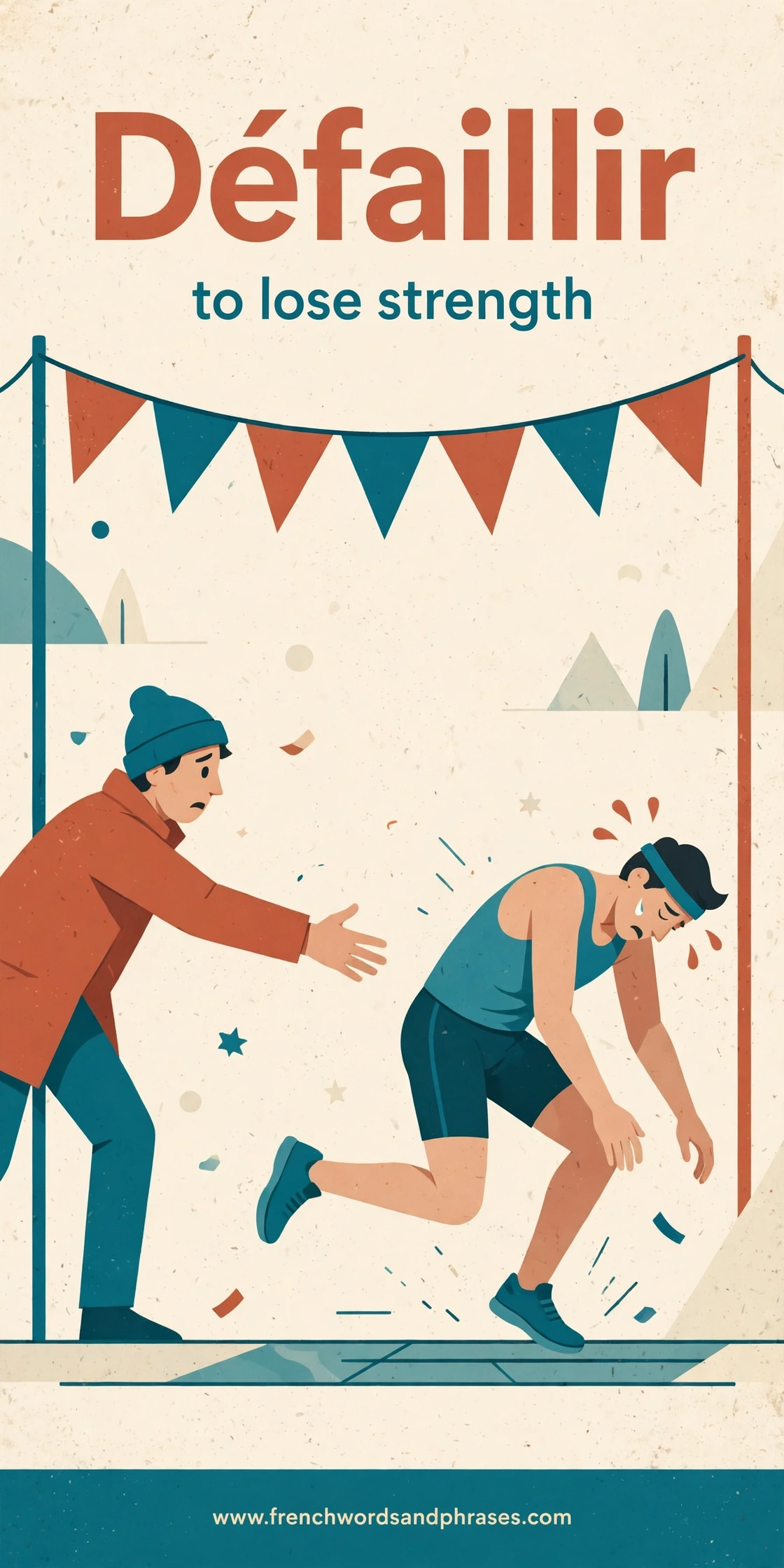
Imagine a marathon runner at the thirty-fifth kilometre. The crowd is shouting, the line is close, and suddenly the legs défaillissent — not a fall, not a stop, just the strength draining out of them like water from a cracked jar.
He has not fallen. His strength is ebbing away — and asking to be rescued.
How to Conjugate Défaillir: Complete French Conjugation Guide
Let’s explore every major conjugation of défaillir, beginning with the indicative mood.
How to Conjugate Défaillir in the Indicative Mood
The indicative mood is used to express facts, observations, actions, and events.
How to Conjugate Défaillir in the Present Tense (Présent)
Used for actions happening now, habitual actions, and general truths.
| Subject | Conjugation |
|---|---|
| je | défaillis |
| tu | défaillis |
| il / elle | défaillit |
| nous | défaillissons |
| vous | défaillissez |
| ils / elles | défaillissent |
Example
Sa voix défaillit à la fin de la chanson.
Her voice falters at the end of the song.
Quick Quiz 1
Complete the sentence:
Nous ne ______ jamais devant la difficulté.
Reveal the answer
défaillissons
Nous ne défaillissons jamais devant la difficulté.
We never falter in the face of difficulty.
How to Conjugate Défaillir in the Passé Composé
Used for completed actions in the past. Défaillir takes the auxiliary verb avoir.
| Subject | Conjugation |
|---|---|
| j’ | ai défailli |
| tu | as défailli |
| il / elle | a défailli |
| nous | avons défailli |
| vous | avez défailli |
| ils / elles | ont défailli |
Example
Il a défailli de fatigue après la course.
He almost collapsed from exhaustion after the race.
How to Conjugate Défaillir in the Imparfait (Imperfect Tense)
Used for habitual past actions, descriptions, and ongoing situations in the past.
| Subject | Conjugation |
|---|---|
| je | défaillissais |
| tu | défaillissais |
| il / elle | défaillissait |
| nous | défaillissions |
| vous | défaillissiez |
| ils / elles | défaillissaient |
Example
Le vieillard défaillissait dès le deuxième étage.
The old man used to lose his strength by the second floor.
Quick Quiz 2
Choose the correct form:
He nearly fainted after the race.
Il ______ après la course. (a défailli / est défailli)
Reveal the answer
a défailli
Il a défailli après la course.
Défaillir takes avoir.
How to Conjugate Défaillir in the Plus-que-parfait
Used to describe an action that had already been completed before another past event.
| Subject | Conjugation |
|---|---|
| j’ | avais défailli |
| tu | avais défailli |
| il / elle | avait défailli |
| nous | avions défailli |
| vous | aviez défailli |
| ils / elles | avaient défailli |
Example
Sa mémoire avait défailli avant même la maladie.
His memory had begun to fail even before the illness.
How to Conjugate Défaillir in the Passé Simple
Primarily used in formal writing, literature, and historical narratives. It is rarely used in everyday conversation.
| Subject | Conjugation |
|---|---|
| je | défaillis |
| tu | défaillis |
| il / elle | défaillit |
| nous | défaillîmes |
| vous | défaillîtes |
| ils / elles | défaillirent |
Example
Le coureur défaillit à cent mètres de l’arrivée.
The runner faltered a hundred metres from the finish.
How to Conjugate Défaillir in the Passé Antérieur
A literary tense used to express an action completed immediately before another past action, generally in the passé simple.
| Subject | Conjugation |
|---|---|
| j’ | eus défailli |
| tu | eus défailli |
| il / elle | eut défailli |
| nous | eûmes défailli |
| vous | eûtes défailli |
| ils / elles | eurent défailli |
Example
Quand le soldat eut défailli, ses camarades le portèrent.
When the soldier had collapsed, his comrades carried him.
How to Conjugate Défaillir in the Future Tense (Futur Simple)
Used to describe actions that will take place in the future.
| Subject | Conjugation |
|---|---|
| je | défaillirai |
| tu | défailliras |
| il / elle | défaillira |
| nous | défaillirons |
| vous | défaillirez |
| ils / elles | défailliront |
Example
Sans eau, tu défailliras sous ce soleil.
Without water, you will lose your strength under this sun.
How to Conjugate Défaillir in the Futur Antérieur (Future Perfect)
Used for an action that will have been completed before a particular point in the future.
| Subject | Conjugation |
|---|---|
| j’ | aurai défailli |
| tu | auras défailli |
| il / elle | aura défailli |
| nous | aurons défailli |
| vous | aurez défailli |
| ils / elles | auront défailli |
Example
À la fin du chantier, ses forces auront défailli plus d’une fois.
By the end of the building work, his strength will have failed more than once.
How to Conjugate Défaillir in the Near Future (Futur Proche)
Used to describe something that is going to happen soon. Formed with aller + infinitive.
| Subject | Conjugation |
|---|---|
| je | vais défaillir |
| tu | vas défaillir |
| il / elle | va défaillir |
| nous | allons défaillir |
| vous | allez défaillir |
| ils / elles | vont défaillir |
Example
Attention, elle va défaillir, donnez-lui une chaise.
Careful, she is about to faint, give her a chair.
How to Conjugate Défaillir in the Conditional Mood
The conditional mood expresses what would happen under certain circumstances. It is also frequently used to make polite requests or express wishes.
How to Conjugate Défaillir in the Present Conditional
| Subject | Conjugation |
|---|---|
| je | défaillirais |
| tu | défaillirais |
| il / elle | défaillirait |
| nous | défaillirions |
| vous | défailliriez |
| ils / elles | défailliraient |
Example
Même épuisé, il ne défaillirait pas devant ses enfants.
Even exhausted, he would not falter in front of his children.
How to Conjugate Défaillir in the Past Conditional
| Subject | Conjugation |
|---|---|
| j’ | aurais défailli |
| tu | aurais défailli |
| il / elle | aurait défailli |
| nous | aurions défailli |
| vous | auriez défailli |
| ils / elles | auraient défailli |
Example
Elle aurait défailli sans ce verre d’eau.
She would have fainted without that glass of water.
Défaillir in the Literary Past Conditional Form
This less common literary form uses the imperfect subjunctive of avoir.
| Subject | Conjugation |
|---|---|
| j’ | eusse défailli |
| tu | eusses défailli |
| il / elle | eût défailli |
| nous | eussions défailli |
| vous | eussiez défailli |
| ils / elles | eussent défailli |
Example
Il eût défailli de joie devant la porte ouverte.
He would have swooned with joy before the open door.
How to Conjugate Défaillir in the Subjunctive Mood
The subjunctive is used to express wishes, emotions, doubts, necessity, and uncertainty. It frequently follows expressions such as il faut que (it is necessary that) or bien que (although).
How to Conjugate Défaillir in the Present Subjunctive
| Subject | Conjugation |
|---|---|
| que je | défaillisse |
| que tu | défaillisses |
| qu’il / qu’elle | défaillisse |
| que nous | défaillissions |
| que vous | défaillissiez |
| qu’ils / qu’elles | défaillissent |
Example
Je crains qu’elle ne défaillisse pendant la cérémonie.
I fear she may faint during the ceremony.
Quick Quiz 3
Complete the sentence using the subjunctive:
Je crains que vous ne ______ sous ce soleil.
Reveal the answer
défaillissiez
Je crains que vous ne défaillissiez sous ce soleil.
I fear you may lose your strength under this sun.
How to Conjugate Défaillir in the Imperfect Subjunctive
A literary tense, rarely encountered in modern spoken French.
| Subject | Conjugation |
|---|---|
| que je | défaillisse |
| que tu | défaillisses |
| qu’il / qu’elle | défaillît |
| que nous | défaillissions |
| que vous | défaillissiez |
| qu’ils / qu’elles | défaillissent |
Example
On le soutenait, de peur qu’il ne défaillît.
They held him up, for fear he might collapse.
How to Conjugate Défaillir in the Pluperfect Subjunctive
A literary construction used to express an action completed before another past action.
| Subject | Conjugation |
|---|---|
| que j’ | eusse défailli |
| que tu | eusses défailli |
| qu’il / qu’elle | eût défailli |
| que nous | eussions défailli |
| que vous | eussiez défailli |
| qu’ils / qu’elles | eussent défailli |
Example
On raconta qu’il eût défailli en entendant la nouvelle.
It was told that he had nearly fainted on hearing the news.
How to Conjugate Défaillir in the Past Subjunctive
| Subject | Conjugation |
|---|---|
| que j’ | aie défailli |
| que tu | aies défailli |
| qu’il / qu’elle | ait défailli |
| que nous | ayons défailli |
| que vous | ayez défailli |
| qu’ils / qu’elles | aient défailli |
Example
Je suis étonné qu’il ait défailli si vite.
I am surprised he gave way so quickly.
How to Conjugate Défaillir in the Imperative
The imperative is used to give commands, instructions, invitations, or suggestions. Subject pronouns are omitted.
How to Conjugate Défaillir in the Present Imperative
| Person | Conjugation |
|---|---|
| (tu) | défaillis |
| (nous) | défaillissons |
| (vous) | défaillissez |
Example
Ne défaillis pas, la ligne est en vue !
Do not falter, the finish line is in sight!
Quick Quiz 4
How would you say Do not falter (tu form)?
Reveal the answer
Ne défaillis pas !
French Participles of Défaillir
Participles are verb forms that can be used in compound tenses and other grammatical constructions.
Present Participle of Défaillir
défaillissant
Défaillissant de chaleur, il s’est assis à l’ombre.
Faint with heat, he sat down in the shade.
Past Participle of Défaillir
défailli
Défailli un instant, le chanteur a retrouvé sa voix.
Having faltered for a moment, the singer found his voice again.
Défaillir in Everyday French: Real-Life Examples
Now that you know the conjugations, let’s see how défaillir appears in everyday French.
Example 1 — Present
Mon courage défaillit devant cet escalier.
My courage fails me in front of this staircase.
Example 2 — Passé composé
Elle a défailli de faim à midi.
She nearly fainted from hunger at midday.
Example 3 — Imparfait
Sa voix défaillissait quand il était ému.
His voice used to falter when he was moved.
Example 4 — Future
Nous ne défaillirons pas.
We will not falter.
Example 5 — Conditional
Tu défaillirais après dix kilomètres sans entraînement.
You would give out after ten kilometres without training.
Example 6 — Imperative
Ne défaillez pas, on arrive !
Do not falter, we are nearly there!
Beyond Translation: The Meaning of Défaillir
English scatters this across faint, falter, fail, give way; French défaillir keeps one verb for the whole slide from strength to weakness.
And its noun runs modern life.
Une défaillance is what hearts, brakes, memories and computer systems all suffer — the verb is literary, but the family name is on every incident report in France.
How to Remember the French Verb Défaillir
Remember it this way: Défaillir is about strength ebbing away — legs, voice, courage, memory.
- La défaillance — a failure, a faint, a breakdown: the noun you will meet everywhere.
- Sans défaillir — without faltering, the heroic negative.
- Second group (-ir): je défaillis, nous défaillissons, past participle défailli, auxiliary avoir.
The key idea is strength ebbing away — legs, voice, courage, memory.
Test Your Knowledge of Défaillir
Let’s see how much you’ve learned. Try answering these questions before revealing the answers.
Question 1
What is une défaillance?
Reveal the answer
A failure, a faint or a breakdown — of a heart, a machine or a memory.
Question 2
How do you say We will not falter in French?
Reveal the answer
Nous ne défaillirons pas.
Question 3
Translate: She nearly fainted from hunger.
Reveal the answer
Elle a défailli de faim.
Question 4
What is the past participle of défaillir?
Reveal the answer
Défailli.
Question 5
Complete the sentence:
Je crains qu’elle ne ______ pendant la cérémonie.
Reveal the answer
défaillisse
Je crains qu’elle ne défaillisse pendant la cérémonie.
I fear she may faint during the ceremony.
Your Final Challenge
Can You Use It?
How would you say this in French?
He does not falter: he grits his teeth and climbs the last flight.
Reveal the answer
Il ne défaillit pas : il serre les dents et monte le dernier étage.
He does not falter: he grits his teeth and climbs the last flight.
A little French. A little curiosity. A richer everyday life.
LEARN FRENCH ONE WORD AT A TIME




