A French Word to Live By
How to Conjugate Déculasser in French
/de.ky.la.se/
Déculasser means to unbreech — to remove the breech of a gun, the block that closes the barrel, for cleaning, inspection or repair.
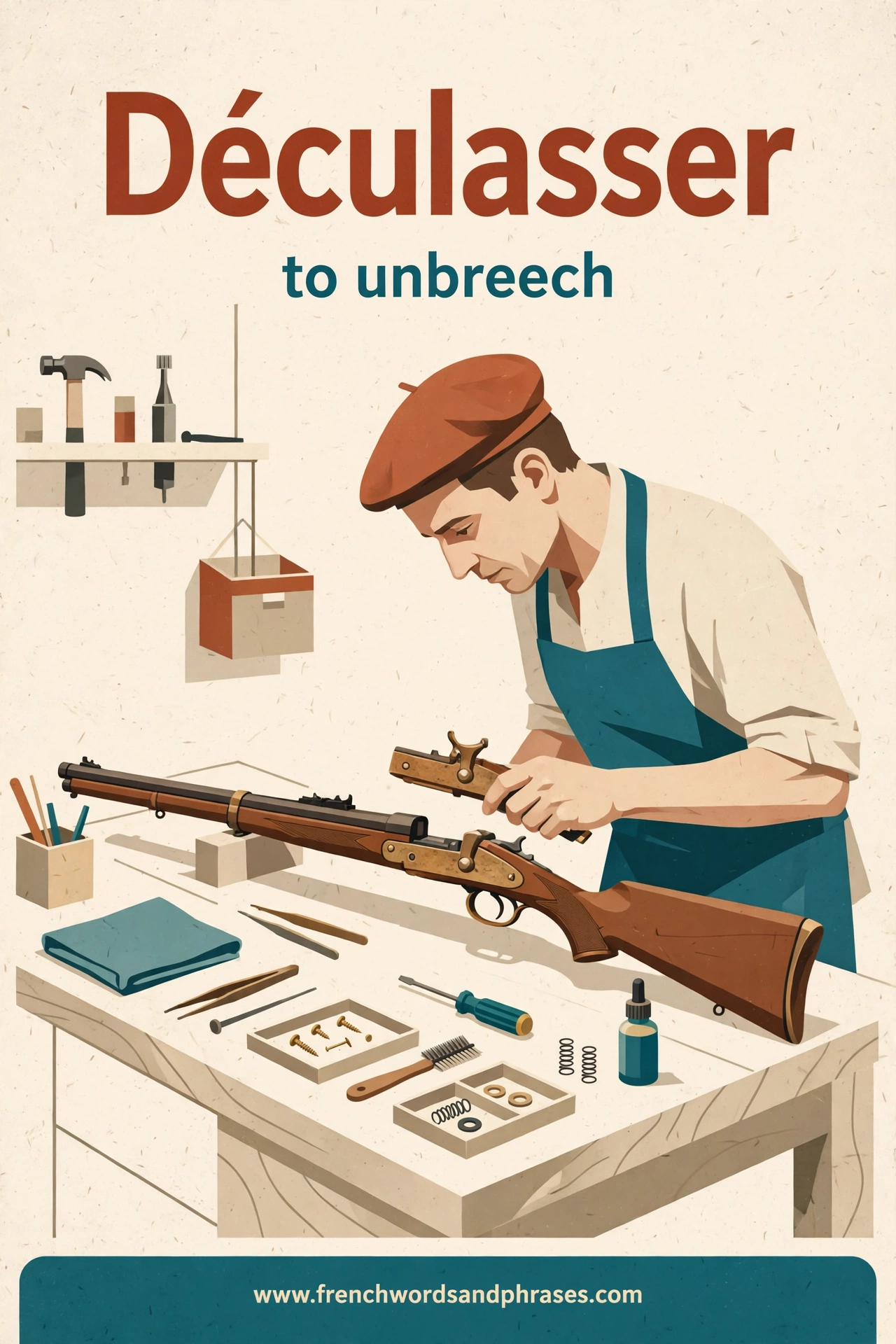
An old cannon on a rampart, a hunter’s rifle opened on a workbench, a soldier field-stripping his weapon by lamplight — déculasser is the gunsmith’s verb for taking the breech off, the first move in cleaning and repairing a firearm.
In this guide, you’ll learn how to conjugate déculasser in all the major French tenses and moods. Explore complete conjugation tables, French examples, English translations, and practice quizzes.
Understanding the French Verb Déculasser
Déculasser is a regular French verb belonging to the first group of verbs, those ending in -er.
It means to unbreech. It is commonly used by gunsmiths and soldiers for removing the breech or bolt assembly of rifles and artillery pieces during cleaning and maintenance, in hunting circles for opening up a gun at the end of the day, and in manuals where déculasser precedes every inspection of the barrel.
Verb classification: First group (-er)
Auxiliary verb: Avoir
Past participle: déculassé
Present participle: déculassant
English equivalents: To unbreech, to remove the breech (of a gun); la culasse — the breech, also a cylinder head in an engine.
One important detail: déculasser is built on la culasse, the breech of a gun — the metal block that closes the back of the barrel and takes the shock of the shot. French drivers know the same word under the bonnet: la culasse is also the cylinder head of an engine, and a blown head gasket is un joint de culasse. The verb itself stays with firearms: to déculasser is to take that block off, for cleaning, inspection or repair.
Experience the Word
Déculasser is the verb of the careful pause — before a gun is cleaned, stored or trusted again, its breech comes off.
Imagine an armoury at dusk. The old soldier lays his rifle on the bench, works the mechanism with practised hands, and déculasse the weapon piece by piece, lining up each part in order on the cloth, as his father taught him.
The rifle is not broken. It has been unbreeched — déculassé — opened up for care and inspection.
How to Conjugate Déculasser: Complete French Conjugation Guide
Let’s explore every major conjugation of déculasser, beginning with the indicative mood.
How to Conjugate Déculasser in the Indicative Mood
The indicative mood is used to express facts, observations, actions, and events.
How to Conjugate Déculasser in the Present Tense (Présent)
Used for actions happening now, habitual actions, and general truths.
| Subject | Conjugation |
|---|---|
| je | déculasse |
| tu | déculasses |
| il / elle | déculasse |
| nous | déculassons |
| vous | déculassez |
| ils / elles | déculassent |
Example
L’armurier déculasse le fusil avant de le nettoyer.
The gunsmith unbreeches the rifle before cleaning it.
Quick Quiz 1
Complete the sentence:
Nous ______ les fusils avant réparation.
Reveal the answer
déculassons
Nous déculassons les fusils avant réparation.
We unbreech the rifles before repair.
How to Conjugate Déculasser in the Passé Composé
Used for completed actions in the past. Déculasser takes the auxiliary verb avoir.
| Subject | Conjugation |
|---|---|
| j’ | ai déculassé |
| tu | as déculassé |
| il / elle | a déculassé |
| nous | avons déculassé |
| vous | avez déculassé |
| ils / elles | ont déculassé |
Example
Il a déculassé son fusil après la chasse.
He unbreeched his rifle after the hunt.
How to Conjugate Déculasser in the Imparfait (Imperfect Tense)
Used for habitual past actions, descriptions, and ongoing situations in the past.
| Subject | Conjugation |
|---|---|
| je | déculassais |
| tu | déculassais |
| il / elle | déculassait |
| nous | déculassions |
| vous | déculassiez |
| ils / elles | déculassaient |
Example
Chaque soir, les soldats déculassaient leurs armes au bivouac.
Every evening, the soldiers used to unbreech their weapons at the bivouac.
Quick Quiz 2
Choose the correct form:
He unbreeched his rifle.
Il ______ son fusil. (a déculassé / est déculassé)
Reveal the answer
a déculassé
Il a déculassé son fusil.
Déculasser takes avoir.
How to Conjugate Déculasser in the Plus-que-parfait
Used to describe an action that had already been completed before another past event.
| Subject | Conjugation |
|---|---|
| j’ | avais déculassé |
| tu | avais déculassé |
| il / elle | avait déculassé |
| nous | avions déculassé |
| vous | aviez déculassé |
| ils / elles | avaient déculassé |
Example
Elle avait déculassé le canon avant l’inspection.
She had unbreeched the cannon before the inspection.
How to Conjugate Déculasser in the Passé Simple
Primarily used in formal writing, literature, and historical narratives. It is rarely used in everyday conversation.
| Subject | Conjugation |
|---|---|
| je | déculassai |
| tu | déculassas |
| il / elle | déculassa |
| nous | déculassâmes |
| vous | déculassâtes |
| ils / elles | déculassèrent |
Example
Le soldat déculassa son fusil et nettoya chaque pièce.
The soldier unbreeched his rifle and cleaned every part.
How to Conjugate Déculasser in the Passé Antérieur
A literary tense used to express an action completed immediately before another past action, generally in the passé simple.
| Subject | Conjugation |
|---|---|
| j’ | eus déculassé |
| tu | eus déculassé |
| il / elle | eut déculassé |
| nous | eûmes déculassé |
| vous | eûtes déculassé |
| ils / elles | eurent déculassé |
Example
Quand il eut déculassé l’arme, il la posa sur l’établi.
When he had unbreeched the weapon, he laid it on the workbench.
How to Conjugate Déculasser in the Future Tense (Futur Simple)
Used to describe actions that will take place in the future.
| Subject | Conjugation |
|---|---|
| je | déculasserai |
| tu | déculasseras |
| il / elle | déculassera |
| nous | déculasserons |
| vous | déculasserez |
| ils / elles | déculasseront |
Example
Demain, nous déculasserons les vieux fusils du musée.
Tomorrow, we will unbreech the museum’s old rifles.
How to Conjugate Déculasser in the Futur Antérieur (Future Perfect)
Used for an action that will have been completed before a particular point in the future.
| Subject | Conjugation |
|---|---|
| j’ | aurai déculassé |
| tu | auras déculassé |
| il / elle | aura déculassé |
| nous | aurons déculassé |
| vous | aurez déculassé |
| ils / elles | auront déculassé |
Example
À la fin de l’exercice, ils auront déculassé toutes les armes.
By the end of the exercise, they will have unbreeched all the weapons.
How to Conjugate Déculasser in the Near Future (Futur Proche)
Used to describe something that is going to happen soon. Formed with aller + infinitive.
| Subject | Conjugation |
|---|---|
| je | vais déculasser |
| tu | vas déculasser |
| il / elle | va déculasser |
| nous | allons déculasser |
| vous | allez déculasser |
| ils / elles | vont déculasser |
Example
Je vais déculasser ce fusil pour vérifier le mécanisme.
I am going to unbreech this rifle to check the mechanism.
How to Conjugate Déculasser in the Conditional Mood
The conditional mood expresses what would happen under certain circumstances. It is also frequently used to make polite requests or express wishes.
How to Conjugate Déculasser in the Present Conditional
| Subject | Conjugation |
|---|---|
| je | déculasserais |
| tu | déculasserais |
| il / elle | déculasserait |
| nous | déculasserions |
| vous | déculasseriez |
| ils / elles | déculasseraient |
Example
Avec le bon outil, on déculasserait ce canon sans forcer.
With the right tool, we would unbreech this cannon without forcing.
How to Conjugate Déculasser in the Past Conditional
| Subject | Conjugation |
|---|---|
| j’ | aurais déculassé |
| tu | aurais déculassé |
| il / elle | aurait déculassé |
| nous | aurions déculassé |
| vous | auriez déculassé |
| ils / elles | auraient déculassé |
Example
Il aurait déculassé son arme plus tôt sans la rouille.
He would have unbreeched his weapon earlier if not for the rust.
Déculasser in the Literary Past Conditional Form
This less common literary form uses the imperfect subjunctive of avoir.
| Subject | Conjugation |
|---|---|
| j’ | eusse déculassé |
| tu | eusses déculassé |
| il / elle | eût déculassé |
| nous | eussions déculassé |
| vous | eussiez déculassé |
| ils / elles | eussent déculassé |
Example
Le canonnier eût déculassé sa pièce avant la bataille.
The gunner would have unbreeched his piece before the battle.
How to Conjugate Déculasser in the Subjunctive Mood
The subjunctive is used to express wishes, emotions, doubts, necessity, and uncertainty. It frequently follows expressions such as il faut que (it is necessary that) or bien que (although).
How to Conjugate Déculasser in the Present Subjunctive
| Subject | Conjugation |
|---|---|
| que je | déculasse |
| que tu | déculasses |
| qu’il / qu’elle | déculasse |
| que nous | déculassions |
| que vous | déculassiez |
| qu’ils / qu’elles | déculassent |
Example
Il faut que vous déculassiez l’arme avant de la ranger.
You must unbreech the weapon before putting it away.
Quick Quiz 3
Complete the sentence using the subjunctive:
Il faut que vous ______ l’arme en toute sécurité.
Reveal the answer
déculassiez
Il faut que vous déculassiez l’arme en toute sécurité.
You must unbreech the weapon safely.
How to Conjugate Déculasser in the Imperfect Subjunctive
A literary tense, rarely encountered in modern spoken French.
| Subject | Conjugation |
|---|---|
| que je | déculassasse |
| que tu | déculassasses |
| qu’il / qu’elle | déculassât |
| que nous | déculassassions |
| que vous | déculassassiez |
| qu’ils / qu’elles | déculassassent |
Example
L’officier voulait que les soldats déculassassent leurs fusils le soir même.
The officer wanted the soldiers to unbreech their rifles that very evening.
How to Conjugate Déculasser in the Pluperfect Subjunctive
A literary construction used to express an action completed before another past action.
| Subject | Conjugation |
|---|---|
| que j’ | eusse déculassé |
| que tu | eusses déculassé |
| qu’il / qu’elle | eût déculassé |
| que nous | eussions déculassé |
| que vous | eussiez déculassé |
| qu’ils / qu’elles | eussent déculassé |
Example
On craignait qu’ils eussent déculassé le canon sans précaution.
People feared they had unbreeched the cannon carelessly.
How to Conjugate Déculasser in the Past Subjunctive
| Subject | Conjugation |
|---|---|
| que j’ | aie déculassé |
| que tu | aies déculassé |
| qu’il / qu’elle | ait déculassé |
| que nous | ayons déculassé |
| que vous | ayez déculassé |
| qu’ils / qu’elles | aient déculassé |
Example
Je suis content que vous ayez déculassé le fusil en toute sécurité.
I am glad you unbreeched the rifle safely.
How to Conjugate Déculasser in the Imperative
The imperative is used to give commands, instructions, invitations, or suggestions. Subject pronouns are omitted.
How to Conjugate Déculasser in the Present Imperative
| Person | Conjugation |
|---|---|
| (tu) | déculasse |
| (nous) | déculassons |
| (vous) | déculassez |
Example
Déculasse ton fusil avant de le nettoyer !
Unbreech your rifle before cleaning it!
Quick Quiz 4
How would you say Unbreech your rifle (tu form)?
Reveal the answer
Déculasse ton fusil !
French Participles of Déculasser
Participles are verb forms that can be used in compound tenses and other grammatical constructions.
Present Participle of Déculasser
déculassant
En déculassant le fusil, il a trouvé le mécanisme encrassé.
While unbreeching the rifle, he found the mechanism fouled.
Past Participle of Déculasser
déculassé
Déculassé et nettoyé, le fusil repartait au râtelier.
Unbreeched and cleaned, the rifle went back to the rack.
Déculasser in Everyday French: Real-Life Examples
Now that you know the conjugations, let’s see how déculasser appears in everyday French.
Example 1 — Present
L’armurier déculasse les fusils avant réparation.
The gunsmith unbreeches the rifles before repair.
Example 2 — Passé composé
Il a déculassé son fusil après la partie de chasse.
He unbreeched his rifle after the hunt.
Example 3 — Imparfait
Les soldats déculassaient leurs armes chaque soir.
The soldiers used to unbreech their weapons every evening.
Example 4 — Future
Nous déculasserons le vieux canon du fort.
We will unbreech the fort’s old cannon.
Example 5 — Conditional
On déculasserait plus facilement avec l’outil d’origine.
We would unbreech more easily with the original tool.
Example 6 — Imperative
Déculassez l’arme avant l’inspection !
Unbreech the weapon before the inspection!
Beyond Translation: The Meaning of Déculasser
English barely keeps to unbreech alive outside old artillery manuals; French déculasser survives because la culasse itself stayed an everyday word — in the armoury and under the car bonnet alike.
One word, two machines.
The block that closes a gun barrel and the head that closes an engine share the same name and the same job: to hold back the explosion.
How to Remember the French Verb Déculasser
Remember it this way: Déculasser is about taking the breech off a gun — the armoury’s first move.
- La culasse — the breech of a gun, and the cylinder head of an engine.
- Déculasser un fusil — the first step of cleaning and inspection.
- Regular -er: je déculasse, nous déculassons, past participle déculassé.
The key idea is taking the breech off a gun — the armoury’s first move.
Test Your Knowledge of Déculasser
Let’s see how much you’ve learned. Try answering these questions before revealing the answers.
Question 1
What is la culasse?
Reveal the answer
The breech of a gun — also the cylinder head of an engine.
Question 2
How do you say The gunsmith unbreeches the rifle in French?
Reveal the answer
L’armurier déculasse le fusil.
Question 3
Translate: He unbreeched his rifle after the hunt.
Reveal the answer
Il a déculassé son fusil après la chasse.
Question 4
What is the past participle of déculasser?
Reveal the answer
Déculassé.
Question 5
Complete the sentence:
Il faut que vous ______ l’arme avant de la ranger.
Reveal the answer
déculassiez
Il faut que vous déculassiez l’arme avant de la ranger.
You must unbreech the weapon before putting it away.
Your Final Challenge
Can You Use It?
How would you say this in French?
The soldier unbreeches his rifle at dusk, cleans every part, and the weapon sleeps in peace.
Reveal the answer
Le soldat déculasse son fusil au crépuscule, nettoie chaque pièce, et l’arme dort en paix.
The soldier unbreeches his rifle at dusk, cleans every part, and the weapon sleeps in peace.
A little French. A little curiosity. A richer everyday life.
LEARN FRENCH ONE WORD AT A TIME