
A French Word to Live By
How to Conjugate Déculotter in French
/de.ky.lɔ.te/
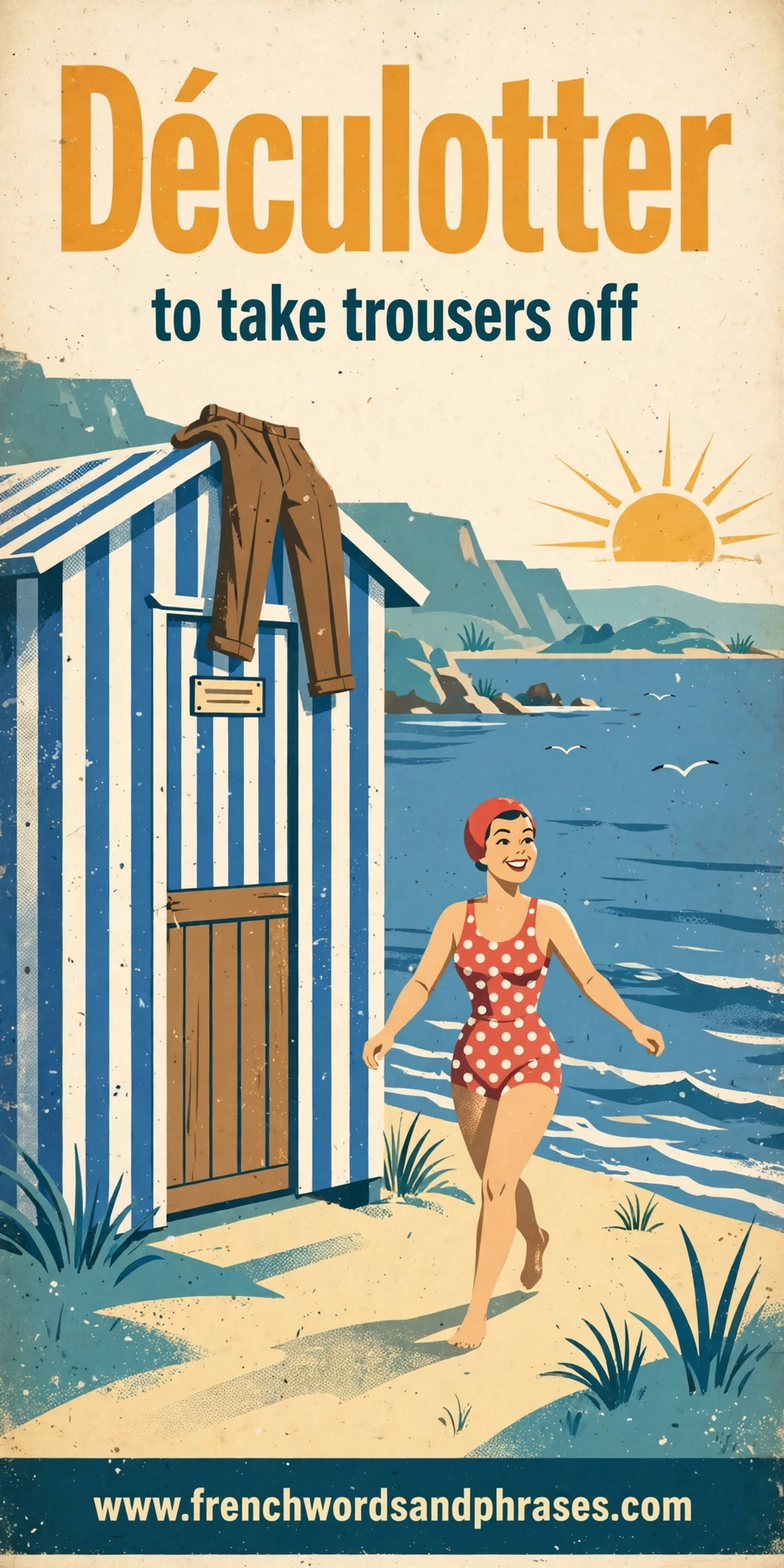
Déculotter means to take trousers off — to pull someone’s trousers (or breeches) down or off.
A small boy caught mid-prank, trousers around his ankles, red-faced while the whole courtyard laughs — déculotter is the verb of that old schoolyard humiliation, and of the simple act behind it: taking someone’s trousers off.
In this guide, you’ll learn how to conjugate déculotter in all the major French tenses and moods. Explore complete conjugation tables, French examples, English translations, and practice quizzes.
Understanding the French Verb Déculotter
Déculotter is a regular French verb belonging to the first group of verbs, those ending in -er.
It means to take trousers off. It is commonly used for the literal act — undressing a child, a patient, a swimmer in a hurry — for the schoolyard prank of pulling a victim’s trousers down as a joke or humiliation, and in the reflexive, figuratively, for giving in or chickening out under pressure.
Verb classification: First group (-er)
Auxiliary verb: Avoir
Past participle: déculotté
Present participle: déculottant
English equivalents: To take someone’s trousers off, to pull trousers down; se déculotter — to take one’s own trousers off, (figurative) to chicken out, to back down.
One important detail: déculotter is built on la culotte, breeches or trousers — in modern French, also women’s knickers. The verb has two lives. Literally, déculotter quelqu’un is to pull their trousers down, the classic playground prank and an old punishment of shame. Reflexively, se déculotter means taking your own trousers off — and, figuratively, backing down or chickening out, as the older phrase has it: se déculotter devant l’ennemi, to lose your nerve and give in. The page stays with the base verb and avoir; the reflexive use is taught alongside.
Experience the Word
Déculotter is the verb of trousers and pride — both tend to end up lowered at the same time.
Imagine a village schoolyard a century ago. The class clown, caught boasting once too often, is held laughing by his friends and déculotté in front of everyone — a shame so complete that grandfathers still tell the story.
Nothing was stolen and no one was hurt. He was déculotté — trousers down, pride down with them.
How to Conjugate Déculotter: Complete French Conjugation Guide
Let’s explore every major conjugation of déculotter, beginning with the indicative mood.
How to Conjugate Déculotter in the Indicative Mood
The indicative mood is used to express facts, observations, actions, and events.
How to Conjugate Déculotter in the Present Tense (Présent)
Used for actions happening now, habitual actions, and general truths.
| Subject | Conjugation |
|---|---|
| je | déculotte |
| tu | déculottes |
| il / elle | déculotte |
| nous | déculottons |
| vous | déculottez |
| ils / elles | déculottent |
Example
La mère déculotte le petit garçon pour le bain.
The mother takes the little boy’s trousers off for his bath.
Quick Quiz 1
Complete the sentence:
Nous ______ le mannequin pour l’habiller.
Reveal the answer
déculottons
Nous déculottons le mannequin pour l’habiller.
We take the dummy’s trousers off to dress it.
How to Conjugate Déculotter in the Passé Composé
Used for completed actions in the past. Déculotter takes the auxiliary verb avoir.
| Subject | Conjugation |
|---|---|
| j’ | ai déculotté |
| tu | as déculotté |
| il / elle | a déculotté |
| nous | avons déculotté |
| vous | avez déculotté |
| ils / elles | ont déculotté |
Example
Les garnements ont déculotté le nouveau dans la cour.
The rascals pulled the new boy’s trousers down in the yard.
How to Conjugate Déculotter in the Imparfait (Imperfect Tense)
Used for habitual past actions, descriptions, and ongoing situations in the past.
| Subject | Conjugation |
|---|---|
| je | déculottais |
| tu | déculottais |
| il / elle | déculottait |
| nous | déculottions |
| vous | déculottiez |
| ils / elles | déculottaient |
Example
À l’école d’autrefois, on déculottait les paresseux pour l’exemple.
In the school of old, lazy boys were debagged as an example.
Quick Quiz 2
Choose the correct form:
They pulled the new boy’s trousers down.
Ils ______ le nouveau. (ont déculotté / sont déculottés)
Reveal the answer
ont déculotté
Ils ont déculotté le nouveau.
Déculotter takes avoir.
How to Conjugate Déculotter in the Plus-que-parfait
Used to describe an action that had already been completed before another past event.
| Subject | Conjugation |
|---|---|
| j’ | avais déculotté |
| tu | avais déculotté |
| il / elle | avait déculotté |
| nous | avions déculotté |
| vous | aviez déculotté |
| ils / elles | avaient déculotté |
Example
Il s’était déculotté devant l’infirmière sans rougir.
He had taken his trousers off in front of the nurse without blushing.
How to Conjugate Déculotter in the Passé Simple
Primarily used in formal writing, literature, and historical narratives. It is rarely used in everyday conversation.
| Subject | Conjugation |
|---|---|
| je | déculottai |
| tu | déculottas |
| il / elle | déculotta |
| nous | déculottâmes |
| vous | déculottâtes |
| ils / elles | déculottèrent |
Example
Les soldats déculottèrent le prisonnier pour le fouiller.
The soldiers took the prisoner’s trousers off to search him.
How to Conjugate Déculotter in the Passé Antérieur
A literary tense used to express an action completed immediately before another past action, generally in the passé simple.
| Subject | Conjugation |
|---|---|
| j’ | eus déculotté |
| tu | eus déculotté |
| il / elle | eut déculotté |
| nous | eûmes déculotté |
| vous | eûtes déculotté |
| ils / elles | eurent déculotté |
Example
Quand ils eurent déculotté le mannequin, les enfants éclatèrent de rire.
When they had pulled the dummy’s trousers down, the children burst out laughing.
How to Conjugate Déculotter in the Future Tense (Futur Simple)
Used to describe actions that will take place in the future.
| Subject | Conjugation |
|---|---|
| je | déculotterai |
| tu | déculotteras |
| il / elle | déculottera |
| nous | déculotterons |
| vous | déculotterez |
| ils / elles | déculotteront |
Example
Le médecin te déculottera pour examiner ta jambe.
The doctor will take your trousers off to examine your leg.
How to Conjugate Déculotter in the Futur Antérieur (Future Perfect)
Used for an action that will have been completed before a particular point in the future.
| Subject | Conjugation |
|---|---|
| j’ | aurai déculotté |
| tu | auras déculotté |
| il / elle | aura déculotté |
| nous | aurons déculotté |
| vous | aurez déculotté |
| ils / elles | auront déculotté |
Example
À la fin de la farce, ils auront déculotté la moitié de la classe.
By the end of the prank, they will have debagged half the class.
How to Conjugate Déculotter in the Near Future (Futur Proche)
Used to describe something that is going to happen soon. Formed with aller + infinitive.
| Subject | Conjugation |
|---|---|
| je | vais déculotter |
| tu | vas déculotter |
| il / elle | va déculotter |
| nous | allons déculotter |
| vous | allez déculotter |
| ils / elles | vont déculotter |
Example
Attention, il va se déculotter pour plonger !
Watch out, he is going to take his trousers off to dive in!
How to Conjugate Déculotter in the Conditional Mood
The conditional mood expresses what would happen under certain circumstances. It is also frequently used to make polite requests or express wishes.
How to Conjugate Déculotter in the Present Conditional
| Subject | Conjugation |
|---|---|
| je | déculotterais |
| tu | déculotterais |
| il / elle | déculotterait |
| nous | déculotterions |
| vous | déculotteriez |
| ils / elles | déculotteraient |
Example
Un vrai ami ne déculotterait jamais quelqu’un en public.
A true friend would never pull someone’s trousers down in public.
How to Conjugate Déculotter in the Past Conditional
| Subject | Conjugation |
|---|---|
| j’ | aurais déculotté |
| tu | aurais déculotté |
| il / elle | aurait déculotté |
| nous | aurions déculotté |
| vous | auriez déculotté |
| ils / elles | auraient déculotté |
Example
Sans le maître, ils auraient déculotté le petit nouveau.
Without the teacher, they would have debagged the new boy.
Déculotter in the Literary Past Conditional Form
This less common literary form uses the imperfect subjunctive of avoir.
| Subject | Conjugation |
|---|---|
| j’ | eusse déculotté |
| tu | eusses déculotté |
| il / elle | eût déculotté |
| nous | eussions déculotté |
| vous | eussiez déculotté |
| ils / elles | eussent déculotté |
Example
Les garnements eussent déculotté le fils du maire lui-même.
The rascals would have debagged even the mayor’s son.
How to Conjugate Déculotter in the Subjunctive Mood
The subjunctive is used to express wishes, emotions, doubts, necessity, and uncertainty. It frequently follows expressions such as il faut que (it is necessary that) or bien que (although).
How to Conjugate Déculotter in the Present Subjunctive
| Subject | Conjugation |
|---|---|
| que je | déculotte |
| que tu | déculottes |
| qu’il / qu’elle | déculotte |
| que nous | déculottions |
| que vous | déculottiez |
| qu’ils / qu’elles | déculottent |
Example
Je ne veux pas que les grands déculottent les petits.
I do not want the big boys pulling the little ones’ trousers down.
Quick Quiz 3
Complete the sentence using the subjunctive:
Je ne veux pas que vous ______ les petits.
Reveal the answer
déculottiez
Je ne veux pas que vous déculottiez les petits.
I do not want you pulling the little ones’ trousers down.
How to Conjugate Déculotter in the Imperfect Subjunctive
A literary tense, rarely encountered in modern spoken French.
| Subject | Conjugation |
|---|---|
| que je | déculottasse |
| que tu | déculottasses |
| qu’il / qu’elle | déculottât |
| que nous | déculottassions |
| que vous | déculottassiez |
| qu’ils / qu’elles | déculottassent |
Example
La mère craignait que l’infirmière déculottât son fils devant tous.
The mother feared the nurse might take her son’s trousers off in front of everyone.
How to Conjugate Déculotter in the Pluperfect Subjunctive
A literary construction used to express an action completed before another past action.
| Subject | Conjugation |
|---|---|
| que j’ | eusse déculotté |
| que tu | eusses déculotté |
| qu’il / qu’elle | eût déculotté |
| que nous | eussions déculotté |
| que vous | eussiez déculotté |
| qu’ils / qu’elles | eussent déculotté |
Example
On racontait qu’ils eussent déculotté le gardien pendant sa sieste.
It was said they had pulled the caretaker’s trousers down during his nap.
How to Conjugate Déculotter in the Past Subjunctive
| Subject | Conjugation |
|---|---|
| que j’ | aie déculotté |
| que tu | aies déculotté |
| qu’il / qu’elle | ait déculotté |
| que nous | ayons déculotté |
| que vous | ayez déculotté |
| qu’ils / qu’elles | aient déculotté |
Example
Je suis étonné qu’ils aient déculotté le mannequin de la vitrine.
I am surprised they pulled down the shop-window dummy’s trousers.
How to Conjugate Déculotter in the Imperative
The imperative is used to give commands, instructions, invitations, or suggestions. Subject pronouns are omitted.
How to Conjugate Déculotter in the Present Imperative
| Person | Conjugation |
|---|---|
| (tu) | déculotte |
| (nous) | déculottons |
| (vous) | déculottez |
Example
Ne déculotte pas ton petit frère pour rire !
Do not pull your little brother’s trousers down for a laugh!
Quick Quiz 4
How would you say Do not pull his trousers down (tu form)?
Reveal the answer
Ne déculotte pas ton petit frère !
French Participles of Déculotter
Participles are verb forms that can be used in compound tenses and other grammatical constructions.
Present Participle of Déculotter
déculottant
En se déculottant pour le bain, le petit a fait rire toute la famille.
Taking his trousers off for his bath, the little one made the whole family laugh.
Past Participle of Déculotter
déculotté
Déculotté en pleine cour, le garçon ne savait plus où se mettre.
Debagged in the middle of the yard, the boy did not know where to hide.
Déculotter in Everyday French: Real-Life Examples
Now that you know the conjugations, let’s see how déculotter appears in everyday French.
Example 1 — Present
Elle déculotte son fils avant le bain.
She takes her son’s trousers off before his bath.
Example 2 — Passé composé
Il s’est déculotté chez le médecin.
He took his trousers off at the doctor’s.
Example 3 — Imparfait
Les garnements déculottaient les nouveaux à la récréation.
The rascals used to debag the new boys at break time.
Example 4 — Future
Tu te déculotteras pour la visite médicale.
You will take your trousers off for the medical examination.
Example 5 — Conditional
Personne ne se déculotterait devant l’adversaire, par fierté.
Nobody would back down before the opponent, out of pride.
Example 6 — Imperative
Déculottez le mannequin pour l’habiller autrement !
Take the dummy’s trousers off to dress it differently!
Beyond Translation: The Meaning of Déculotter
English keeps a slangy twin — to debag — for the same schoolyard crime; French déculotter is the standard verb, rooted in la culotte, the breeches of the old regime.
And the reflexive turns the joke into character.
Se déculotter — literally to take your own trousers off — came to mean giving in, losing your nerve: the ultimate surrender, performed on yourself.
How to Remember the French Verb Déculotter
Remember it this way: Déculotter is about trousers down — the prank, the bath, and the figurative surrender.
- La culotte — trousers, breeches (and knickers); déculotter takes them off.
- Se déculotter — to take your own trousers off; figuratively, to chicken out, to give in.
- Regular -er: je déculotte, nous déculottons, past participle déculotté.
The key idea is trousers down — the prank, the bath, and the figurative surrender.
Test Your Knowledge of Déculotter
Let’s see how much you’ve learned. Try answering these questions before revealing the answers.
Question 1
What does se déculotter mean figuratively?
Reveal the answer
To chicken out, to give in — literally, to take your own trousers off.
Question 2
How do you say She takes her son’s trousers off in French?
Reveal the answer
Elle déculotte son fils.
Question 3
Translate: The rascals pulled the new boy’s trousers down.
Reveal the answer
Les garnements ont déculotté le nouveau.
Question 4
What is the past participle of déculotter?
Reveal the answer
Déculotté.
Question 5
Complete the sentence:
Je ne veux pas que les grands ______ les petits.
Reveal the answer
déculottent
Je ne veux pas que les grands déculottent les petits.
I do not want the big boys pulling the little ones’ trousers down.
Your Final Challenge
Can You Use It?
How would you say this in French?
The rascal pulled down the shop-window dummy’s trousers, and the whole village is still laughing about it.
Reveal the answer
Le garnement a déculotté le mannequin de la vitrine, et tout le village en rit encore.
The rascal pulled down the shop-window dummy’s trousers, and the whole village is still laughing about it.
A little French. A little curiosity. A richer everyday life.
LEARN FRENCH ONE WORD AT A TIME




