A French Word to Live By
How to Conjugate Déconcentrer in French
/de.kɔ̃.sɑ̃.tʁe/
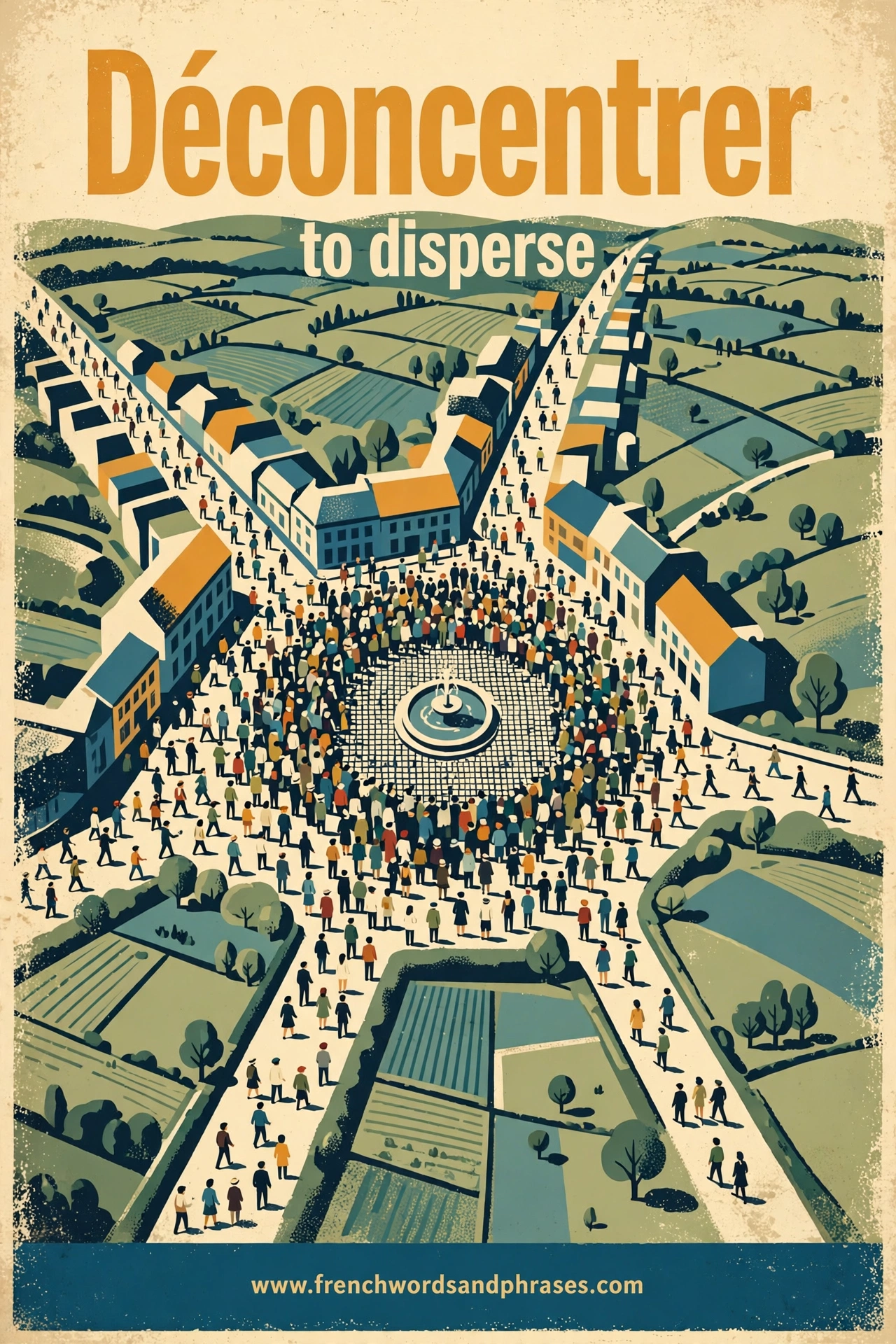
Déconcentrer means to disperse.
A capital city choking on ministries while the provinces wait, a single office holding every file — déconcentrer is the verb of dispersing what is concentrated: sending services, people and power out from the centre.
In this guide, you’ll learn how to conjugate déconcentrer in all the major French tenses and moods. Explore complete conjugation tables, French examples, English translations, and practice quizzes.
Understanding the French Verb Déconcentrer
Déconcentrer is a regular French verb belonging to the first group of verbs, those ending in -er.
It means to disperse. It is commonly used in administration for spreading state services and offices out of the capital, in planning for dispersing crowds, traffic or facilities, and for breaking someone’s focus — and in the reflexive for minds that wander at the wrong moment.
Verb classification: First group (-er)
Auxiliary verb: Avoir
Past participle: déconcentré
Present participle: déconcentrant
English equivalents: To disperse, to deconcentrate; (administration) to spread services out from the centre; se déconcentrer — to lose one’s concentration.
One important detail: déconcentrer is dé- (undoing) plus concentrer, and in French public life its noun la déconcentration names a precise policy: the central state disperses its own services across the country — des services déconcentrés, local branches of national ministries. That is not the same as la décentralisation, which hands real power to elected regions. The reflexive se déconcentrer belongs to sport and exams: to lose focus at the worst moment — le gardien s’est déconcentré, the goalkeeper switched off. The past participle is déconcentré.
Experience the Word
Déconcentrer is the verb of the over-full centre — everything piled in one place, until the place can no longer breathe.
Imagine a ministry corridor in Paris where every file from every village must climb the same stairs. Then imagine the same services planted in forty towns, close to the people who use them: that journey outward is déconcentrer.
Nothing has been abolished. It has been dispersed — spread out, shared out, brought closer.
How to Conjugate Déconcentrer: Complete French Conjugation Guide
Let’s explore every major conjugation of déconcentrer, beginning with the indicative mood.
How to Conjugate Déconcentrer in the Indicative Mood
The indicative mood is used to express facts, observations, actions, and events.
How to Conjugate Déconcentrer in the Present Tense (Présent)
Used for actions happening now, habitual actions, and general truths.
| Subject | Conjugation |
|---|---|
| je | déconcentre |
| tu | déconcentres |
| il / elle | déconcentre |
| nous | déconcentrons |
| vous | déconcentrez |
| ils / elles | déconcentrent |
Example
L’État déconcentre ses services dans les régions.
The state disperses its services into the regions.
Quick Quiz 1
Complete the sentence:
Nous ______ les services dans les régions.
Reveal the answer
déconcentrons
Nous déconcentrons les services dans les régions.
We disperse the services into the regions.
How to Conjugate Déconcentrer in the Passé Composé
Used for completed actions in the past. Déconcentrer takes the auxiliary verb avoir.
| Subject | Conjugation |
|---|---|
| j’ | ai déconcentré |
| tu | as déconcentré |
| il / elle | a déconcentré |
| nous | avons déconcentré |
| vous | avez déconcentré |
| ils / elles | ont déconcentré |
Example
La mairie a déconcentré les guichets dans tous les quartiers.
The town hall dispersed its counters into every district.
How to Conjugate Déconcentrer in the Imparfait (Imperfect Tense)
Used for habitual past actions, descriptions, and ongoing situations in the past.
| Subject | Conjugation |
|---|---|
| je | déconcentrais |
| tu | déconcentrais |
| il / elle | déconcentrait |
| nous | déconcentrions |
| vous | déconcentriez |
| ils / elles | déconcentraient |
Example
Autrefois, on déconcentrait rarement l’administration hors de Paris.
In the old days, the administration was rarely dispersed outside Paris.
Quick Quiz 2
Choose the correct form:
The town dispersed the offices.
La ville ______ les bureaux. (a déconcentré / est déconcentrée)
Reveal the answer
a déconcentré
La ville a déconcentré les bureaux.
Déconcentrer takes avoir.
How to Conjugate Déconcentrer in the Plus-que-parfait
Used to describe an action that had already been completed before another past event.
| Subject | Conjugation |
|---|---|
| j’ | avais déconcentré |
| tu | avais déconcentré |
| il / elle | avait déconcentré |
| nous | avions déconcentré |
| vous | aviez déconcentré |
| ils / elles | avaient déconcentré |
Example
Ils avaient déconcentré les bureaux avant la réforme.
They had dispersed the offices before the reform.
How to Conjugate Déconcentrer in the Passé Simple
Primarily used in formal writing, literature, and historical narratives. It is rarely used in everyday conversation.
| Subject | Conjugation |
|---|---|
| je | déconcentrai |
| tu | déconcentras |
| il / elle | déconcentra |
| nous | déconcentrâmes |
| vous | déconcentrâtes |
| ils / elles | déconcentrèrent |
Example
Le ministre déconcentra les archives dans trois villes.
The minister dispersed the archives into three towns.
How to Conjugate Déconcentrer in the Passé Antérieur
A literary tense used to express an action completed immediately before another past action, generally in the passé simple.
| Subject | Conjugation |
|---|---|
| j’ | eus déconcentré |
| tu | eus déconcentré |
| il / elle | eut déconcentré |
| nous | eûmes déconcentré |
| vous | eûtes déconcentré |
| ils / elles | eurent déconcentré |
Example
Quand le préfet eut déconcentré les services, la région respira.
When the prefect had dispersed the services, the region breathed easier.
How to Conjugate Déconcentrer in the Future Tense (Futur Simple)
Used to describe actions that will take place in the future.
| Subject | Conjugation |
|---|---|
| je | déconcentrerai |
| tu | déconcentreras |
| il / elle | déconcentrera |
| nous | déconcentrerons |
| vous | déconcentrerez |
| ils / elles | déconcentreront |
Example
Le gouvernement déconcentrera plusieurs agences l’an prochain.
The government will disperse several agencies next year.
How to Conjugate Déconcentrer in the Futur Antérieur (Future Perfect)
Used for an action that will have been completed before a particular point in the future.
| Subject | Conjugation |
|---|---|
| j’ | aurai déconcentré |
| tu | auras déconcentré |
| il / elle | aura déconcentré |
| nous | aurons déconcentré |
| vous | aurez déconcentré |
| ils / elles | auront déconcentré |
Example
À la fin du chantier, ils auront déconcentré tout le trafic.
By the end of the works, they will have dispersed all the traffic.
How to Conjugate Déconcentrer in the Near Future (Futur Proche)
Used to describe something that is going to happen soon. Formed with aller + infinitive.
| Subject | Conjugation |
|---|---|
| je | vais déconcentrer |
| tu | vas déconcentrer |
| il / elle | va déconcentrer |
| nous | allons déconcentrer |
| vous | allez déconcentrer |
| ils / elles | vont déconcentrer |
Example
La ville va déconcentrer les parkings autour du centre.
The town is going to disperse the car parks around the centre.
How to Conjugate Déconcentrer in the Conditional Mood
The conditional mood expresses what would happen under certain circumstances. It is also frequently used to make polite requests or express wishes.
How to Conjugate Déconcentrer in the Present Conditional
| Subject | Conjugation |
|---|---|
| je | déconcentrerais |
| tu | déconcentrerais |
| il / elle | déconcentrerait |
| nous | déconcentrerions |
| vous | déconcentreriez |
| ils / elles | déconcentreraient |
Example
Avec plus de moyens, on déconcentrerait les universités.
With more resources, the universities would be dispersed.
How to Conjugate Déconcentrer in the Past Conditional
| Subject | Conjugation |
|---|---|
| j’ | aurais déconcentré |
| tu | aurais déconcentré |
| il / elle | aurait déconcentré |
| nous | aurions déconcentré |
| vous | auriez déconcentré |
| ils / elles | auraient déconcentré |
Example
Elle aurait déconcentré les équipes sans les retards.
She would have dispersed the teams without the delays.
Déconcentrer in the Literary Past Conditional Form
This less common literary form uses the imperfect subjunctive of avoir.
| Subject | Conjugation |
|---|---|
| j’ | eusse déconcentré |
| tu | eusses déconcentré |
| il / elle | eût déconcentré |
| nous | eussions déconcentré |
| vous | eussiez déconcentré |
| ils / elles | eussent déconcentré |
Example
Le roi eût déconcentré sa cour dans les provinces.
The king would have dispersed his court into the provinces.
How to Conjugate Déconcentrer in the Subjunctive Mood
The subjunctive is used to express wishes, emotions, doubts, necessity, and uncertainty. It frequently follows expressions such as il faut que (it is necessary that) or bien que (although).
How to Conjugate Déconcentrer in the Present Subjunctive
| Subject | Conjugation |
|---|---|
| que je | déconcentre |
| que tu | déconcentres |
| qu’il / qu’elle | déconcentre |
| que nous | déconcentrions |
| que vous | déconcentriez |
| qu’ils / qu’elles | déconcentrent |
Example
Il faut que la région déconcentre ses équipements culturels.
The region must disperse its cultural facilities.
Quick Quiz 3
Complete the sentence using the subjunctive:
Il faut que vous ______ les guichets.
Reveal the answer
déconcentriez
Il faut que vous déconcentriez les guichets.
You must disperse the counters.
How to Conjugate Déconcentrer in the Imperfect Subjunctive
A literary tense, rarely encountered in modern spoken French.
| Subject | Conjugation |
|---|---|
| que je | déconcentrasse |
| que tu | déconcentrasses |
| qu’il / qu’elle | déconcentrât |
| que nous | déconcentrassions |
| que vous | déconcentrassiez |
| qu’ils / qu’elles | déconcentrassent |
Example
Le maire voulait qu’on déconcentrât les marchés.
The mayor wanted the markets to be dispersed.
How to Conjugate Déconcentrer in the Pluperfect Subjunctive
A literary construction used to express an action completed before another past action.
| Subject | Conjugation |
|---|---|
| que j’ | eusse déconcentré |
| que tu | eusses déconcentré |
| qu’il / qu’elle | eût déconcentré |
| que nous | eussions déconcentré |
| que vous | eussiez déconcentré |
| qu’ils / qu’elles | eussent déconcentré |
Example
On doutait qu’ils eussent déconcentré assez de services.
People doubted they had dispersed enough services.
How to Conjugate Déconcentrer in the Past Subjunctive
| Subject | Conjugation |
|---|---|
| que j’ | aie déconcentré |
| que tu | aies déconcentré |
| qu’il / qu’elle | ait déconcentré |
| que nous | ayons déconcentré |
| que vous | ayez déconcentré |
| qu’ils / qu’elles | aient déconcentré |
Example
Je suis ravi que la ville ait déconcentré les bureaux.
I am glad the town dispersed the offices.
How to Conjugate Déconcentrer in the Imperative
The imperative is used to give commands, instructions, invitations, or suggestions. Subject pronouns are omitted.
How to Conjugate Déconcentrer in the Present Imperative
| Person | Conjugation |
|---|---|
| (tu) | déconcentre |
| (nous) | déconcentrons |
| (vous) | déconcentrez |
Example
Déconcentrez les services, les campagnes en ont besoin !
Disperse the services, the countryside needs them!
Quick Quiz 4
How would you say Do not break their concentration (tu form)?
Reveal the answer
Ne déconcentre pas les candidats !
French Participles of Déconcentrer
Participles are verb forms that can be used in compound tenses and other grammatical constructions.
Present Participle of Déconcentrer
déconcentrant
En déconcentrant ses agences, l’État rapproche les décisions des citoyens.
By dispersing its agencies, the state brings decisions closer to citizens.
Past Participle of Déconcentrer
déconcentré
Déconcentrés dans tout le pays, les services répondent plus vite.
Dispersed across the whole country, the services respond faster.
Déconcentrer in Everyday French: Real-Life Examples
Now that you know the conjugations, let’s see how déconcentrer appears in everyday French.
Example 1 — Present
Le bruit déconcentre les élèves pendant l’examen.
The noise breaks the pupils’ concentration during the exam.
Example 2 — Passé composé
La région a déconcentré ses services en dix ans.
The region dispersed its services over ten years.
Example 3 — Imparfait
La foule déconcentrait le gardien à chaque action.
The crowd kept breaking the goalkeeper’s concentration at every play.
Example 4 — Future
Nous déconcentrerons les bureaux dans trois villes.
We will disperse the offices into three towns.
Example 5 — Conditional
Tu déconcentrerais tout le monde avec cette musique.
You would break everyone’s concentration with that music.
Example 6 — Imperative
Ne déconcentrez pas les candidats pendant l’épreuve !
Do not break the candidates’ concentration during the test!
Beyond Translation: The Meaning of Déconcentrer
English needs deconcentrate in textbooks and plain spread out everywhere else; French déconcentrer runs a ministry and a classroom with the same word.
One verb for the map and the mind.
Services déconcentrés across a country, and un élève déconcentré by a noise in the corridor — concentration, in French, is something a place or a person can hold, or lose.
How to Remember the French Verb Déconcentrer
Remember it this way: Déconcentrer is about dispersing the centre — services, crowds and wandering minds.
- Dé- undoes concentrer: what was piled in the centre is dispersed.
- La déconcentration disperses the state’s own services; la décentralisation hands power to the regions.
- Regular -er: je déconcentre, nous déconcentrons, past participle déconcentré.
The key idea is dispersing the centre — services, crowds and wandering minds.
Test Your Knowledge of Déconcentrer
Let’s see how much you’ve learned. Try answering these questions before revealing the answers.
Question 1
What is la déconcentration in French public life?
Reveal the answer
The dispersal of state services out of the capital into local branches.
Question 2
How do you say The state disperses its services in French?
Reveal the answer
L’État déconcentre ses services.
Question 3
Translate: The noise breaks the pupils’ concentration.
Reveal the answer
Le bruit déconcentre les élèves.
Question 4
What is the past participle of déconcentrer?
Reveal the answer
Déconcentré.
Question 5
Complete the sentence:
Il faut que la région ______ ses équipements.
Reveal the answer
déconcentre
Il faut que la région déconcentre ses équipements.
The region must disperse its facilities.
Your Final Challenge
Can You Use It?
How would you say this in French?
The state disperses its services, and the small towns get their open counters back.
Reveal the answer
L’État déconcentre ses services, et les petites villes retrouvent des guichets ouverts.
The state disperses its services, and the small towns get their open counters back.
A little French. A little curiosity. A richer everyday life.
LEARN FRENCH ONE WORD AT A TIME