A French Word to Live By
How to Conjugate Décompter in French
/de.kɔ̃.te/
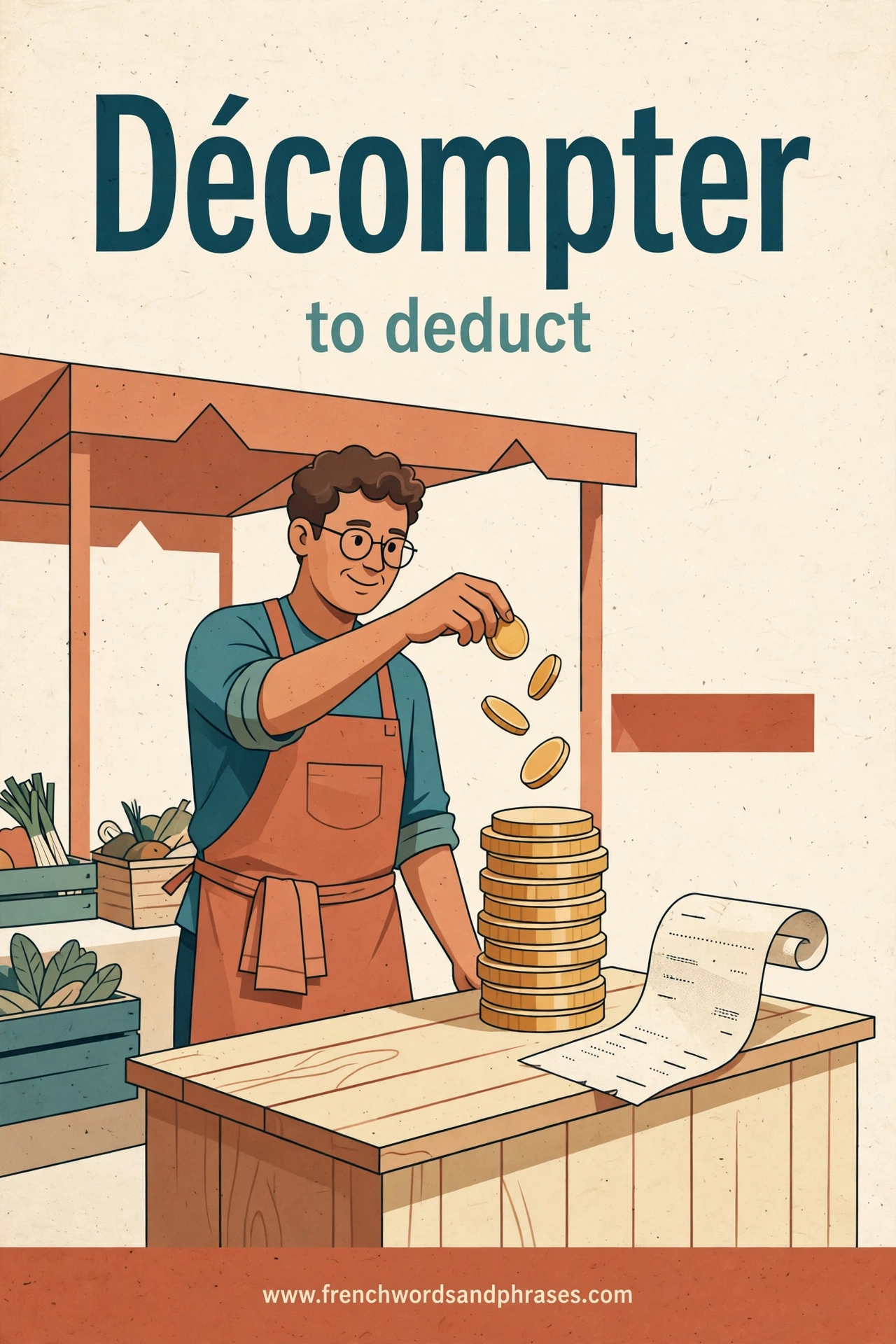
Décompter means to deduct.
A salary slip where hours vanish before the total, a traveller counting the days left before the holidays — décompter is the verb of taking away from a count: money from a pay packet, days from a wait.
In this guide, you’ll learn how to conjugate décompter in all the major French tenses and moods. Explore complete conjugation tables, French examples, English translations, and practice quizzes.
Understanding the French Verb Décompter
Décompter is a regular French verb belonging to the first group of verbs, those ending in -er.
It means to deduct. It is commonly used in payroll and accounts for sums deducted from wages or bills, in administration for leave and hours taken off an allowance, and in everyday speech for counting down the days to a holiday, a wedding or a release.
Verb classification: First group (-er)
Auxiliary verb: Avoir
Past participle: décompté
Present participle: décomptant
English equivalents: To deduct, to take off an amount; décompter les jours — to count down the days; le décompte — a countdown, an itemised statement.
One important detail: décompter is dé- (taking away) plus compter, to count — and its noun le décompte does double duty in French life. It is the countdown before a happy event: le décompte des jours avant Noël. And it is the itemised statement nobody enjoys: un décompte de charges, a breakdown of charges, the document that lists exactly what was deducted and why. On a payslip, look for sums décomptées — taken off before the total you actually receive.
Experience the Word
Décompter is the verb of the shrinking total — something counted, then counted down, sum by sum or day by day.
Imagine a child in December with a paper calendar on the bedroom wall. Each evening a cross, each morning one day fewer — she décompte les jours, and the waiting itself becomes a small daily ceremony.
The total has not been paid or reached. It has been reduced — deducted, counted down, brought closer.
How to Conjugate Décompter: Complete French Conjugation Guide
Let’s explore every major conjugation of décompter, beginning with the indicative mood.
How to Conjugate Décompter in the Indicative Mood
The indicative mood is used to express facts, observations, actions, and events.
How to Conjugate Décompter in the Present Tense (Présent)
Used for actions happening now, habitual actions, and general truths.
| Subject | Conjugation |
|---|---|
| je | décompte |
| tu | décomptes |
| il / elle | décompte |
| nous | décomptons |
| vous | décomptez |
| ils / elles | décomptent |
Example
L’employeur décompte les absences sur le salaire du mois.
The employer deducts the absences from the month’s salary.
Quick Quiz 1
Complete the sentence:
Nous ______ les jours avant le départ.
Reveal the answer
décomptons
Nous décomptons les jours avant le départ.
We are counting down the days before the departure.
How to Conjugate Décompter in the Passé Composé
Used for completed actions in the past. Décompter takes the auxiliary verb avoir.
| Subject | Conjugation |
|---|---|
| j’ | ai décompté |
| tu | as décompté |
| il / elle | a décompté |
| nous | avons décompté |
| vous | avez décompté |
| ils / elles | ont décompté |
Example
Ils ont décompté deux jours de congé pour le pont.
They deducted two days of leave for the long weekend.
How to Conjugate Décompter in the Imparfait (Imperfect Tense)
Used for habitual past actions, descriptions, and ongoing situations in the past.
| Subject | Conjugation |
|---|---|
| je | décomptais |
| tu | décomptais |
| il / elle | décomptait |
| nous | décomptions |
| vous | décomptiez |
| ils / elles | décomptaient |
Example
Chaque soir, elle décomptait les jours avant le départ.
Every evening, she counted down the days before the departure.
Quick Quiz 2
Choose the correct form:
The bank deducted charges.
La banque ______ des frais. (a décompté / est décomptée)
Reveal the answer
a décompté
La banque a décompté des frais.
Décompter takes avoir.
How to Conjugate Décompter in the Plus-que-parfait
Used to describe an action that had already been completed before another past event.
| Subject | Conjugation |
|---|---|
| j’ | avais décompté |
| tu | avais décompté |
| il / elle | avait décompté |
| nous | avions décompté |
| vous | aviez décompté |
| ils / elles | avaient décompté |
Example
La banque avait décompté des frais sans prévenir.
The bank had deducted charges without warning.
How to Conjugate Décompter in the Passé Simple
Primarily used in formal writing, literature, and historical narratives. It is rarely used in everyday conversation.
| Subject | Conjugation |
|---|---|
| je | décomptai |
| tu | décomptas |
| il / elle | décompta |
| nous | décomptâmes |
| vous | décomptâtes |
| ils / elles | décomptèrent |
Example
Le trésorier décompta la somme du total annuel.
The treasurer deducted the sum from the annual total.
How to Conjugate Décompter in the Passé Antérieur
A literary tense used to express an action completed immediately before another past action, generally in the passé simple.
| Subject | Conjugation |
|---|---|
| j’ | eus décompté |
| tu | eus décompté |
| il / elle | eut décompté |
| nous | eûmes décompté |
| vous | eûtes décompté |
| ils / elles | eurent décompté |
Example
Quand il eut décompté les heures, il signa le relevé.
When he had deducted the hours, he signed the statement.
How to Conjugate Décompter in the Future Tense (Futur Simple)
Used to describe actions that will take place in the future.
| Subject | Conjugation |
|---|---|
| je | décompterai |
| tu | décompteras |
| il / elle | décomptera |
| nous | décompterons |
| vous | décompterez |
| ils / elles | décompteront |
Example
Nous décompterons ces frais sur la prochaine facture.
We will deduct these charges from the next bill.
How to Conjugate Décompter in the Futur Antérieur (Future Perfect)
Used for an action that will have been completed before a particular point in the future.
| Subject | Conjugation |
|---|---|
| j’ | aurai décompté |
| tu | auras décompté |
| il / elle | aura décompté |
| nous | aurons décompté |
| vous | aurez décompté |
| ils / elles | auront décompté |
Example
À la fin du mois, ils auront décompté toutes les absences.
By the end of the month, they will have deducted all the absences.
How to Conjugate Décompter in the Near Future (Futur Proche)
Used to describe something that is going to happen soon. Formed with aller + infinitive.
| Subject | Conjugation |
|---|---|
| je | vais décompter |
| tu | vas décompter |
| il / elle | va décompter |
| nous | allons décompter |
| vous | allez décompter |
| ils / elles | vont décompter |
Example
Je vais décompter les jours jusqu’aux vacances.
I am going to count down the days until the holidays.
How to Conjugate Décompter in the Conditional Mood
The conditional mood expresses what would happen under certain circumstances. It is also frequently used to make polite requests or express wishes.
How to Conjugate Décompter in the Present Conditional
| Subject | Conjugation |
|---|---|
| je | décompterais |
| tu | décompterais |
| il / elle | décompterait |
| nous | décompterions |
| vous | décompteriez |
| ils / elles | décompteraient |
Example
Sans cette règle, on décompterait les pauses du temps de travail.
Without this rule, breaks would be deducted from working time.
How to Conjugate Décompter in the Past Conditional
| Subject | Conjugation |
|---|---|
| j’ | aurais décompté |
| tu | aurais décompté |
| il / elle | aurait décompté |
| nous | aurions décompté |
| vous | auriez décompté |
| ils / elles | auraient décompté |
Example
Elle aurait décompté la somme si le client avait tardé.
She would have deducted the sum if the client had delayed.
Décompter in the Literary Past Conditional Form
This less common literary form uses the imperfect subjunctive of avoir.
| Subject | Conjugation |
|---|---|
| j’ | eusse décompté |
| tu | eusses décompté |
| il / elle | eût décompté |
| nous | eussions décompté |
| vous | eussiez décompté |
| ils / elles | eussent décompté |
Example
Le geôlier eût décompté les jours sur le mur de la cellule.
The jailer would have counted down the days on the cell wall.
How to Conjugate Décompter in the Subjunctive Mood
The subjunctive is used to express wishes, emotions, doubts, necessity, and uncertainty. It frequently follows expressions such as il faut que (it is necessary that) or bien que (although).
How to Conjugate Décompter in the Present Subjunctive
| Subject | Conjugation |
|---|---|
| que je | décompte |
| que tu | décomptes |
| qu’il / qu’elle | décompte |
| que nous | décomptions |
| que vous | décomptiez |
| qu’ils / qu’elles | décomptent |
Example
Il faut que tu décomptes cette somme de ton budget.
You must deduct this sum from your budget.
Quick Quiz 3
Complete the sentence using the subjunctive:
Il faut que vous ______ les heures d’absence.
Reveal the answer
décomptiez
Il faut que vous décomptiez les heures d’absence.
You must deduct the hours of absence.
How to Conjugate Décompter in the Imperfect Subjunctive
A literary tense, rarely encountered in modern spoken French.
| Subject | Conjugation |
|---|---|
| que je | décomptasse |
| que tu | décomptasses |
| qu’il / qu’elle | décomptât |
| que nous | décomptassions |
| que vous | décomptassiez |
| qu’ils / qu’elles | décomptassent |
Example
Il demandait qu’on décomptât les jours de grève.
He asked for the strike days to be deducted.
How to Conjugate Décompter in the Pluperfect Subjunctive
A literary construction used to express an action completed before another past action.
| Subject | Conjugation |
|---|---|
| que j’ | eusse décompté |
| que tu | eusses décompté |
| qu’il / qu’elle | eût décompté |
| que nous | eussions décompté |
| que vous | eussiez décompté |
| qu’ils / qu’elles | eussent décompté |
Example
Elle vérifia qu’ils eussent décompté la bonne somme.
She checked that they had deducted the right sum.
How to Conjugate Décompter in the Past Subjunctive
| Subject | Conjugation |
|---|---|
| que j’ | aie décompté |
| que tu | aies décompté |
| qu’il / qu’elle | ait décompté |
| que nous | ayons décompté |
| que vous | ayez décompté |
| qu’ils / qu’elles | aient décompté |
Example
Je suis surpris qu’ils aient décompté autant de frais.
I am surprised they deducted so many charges.
How to Conjugate Décompter in the Imperative
The imperative is used to give commands, instructions, invitations, or suggestions. Subject pronouns are omitted.
How to Conjugate Décompter in the Present Imperative
| Person | Conjugation |
|---|---|
| (tu) | décompte |
| (nous) | décomptons |
| (vous) | décomptez |
Example
Décompte les jours, les vacances approchent !
Count down the days, the holidays are coming!
Quick Quiz 4
How would you say Count down the days (tu form)?
Reveal the answer
Décompte les jours !
French Participles of Décompter
Participles are verb forms that can be used in compound tenses and other grammatical constructions.
Present Participle of Décompter
décomptant
En décomptant les heures, elle a trouvé une erreur.
While deducting the hours, she found a mistake.
Past Participle of Décompter
décompté
Décomptée du salaire, la somme apparaît sur le bulletin.
Deducted from the salary, the sum appears on the payslip.
Décompter in Everyday French: Real-Life Examples
Now that you know the conjugations, let’s see how décompter appears in everyday French.
Example 1 — Present
On décompte les congés au fur et à mesure.
Leave days are deducted as they are taken.
Example 2 — Passé composé
Ils ont décompté dix euros de frais bancaires.
They deducted ten euros in bank charges.
Example 3 — Imparfait
Enfant, je décomptais les jours avant Noël.
As a child, I counted down the days before Christmas.
Example 4 — Future
Le logiciel décomptera les heures automatiquement.
The software will deduct the hours automatically.
Example 5 — Conditional
On décompterait les pauses si la loi changeait.
Breaks would be deducted if the law changed.
Example 6 — Imperative
Décomptez bien les jours avant de réserver !
Count the days carefully before booking!
Beyond Translation: The Meaning of Décompter
English splits the idea — deduct for money, count down for days; French décompter keeps both in one verb.
The payslip and the calendar share a word.
The sum décomptée from a salary and the days décomptés before a wedding are the same gesture: a total, patiently reduced.
How to Remember the French Verb Décompter
Remember it this way: Décompter is about taking away from the count — money off, days down.
- Dé- takes away from compter, to count: décompter is counting in reverse.
- Le décompte — both the countdown to a holiday and the itemised statement.
- Regular -er: je décompte, nous décomptons, past participle décompté.
The key idea is taking away from the count — money off, days down.
Test Your Knowledge of Décompter
Let’s see how much you’ve learned. Try answering these questions before revealing the answers.
Question 1
What is un décompte?
Reveal the answer
A countdown — or an itemised statement of charges.
Question 2
How do you say They deducted ten euros in French?
Reveal the answer
Ils ont décompté dix euros.
Question 3
Translate: She counted down the days before the holidays.
Reveal the answer
Elle décomptait les jours avant les vacances.
Question 4
What is the past participle of décompter?
Reveal the answer
Décompté.
Question 5
Complete the sentence:
Il faut que tu ______ cette somme de ton budget.
Reveal the answer
décomptes
Il faut que tu décomptes cette somme de ton budget.
You must deduct this sum from your budget.
Your Final Challenge
Can You Use It?
How would you say this in French?
She counts down the days before the departure, and every morning the suitcase seems lighter.
Reveal the answer
Elle décompte les jours avant le départ, et chaque matin la valise semble plus légère.
She counts down the days before the departure, and every morning the suitcase seems lighter.
A little French. A little curiosity. A richer everyday life.
LEARN FRENCH ONE WORD AT A TIME