
A French Word to Live By
How to Conjugate Mécher in French
/me.ʃe/
Mécher means to fumigate.
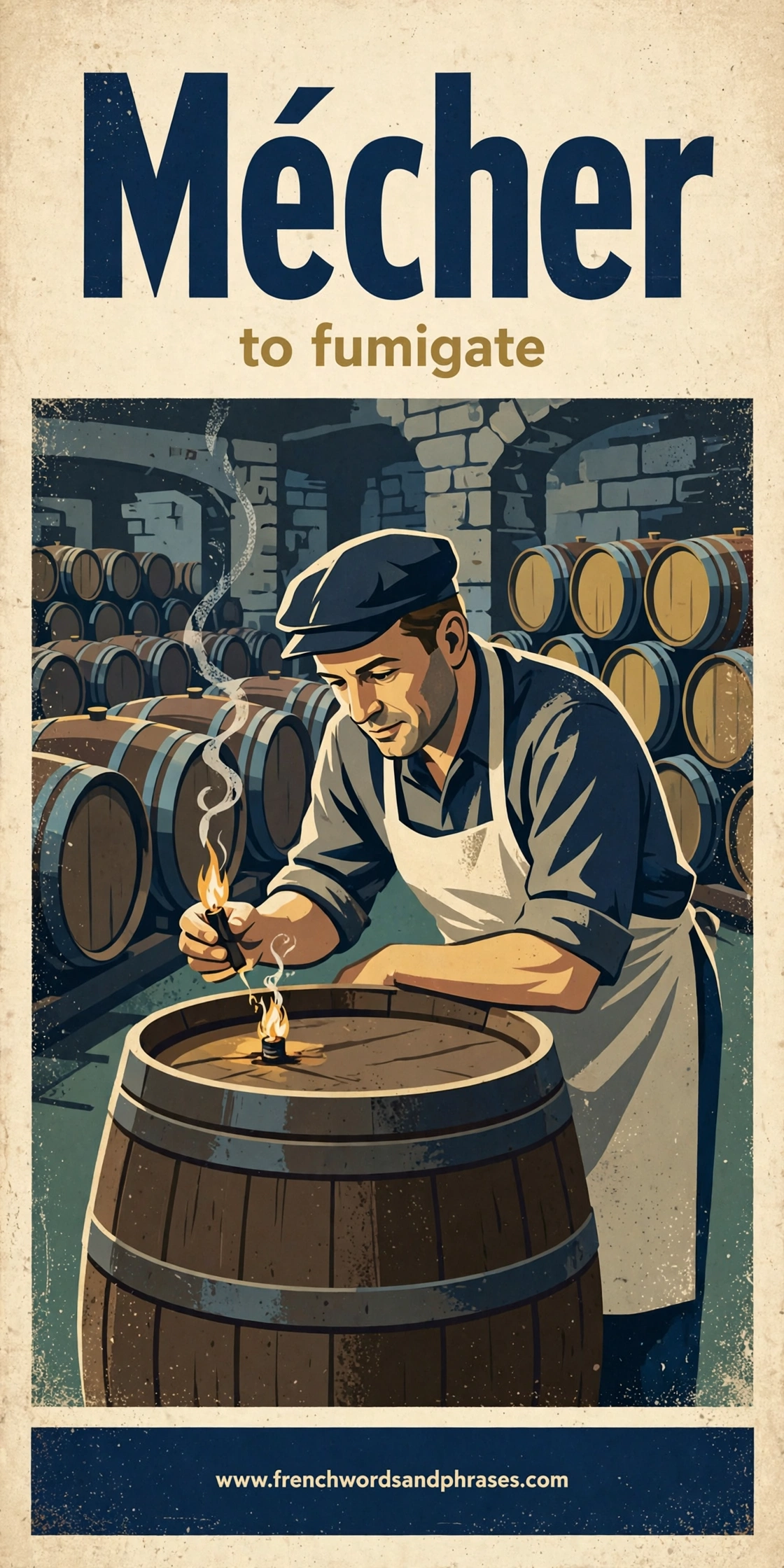
A thin wick of sulphur lowered into an empty wine barrel, a wisp of smoke, the lid closed tight — mécher is the old cellar verb of disinfection by smoke, burning a mèche to keep the wood sweet and the wine safe.
In this guide, you’ll learn how to conjugate mécher in all the major French tenses and moods. Explore complete conjugation tables, French examples, English translations, and practice quizzes.
Understanding the French Verb Mécher
Mécher is a regular French verb belonging to the first group of verbs, those ending in -er.
It means to fumigate. It is commonly used in wine cellars for sulphuring barrels and casks before filling, in older houses for disinfecting rooms by smoke, and in hospitals and first aid for packing wounds with gauze (mécher une plaie, un abcès).
Verb classification: First group (-er)
Auxiliary verb: Avoir
Past participle: méché
Present participle: méchant
English equivalents: To fumigate with a sulphur wick (barrels, cellars); (surgery) to pack a wound with gauze — mécher une plaie.
One important detail: mécher is named after its tool — une mèche, a wick. The winemaker burns a sulphur wick inside the empty barrel, and the smoke kills the germs that would spoil the wine: mécher un tonneau. Surgeons borrowed the same word for a different wick: mécher une plaie is to pack a wound with a strip of gauze so it heals cleanly. And the spelling breathes: the é opens to è before a mute syllable — je mèche, il mèche — but stays é in nous méchons.
Experience the Word
Mécher is the verb of the purifying smoke — a wick, a flame, and a closed door doing the cleaning.
Imagine a Burgundy cellar in September, a week before the harvest. The tonnelier lowers a burning sulphur wick into each empty barrel, closes the bung, and moves down the row — mécher les fûts — while the sharp smell of smoke promises a clean home for the new wine.
No water, no scrubbing. Smoke has done the work — the barrel has been méché, disinfected and ready.
How to Conjugate Mécher: Complete French Conjugation Guide
Let’s explore every major conjugation of mécher, beginning with the indicative mood.
How to Conjugate Mécher in the Indicative Mood
The indicative mood is used to express facts, observations, actions, and events.
How to Conjugate Mécher in the Present Tense (Présent)
Used for actions happening now, habitual actions, and general truths.
| Subject | Conjugation |
|---|---|
| je | mèche |
| tu | mèches |
| il / elle | mèche |
| nous | méchons |
| vous | méchez |
| ils / elles | mèchent |
Example
Le tonnelier mèche le fût avant d’y mettre le vin.
The cooper fumigates the cask before putting the wine in it.
Quick Quiz 1
Complete the sentence:
Nous ______ les tonneaux avant les vendanges.
Reveal the answer
méchons
Nous méchons les tonneaux avant les vendanges.
We fumigate the barrels before the grape harvest.
How to Conjugate Mécher in the Passé Composé
Used for completed actions in the past. Mécher takes the auxiliary verb avoir.
| Subject | Conjugation |
|---|---|
| j’ | ai méché |
| tu | as méché |
| il / elle | a méché |
| nous | avons méché |
| vous | avez méché |
| ils / elles | ont méché |
Example
Le vigneron a méché tous ses tonneaux en septembre.
The winemaker fumigated all his barrels in September.
How to Conjugate Mécher in the Imparfait (Imperfect Tense)
Used for habitual past actions, descriptions, and ongoing situations in the past.
| Subject | Conjugation |
|---|---|
| je | méchais |
| tu | méchais |
| il / elle | méchait |
| nous | méchions |
| vous | méchiez |
| ils / elles | méchaient |
Example
Autrefois, on méchait les caves chaque automne.
In the old days, cellars were fumigated every autumn.
Quick Quiz 2
Choose the correct form:
The winemaker fumigated the cellar.
Le vigneron ______ la cave. (a méché / est méché)
Reveal the answer
a méché
Le vigneron a méché la cave.
Mécher takes avoir.
How to Conjugate Mécher in the Plus-que-parfait
Used to describe an action that had already been completed before another past event.
| Subject | Conjugation |
|---|---|
| j’ | avais méché |
| tu | avais méché |
| il / elle | avait méché |
| nous | avions méché |
| vous | aviez méché |
| ils / elles | avaient méché |
Example
Nous avions méché la cave avant de descendre les bouteilles.
We had fumigated the cellar before taking the bottles down.
How to Conjugate Mécher in the Passé Simple
Primarily used in formal writing, literature, and historical narratives. It is rarely used in everyday conversation.
| Subject | Conjugation |
|---|---|
| je | méchai |
| tu | méchas |
| il / elle | mécha |
| nous | méchâmes |
| vous | méchâtes |
| ils / elles | méchèrent |
Example
L’infirmière mécha la plaie avec soin.
The nurse packed the wound with gauze, carefully.
How to Conjugate Mécher in the Passé Antérieur
A literary tense used to express an action completed immediately before another past action, generally in the passé simple.
| Subject | Conjugation |
|---|---|
| j’ | eus méché |
| tu | eus méché |
| il / elle | eut méché |
| nous | eûmes méché |
| vous | eûtes méché |
| ils / elles | eurent méché |
Example
Quand il eut méché le dernier tonneau, il ferma la cave.
When he had fumigated the last barrel, he closed the cellar.
How to Conjugate Mécher in the Future Tense (Futur Simple)
Used to describe actions that will take place in the future.
| Subject | Conjugation |
|---|---|
| je | mècherai |
| tu | mècheras |
| il / elle | mèchera |
| nous | mècherons |
| vous | mècherez |
| ils / elles | mècheront |
Example
Demain, le vigneron mèchera les tonneaux de la grande cave.
Tomorrow, the winemaker will fumigate the barrels in the big cellar.
How to Conjugate Mécher in the Futur Antérieur (Future Perfect)
Used for an action that will have been completed before a particular point in the future.
| Subject | Conjugation |
|---|---|
| j’ | aurai méché |
| tu | auras méché |
| il / elle | aura méché |
| nous | aurons méché |
| vous | aurez méché |
| ils / elles | auront méché |
Example
À la fin de la semaine, ils auront méché les deux cents fûts de la récolte.
By the end of the week, they will have fumigated the two hundred casks of the harvest.
How to Conjugate Mécher in the Near Future (Futur Proche)
Used to describe something that is going to happen soon. Formed with aller + infinitive.
| Subject | Conjugation |
|---|---|
| je | vais mécher |
| tu | vas mécher |
| il / elle | va mécher |
| nous | allons mécher |
| vous | allez mécher |
| ils / elles | vont mécher |
Example
Je vais mécher ce tonneau avant le remplissage.
I am going to fumigate this barrel before filling it.
How to Conjugate Mécher in the Conditional Mood
The conditional mood expresses what would happen under certain circumstances. It is also frequently used to make polite requests or express wishes.
How to Conjugate Mécher in the Present Conditional
| Subject | Conjugation |
|---|---|
| je | mècherais |
| tu | mècherais |
| il / elle | mècherait |
| nous | mècherions |
| vous | mècheriez |
| ils / elles | mècheraient |
Example
Avec une mèche de soufre, tu mècherais ce fût en cinq minutes.
With a sulphur wick, you would fumigate this cask in five minutes.
How to Conjugate Mécher in the Past Conditional
| Subject | Conjugation |
|---|---|
| j’ | aurais méché |
| tu | aurais méché |
| il / elle | aurait méché |
| nous | aurions méché |
| vous | auriez méché |
| ils / elles | auraient méché |
Example
Elle aurait méché la plaie plus tôt si elle avait eu de la gaze.
She would have packed the wound sooner if she had had some gauze.
Mécher in the Literary Past Conditional Form
This less common literary form uses the imperfect subjunctive of avoir.
| Subject | Conjugation |
|---|---|
| j’ | eusse méché |
| tu | eusses méché |
| il / elle | eût méché |
| nous | eussions méché |
| vous | eussiez méché |
| ils / elles | eussent méché |
Example
Il eût méché la cave entière avant les vendanges.
He would have fumigated the whole cellar before the grape harvest.
How to Conjugate Mécher in the Subjunctive Mood
The subjunctive is used to express wishes, emotions, doubts, necessity, and uncertainty. It frequently follows expressions such as il faut que (it is necessary that) or bien que (although).
How to Conjugate Mécher in the Present Subjunctive
| Subject | Conjugation |
|---|---|
| que je | mèche |
| que tu | mèches |
| qu’il / qu’elle | mèche |
| que nous | méchions |
| que vous | méchiez |
| qu’ils / qu’elles | mèchent |
Example
Il faut que tu mèches le tonneau avant de le remplir.
You must fumigate the barrel before filling it.
Quick Quiz 3
Complete the sentence using the subjunctive:
Il faut que vous ______ le fût.
Reveal the answer
méchiez
Il faut que vous méchiez le fût.
You must fumigate the cask.
How to Conjugate Mécher in the Imperfect Subjunctive
A literary tense, rarely encountered in modern spoken French.
| Subject | Conjugation |
|---|---|
| que je | méchasse |
| que tu | méchasses |
| qu’il / qu’elle | méchât |
| que nous | méchassions |
| que vous | méchassiez |
| qu’ils / qu’elles | méchassent |
Example
Le maître de chai voulait que l’ouvrier méchât les fûts un à un.
The cellar master wanted the worker to fumigate the casks one by one.
How to Conjugate Mécher in the Pluperfect Subjunctive
A literary construction used to express an action completed before another past action.
| Subject | Conjugation |
|---|---|
| que j’ | eusse méché |
| que tu | eusses méché |
| qu’il / qu’elle | eût méché |
| que nous | eussions méché |
| que vous | eussiez méché |
| qu’ils / qu’elles | eussent méché |
Example
Il regrettait que nous eussions méché la cave si tard.
He regretted that we had fumigated the cellar so late.
How to Conjugate Mécher in the Past Subjunctive
| Subject | Conjugation |
|---|---|
| que j’ | aie méché |
| que tu | aies méché |
| qu’il / qu’elle | ait méché |
| que nous | ayons méché |
| que vous | ayez méché |
| qu’ils / qu’elles | aient méché |
Example
Je suis content que tu aies méché les tonneaux à temps.
I am glad you fumigated the barrels in time.
How to Conjugate Mécher in the Imperative
The imperative is used to give commands, instructions, invitations, or suggestions. Subject pronouns are omitted.
How to Conjugate Mécher in the Present Imperative
| Person | Conjugation |
|---|---|
| (tu) | mèche |
| (nous) | méchons |
| (vous) | méchez |
Example
Mèche le fût, puis ferme bien le bondon !
Fumigate the cask, then close the bung tightly!
Quick Quiz 4
How would you say Fumigate the barrel (tu form)?
Reveal the answer
Mèche le tonneau !
French Participles of Mécher
Participles are verb forms that can be used in compound tenses and other grammatical constructions.
Present Participle of Mécher
méchant
En méchant le tonneau, il surveillait la mèche de soufre.
While fumigating the barrel, he kept an eye on the sulphur wick.
Past Participle of Mécher
méché
Méché au soufre, le tonneau attend le vin nouveau.
Fumigated with sulphur, the barrel awaits the new wine.
Mécher in Everyday French: Real-Life Examples
Now that you know the conjugations, let’s see how mécher appears in everyday French.
Example 1 — Present
On mèche les tonneaux avant les vendanges.
The barrels are fumigated before the grape harvest.
Example 2 — Passé composé
Le vigneron a méché sa cave entière.
The winemaker fumigated his whole cellar.
Example 3 — Imparfait
Grand-père méchait ses fûts chaque automne.
Grandfather used to fumigate his casks every autumn.
Example 4 — Future
Nous mècherons les tonneaux demain matin.
We will fumigate the barrels tomorrow morning.
Example 5 — Conditional
Tu mècherais la plaie avec une mèche propre.
You would pack the wound with a clean strip of gauze.
Example 6 — Imperative
Méchez le fût avant de le remplir !
Fumigate the cask before filling it!
Beyond Translation: The Meaning of Mécher
English fumigate sounds like a pest-control company; French mécher sounds like a cellar — because it is not built on smoke (fumée) but on the wick itself, la mèche.
One wick, two worlds.
In the barrel, the sulphur wick disinfects the wood; in the wound, the gauze wick keeps the flesh clean. Mécher remembers both: the cooper and the nurse share a verb because they share a tool.
How to Remember the French Verb Mécher
Remember it this way: Mécher is about the sulphur wick in the wine barrel — je mèche, nous méchons.
- Une mèche is a wick — mécher is what you do with one: burn it in a barrel, or pack it in a wound.
- The é opens to è before a mute syllable — je mèche, tu mèches — and stays é in nous méchons.
- Regular -er: past participle méché — un tonneau méché, a fumigated barrel.
The key idea is the sulphur wick in the wine barrel — je mèche, nous méchons.
Test Your Knowledge of Mécher
Let’s see how much you’ve learned. Try answering these questions before revealing the answers.
Question 1
What is une mèche, the word inside mécher?
Reveal the answer
A wick — a sulphur wick for barrels, a strip of gauze for wounds.
Question 2
How do you say The winemaker fumigated his barrels in French?
Reveal the answer
Le vigneron a méché ses tonneaux.
Question 3
Translate: You must fumigate the barrel before filling it.
Reveal the answer
Il faut que tu mèches le tonneau avant de le remplir.
Question 4
What is the past participle of mécher?
Reveal the answer
Méché.
Question 5
Complete the sentence:
Il faut que tu ______ la cave avant l’hiver.
Reveal the answer
mèches
Il faut que tu mèches la cave avant l’hiver.
You must fumigate the cellar before winter.
Your Final Challenge
Can You Use It?
How would you say this in French?
He fumigates the last barrel, and the cellar is ready for the new wine.
Reveal the answer
Il mèche le dernier tonneau, et la cave est prête pour le vin nouveau.
He fumigates the last barrel, and the cellar is ready for the new wine.
A little French. A little curiosity. A richer everyday life.
LEARN FRENCH ONE WORD AT A TIME




