
A French Word to Live By
How to Conjugate Mécaniser in French
/me.ka.ni.ze/
Mécaniser means to mechanize.
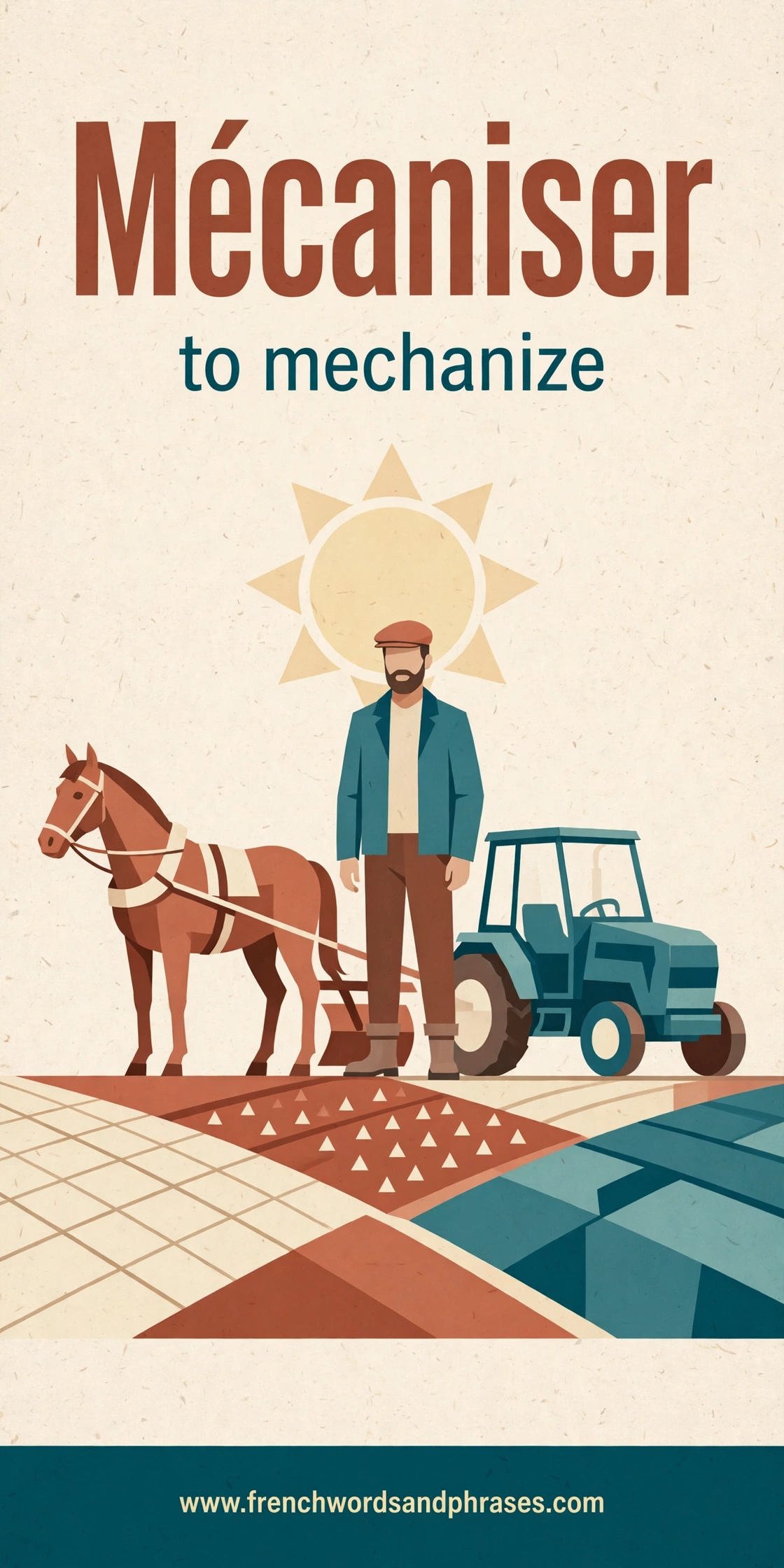
A harvest once gathered by a hundred hands now rolling in behind one tractor, letters once sorted by eye now flying through a machine — mécaniser is the verb of the great replacement: muscle and patience giving way to gears and engines.
In this guide, you’ll learn how to conjugate mécaniser in all the major French tenses and moods. Explore complete conjugation tables, French examples, English translations, and practice quizzes.
Understanding the French Verb Mécaniser
Mécaniser is a regular French verb belonging to the first group of verbs, those ending in -er.
It means to mechanize. It is commonly used for farming (mécaniser la récolte, les vendanges), for industry and workshops (mécaniser la production, le tri), for armies becoming motorized, and in history and economics writing about the transformation of work.
Verb classification: First group (-er)
Auxiliary verb: Avoir
Past participle: mécanisé
Present participle: mécanisant
English equivalents: To mechanize; mécaniser l’agriculture — to mechanize farming; la mécanisation — mechanization.
One important detail: mécaniser carries the é of mécanique, and the two words travel together — where there is a machine (une machine), there is mécanique, and mécaniser is the verb that brings the machines in. French farming history is told with this word: la mécanisation des campagnes, the mechanization of the countryside, when the tractor replaced the horse in a single generation. Its reflexive exists too, in the military sense: une division qui se mécanise, a division that becomes motorized.
Experience the Word
Mécaniser is the verb of the machine arriving — one engine doing the work of a village, for better and for worse.
Imagine a farm in the Beauce in 1950. The grandfather watches from the gate as the first tractor crosses the field his horses ploughed for forty years. In one morning, the farm has mécanisé its harvest — and nothing will ever be quite the same.
The work is still done. But hands have given way to machines — that is mécaniser.
How to Conjugate Mécaniser: Complete French Conjugation Guide
Let’s explore every major conjugation of mécaniser, beginning with the indicative mood.
How to Conjugate Mécaniser in the Indicative Mood
The indicative mood is used to express facts, observations, actions, and events.
How to Conjugate Mécaniser in the Present Tense (Présent)
Used for actions happening now, habitual actions, and general truths.
| Subject | Conjugation |
|---|---|
| je | mécanise |
| tu | mécanises |
| il / elle | mécanise |
| nous | mécanisons |
| vous | mécanisez |
| ils / elles | mécanisent |
Example
L’usine mécanise le tri des colis.
The factory is mechanizing the sorting of parcels.
Quick Quiz 1
Complete the sentence:
Nous ______ les vendanges cette année.
Reveal the answer
mécanisons
Nous mécanisons les vendanges cette année.
We are mechanizing the grape harvest this year.
How to Conjugate Mécaniser in the Passé Composé
Used for completed actions in the past. Mécaniser takes the auxiliary verb avoir.
| Subject | Conjugation |
|---|---|
| j’ | ai mécanisé |
| tu | as mécanisé |
| il / elle | a mécanisé |
| nous | avons mécanisé |
| vous | avez mécanisé |
| ils / elles | ont mécanisé |
Example
Ils ont mécanisé la récolte du raisin en dix ans.
They mechanized the grape harvest in ten years.
How to Conjugate Mécaniser in the Imparfait (Imperfect Tense)
Used for habitual past actions, descriptions, and ongoing situations in the past.
| Subject | Conjugation |
|---|---|
| je | mécanisais |
| tu | mécanisais |
| il / elle | mécanisait |
| nous | mécanisions |
| vous | mécanisiez |
| ils / elles | mécanisaient |
Example
Autrefois, on mécanisait lentement, faute d’argent.
In the old days, farms mechanized slowly, for lack of money.
Quick Quiz 2
Choose the correct form:
They mechanized the production line.
Ils ______ la chaîne de production. (ont mécanisé / sont mécanisés)
Reveal the answer
ont mécanisé
Ils ont mécanisé la chaîne de production.
Mécaniser takes avoir.
How to Conjugate Mécaniser in the Plus-que-parfait
Used to describe an action that had already been completed before another past event.
| Subject | Conjugation |
|---|---|
| j’ | avais mécanisé |
| tu | avais mécanisé |
| il / elle | avait mécanisé |
| nous | avions mécanisé |
| vous | aviez mécanisé |
| ils / elles | avaient mécanisé |
Example
La région avait mécanisé ses fermes avant les autres.
The region had mechanized its farms before the others.
How to Conjugate Mécaniser in the Passé Simple
Primarily used in formal writing, literature, and historical narratives. It is rarely used in everyday conversation.
| Subject | Conjugation |
|---|---|
| je | mécanisai |
| tu | mécanisas |
| il / elle | mécanisa |
| nous | mécanisâmes |
| vous | mécanisâtes |
| ils / elles | mécanisèrent |
Example
L’ingénieur mécanisa toute la chaîne de production.
The engineer mechanized the whole production line.
How to Conjugate Mécaniser in the Passé Antérieur
A literary tense used to express an action completed immediately before another past action, generally in the passé simple.
| Subject | Conjugation |
|---|---|
| j’ | eus mécanisé |
| tu | eus mécanisé |
| il / elle | eut mécanisé |
| nous | eûmes mécanisé |
| vous | eûtes mécanisé |
| ils / elles | eurent mécanisé |
Example
Quand l’atelier eut mécanisé le polissage, la cadence doubla.
When the workshop had mechanized the polishing, the pace doubled.
How to Conjugate Mécaniser in the Future Tense (Futur Simple)
Used to describe actions that will take place in the future.
| Subject | Conjugation |
|---|---|
| je | mécaniserai |
| tu | mécaniseras |
| il / elle | mécanisera |
| nous | mécaniserons |
| vous | mécaniserez |
| ils / elles | mécaniseront |
Example
Demain, la poste mécanisera le tri du courrier.
Tomorrow, the post office will mechanize the sorting of the mail.
How to Conjugate Mécaniser in the Futur Antérieur (Future Perfect)
Used for an action that will have been completed before a particular point in the future.
| Subject | Conjugation |
|---|---|
| j’ | aurai mécanisé |
| tu | auras mécanisé |
| il / elle | aura mécanisé |
| nous | aurons mécanisé |
| vous | aurez mécanisé |
| ils / elles | auront mécanisé |
Example
À la fin du siècle, l’agriculture aura mécanisé presque tous les gestes.
By the end of the century, farming will have mechanized almost every task.
How to Conjugate Mécaniser in the Near Future (Futur Proche)
Used to describe something that is going to happen soon. Formed with aller + infinitive.
| Subject | Conjugation |
|---|---|
| je | vais mécaniser |
| tu | vas mécaniser |
| il / elle | va mécaniser |
| nous | allons mécaniser |
| vous | allez mécaniser |
| ils / elles | vont mécaniser |
Example
Le vignoble va mécaniser les vendanges cette année.
The vineyard is going to mechanize the harvest this year.
How to Conjugate Mécaniser in the Conditional Mood
The conditional mood expresses what would happen under certain circumstances. It is also frequently used to make polite requests or express wishes.
How to Conjugate Mécaniser in the Present Conditional
| Subject | Conjugation |
|---|---|
| je | mécaniserais |
| tu | mécaniserais |
| il / elle | mécaniserait |
| nous | mécaniserions |
| vous | mécaniseriez |
| ils / elles | mécaniseraient |
Example
Avec plus de moyens, nous mécaniserions l’emballage.
With more resources, we would mechanize the packing.
How to Conjugate Mécaniser in the Past Conditional
| Subject | Conjugation |
|---|---|
| j’ | aurais mécanisé |
| tu | aurais mécanisé |
| il / elle | aurait mécanisé |
| nous | aurions mécanisé |
| vous | auriez mécanisé |
| ils / elles | auraient mécanisé |
Example
Elle aurait mécanisé l’atelier si le crédit avait suivi.
She would have mechanized the workshop if the loan had come through.
Mécaniser in the Literary Past Conditional Form
This less common literary form uses the imperfect subjunctive of avoir.
| Subject | Conjugation |
|---|---|
| j’ | eusse mécanisé |
| tu | eusses mécanisé |
| il / elle | eût mécanisé |
| nous | eussions mécanisé |
| vous | eussiez mécanisé |
| ils / elles | eussent mécanisé |
Example
Il eût mécanisé toute l’exploitation sans regarder à la dépense.
He would have mechanized the whole farm without counting the cost.
How to Conjugate Mécaniser in the Subjunctive Mood
The subjunctive is used to express wishes, emotions, doubts, necessity, and uncertainty. It frequently follows expressions such as il faut que (it is necessary that) or bien que (although).
How to Conjugate Mécaniser in the Present Subjunctive
| Subject | Conjugation |
|---|---|
| que je | mécanise |
| que tu | mécanises |
| qu’il / qu’elle | mécanise |
| que nous | mécanisions |
| que vous | mécanisiez |
| qu’ils / qu’elles | mécanisent |
Example
Il faut que la ferme mécanise la traite des vaches.
The farm must mechanize the milking of the cows.
Quick Quiz 3
Complete the sentence using the subjunctive:
Il faut que vous ______ le tri des colis.
Reveal the answer
mécanisiez
Il faut que vous mécanisiez le tri des colis.
You must mechanize the sorting of the parcels.
How to Conjugate Mécaniser in the Imperfect Subjunctive
A literary tense, rarely encountered in modern spoken French.
| Subject | Conjugation |
|---|---|
| que je | mécanisasse |
| que tu | mécanisasses |
| qu’il / qu’elle | mécanisât |
| que nous | mécanisassions |
| que vous | mécanisassiez |
| qu’ils / qu’elles | mécanisassent |
Example
Le syndicat craignait que l’usine mécanisât trop vite.
The union feared the factory might mechanize too fast.
How to Conjugate Mécaniser in the Pluperfect Subjunctive
A literary construction used to express an action completed before another past action.
| Subject | Conjugation |
|---|---|
| que j’ | eusse mécanisé |
| que tu | eusses mécanisé |
| qu’il / qu’elle | eût mécanisé |
| que nous | eussions mécanisé |
| que vous | eussiez mécanisé |
| qu’ils / qu’elles | eussent mécanisé |
Example
On racontait que le village eût mécanisé ses champs dès 1930.
It was said that the village had mechanized its fields as early as 1930.
How to Conjugate Mécaniser in the Past Subjunctive
| Subject | Conjugation |
|---|---|
| que j’ | aie mécanisé |
| que tu | aies mécanisé |
| qu’il / qu’elle | ait mécanisé |
| que nous | ayons mécanisé |
| que vous | ayez mécanisé |
| qu’ils / qu’elles | aient mécanisé |
Example
Je suis surpris que l’atelier ait mécanisé si tard.
I am surprised the workshop mechanized so late.
How to Conjugate Mécaniser in the Imperative
The imperative is used to give commands, instructions, invitations, or suggestions. Subject pronouns are omitted.
How to Conjugate Mécaniser in the Present Imperative
| Person | Conjugation |
|---|---|
| (tu) | mécanise |
| (nous) | mécanisons |
| (vous) | mécanisez |
Example
Mécanisez la récolte, la main-d’œuvre manque !
Mechanize the harvest, labour is short!
Quick Quiz 4
How would you say Mechanize the harvest (tu form)?
Reveal the answer
Mécanise la récolte !
French Participles of Mécaniser
Participles are verb forms that can be used in compound tenses and other grammatical constructions.
Present Participle of Mécaniser
mécanisant
En mécanisant le tri, la poste a gagné une heure par tournée.
By mechanizing the sorting, the post office saved an hour per round.
Past Participle of Mécaniser
mécanisé
Mécanisée dès les années cinquante, la plaine produit trois fois plus.
Mechanized since the fifties, the plain produces three times as much.
Mécaniser in Everyday French: Real-Life Examples
Now that you know the conjugations, let’s see how mécaniser appears in everyday French.
Example 1 — Present
La ferme mécanise la traite depuis janvier.
The farm has mechanized milking since January.
Example 2 — Passé composé
On a mécanisé les vendanges cette année.
The grape harvest was mechanized this year.
Example 3 — Imparfait
Chaque village mécanisait ses champs à son rythme.
Each village mechanized its fields at its own pace.
Example 4 — Future
L’usine mécanisera l’emballage au printemps.
The factory will mechanize the packing in spring.
Example 5 — Conditional
Tu mécaniserais le tri avec une machine d’occasion.
You would mechanize the sorting with a second-hand machine.
Example 6 — Imperative
Mécanise la récolte avant la pluie !
Mechanize the harvest before the rain!
Beyond Translation: The Meaning of Mécaniser
English mechanize sounds like engineering; French mécaniser sounds like history — the word of the tractor arriving in the village.
It carries a whole century in its syllables.
Behind mécaniser stand the emptied farms, the doubled harvests, the grandfathers watching from the gate. It is a regular little -er verb that quietly narrates the biggest change in French working life.
How to Remember the French Verb Mécaniser
Remember it this way: Mécaniser is about the machine arriving — the tractor replacing the horse in one generation.
- Mécaniser goes with farms and factories — la récolte, la traite, le tri, la production.
- La mécanisation des campagnes — the mechanization of the countryside: the word’s great historical scene.
- Regular -er: je mécanise, nous mécanisons, past participle mécanisé.
The key idea is the machine arriving — the tractor replacing the horse in one generation.
Test Your Knowledge of Mécaniser
Let’s see how much you’ve learned. Try answering these questions before revealing the answers.
Question 1
What is la mécanisation des campagnes?
Reveal the answer
The mechanization of the countryside — when tractors replaced horses on French farms.
Question 2
How do you say They mechanized the harvest in French?
Reveal the answer
Ils ont mécanisé la récolte.
Question 3
Translate: The factory is mechanizing the sorting of parcels.
Reveal the answer
L’usine mécanise le tri des colis.
Question 4
What is the past participle of mécaniser?
Reveal the answer
Mécanisé.
Question 5
Complete the sentence:
Il faut que la ferme ______ la traite des vaches.
Reveal the answer
mécanise
Il faut que la ferme mécanise la traite des vaches.
The farm must mechanize the milking of the cows.
Your Final Challenge
Can You Use It?
How would you say this in French?
The tractor mechanizes the harvest, and the whole village watches from the gate.
Reveal the answer
Le tracteur mécanise la récolte, et le village entier regarde depuis la barrière.
The tractor mechanizes the harvest, and the whole village watches from the gate.
A little French. A little curiosity. A richer everyday life.
LEARN FRENCH ONE WORD AT A TIME




