A French Word to Live By
How to Conjugate Mazouter in French
/ma.zu.te/
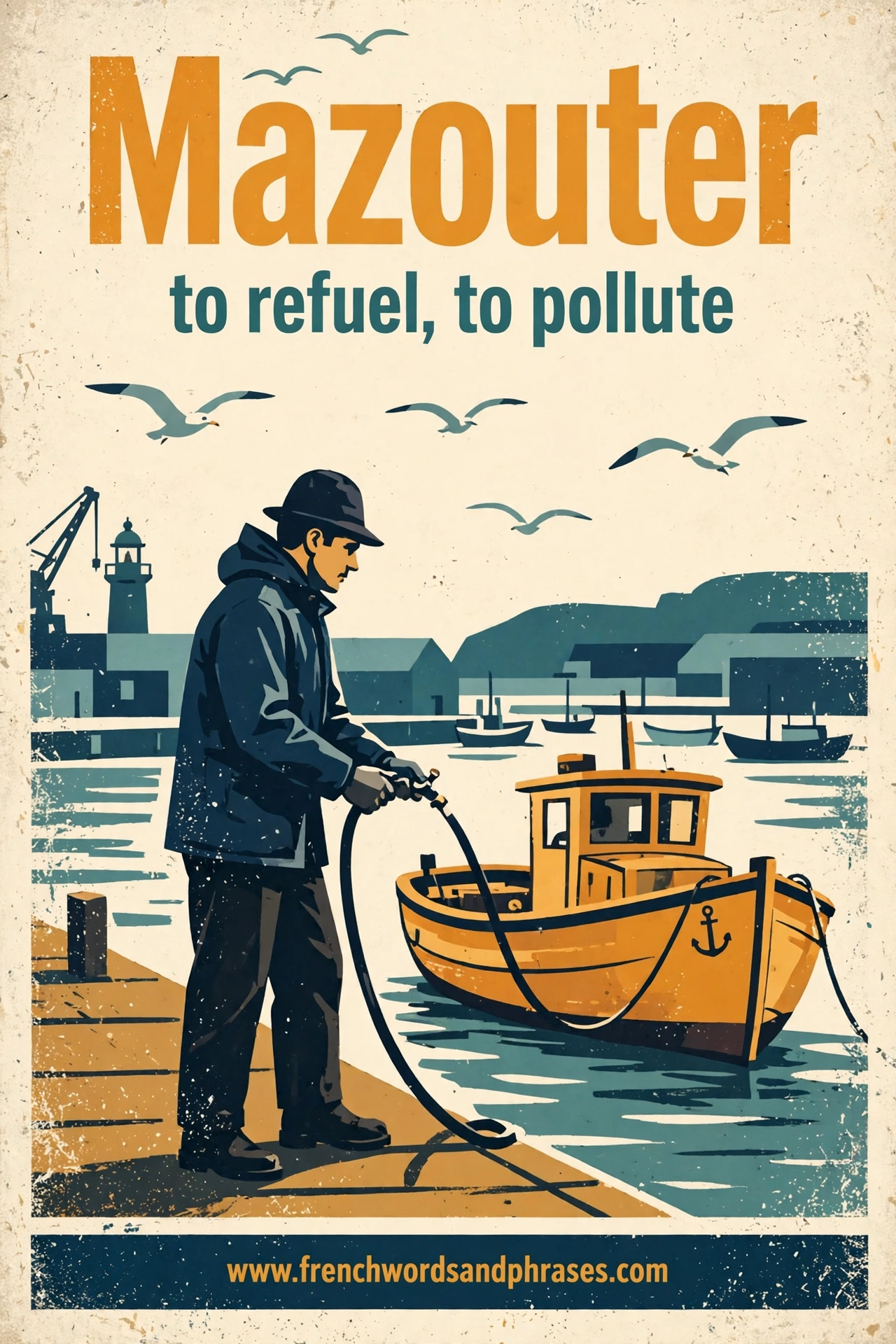
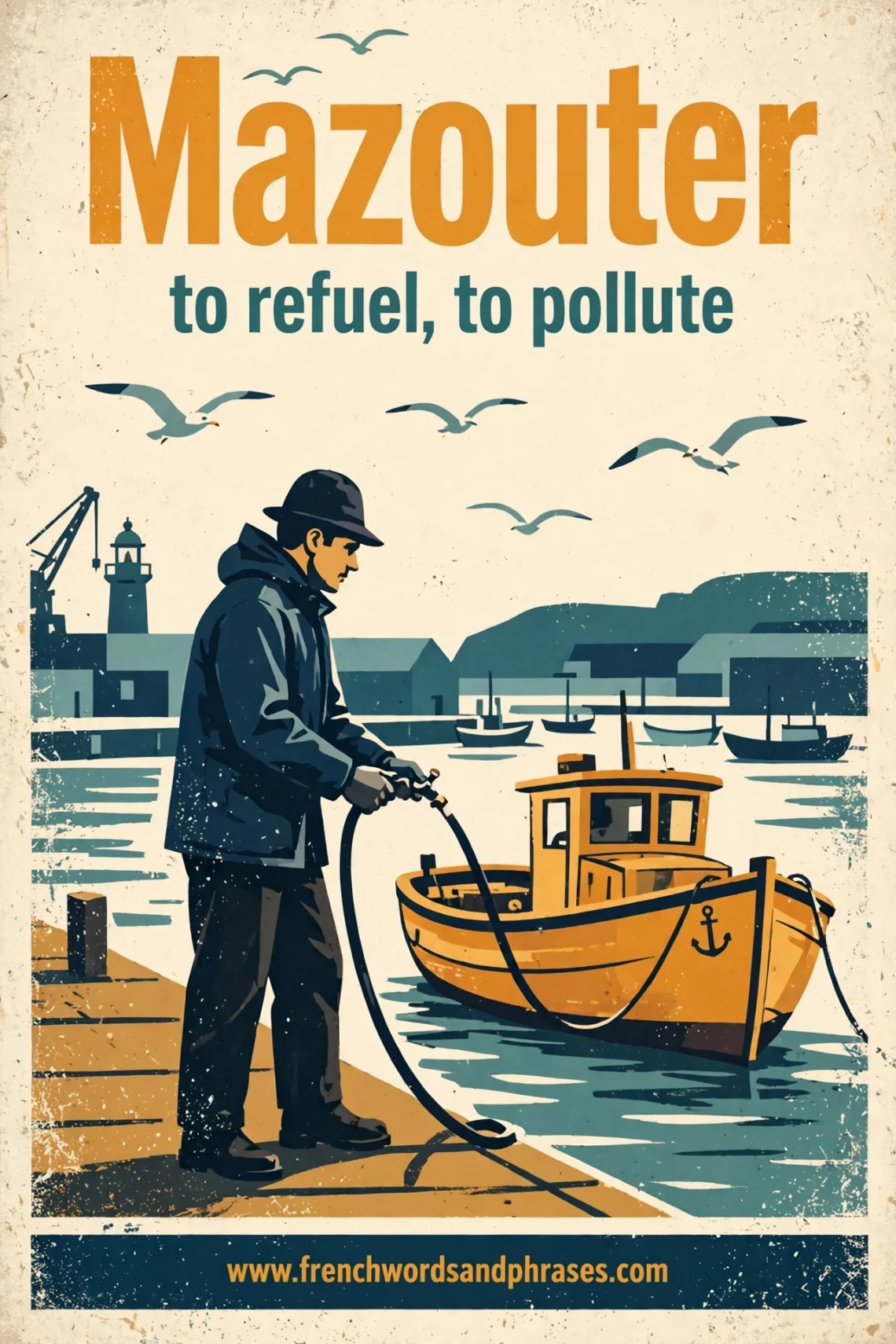
Mazouter means to refuel, to pollute.
A trawler taking on black fuel oil at dawn, a tanker leaking its cargo onto a white beach, gulls washed up dark and helpless — mazouter is a verb of two faces: filling a tank with fuel oil, and soiling the sea with it.
In this guide, you’ll learn how to conjugate mazouter in all the major French tenses and moods. Explore complete conjugation tables, French examples, English translations, and practice quizzes.
Understanding the French Verb Mazouter
Mazouter is a regular French verb belonging to the first group of verbs, those ending in -er.
It means to refuel, to pollute. It is commonly used at ports for refuelling ships and heating systems with fuel oil, and far more often in news reports for oil spills — birds, beaches, rocks and fishing boats soiled by mazout after a wreck or a leak.
Verb classification: First group (-er)
Auxiliary verb: Avoir
Past participle: mazouté
Present participle: mazoutant
English equivalents: To refuel with fuel oil (mazout); to pollute with oil — les oiseaux mazoutés, oiled birds; une plage mazoutée, an oil-soiled beach.
One important detail: mazouter is built on le mazout — heavy fuel oil, the dark diesel of ships, lorries and old boilers. At the harbour it is practical: mazouter un navire, to refuel a ship. But France knows the word best from bad news — after every tanker disaster, the newspapers fill with oiseaux mazoutés, birds coated in oil, and plages mazoutées. The verb of refuelling became the verb of oil pollution, and that second sense has nearly swallowed the first.
Experience the Word
Mazouter is the verb of black oil — welcome in a tank, a disaster on a feather.
Imagine a Breton beach after a storm. Volunteers in white suits walk the sand with buckets, lifting gulls whose feathers are glued with oil — des oiseaux mazoutés — and carrying them one by one to be washed in warm water and detergent.
The same oil that drives the ships has stopped the birds flying. Mazouter names both the filling and the fouling.
How to Conjugate Mazouter: Complete French Conjugation Guide
Let’s explore every major conjugation of mazouter, beginning with the indicative mood.
How to Conjugate Mazouter in the Indicative Mood
The indicative mood is used to express facts, observations, actions, and events.
How to Conjugate Mazouter in the Present Tense (Présent)
Used for actions happening now, habitual actions, and general truths.
| Subject | Conjugation |
|---|---|
| je | mazoute |
| tu | mazoutes |
| il / elle | mazoute |
| nous | mazoutons |
| vous | mazoutez |
| ils / elles | mazoutent |
Example
Le chalutier mazoute au port avant l’aube.
The trawler refuels at the port before dawn.
Quick Quiz 1
Complete the sentence:
Nous ______ le bateau au port.
Reveal the answer
mazoutons
Nous mazoutons le bateau au port.
We refuel the boat at the port.
How to Conjugate Mazouter in the Passé Composé
Used for completed actions in the past. Mazouter takes the auxiliary verb avoir.
| Subject | Conjugation |
|---|---|
| j’ | ai mazouté |
| tu | as mazouté |
| il / elle | a mazouté |
| nous | avons mazouté |
| vous | avez mazouté |
| ils / elles | ont mazouté |
Example
La marée noire a mazouté vingt kilomètres de côte.
The oil slick soiled twenty kilometres of coastline.
How to Conjugate Mazouter in the Imparfait (Imperfect Tense)
Used for habitual past actions, descriptions, and ongoing situations in the past.
| Subject | Conjugation |
|---|---|
| je | mazoutais |
| tu | mazoutais |
| il / elle | mazoutait |
| nous | mazoutions |
| vous | mazoutiez |
| ils / elles | mazoutaient |
Example
Chaque semaine, le camion mazoutait les chaudières du village.
Every week, the lorry used to deliver fuel oil to the village boilers.
Quick Quiz 2
Choose the correct form:
The slick soiled the coast.
La marée noire ______ la côte. (a mazouté / est mazoutée)
Reveal the answer
a mazouté
La marée noire a mazouté la côte.
Mazouter takes avoir.
How to Conjugate Mazouter in the Plus-que-parfait
Used to describe an action that had already been completed before another past event.
| Subject | Conjugation |
|---|---|
| j’ | avais mazouté |
| tu | avais mazouté |
| il / elle | avait mazouté |
| nous | avions mazouté |
| vous | aviez mazouté |
| ils / elles | avaient mazouté |
Example
La fuite avait mazouté la plage avant l’arrivée des secours.
The leak had oiled the beach before the rescuers arrived.
How to Conjugate Mazouter in the Passé Simple
Primarily used in formal writing, literature, and historical narratives. It is rarely used in everyday conversation.
| Subject | Conjugation |
|---|---|
| je | mazoutai |
| tu | mazoutas |
| il / elle | mazouta |
| nous | mazoutâmes |
| vous | mazoutâtes |
| ils / elles | mazoutèrent |
Example
Le naufrage mazouta les rochers et les oiseaux de la réserve.
The shipwreck oiled the rocks and the birds of the reserve.
How to Conjugate Mazouter in the Passé Antérieur
A literary tense used to express an action completed immediately before another past action, generally in the passé simple.
| Subject | Conjugation |
|---|---|
| j’ | eus mazouté |
| tu | eus mazouté |
| il / elle | eut mazouté |
| nous | eûmes mazouté |
| vous | eûtes mazouté |
| ils / elles | eurent mazouté |
Example
Quand le pétrolier eut mazouté la baie, les pêcheurs rentrèrent au port.
When the tanker had fouled the bay with oil, the fishermen returned to port.
How to Conjugate Mazouter in the Future Tense (Futur Simple)
Used to describe actions that will take place in the future.
| Subject | Conjugation |
|---|---|
| je | mazouterai |
| tu | mazouteras |
| il / elle | mazoutera |
| nous | mazouterons |
| vous | mazouterez |
| ils / elles | mazouteront |
Example
Demain, le ferry mazoutera à quai pendant la nuit.
Tomorrow, the ferry will refuel at the quay during the night.
How to Conjugate Mazouter in the Futur Antérieur (Future Perfect)
Used for an action that will have been completed before a particular point in the future.
| Subject | Conjugation |
|---|---|
| j’ | aurai mazouté |
| tu | auras mazouté |
| il / elle | aura mazouté |
| nous | aurons mazouté |
| vous | aurez mazouté |
| ils / elles | auront mazouté |
Example
À la fin du mois, la compagnie aura mazouté toute sa flotte pour l’hiver.
By the end of the month, the company will have refuelled its whole fleet for the winter.
How to Conjugate Mazouter in the Near Future (Futur Proche)
Used to describe something that is going to happen soon. Formed with aller + infinitive.
| Subject | Conjugation |
|---|---|
| je | vais mazouter |
| tu | vas mazouter |
| il / elle | va mazouter |
| nous | allons mazouter |
| vous | allez mazouter |
| ils / elles | vont mazouter |
Example
Attention, le tuyau va mazouter toute la cale si on ne le ferme pas !
Careful, the pipe is going to oil the whole hold if we do not shut it off!
How to Conjugate Mazouter in the Conditional Mood
The conditional mood expresses what would happen under certain circumstances. It is also frequently used to make polite requests or express wishes.
How to Conjugate Mazouter in the Present Conditional
| Subject | Conjugation |
|---|---|
| je | mazouterais |
| tu | mazouterais |
| il / elle | mazouterait |
| nous | mazouterions |
| vous | mazouteriez |
| ils / elles | mazouteraient |
Example
Sans cette fuite, la marée ne mazouterait pas les plages.
Without this leak, the tide would not oil the beaches.
How to Conjugate Mazouter in the Past Conditional
| Subject | Conjugation |
|---|---|
| j’ | aurais mazouté |
| tu | aurais mazouté |
| il / elle | aurait mazouté |
| nous | aurions mazouté |
| vous | auriez mazouté |
| ils / elles | auraient mazouté |
Example
Le vieux tuyau aurait mazouté le port entier sans l’alarme.
The old pipe would have oiled the whole port without the alarm.
Mazouter in the Literary Past Conditional Form
This less common literary form uses the imperfect subjunctive of avoir.
| Subject | Conjugation |
|---|---|
| j’ | eusse mazouté |
| tu | eusses mazouté |
| il / elle | eût mazouté |
| nous | eussions mazouté |
| vous | eussiez mazouté |
| ils / elles | eussent mazouté |
Example
Il eût mazouté sa propre plage plutôt que de payer la réparation.
He would have oiled his own beach rather than pay for the repair.
How to Conjugate Mazouter in the Subjunctive Mood
The subjunctive is used to express wishes, emotions, doubts, necessity, and uncertainty. It frequently follows expressions such as il faut que (it is necessary that) or bien que (although).
How to Conjugate Mazouter in the Present Subjunctive
| Subject | Conjugation |
|---|---|
| que je | mazoute |
| que tu | mazoutes |
| qu’il / qu’elle | mazoute |
| que nous | mazoutions |
| que vous | mazoutiez |
| qu’ils / qu’elles | mazoutent |
Example
Il faut que l’équipage mazoute le navire avant la marée.
The crew must refuel the ship before the tide.
Quick Quiz 3
Complete the sentence using the subjunctive:
On craint que la nappe ______ les huîtres.
Reveal the answer
mazoute
On craint que la nappe mazoute les huîtres.
People fear the slick will oil the oysters.
How to Conjugate Mazouter in the Imperfect Subjunctive
A literary tense, rarely encountered in modern spoken French.
| Subject | Conjugation |
|---|---|
| que je | mazoutasse |
| que tu | mazoutasses |
| qu’il / qu’elle | mazoutât |
| que nous | mazoutassions |
| que vous | mazoutassiez |
| qu’ils / qu’elles | mazoutassent |
Example
On craignait que la nappe mazoutât les parcs à huîtres.
People feared the slick might oil the oyster beds.
How to Conjugate Mazouter in the Pluperfect Subjunctive
A literary construction used to express an action completed before another past action.
| Subject | Conjugation |
|---|---|
| que j’ | eusse mazouté |
| que tu | eusses mazouté |
| qu’il / qu’elle | eût mazouté |
| que nous | eussions mazouté |
| que vous | eussiez mazouté |
| qu’ils / qu’elles | eussent mazouté |
Example
Les bénévoles regrettaient que la marée eût mazouté tant d’oiseaux.
The volunteers regretted that the tide had oiled so many birds.
How to Conjugate Mazouter in the Past Subjunctive
| Subject | Conjugation |
|---|---|
| que j’ | aie mazouté |
| que tu | aies mazouté |
| qu’il / qu’elle | ait mazouté |
| que nous | ayons mazouté |
| que vous | ayez mazouté |
| qu’ils / qu’elles | aient mazouté |
Example
Je suis triste que le pétrole ait mazouté cette belle crique.
I am sad that the oil has soiled this beautiful cove.
How to Conjugate Mazouter in the Imperative
The imperative is used to give commands, instructions, invitations, or suggestions. Subject pronouns are omitted.
How to Conjugate Mazouter in the Present Imperative
| Person | Conjugation |
|---|---|
| (tu) | mazoute |
| (nous) | mazoutons |
| (vous) | mazoutez |
Example
Mazoutez le bateau ce soir, on part à l’aube !
Refuel the boat this evening, we leave at dawn!
Quick Quiz 4
How would you say Refuel the boat (tu form)?
Reveal the answer
Mazoute le bateau !
French Participles of Mazouter
Participles are verb forms that can be used in compound tenses and other grammatical constructions.
Present Participle of Mazouter
mazoutant
En mazoutant la côte, la marée noire a tué des milliers d’oiseaux.
By oiling the coast, the slick killed thousands of birds.
Past Participle of Mazouter
mazouté
Mazouté de la tête aux pattes, le goéland ne pouvait plus voler.
Oiled from head to feet, the gull could no longer fly.
Mazouter in Everyday French: Real-Life Examples
Now that you know the conjugations, let’s see how mazouter appears in everyday French.
Example 1 — Present
Le bateau mazoute au port le soir.
The boat refuels at the port in the evening.
Example 2 — Passé composé
La marée noire a mazouté la plage.
The oil slick soiled the beach.
Example 3 — Imparfait
On mazoutait les chaudières à l’automne.
The boilers were filled with fuel oil in autumn.
Example 4 — Future
Les bénévoles nettoieront les oiseaux que la mer mazoutera encore.
The volunteers will clean the birds that the sea will oil again.
Example 5 — Conditional
Une seule fuite mazouterait tout le port.
A single leak would oil the whole port.
Example 6 — Imperative
Mazoute le chalutier avant la tempête !
Refuel the trawler before the storm!
Beyond Translation: The Meaning of Mazouter
English needs two unrelated verbs — to refuel and to pollute with oil; French mazouter refuses to separate them, because the substance is the same.
Le mazout is both cargo and catastrophe.
In the tank it is energy; on the water it is a marée noire, a black tide. Mazouter holds the whole story in one word — and its participle, mazouté, has become the portrait of every oiled bird on the evening news.
How to Remember the French Verb Mazouter
Remember it this way: Mazouter is about black fuel oil — welcome in the tank, a disaster on the beach.
- Le mazout is heavy fuel oil — mazouter fills a tank with it, or soils a coast with it.
- Des oiseaux mazoutés — oiled birds: the phrase every French oil-spill report uses.
- Regular -er: je mazoute, nous mazoutons, past participle mazouté.
The key idea is black fuel oil — welcome in the tank, a disaster on the beach.
Test Your Knowledge of Mazouter
Let’s see how much you’ve learned. Try answering these questions before revealing the answers.
Question 1
What is le mazout?
Reveal the answer
Heavy fuel oil — the dark oil of ships, lorries and old boilers.
Question 2
How do you say oiled birds in French?
Reveal the answer
Des oiseaux mazoutés.
Question 3
Translate: The slick soiled the beach.
Reveal the answer
La marée noire a mazouté la plage.
Question 4
What is the past participle of mazouter?
Reveal the answer
Mazouté.
Question 5
Complete the sentence:
Il faut que l’équipage ______ le navire avant la marée.
Reveal the answer
mazoute
Il faut que l’équipage mazoute le navire avant la marée.
The crew must refuel the ship before the tide.
Your Final Challenge
Can You Use It?
How would you say this in French?
The volunteers wash an oiled bird, and soon it takes flight again.
Reveal the answer
Les bénévoles lavent un oiseau mazouté, et bientôt il reprend son vol.
The volunteers wash an oiled bird, and soon it takes flight again.
A little French. A little curiosity. A richer everyday life.
LEARN FRENCH ONE WORD AT A TIME