
A French Word to Live By
How to Conjugate Massacrer in French
/ma.sa.kʁe/
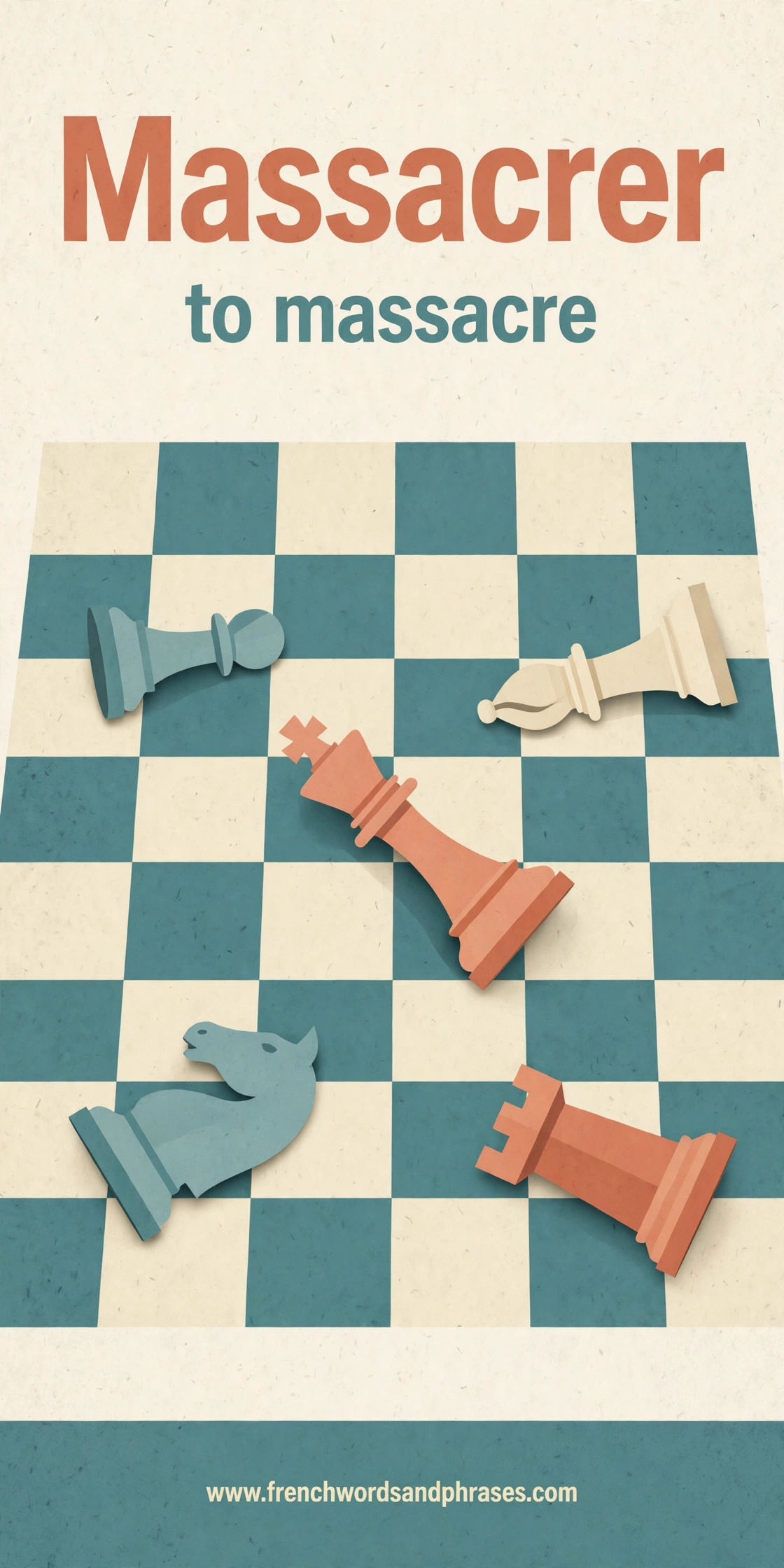
Massacrer means to massacre.
A word with two faces: the grim verb of battlefields and massacres — and, in everyday French, the comic exaggeration for a song sung off-key, a language spoken badly, a job thoroughly ruined. Massacrer is heavy history and kitchen-table hyperbole in one.
In this guide, you’ll learn how to conjugate massacrer in all the major French tenses and moods. Explore complete conjugation tables, French examples, English translations, and practice quizzes.
Understanding the French Verb Massacrer
Massacrer is a regular French verb belonging to the first group of verbs, those ending in -er.
It means to massacre. It is commonly used in history and news for massacres of soldiers, prisoners and populations, and in everyday exaggeration for ruined work, mangled languages, murdered songs and hopeless haircuts — always understood as hyperbole when the object is a thing and not a person.
Verb classification: First group (-er)
Auxiliary verb: Avoir
Past participle: massacré
Present participle: massacrant
English equivalents: To massacre, to slaughter; (familiar) to butcher, to murder (a song, a language), to ruin a job.
One important detail: massacrer leads a double life in French. Its first sense is the terrible one — to massacre, to slaughter defenceless people, a word of war reports and history books. But in familiar speech it softens into exaggeration: il massacre la langue française, he butchers the French language; elle massacre cette chanson, she murders this song; tu as massacré ma coiffure, you have ruined my haircut. Same verb — horror in the headlines, comedy at home.
Experience the Word
Massacrer is the verb of total ruin — nothing left standing, whether it is an army in a history book or a love song at a family party.
Imagine a village fête on a summer night. Uncle Henri takes the microphone, closes his eyes, and delivers the national anthem in a key nobody has ever heard before, while the children cover their ears and laugh.
The song has not just been sung badly. It has been massacred — joyfully, completely, in front of everyone.
How to Conjugate Massacrer: Complete French Conjugation Guide
Let’s explore every major conjugation of massacrer, beginning with the indicative mood.
How to Conjugate Massacrer in the Indicative Mood
The indicative mood is used to express facts, observations, actions, and events.
How to Conjugate Massacrer in the Present Tense (Présent)
Used for actions happening now, habitual actions, and general truths.
| Subject | Conjugation |
|---|---|
| je | massacre |
| tu | massacres |
| il / elle | massacre |
| nous | massacrons |
| vous | massacrez |
| ils / elles | massacrent |
Example
Il massacre la chanson avec un enthousiasme terrible.
He murders the song with terrible enthusiasm.
Quick Quiz 1
Complete the sentence:
Nous ______ les classiques au piano.
Reveal the answer
massacrons
Nous massacrons les classiques au piano.
We murder the classics on the piano.
How to Conjugate Massacrer in the Passé Composé
Used for completed actions in the past. Massacrer takes the auxiliary verb avoir.
| Subject | Conjugation |
|---|---|
| j’ | ai massacré |
| tu | as massacré |
| il / elle | a massacré |
| nous | avons massacré |
| vous | avez massacré |
| ils / elles | ont massacré |
Example
Les envahisseurs ont massacré la garnison de la ville.
The invaders massacred the town’s garrison.
How to Conjugate Massacrer in the Imparfait (Imperfect Tense)
Used for habitual past actions, descriptions, and ongoing situations in the past.
| Subject | Conjugation |
|---|---|
| je | massacrais |
| tu | massacrais |
| il / elle | massacrait |
| nous | massacrions |
| vous | massacriez |
| ils / elles | massacraient |
Example
Chaque été, mon cousin massacrait les classiques au piano.
Every summer, my cousin used to butcher the classics on the piano.
Quick Quiz 2
Choose the correct form:
The hairdresser ruined my hair.
Le coiffeur ______ mes cheveux. (a massacré / est massacré)
Reveal the answer
a massacré
Le coiffeur a massacré mes cheveux.
Massacrer takes avoir.
How to Conjugate Massacrer in the Plus-que-parfait
Used to describe an action that had already been completed before another past event.
| Subject | Conjugation |
|---|---|
| j’ | avais massacré |
| tu | avais massacré |
| il / elle | avait massacré |
| nous | avions massacré |
| vous | aviez massacré |
| ils / elles | avaient massacré |
Example
L’armée avait massacré les prisonniers avant de fuir.
The army had massacred the prisoners before fleeing.
How to Conjugate Massacrer in the Passé Simple
Primarily used in formal writing, literature, and historical narratives. It is rarely used in everyday conversation.
| Subject | Conjugation |
|---|---|
| je | massacrai |
| tu | massacras |
| il / elle | massacra |
| nous | massacrâmes |
| vous | massacrâtes |
| ils / elles | massacrèrent |
Example
Les soldats massacrèrent les défenseurs de la citadelle.
The soldiers massacred the defenders of the citadel.
How to Conjugate Massacrer in the Passé Antérieur
A literary tense used to express an action completed immediately before another past action, generally in the passé simple.
| Subject | Conjugation |
|---|---|
| j’ | eus massacré |
| tu | eus massacré |
| il / elle | eut massacré |
| nous | eûmes massacré |
| vous | eûtes massacré |
| ils / elles | eurent massacré |
Example
Quand il eut massacré la pièce entière, le public resta silencieux.
When he had murdered the whole piece, the audience stayed silent.
How to Conjugate Massacrer in the Future Tense (Futur Simple)
Used to describe actions that will take place in the future.
| Subject | Conjugation |
|---|---|
| je | massacrerai |
| tu | massacreras |
| il / elle | massacrera |
| nous | massacrerons |
| vous | massacrerez |
| ils / elles | massacreront |
Example
Si tu continues ainsi, tu massacreras ta nouvelle coiffure.
If you carry on like that, you will ruin your new haircut.
How to Conjugate Massacrer in the Futur Antérieur (Future Perfect)
Used for an action that will have been completed before a particular point in the future.
| Subject | Conjugation |
|---|---|
| j’ | aurai massacré |
| tu | auras massacré |
| il / elle | aura massacré |
| nous | aurons massacré |
| vous | aurez massacré |
| ils / elles | auront massacré |
Example
À la fin du concert, ils auront massacré trois chansons.
By the end of the concert, they will have murdered three songs.
How to Conjugate Massacrer in the Near Future (Futur Proche)
Used to describe something that is going to happen soon. Formed with aller + infinitive.
| Subject | Conjugation |
|---|---|
| je | vais massacrer |
| tu | vas massacrer |
| il / elle | va massacrer |
| nous | allons massacrer |
| vous | allez massacrer |
| ils / elles | vont massacrer |
Example
Attention, ce coiffeur va massacrer tes cheveux.
Careful, this hairdresser is going to butcher your hair.
How to Conjugate Massacrer in the Conditional Mood
The conditional mood expresses what would happen under certain circumstances. It is also frequently used to make polite requests or express wishes.
How to Conjugate Massacrer in the Present Conditional
| Subject | Conjugation |
|---|---|
| je | massacrerais |
| tu | massacrerais |
| il / elle | massacrerait |
| nous | massacrerions |
| vous | massacreriez |
| ils / elles | massacreraient |
Example
Sans répétition, nous massacrerions le concert entier.
Without rehearsal, we would murder the whole concert.
How to Conjugate Massacrer in the Past Conditional
| Subject | Conjugation |
|---|---|
| j’ | aurais massacré |
| tu | aurais massacré |
| il / elle | aurait massacré |
| nous | aurions massacré |
| vous | auriez massacré |
| ils / elles | auraient massacré |
Example
Elle aurait massacré la traduction sans dictionnaire.
She would have butchered the translation without a dictionary.
Massacrer in the Literary Past Conditional Form
This less common literary form uses the imperfect subjunctive of avoir.
| Subject | Conjugation |
|---|---|
| j’ | eusse massacré |
| tu | eusses massacré |
| il / elle | eût massacré |
| nous | eussions massacré |
| vous | eussiez massacré |
| ils / elles | eussent massacré |
Example
Il eût massacré l’ennemi sans pitié, dit la chronique.
He would have massacred the enemy without mercy, says the chronicle.
How to Conjugate Massacrer in the Subjunctive Mood
The subjunctive is used to express wishes, emotions, doubts, necessity, and uncertainty. It frequently follows expressions such as il faut que (it is necessary that) or bien que (although).
How to Conjugate Massacrer in the Present Subjunctive
| Subject | Conjugation |
|---|---|
| que je | massacre |
| que tu | massacres |
| qu’il / qu’elle | massacre |
| que nous | massacrions |
| que vous | massacriez |
| qu’ils / qu’elles | massacrent |
Example
Il faut que personne ne massacre cette belle chanson.
Nobody must murder this beautiful song.
Quick Quiz 3
Complete the sentence using the subjunctive:
Il faut que vous ne ______ pas les rosiers.
Reveal the answer
massacriez
Il faut que vous ne massacriez pas les rosiers.
You must not ruin the rose bushes.
How to Conjugate Massacrer in the Imperfect Subjunctive
A literary tense, rarely encountered in modern spoken French.
| Subject | Conjugation |
|---|---|
| que je | massacrasse |
| que tu | massacrasses |
| qu’il / qu’elle | massacrât |
| que nous | massacrassions |
| que vous | massacrassiez |
| qu’ils / qu’elles | massacrassent |
Example
Je craignais qu’il massacrât l’accent italien.
I feared he might butcher the Italian accent.
How to Conjugate Massacrer in the Pluperfect Subjunctive
A literary construction used to express an action completed before another past action.
| Subject | Conjugation |
|---|---|
| que j’ | eusse massacré |
| que tu | eusses massacré |
| qu’il / qu’elle | eût massacré |
| que nous | eussions massacré |
| que vous | eussiez massacré |
| qu’ils / qu’elles | eussent massacré |
Example
Le journal rapportait que les troupes eussent massacré le village.
The newspaper reported that the troops had massacred the village.
How to Conjugate Massacrer in the Past Subjunctive
| Subject | Conjugation |
|---|---|
| que j’ | aie massacré |
| que tu | aies massacré |
| qu’il / qu’elle | ait massacré |
| que nous | ayons massacré |
| que vous | ayez massacré |
| qu’ils / qu’elles | aient massacré |
Example
Je suis désolé que le jardinier ait massacré tes rosiers.
I am sorry the gardener ruined your rose bushes.
How to Conjugate Massacrer in the Imperative
The imperative is used to give commands, instructions, invitations, or suggestions. Subject pronouns are omitted.
How to Conjugate Massacrer in the Present Imperative
| Person | Conjugation |
|---|---|
| (tu) | massacre |
| (nous) | massacrons |
| (vous) | massacrez |
Example
Ne massacre pas cette mélodie, chante-la doucement !
Do not murder this tune, sing it gently!
Quick Quiz 4
How would you say Do not murder this song (tu form)?
Reveal the answer
Ne massacre pas cette chanson !
French Participles of Massacrer
Participles are verb forms that can be used in compound tenses and other grammatical constructions.
Present Participle of Massacrer
massacrant
En massacrant l’anglais, il faisait rire toute la classe.
By butchering English, he made the whole class laugh.
Past Participle of Massacrer
massacré
Massacrée par le vent, la récolte était perdue.
Destroyed by the wind, the harvest was lost.
Massacrer in Everyday French: Real-Life Examples
Now that you know the conjugations, let’s see how massacrer appears in everyday French.
Example 1 — Present
Mon frère massacre l’italien avec confiance.
My brother butchers Italian with confidence.
Example 2 — Passé composé
Le coiffeur a massacré ma frange.
The hairdresser ruined my fringe.
Example 3 — Imparfait
Autrefois, ce groupe massacrait les chansons des Beatles.
In the old days, this band used to murder Beatles songs.
Example 4 — Future
Tu massacreras le gâteau si tu le coupes ainsi.
You will ruin the cake if you cut it like that.
Example 5 — Conditional
Je massacrerais ce texte sans mon dictionnaire.
I would butcher this text without my dictionary.
Example 6 — Imperative
Ne massacrez pas les rosiers en les taillant !
Do not ruin the rose bushes by pruning them!
Beyond Translation: The Meaning of Massacrer
English keeps massacre for atrocities and reaches for butcher or murder for the jokes; French massacrer does both jobs with one word.
Context decides whether it is horror or humour.
Massacrer des prisonniers belongs to the history book; massacrer une chanson belongs to the family dinner. French speakers slide between the two without blinking — the exaggeration is the joke.
How to Remember the French Verb Massacrer
Remember it this way: Massacrer is about total ruin — armies in history, songs at the family party.
- Two registers: history’s massacre, and the familiar butchering of songs and languages.
- Massacrer une chanson, massacrer une langue — the everyday objects are things, not people.
- Regular -er: je massacre, nous massacrons, past participle massacré.
The key idea is total ruin — armies in history, songs at the family party.
Test Your Knowledge of Massacrer
Let’s see how much you’ve learned. Try answering these questions before revealing the answers.
Question 1
In everyday speech, what does il massacre cette chanson mean?
Reveal the answer
He murders the song — he sings it very badly; it is exaggeration, not violence.
Question 2
How do you say The hairdresser ruined my fringe in French?
Reveal the answer
Le coiffeur a massacré ma frange.
Question 3
Translate: The soldiers massacred the defenders of the citadel.
Reveal the answer
Les soldats ont massacré les défenseurs de la citadelle.
Question 4
What is the past participle of massacrer?
Reveal the answer
Massacré.
Question 5
Complete the sentence:
Il faut que personne ne ______ cette chanson.
Reveal the answer
massacre
Il faut que personne ne massacre cette chanson.
Nobody must murder this song.
Your Final Challenge
Can You Use It?
How would you say this in French?
He murders the song, but everyone sings along with him.
Reveal the answer
Il massacre la chanson, mais tout le monde chante avec lui.
He murders the song, but everyone sings along with him.
A little French. A little curiosity. A richer everyday life.
LEARN FRENCH ONE WORD AT A TIME




