A French Word to Live By
How to Conjugate Marquer in French
/maʁ.ke/
Marquer means to mark, to score.
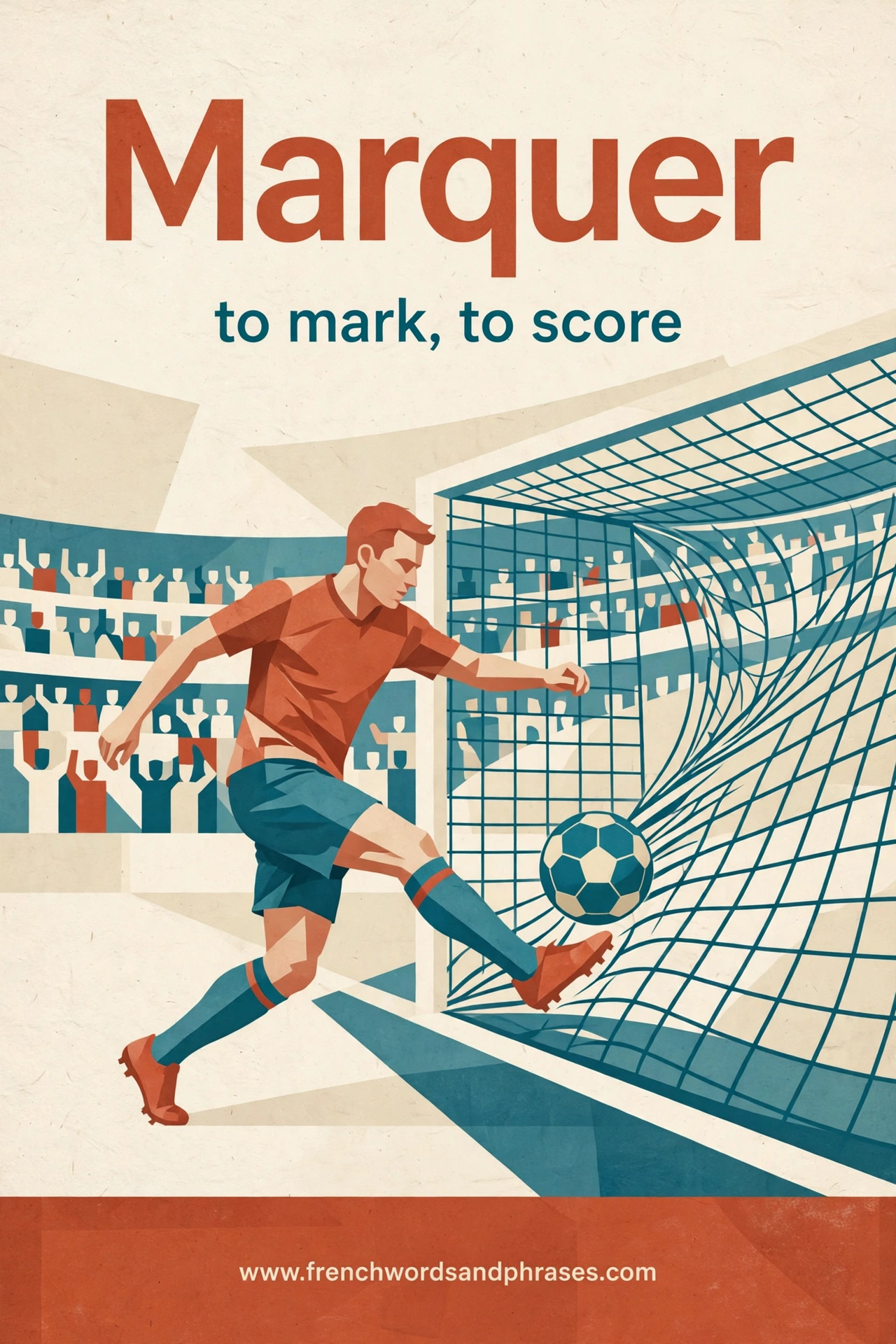
A striker wheeling away with his arms wide, a teacher’s red pen, a ribbon left between two pages — marquer is the verb of the mark that stays: a goal scored, a date circled, an impression that nobody forgets.
In this guide, you’ll learn how to conjugate marquer in all the major French tenses and moods. Explore complete conjugation tables, French examples, English translations, and practice quizzes.
Understanding the French Verb Marquer
Marquer is a regular French verb belonging to the first group of verbs, those ending in -er.
It means to mark, to score. It is commonly used for scoring goals and points, for marking pages, dates and places on a map, for teachers marking work, and for events and people that mark a whole generation — un film qui a marqué son époque.
Verb classification: First group (-er)
Auxiliary verb: Avoir
Past participle: marqué
Present participle: marquant
English equivalents: To mark, to score (a goal, a point); to leave a mark on; marquer les esprits — to leave a lasting impression.
One important detail: marquer lives its most famous life on the football pitch — marquer un but, to score a goal. Off the pitch it marks pages, dates and copies, and in its grandest phrase it marks minds: marquer les esprits, to leave a lasting impression on everyone who was there. Its past participle is marqué: un moment marqué par l’émotion, a moment marked by emotion.
Experience the Word
Marquer is the verb of the trace that remains — the goal in the record book, the date in the diary, the moment in the memory.
Imagine a small stadium on a Saturday night. The score is level, the clock is dying — then the ball hits the net, and a boy in the stands knows he will marquer this evening in his memory for the rest of his life.
The ball has crossed a line. And everything is marked — the score, the night, the boy.
How to Conjugate Marquer: Complete French Conjugation Guide
Let’s explore every major conjugation of marquer, beginning with the indicative mood.
How to Conjugate Marquer in the Indicative Mood
The indicative mood is used to express facts, observations, actions, and events.
How to Conjugate Marquer in the Present Tense (Présent)
Used for actions happening now, habitual actions, and general truths.
| Subject | Conjugation |
|---|---|
| je | marque |
| tu | marques |
| il / elle | marque |
| nous | marquons |
| vous | marquez |
| ils / elles | marquent |
Example
Il marque le troisième but du match.
He scores the third goal of the match.
Quick Quiz 1
Complete the sentence:
Nous ______ la date sur le calendrier.
Reveal the answer
marquons
Nous marquons la date sur le calendrier.
We mark the date on the calendar.
How to Conjugate Marquer in the Passé Composé
Used for completed actions in the past. Marquer takes the auxiliary verb avoir.
| Subject | Conjugation |
|---|---|
| j’ | ai marqué |
| tu | as marqué |
| il / elle | a marqué |
| nous | avons marqué |
| vous | avez marqué |
| ils / elles | ont marqué |
Example
Elle a marqué la page avec un ruban rouge.
She marked the page with a red ribbon.
How to Conjugate Marquer in the Imparfait (Imperfect Tense)
Used for habitual past actions, descriptions, and ongoing situations in the past.
| Subject | Conjugation |
|---|---|
| je | marquais |
| tu | marquais |
| il / elle | marquait |
| nous | marquions |
| vous | marquiez |
| ils / elles | marquaient |
Example
Le professeur marquait les fautes au crayon rouge.
The teacher used to mark the mistakes in red pencil.
Quick Quiz 2
Choose the correct form:
She scored a goal.
Elle ______ un but. (a marqué / est marquée)
Reveal the answer
a marqué
Elle a marqué un but.
Marquer takes avoir.
How to Conjugate Marquer in the Plus-que-parfait
Used to describe an action that had already been completed before another past event.
| Subject | Conjugation |
|---|---|
| j’ | avais marqué |
| tu | avais marqué |
| il / elle | avait marqué |
| nous | avions marqué |
| vous | aviez marqué |
| ils / elles | avaient marqué |
Example
Nous avions marqué la date sur le calendrier.
We had marked the date on the calendar.
How to Conjugate Marquer in the Passé Simple
Primarily used in formal writing, literature, and historical narratives. It is rarely used in everyday conversation.
| Subject | Conjugation |
|---|---|
| je | marquai |
| tu | marquas |
| il / elle | marqua |
| nous | marquâmes |
| vous | marquâtes |
| ils / elles | marquèrent |
Example
L’attaquant marqua le but de la victoire.
The striker scored the winning goal.
How to Conjugate Marquer in the Passé Antérieur
A literary tense used to express an action completed immediately before another past action, generally in the passé simple.
| Subject | Conjugation |
|---|---|
| j’ | eus marqué |
| tu | eus marqué |
| il / elle | eut marqué |
| nous | eûmes marqué |
| vous | eûtes marqué |
| ils / elles | eurent marqué |
Example
Quand il eut marqué son but, le stade explosa de joie.
When he had scored his goal, the stadium erupted with joy.
How to Conjugate Marquer in the Future Tense (Futur Simple)
Used to describe actions that will take place in the future.
| Subject | Conjugation |
|---|---|
| je | marquerai |
| tu | marqueras |
| il / elle | marquera |
| nous | marquerons |
| vous | marquerez |
| ils / elles | marqueront |
Example
Demain, elle marquera les copies des élèves.
Tomorrow, she will mark the pupils’ work.
How to Conjugate Marquer in the Futur Antérieur (Future Perfect)
Used for an action that will have been completed before a particular point in the future.
| Subject | Conjugation |
|---|---|
| j’ | aurai marqué |
| tu | auras marqué |
| il / elle | aura marqué |
| nous | aurons marqué |
| vous | aurez marqué |
| ils / elles | auront marqué |
Example
À la fin du match, il aura marqué deux buts.
By the end of the match, he will have scored two goals.
How to Conjugate Marquer in the Near Future (Futur Proche)
Used to describe something that is going to happen soon. Formed with aller + infinitive.
| Subject | Conjugation |
|---|---|
| je | vais marquer |
| tu | vas marquer |
| il / elle | va marquer |
| nous | allons marquer |
| vous | allez marquer |
| ils / elles | vont marquer |
Example
Je vais marquer cette date dans mon agenda.
I am going to mark this date in my diary.
How to Conjugate Marquer in the Conditional Mood
The conditional mood expresses what would happen under certain circumstances. It is also frequently used to make polite requests or express wishes.
How to Conjugate Marquer in the Present Conditional
| Subject | Conjugation |
|---|---|
| je | marquerais |
| tu | marquerais |
| il / elle | marquerait |
| nous | marquerions |
| vous | marqueriez |
| ils / elles | marqueraient |
Example
Sans ce défenseur, ils marqueraient plus souvent.
Without that defender, they would score more often.
How to Conjugate Marquer in the Past Conditional
| Subject | Conjugation |
|---|---|
| j’ | aurais marqué |
| tu | aurais marqué |
| il / elle | aurait marqué |
| nous | aurions marqué |
| vous | auriez marqué |
| ils / elles | auraient marqué |
Example
Elle aurait marqué le but sans cette blessure.
She would have scored the goal without that injury.
Marquer in the Literary Past Conditional Form
This less common literary form uses the imperfect subjunctive of avoir.
| Subject | Conjugation |
|---|---|
| j’ | eusse marqué |
| tu | eusses marqué |
| il / elle | eût marqué |
| nous | eussions marqué |
| vous | eussiez marqué |
| ils / elles | eussent marqué |
Example
Il eût marqué les esprits par son discours.
He would have left a lasting impression with his speech.
How to Conjugate Marquer in the Subjunctive Mood
The subjunctive is used to express wishes, emotions, doubts, necessity, and uncertainty. It frequently follows expressions such as il faut que (it is necessary that) or bien que (although).
How to Conjugate Marquer in the Present Subjunctive
| Subject | Conjugation |
|---|---|
| que je | marque |
| que tu | marques |
| qu’il / qu’elle | marque |
| que nous | marquions |
| que vous | marquiez |
| qu’ils / qu’elles | marquent |
Example
Il faut que tu marques la page avant de fermer le livre.
You must mark the page before closing the book.
Quick Quiz 3
Complete the sentence using the subjunctive:
Il faut que vous ______ la page.
Reveal the answer
marquiez
Il faut que vous marquiez la page.
You must mark the page.
How to Conjugate Marquer in the Imperfect Subjunctive
A literary tense, rarely encountered in modern spoken French.
| Subject | Conjugation |
|---|---|
| que je | marquasse |
| que tu | marquasses |
| qu’il / qu’elle | marquât |
| que nous | marquassions |
| que vous | marquassiez |
| qu’ils / qu’elles | marquassent |
Example
Je voulais qu’il marquât le coup franc.
I wanted him to score the free kick.
How to Conjugate Marquer in the Pluperfect Subjunctive
A literary construction used to express an action completed before another past action.
| Subject | Conjugation |
|---|---|
| que j’ | eusse marqué |
| que tu | eusses marqué |
| qu’il / qu’elle | eût marqué |
| que nous | eussions marqué |
| que vous | eussiez marqué |
| qu’ils / qu’elles | eussent marqué |
Example
Il regrettait que nous eussions marqué si tard.
He regretted that we had scored so late.
How to Conjugate Marquer in the Past Subjunctive
| Subject | Conjugation |
|---|---|
| que j’ | aie marqué |
| que tu | aies marqué |
| qu’il / qu’elle | ait marqué |
| que nous | ayons marqué |
| que vous | ayez marqué |
| qu’ils / qu’elles | aient marqué |
Example
Je suis content que tu aies marqué ce but.
I am glad you scored that goal.
How to Conjugate Marquer in the Imperative
The imperative is used to give commands, instructions, invitations, or suggestions. Subject pronouns are omitted.
How to Conjugate Marquer in the Present Imperative
| Person | Conjugation |
|---|---|
| (tu) | marque |
| (nous) | marquons |
| (vous) | marquez |
Example
Marque la date sur le calendrier !
Mark the date on the calendar!
Quick Quiz 4
How would you say Mark the date (tu form)?
Reveal the answer
Marque la date !
French Participles of Marquer
Participles are verb forms that can be used in compound tenses and other grammatical constructions.
Present Participle of Marquer
marquant
En marquant ce but, il est devenu le héros du match.
By scoring that goal, he became the hero of the match.
Past Participle of Marquer
marqué
Marqué par cette rencontre, il n’a plus jamais douté.
Marked by that meeting, he never doubted again.
Marquer in Everyday French: Real-Life Examples
Now that you know the conjugations, let’s see how marquer appears in everyday French.
Example 1 — Present
Il marque toujours ses pages d’un ruban.
He always marks his pages with a ribbon.
Example 2 — Passé composé
Elle a marqué deux buts hier soir.
She scored two goals last night.
Example 3 — Imparfait
On marquait les fautes en rouge, autrefois.
In the old days, mistakes were marked in red.
Example 4 — Future
Je marquerai la date en rouge.
I will mark the date in red.
Example 5 — Conditional
Tu marquerais un but, toi aussi ?
Would you score a goal too?
Example 6 — Imperative
Marquez vos réponses au crayon !
Mark your answers in pencil!
Beyond Translation: The Meaning of Marquer
English splits this work between mark and score; French marquer holds both in one word — and then climbs higher.
Marquer les esprits is the real prize.
Goals are forgotten by the next match, but a speech, a film or a kindness that a marqué les esprits stays marked in people for decades. The verb of the red pen becomes the verb of memory itself.
How to Remember the French Verb Marquer
Remember it this way: Marquer is about goals, dates and lasting impressions.
- Marquer un but — to score a goal: the marquer every football fan knows.
- Marquer les esprits — to leave a mark on minds, a lasting impression.
- Regular -er: je marque, nous marquons, past participle marqué.
The key idea is goals, dates and lasting impressions.
Test Your Knowledge of Marquer
Let’s see how much you’ve learned. Try answering these questions before revealing the answers.
Question 1
How do you say to score a goal in French?
Reveal the answer
Marquer un but.
Question 2
What does marquer les esprits mean?
Reveal the answer
To leave a lasting impression — literally, to mark people’s minds.
Question 3
Translate: She scored two goals last night.
Reveal the answer
Elle a marqué deux buts hier soir.
Question 4
What is the past participle of marquer?
Reveal the answer
Marqué.
Question 5
Complete the sentence:
Il faut que tu ______ la page avant de fermer le livre.
Reveal the answer
marques
Il faut que tu marques la page avant de fermer le livre.
You must mark the page before closing the book.
Your Final Challenge
Can You Use It?
How would you say this in French?
He scores the winning goal, and the whole stadium rises.
Reveal the answer
Il marque le but de la victoire, et le stade entier se lève.
He scores the winning goal, and the whole stadium rises.
A little French. A little curiosity. A richer everyday life.
LEARN FRENCH ONE WORD AT A TIME