A French Word to Live By
How to Conjugate Marqueter in French
/maʁ.kə.te/
Marqueter means to inlay.
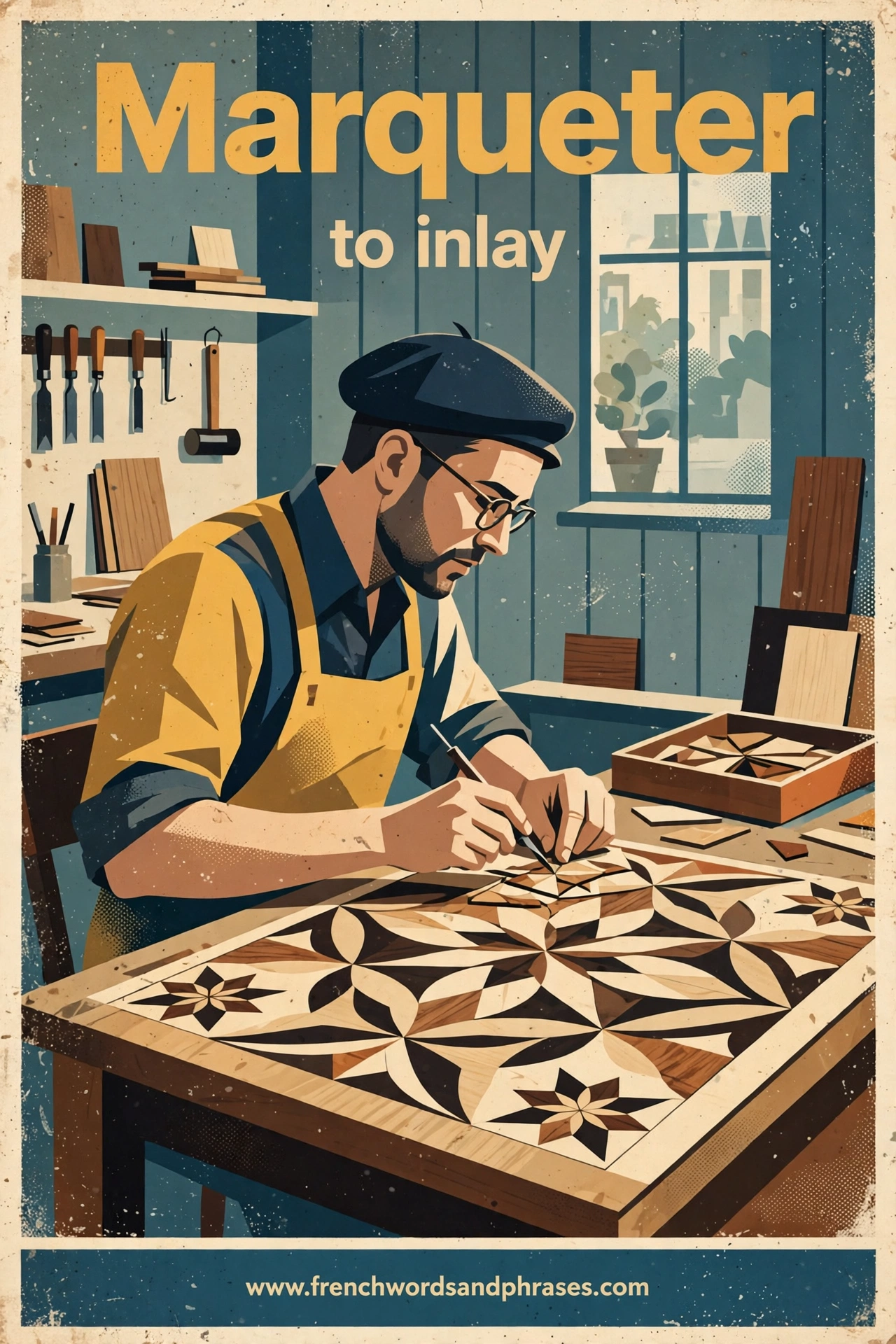
A rose of pale wood blooming on a dark walnut panel, a bird built from a dozen different veneers — marqueter is the cabinetmaker’s most patient verb: to inlay one precious material into another until the surface becomes a picture.
In this guide, you’ll learn how to conjugate marqueter in all the major French tenses and moods. Explore complete conjugation tables, French examples, English translations, and practice quizzes.
Understanding the French Verb Marqueter
Marqueter is a regular French verb belonging to the first group of verbs, those ending in -er.
It means to inlay. It is commonly used for inlaying tabletops, cabinet doors, boxes and musical instruments with contrasting woods, for restoring antique furniture, and wherever la marqueterie turns a useful object into a work of art.
Verb classification: First group (-er)
Auxiliary verb: Avoir
Past participle: marqueté
Present participle: marquetant
English equivalents: To inlay (wood, ivory, mother-of-pearl); la marqueterie — marquetry, the art of inlaid work.
One important detail: on this page marqueter follows the plain regular -er pattern from start to finish — the stem marquet- plus the ordinary -er endings, past participle marqueté. The craft it names is la marqueterie: thin pieces of precious wood, shell or mother-of-pearl cut and fitted into a surface like a puzzle, and the craftsman who does it is un marqueteur.
Experience the Word
Marqueter is the verb of the wooden picture — every petal, feather and leaf a separate piece of veneer, cut by hand.
Imagine a quiet workshop smelling of glue and walnut. On the bench, a panel slowly fills with flowers — rosewood, lemonwood, maple — each piece fitted so exactly that the seams disappear.
It is not painted and not carved. It has been inlaid — picture and furniture in one.
How to Conjugate Marqueter: Complete French Conjugation Guide
Let’s explore every major conjugation of marqueter, beginning with the indicative mood.
How to Conjugate Marqueter in the Indicative Mood
The indicative mood is used to express facts, observations, actions, and events.
How to Conjugate Marqueter in the Present Tense (Présent)
Used for actions happening now, habitual actions, and general truths.
| Subject | Conjugation |
|---|---|
| je | marquete |
| tu | marquetes |
| il / elle | marquete |
| nous | marquetons |
| vous | marquetez |
| ils / elles | marquetent |
Example
Nous marquetons le noyer avec du citronnier.
We inlay the walnut with lemonwood.
Quick Quiz 1
Complete the sentence:
Nous ______ le noyer et l’érable.
Reveal the answer
marquetons
Nous marquetons le noyer et l’érable.
We inlay walnut and maple.
How to Conjugate Marqueter in the Passé Composé
Used for completed actions in the past. Marqueter takes the auxiliary verb avoir.
| Subject | Conjugation |
|---|---|
| j’ | ai marqueté |
| tu | as marqueté |
| il / elle | a marqueté |
| nous | avons marqueté |
| vous | avez marqueté |
| ils / elles | ont marqueté |
Example
Il a marqueté le couvercle de la boîte à bijoux.
He inlaid the lid of the jewellery box.
How to Conjugate Marqueter in the Imparfait (Imperfect Tense)
Used for habitual past actions, descriptions, and ongoing situations in the past.
| Subject | Conjugation |
|---|---|
| je | marquetais |
| tu | marquetais |
| il / elle | marquetait |
| nous | marquetions |
| vous | marquetiez |
| ils / elles | marquetaient |
Example
Les artisans marquetaient les meubles du château.
The craftsmen used to inlay the castle’s furniture.
Quick Quiz 2
Choose the correct form:
He inlaid the lid.
Il ______ le couvercle. (a marqueté / est marqueté)
Reveal the answer
a marqueté
Il a marqueté le couvercle.
Marqueter takes avoir.
How to Conjugate Marqueter in the Plus-que-parfait
Used to describe an action that had already been completed before another past event.
| Subject | Conjugation |
|---|---|
| j’ | avais marqueté |
| tu | avais marqueté |
| il / elle | avait marqueté |
| nous | avions marqueté |
| vous | aviez marqueté |
| ils / elles | avaient marqueté |
Example
Elle avait marqueté le plateau avant de le vernir.
She had inlaid the tray before varnishing it.
How to Conjugate Marqueter in the Passé Simple
Primarily used in formal writing, literature, and historical narratives. It is rarely used in everyday conversation.
| Subject | Conjugation |
|---|---|
| je | marquetai |
| tu | marquetas |
| il / elle | marqueta |
| nous | marquetâmes |
| vous | marquetâtes |
| ils / elles | marquetèrent |
Example
Le maître marqueta le panneau en une semaine.
The master craftsman inlaid the panel in a week.
How to Conjugate Marqueter in the Passé Antérieur
A literary tense used to express an action completed immediately before another past action, generally in the passé simple.
| Subject | Conjugation |
|---|---|
| j’ | eus marqueté |
| tu | eus marqueté |
| il / elle | eut marqueté |
| nous | eûmes marqueté |
| vous | eûtes marqueté |
| ils / elles | eurent marqueté |
Example
Quand ils eurent marqueté le tiroir, ils le présentèrent au client.
When they had inlaid the drawer, they presented it to the client.
How to Conjugate Marqueter in the Future Tense (Futur Simple)
Used to describe actions that will take place in the future.
| Subject | Conjugation |
|---|---|
| je | marqueterai |
| tu | marqueteras |
| il / elle | marquetera |
| nous | marqueterons |
| vous | marqueterez |
| ils / elles | marqueteront |
Example
Nous marqueterons le dessus de la commode.
We will inlay the top of the chest of drawers.
How to Conjugate Marqueter in the Futur Antérieur (Future Perfect)
Used for an action that will have been completed before a particular point in the future.
| Subject | Conjugation |
|---|---|
| j’ | aurai marqueté |
| tu | auras marqueté |
| il / elle | aura marqueté |
| nous | aurons marqueté |
| vous | aurez marqueté |
| ils / elles | auront marqueté |
Example
À la fin du mois, vous aurez marqueté les deux portes.
By the end of the month, you will have inlaid both doors.
How to Conjugate Marqueter in the Near Future (Futur Proche)
Used to describe something that is going to happen soon. Formed with aller + infinitive.
| Subject | Conjugation |
|---|---|
| je | vais marqueter |
| tu | vas marqueter |
| il / elle | va marqueter |
| nous | allons marqueter |
| vous | allez marqueter |
| ils / elles | vont marqueter |
Example
Nous allons marqueter ce panneau de fleurs.
We are going to inlay this panel with flowers.
How to Conjugate Marqueter in the Conditional Mood
The conditional mood expresses what would happen under certain circumstances. It is also frequently used to make polite requests or express wishes.
How to Conjugate Marqueter in the Present Conditional
| Subject | Conjugation |
|---|---|
| je | marqueterais |
| tu | marqueterais |
| il / elle | marqueterait |
| nous | marqueterions |
| vous | marqueteriez |
| ils / elles | marqueteraient |
Example
Avec plus de temps, nous marqueterions tout le cabinet.
With more time, we would inlay the whole cabinet.
How to Conjugate Marqueter in the Past Conditional
| Subject | Conjugation |
|---|---|
| j’ | aurais marqueté |
| tu | aurais marqueté |
| il / elle | aurait marqueté |
| nous | aurions marqueté |
| vous | auriez marqueté |
| ils / elles | auraient marqueté |
Example
Ils auraient marqueté le plateau si le bois avait suffi.
They would have inlaid the tray if there had been enough wood.
Marqueter in the Literary Past Conditional Form
This less common literary form uses the imperfect subjunctive of avoir.
| Subject | Conjugation |
|---|---|
| j’ | eusse marqueté |
| tu | eusses marqueté |
| il / elle | eût marqueté |
| nous | eussions marqueté |
| vous | eussiez marqueté |
| ils / elles | eussent marqueté |
Example
Nous eussions marqueté le coffret pour la reine.
We would have inlaid the casket for the queen.
How to Conjugate Marqueter in the Subjunctive Mood
The subjunctive is used to express wishes, emotions, doubts, necessity, and uncertainty. It frequently follows expressions such as il faut que (it is necessary that) or bien que (although).
How to Conjugate Marqueter in the Present Subjunctive
| Subject | Conjugation |
|---|---|
| que je | marquete |
| que tu | marquetes |
| qu’il / qu’elle | marquete |
| que nous | marquetions |
| que vous | marquetiez |
| qu’ils / qu’elles | marquetent |
Example
Il faut que nous marquetions le panneau avant le vernissage.
We must inlay the panel before the varnishing.
Quick Quiz 3
Complete the sentence using the subjunctive:
Il faut que vous ______ le tiroir.
Reveal the answer
marquetiez
Il faut que vous marquetiez le tiroir.
You must inlay the drawer.
How to Conjugate Marqueter in the Imperfect Subjunctive
A literary tense, rarely encountered in modern spoken French.
| Subject | Conjugation |
|---|---|
| que je | marquetasse |
| que tu | marquetasses |
| qu’il / qu’elle | marquetât |
| que nous | marquetassions |
| que vous | marquetassiez |
| qu’ils / qu’elles | marquetassent |
Example
Le client voulait que l’artisan marquetât le tiroir.
The client wanted the craftsman to inlay the drawer.
How to Conjugate Marqueter in the Pluperfect Subjunctive
A literary construction used to express an action completed before another past action.
| Subject | Conjugation |
|---|---|
| que j’ | eusse marqueté |
| que tu | eusses marqueté |
| qu’il / qu’elle | eût marqueté |
| que nous | eussions marqueté |
| que vous | eussiez marqueté |
| qu’ils / qu’elles | eussent marqueté |
Example
Il regrettait que nous eussions marqueté si vite.
He regretted that we had done the inlay so quickly.
How to Conjugate Marqueter in the Past Subjunctive
| Subject | Conjugation |
|---|---|
| que j’ | aie marqueté |
| que tu | aies marqueté |
| qu’il / qu’elle | ait marqueté |
| que nous | ayons marqueté |
| que vous | ayez marqueté |
| qu’ils / qu’elles | aient marqueté |
Example
Je suis content que vous ayez marqueté la porte.
I am glad you inlaid the door.
How to Conjugate Marqueter in the Imperative
The imperative is used to give commands, instructions, invitations, or suggestions. Subject pronouns are omitted.
How to Conjugate Marqueter in the Present Imperative
| Person | Conjugation |
|---|---|
| (tu) | marquete |
| (nous) | marquetons |
| (vous) | marquetez |
Example
Marquetez les panneaux avec soin !
Inlay the panels with care!
Quick Quiz 4
How would you say Inlay the panel (vous form)?
Reveal the answer
Marquetez le panneau !
French Participles of Marqueter
Participles are verb forms that can be used in compound tenses and other grammatical constructions.
Present Participle of Marqueter
marquetant
En marquetant le bois, il chantait doucement.
While inlaying the wood, he hummed softly.
Past Participle of Marqueter
marqueté
Marqueté de fleurs, le panneau ravit les visiteurs.
Inlaid with flowers, the panel delights visitors.
Marqueter in Everyday French: Real-Life Examples
Now that you know the conjugations, let’s see how marqueter appears in everyday French.
Example 1 — Present
Nous marquetons le noyer et l’érable.
We inlay walnut and maple.
Example 2 — Passé composé
Elle a marqueté un coffret pour sa fille.
She inlaid a casket for her daughter.
Example 3 — Imparfait
Les ateliers marquetaient les meubles de luxe.
The workshops used to inlay luxury furniture.
Example 4 — Future
Nous marqueterons la commode ce printemps.
We will inlay the chest of drawers this spring.
Example 5 — Conditional
Vous marqueteriez ce plateau, vous ?
Would you inlay this tray?
Example 6 — Imperative
Marquetez le panneau avant de le vernir !
Inlay the panel before varnishing it!
Beyond Translation: The Meaning of Marqueter
English inlay is a quiet technical word; French marqueter names a whole art, with its own masters, museums and masterpieces.
La marqueterie is painting without paint.
The colours are woods — dark walnut, pale maple, red padauk — and the brush is a saw blade thinner than a hair. When a French antique is marqueté, its surface is a picture you can run your hand across.
How to Remember the French Verb Marqueter
Remember it this way: Marqueter is about the wooden picture — veneer flowers on walnut.
- La marqueterie — marquetry: the art, the workshop word, the museum label.
- Un marqueteur — the craftsman who inlays; his pieces are cut like a puzzle.
- Regular -er pattern throughout this page: nous marquetons, vous marquetez, past participle marqueté.
The key idea is the wooden picture — veneer flowers on walnut.
Test Your Knowledge of Marqueter
Let’s see how much you’ve learned. Try answering these questions before revealing the answers.
Question 1
What is la marqueterie?
Reveal the answer
Marquetry — the art of inlaying wood and other materials into a surface to form a picture.
Question 2
How do you say We inlay the walnut with lemonwood in French?
Reveal the answer
Nous marquetons le noyer avec du citronnier.
Question 3
Translate: He inlaid the lid of the jewellery box.
Reveal the answer
Il a marqueté le couvercle de la boîte à bijoux.
Question 4
What is the past participle of marqueter?
Reveal the answer
Marqueté.
Question 5
Complete the sentence:
Il faut que nous ______ le panneau avant le vernissage.
Reveal the answer
marquetions
Il faut que nous marquetions le panneau avant le vernissage.
We must inlay the panel before the varnishing.
Your Final Challenge
Can You Use It?
How would you say this in French?
We inlay the panel with flowers, and the wood becomes a garden.
Reveal the answer
Nous marquetons le panneau de fleurs, et le bois devient un jardin.
We inlay the panel with flowers, and the wood becomes a garden.
A little French. A little curiosity. A richer everyday life.
LEARN FRENCH ONE WORD AT A TIME