
A French Word to Live By
How to Conjugate Maroquiner in French
/ma.ʁɔ.ki.ne/
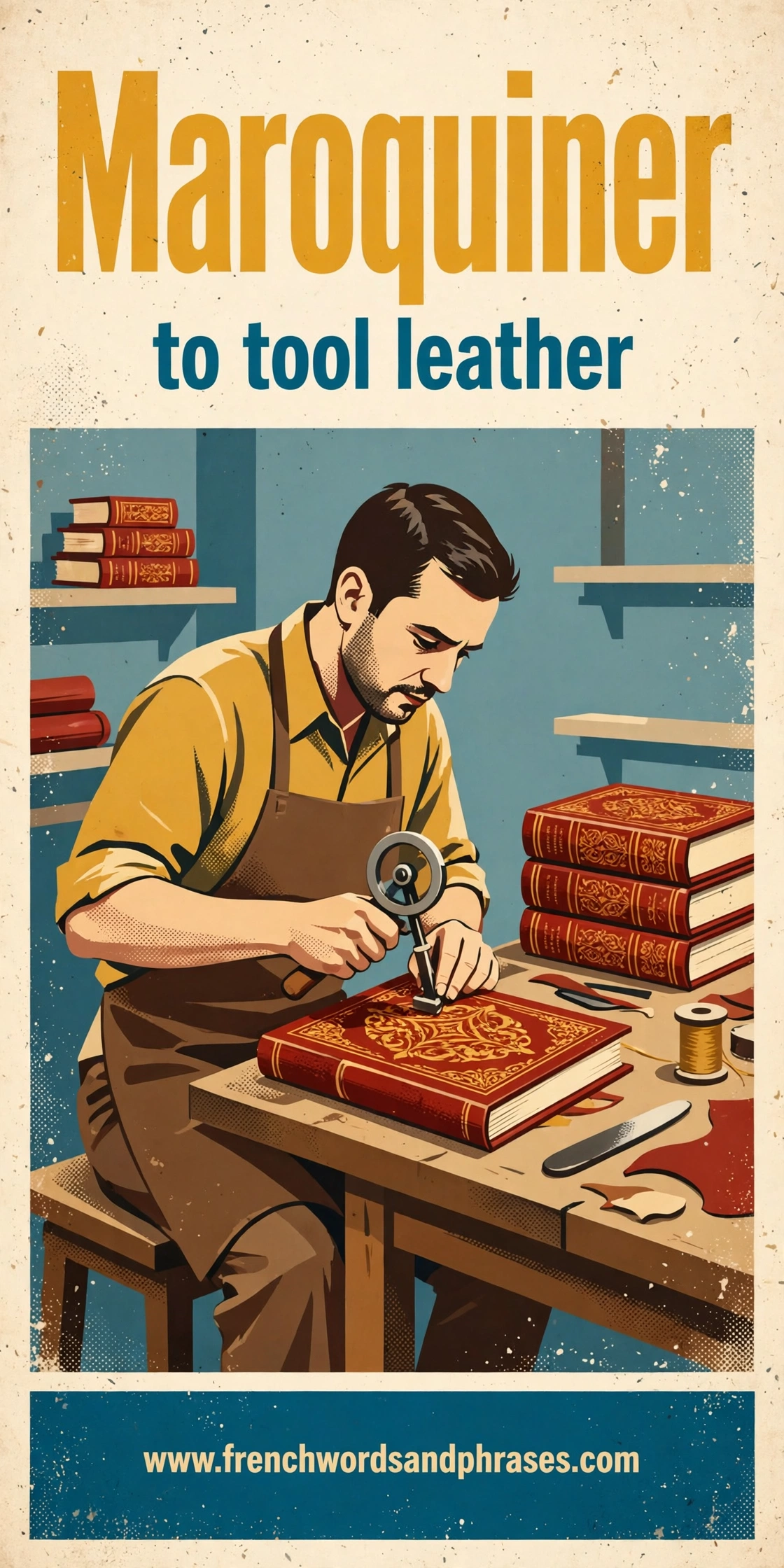
Maroquiner means to tool leather.
A goatskin grained and dyed deep red, a book cover finished like a jewel — maroquiner is the leather-worker’s verb, named for the Moroccan leather that once set the standard for them all.
In this guide, you’ll learn how to conjugate maroquiner in all the major French tenses and moods. Explore complete conjugation tables, French examples, English translations, and practice quizzes.
Understanding the French Verb Maroquiner
Maroquiner is a regular French verb belonging to the first group of verbs, those ending in -er.
It means to tool leather. It is commonly used in bookbinding for graining and finishing the leather of covers, in leather workshops for preparing skins in the morocco style, and in the wider world of la maroquinerie — fine leather goods.
Verb classification: First group (-er)
Auxiliary verb: Avoir
Past participle: maroquiné
Present participle: maroquinant
English equivalents: To tool leather, to grain leather like morocco; la maroquinerie — fine leather goods.
One important detail: maroquiner carries a country inside it — le Maroc, Morocco, whose grained goatskins, le maroquin, were once the finest leather in Europe. The verb is the bookbinder’s and leather-worker’s word for graining, dyeing and finishing a skin in that style; the trade it named, la maroquinerie, now covers all fine leather goods — bags, wallets, belts and gloves.
Experience the Word
Maroquiner is the verb of patient hands — grain by grain, the skin takes its pattern and its shine.
Imagine a binder’s workshop smelling of leather and glue. An old book waits without a cover; by Friday it will leave dressed in deep red, maroquiné et doré, ready for another century.
The leather is not new. It has been tooled — given back its grain, its colour, its pride.
How to Conjugate Maroquiner: Complete French Conjugation Guide
Let’s explore every major conjugation of maroquiner, beginning with the indicative mood.
How to Conjugate Maroquiner in the Indicative Mood
The indicative mood is used to express facts, observations, actions, and events.
How to Conjugate Maroquiner in the Present Tense (Présent)
Used for actions happening now, habitual actions, and general truths.
| Subject | Conjugation |
|---|---|
| je | maroquine |
| tu | maroquines |
| il / elle | maroquine |
| nous | maroquinons |
| vous | maroquinez |
| ils / elles | maroquinent |
Example
Le relieur maroquine la peau de chèvre pour la couverture.
The bookbinder tools the goatskin for the cover.
Quick Quiz 1
Complete the sentence:
Nous ______ les peaux pour la collection.
Reveal the answer
maroquinons
Nous maroquinons les peaux pour la collection.
We tool the skins for the collection.
How to Conjugate Maroquiner in the Passé Composé
Used for completed actions in the past. Maroquiner takes the auxiliary verb avoir.
| Subject | Conjugation |
|---|---|
| j’ | ai maroquiné |
| tu | as maroquiné |
| il / elle | a maroquiné |
| nous | avons maroquiné |
| vous | avez maroquiné |
| ils / elles | ont maroquiné |
Example
Elle a maroquiné le cuir avant de le dorer.
She tooled the leather before gilding it.
How to Conjugate Maroquiner in the Imparfait (Imperfect Tense)
Used for habitual past actions, descriptions, and ongoing situations in the past.
| Subject | Conjugation |
|---|---|
| je | maroquinais |
| tu | maroquinais |
| il / elle | maroquinait |
| nous | maroquinions |
| vous | maroquiniez |
| ils / elles | maroquinaient |
Example
Dans cet atelier, on maroquinait les peaux à la main.
In this workshop, the skins were tooled by hand.
Quick Quiz 2
Choose the correct form:
He tooled the leather.
Il ______ le cuir. (a maroquiné / est maroquiné)
Reveal the answer
a maroquiné
Il a maroquiné le cuir.
Maroquiner takes avoir.
How to Conjugate Maroquiner in the Plus-que-parfait
Used to describe an action that had already been completed before another past event.
| Subject | Conjugation |
|---|---|
| j’ | avais maroquiné |
| tu | avais maroquiné |
| il / elle | avait maroquiné |
| nous | avions maroquiné |
| vous | aviez maroquiné |
| ils / elles | avaient maroquiné |
Example
Il avait maroquiné le cuir pendant des jours avant la reliure.
He had tooled the leather for days before the binding.
How to Conjugate Maroquiner in the Passé Simple
Primarily used in formal writing, literature, and historical narratives. It is rarely used in everyday conversation.
| Subject | Conjugation |
|---|---|
| je | maroquinai |
| tu | maroquinas |
| il / elle | maroquina |
| nous | maroquinâmes |
| vous | maroquinâtes |
| ils / elles | maroquinèrent |
Example
Le maître maroquina la peau et la teignit en rouge profond.
The master tooled the skin and dyed it deep red.
How to Conjugate Maroquiner in the Passé Antérieur
A literary tense used to express an action completed immediately before another past action, generally in the passé simple.
| Subject | Conjugation |
|---|---|
| j’ | eus maroquiné |
| tu | eus maroquiné |
| il / elle | eut maroquiné |
| nous | eûmes maroquiné |
| vous | eûtes maroquiné |
| ils / elles | eurent maroquiné |
Example
Quand l’artisan eut maroquiné la couverture, il posa les fers à dorer.
When the craftsman had tooled the cover, he set down the gilding tools.
How to Conjugate Maroquiner in the Future Tense (Futur Simple)
Used to describe actions that will take place in the future.
| Subject | Conjugation |
|---|---|
| je | maroquinerai |
| tu | maroquineras |
| il / elle | maroquinera |
| nous | maroquinerons |
| vous | maroquinerez |
| ils / elles | maroquineront |
Example
Demain, nous maroquinerons les peaux pour la nouvelle collection.
Tomorrow, we will tool the skins for the new collection.
How to Conjugate Maroquiner in the Futur Antérieur (Future Perfect)
Used for an action that will have been completed before a particular point in the future.
| Subject | Conjugation |
|---|---|
| j’ | aurai maroquiné |
| tu | auras maroquiné |
| il / elle | aura maroquiné |
| nous | aurons maroquiné |
| vous | aurez maroquiné |
| ils / elles | auront maroquiné |
Example
À la fin du stage, les élèves auront maroquiné leur premier livre.
By the end of the course, the students will have tooled their first book.
How to Conjugate Maroquiner in the Near Future (Futur Proche)
Used to describe something that is going to happen soon. Formed with aller + infinitive.
| Subject | Conjugation |
|---|---|
| je | vais maroquiner |
| tu | vas maroquiner |
| il / elle | va maroquiner |
| nous | allons maroquiner |
| vous | allez maroquiner |
| ils / elles | vont maroquiner |
Example
Je vais maroquiner cette peau pour un portefeuille.
I am going to tool this skin for a wallet.
How to Conjugate Maroquiner in the Conditional Mood
The conditional mood expresses what would happen under certain circumstances. It is also frequently used to make polite requests or express wishes.
How to Conjugate Maroquiner in the Present Conditional
| Subject | Conjugation |
|---|---|
| je | maroquinerais |
| tu | maroquinerais |
| il / elle | maroquinerait |
| nous | maroquinerions |
| vous | maroquineriez |
| ils / elles | maroquineraient |
Example
Avec plus de temps, il maroquinerait chaque couverture lui-même.
With more time, he would tool every cover himself.
How to Conjugate Maroquiner in the Past Conditional
| Subject | Conjugation |
|---|---|
| j’ | aurais maroquiné |
| tu | aurais maroquiné |
| il / elle | aurait maroquiné |
| nous | aurions maroquiné |
| vous | auriez maroquiné |
| ils / elles | auraient maroquiné |
Example
Elle aurait maroquiné le cuir si l’atelier avait eu la presse.
She would have tooled the leather if the workshop had had the press.
Maroquiner in the Literary Past Conditional Form
This less common literary form uses the imperfect subjunctive of avoir.
| Subject | Conjugation |
|---|---|
| j’ | eusse maroquiné |
| tu | eusses maroquiné |
| il / elle | eût maroquiné |
| nous | eussions maroquiné |
| vous | eussiez maroquiné |
| ils / elles | eussent maroquiné |
Example
Il eût maroquiné la peau selon la méthode ancienne.
He would have tooled the skin by the old method.
How to Conjugate Maroquiner in the Subjunctive Mood
The subjunctive is used to express wishes, emotions, doubts, necessity, and uncertainty. It frequently follows expressions such as il faut que (it is necessary that) or bien que (although).
How to Conjugate Maroquiner in the Present Subjunctive
| Subject | Conjugation |
|---|---|
| que je | maroquine |
| que tu | maroquines |
| qu’il / qu’elle | maroquine |
| que nous | maroquinions |
| que vous | maroquiniez |
| qu’ils / qu’elles | maroquinent |
Example
Il faut que tu maroquines la peau avant la dorure.
You must tool the skin before the gilding.
Quick Quiz 3
Complete the sentence using the subjunctive:
Il faut que vous ______ la peau.
Reveal the answer
maroquiniez
Il faut que vous maroquiniez la peau.
You must tool the skin.
How to Conjugate Maroquiner in the Imperfect Subjunctive
A literary tense, rarely encountered in modern spoken French.
| Subject | Conjugation |
|---|---|
| que je | maroquinasse |
| que tu | maroquinasses |
| qu’il / qu’elle | maroquinât |
| que nous | maroquinassions |
| que vous | maroquinassiez |
| qu’ils / qu’elles | maroquinassent |
Example
Le maître voulait que l’apprenti maroquinât sa première peau.
The master wanted the apprentice to tool his first skin.
How to Conjugate Maroquiner in the Pluperfect Subjunctive
A literary construction used to express an action completed before another past action.
| Subject | Conjugation |
|---|---|
| que j’ | eusse maroquiné |
| que tu | eusses maroquiné |
| qu’il / qu’elle | eût maroquiné |
| que nous | eussions maroquiné |
| que vous | eussiez maroquiné |
| qu’ils / qu’elles | eussent maroquiné |
Example
On racontait que le relieur eût maroquiné des livres pour des rois.
They told how the binder had tooled books for kings.
How to Conjugate Maroquiner in the Past Subjunctive
| Subject | Conjugation |
|---|---|
| que j’ | aie maroquiné |
| que tu | aies maroquiné |
| qu’il / qu’elle | ait maroquiné |
| que nous | ayons maroquiné |
| que vous | ayez maroquiné |
| qu’ils / qu’elles | aient maroquiné |
Example
Je suis content que tu aies maroquiné ce cuir, il est magnifique.
I am glad you tooled this leather, it is magnificent.
How to Conjugate Maroquiner in the Imperative
The imperative is used to give commands, instructions, invitations, or suggestions. Subject pronouns are omitted.
How to Conjugate Maroquiner in the Present Imperative
| Person | Conjugation |
|---|---|
| (tu) | maroquine |
| (nous) | maroquinons |
| (vous) | maroquinez |
Example
Maroquine la peau doucement, sans la marquer !
Tool the skin gently, without marking it!
Quick Quiz 4
How would you say Tool the skin (tu form)?
Reveal the answer
Maroquine la peau !
French Participles of Maroquiner
Participles are verb forms that can be used in compound tenses and other grammatical constructions.
Present Participle of Maroquiner
maroquinant
En maroquinant le cuir, elle suivait un geste centenaire.
While tooling the leather, she followed a centuries-old gesture.
Past Participle of Maroquiner
maroquiné
Maroquinée et dorée, la couverture devenait un bijou.
Tooled and gilded, the cover became a jewel.
Maroquiner in Everyday French: Real-Life Examples
Now that you know the conjugations, let’s see how maroquiner appears in everyday French.
Example 1 — Present
Ce relieur maroquine encore à l’ancienne.
This bookbinder still tools leather the old way.
Example 2 — Passé composé
Nous avons maroquiné les peaux pour les sacs.
We tooled the skins for the bags.
Example 3 — Imparfait
Son atelier maroquinait pour les grandes librairies.
His workshop used to tool leather for the great bookshops.
Example 4 — Future
Tu maroquineras ta première couverture ce printemps.
You will tool your first cover this spring.
Example 5 — Conditional
Je maroquinerais ce cuir pour un cadeau.
I would tool this leather for a gift.
Example 6 — Imperative
Maroquinez la peau avant de la teindre !
Tool the skin before dyeing it!
Beyond Translation: The Meaning of Maroquiner
English names the leather — morocco — and stops there; French maroquiner makes a verb of the whole craft.
One word, one workshop.
Le maroquin is the grained goatskin, maroquiner is preparing it, and la maroquinerie is the trade that grew from it — today, every fine bag and wallet in the shop window.
How to Remember the French Verb Maroquiner
Remember it this way: Maroquiner is about Morocco leather — the bookbinder’s grained finish.
- Le Maroc — Morocco — hides at the start of the word.
- La maroquinerie — the fine leather-goods trade built on this craft.
- Regular -er: je maroquine, nous maroquinons, past participle maroquiné.
The key idea is Morocco leather — the bookbinder’s grained finish.
Test Your Knowledge of Maroquiner
Let’s see how much you’ve learned. Try answering these questions before revealing the answers.
Question 1
Which country hides inside maroquiner?
Reveal the answer
Morocco — le Maroc, whose goatskin leather set the standard.
Question 2
How do you say The bookbinder tools the goatskin in French?
Reveal the answer
Le relieur maroquine la peau de chèvre.
Question 3
Translate: She tooled the leather before gilding it.
Reveal the answer
Elle a maroquiné le cuir avant de le dorer.
Question 4
What is the past participle of maroquiner?
Reveal the answer
Maroquiné.
Question 5
Complete the sentence:
Il faut que tu ______ la peau avant la dorure.
Reveal the answer
maroquines
Il faut que tu maroquines la peau avant la dorure.
You must tool the skin before the gilding.
Your Final Challenge
Can You Use It?
How would you say this in French?
She tools the goatskin, and the old book becomes a treasure again.
Reveal the answer
Elle maroquine la peau de chèvre, et le vieux livre redevient un trésor.
She tools the goatskin, and the old book becomes a treasure again.
A little French. A little curiosity. A richer everyday life.
LEARN FRENCH ONE WORD AT A TIME




