A French Word to Live By
How to Conjugate Marivauder in French
/ma.ʁi.vo.de/
Marivauder means to banter, to flirt — in witty, elegant repartee.
Two servants trading compliments sharper than their masters’, a love confession hidden inside a joke — marivauder is the verb of gallant wordplay, named after the playwright Marivaux, whose characters fall in love by talking beautifully.
In this guide, you’ll learn how to conjugate marivauder in all the major French tenses and moods. Explore complete conjugation tables, French examples, English translations, and practice quizzes.
Understanding the French Verb Marivauder
Marivauder is a regular French verb belonging to the first group of verbs, those ending in -er.
It means to banter, to flirt. It is commonly used for two people exchanging witty, flirtatious repartee, in theatre and literary discussion for Marivaux’s style of amorous dialogue, and with a smile for any conversation where the compliments are really declarations in disguise.
Verb classification: First group (-er)
Auxiliary verb: Avoir
Past participle: marivaudé
Present participle: marivaudant
English equivalents: To banter, to exchange witty gallantries, to flirt in words; le marivaudage — witty amorous badinage.
One important detail: marivauder is a proper name turned into a verb — Pierre de Marivaux (1688–1763), the playwright of Le Jeu de l’amour et du hasard, wrote love scenes as fencing matches of wit, and French kept his name for the game itself: le marivaudage. To marivauder is not simply to flirt; it is to flirt in sentences — compliments with a twist, confessions disguised as jokes, feelings advanced one elegant reply at a time.
Experience the Word
Marivauder is the verb of love at the talking stage — nothing declared, everything said, in sentences too pretty to be accidental.
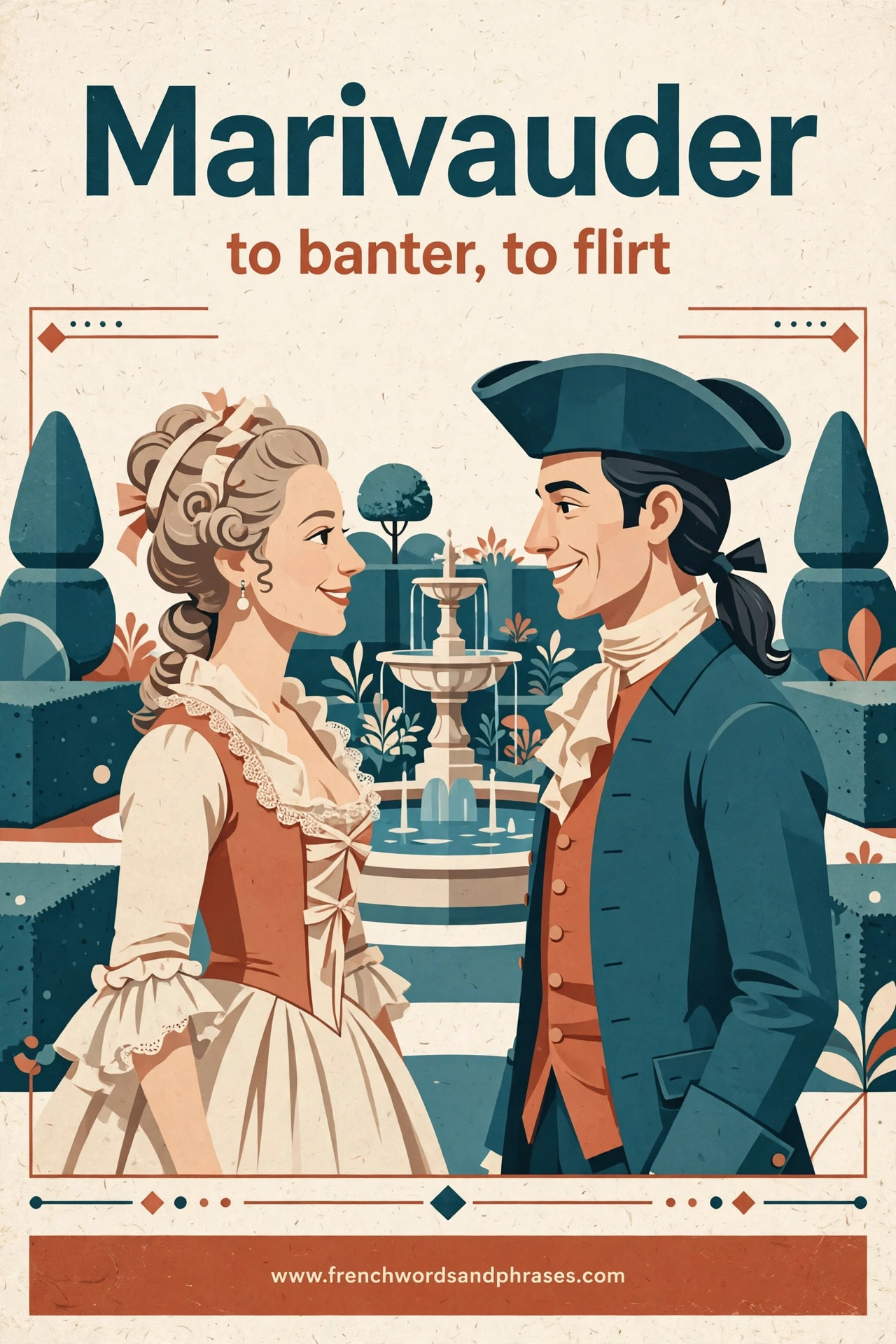
Imagine a garden party in the eighteenth century. A young valet — really a master in disguise — trades compliments with a maid who is secretly the mistress, and every polite sentence lands like a small, deliberate arrow.
Nothing has been confessed. They have bantered — and fallen in love entirely in dialogue.
How to Conjugate Marivauder: Complete French Conjugation Guide
Let’s explore every major conjugation of marivauder, beginning with the indicative mood.
How to Conjugate Marivauder in the Indicative Mood
The indicative mood is used to express facts, observations, actions, and events.
How to Conjugate Marivauder in the Present Tense (Présent)
Used for actions happening now, habitual actions, and general truths.
| Subject | Conjugation |
|---|---|
| je | marivaude |
| tu | marivaudes |
| il / elle | marivaude |
| nous | marivaudons |
| vous | marivaudez |
| ils / elles | marivaudent |
Example
Ils marivaudent depuis le début de la soirée.
They have been exchanging witty gallantries since the start of the evening.
Quick Quiz 1
Complete the sentence:
Nous ______ depuis le début de la soirée.
Reveal the answer
marivaudons
Nous marivaudons depuis le début de la soirée.
We have been bantering since the start of the evening.
How to Conjugate Marivauder in the Passé Composé
Used for completed actions in the past. Marivauder takes the auxiliary verb avoir.
| Subject | Conjugation |
|---|---|
| j’ | ai marivaudé |
| tu | as marivaudé |
| il / elle | a marivaudé |
| nous | avons marivaudé |
| vous | avez marivaudé |
| ils / elles | ont marivaudé |
Example
Elle a marivaudé avec le jeune comte pendant tout le bal.
She bantered with the young count throughout the ball.
How to Conjugate Marivauder in the Imparfait (Imperfect Tense)
Used for habitual past actions, descriptions, and ongoing situations in the past.
| Subject | Conjugation |
|---|---|
| je | marivaudais |
| tu | marivaudais |
| il / elle | marivaudait |
| nous | marivaudions |
| vous | marivaudiez |
| ils / elles | marivaudaient |
Example
Dans les salons, on marivaudait avant de danser.
In the salons, people used to trade witty compliments before dancing.
Quick Quiz 2
Choose the correct form:
She bantered all evening.
Elle ______ toute la soirée. (a marivaudé / est marivaudée)
Reveal the answer
a marivaudé
Elle a marivaudé toute la soirée.
Marivauder takes avoir.
How to Conjugate Marivauder in the Plus-que-parfait
Used to describe an action that had already been completed before another past event.
| Subject | Conjugation |
|---|---|
| j’ | avais marivaudé |
| tu | avais marivaudé |
| il / elle | avait marivaudé |
| nous | avions marivaudé |
| vous | aviez marivaudé |
| ils / elles | avaient marivaudé |
Example
Nous avions marivaudé si longtemps que le dîner avait refroidi.
We had bantered for so long that dinner had gone cold.
How to Conjugate Marivauder in the Passé Simple
Primarily used in formal writing, literature, and historical narratives. It is rarely used in everyday conversation.
| Subject | Conjugation |
|---|---|
| je | marivaudai |
| tu | marivaudas |
| il / elle | marivauda |
| nous | marivaudâmes |
| vous | marivaudâtes |
| ils / elles | marivaudèrent |
Example
Elle marivauda un instant, puis avoua enfin son secret.
She bantered for a moment, then finally confessed her secret.
How to Conjugate Marivauder in the Passé Antérieur
A literary tense used to express an action completed immediately before another past action, generally in the passé simple.
| Subject | Conjugation |
|---|---|
| j’ | eus marivaudé |
| tu | eus marivaudé |
| il / elle | eut marivaudé |
| nous | eûmes marivaudé |
| vous | eûtes marivaudé |
| ils / elles | eurent marivaudé |
Example
Quand ils eurent marivaudé toute la soirée, ils se promirent de se revoir.
When they had exchanged gallantries all evening, they promised to meet again.
How to Conjugate Marivauder in the Future Tense (Futur Simple)
Used to describe actions that will take place in the future.
| Subject | Conjugation |
|---|---|
| je | marivauderai |
| tu | marivauderas |
| il / elle | marivaudera |
| nous | marivauderons |
| vous | marivauderez |
| ils / elles | marivauderont |
Example
Demain, au jardin, ils marivauderont comme au premier jour.
Tomorrow, in the garden, they will banter as on the first day.
How to Conjugate Marivauder in the Futur Antérieur (Future Perfect)
Used for an action that will have been completed before a particular point in the future.
| Subject | Conjugation |
|---|---|
| j’ | aurai marivaudé |
| tu | auras marivaudé |
| il / elle | aura marivaudé |
| nous | aurons marivaudé |
| vous | aurez marivaudé |
| ils / elles | auront marivaudé |
Example
À la fin de la pièce, les deux valets auront marivaudé plus que leurs maîtres.
By the end of the play, the two servants will have bantered more than their masters.
How to Conjugate Marivauder in the Near Future (Futur Proche)
Used to describe something that is going to happen soon. Formed with aller + infinitive.
| Subject | Conjugation |
|---|---|
| je | vais marivauder |
| tu | vas marivauder |
| il / elle | va marivauder |
| nous | allons marivauder |
| vous | allez marivauder |
| ils / elles | vont marivauder |
Example
Je vais marivauder un peu avec elle, elle adore les mots d’esprit.
I am going to banter a little with her, she loves witty remarks.
How to Conjugate Marivauder in the Conditional Mood
The conditional mood expresses what would happen under certain circumstances. It is also frequently used to make polite requests or express wishes.
How to Conjugate Marivauder in the Present Conditional
| Subject | Conjugation |
|---|---|
| je | marivauderais |
| tu | marivauderais |
| il / elle | marivauderait |
| nous | marivauderions |
| vous | marivauderiez |
| ils / elles | marivauderaient |
Example
Avec un tel public, je marivauderais toute la soirée.
With such an audience, I would exchange gallantries all evening.
How to Conjugate Marivauder in the Past Conditional
| Subject | Conjugation |
|---|---|
| j’ | aurais marivaudé |
| tu | aurais marivaudé |
| il / elle | aurait marivaudé |
| nous | aurions marivaudé |
| vous | auriez marivaudé |
| ils / elles | auraient marivaudé |
Example
Elle aurait marivaudé plus longtemps si la musique n’avait pas commencé.
She would have bantered longer if the music had not started.
Marivauder in the Literary Past Conditional Form
This less common literary form uses the imperfect subjunctive of avoir.
| Subject | Conjugation |
|---|---|
| j’ | eusse marivaudé |
| tu | eusses marivaudé |
| il / elle | eût marivaudé |
| nous | eussions marivaudé |
| vous | eussiez marivaudé |
| ils / elles | eussent marivaudé |
Example
Il eût marivaudé avec la grâce d’un personnage de Marivaux.
He would have bantered with the grace of a character from Marivaux.
How to Conjugate Marivauder in the Subjunctive Mood
The subjunctive is used to express wishes, emotions, doubts, necessity, and uncertainty. It frequently follows expressions such as il faut que (it is necessary that) or bien que (although).
How to Conjugate Marivauder in the Present Subjunctive
| Subject | Conjugation |
|---|---|
| que je | marivaude |
| que tu | marivaudes |
| qu’il / qu’elle | marivaude |
| que nous | marivaudions |
| que vous | marivaudiez |
| qu’ils / qu’elles | marivaudent |
Example
Il faut que tu marivaudes un peu, la conversation s’endort.
You must banter a little, the conversation is falling asleep.
Quick Quiz 3
Complete the sentence using the subjunctive:
Il faut que vous ______ un peu.
Reveal the answer
marivaudiez
Il faut que vous marivaudiez un peu.
You must banter a little.
How to Conjugate Marivauder in the Imperfect Subjunctive
A literary tense, rarely encountered in modern spoken French.
| Subject | Conjugation |
|---|---|
| que je | marivaudasse |
| que tu | marivaudasses |
| qu’il / qu’elle | marivaudât |
| que nous | marivaudassions |
| que vous | marivaudassiez |
| qu’ils / qu’elles | marivaudassent |
Example
Je voulais qu’elle marivaudât avec moins de retenue.
I wanted her to banter with less reserve.
How to Conjugate Marivauder in the Pluperfect Subjunctive
A literary construction used to express an action completed before another past action.
| Subject | Conjugation |
|---|---|
| que j’ | eusse marivaudé |
| que tu | eusses marivaudé |
| qu’il / qu’elle | eût marivaudé |
| que nous | eussions marivaudé |
| que vous | eussiez marivaudé |
| qu’ils / qu’elles | eussent marivaudé |
Example
Il regrettait que nous eussions marivaudé au lieu de parler franchement.
He regretted that we had traded gallantries instead of speaking frankly.
How to Conjugate Marivauder in the Past Subjunctive
| Subject | Conjugation |
|---|---|
| que j’ | aie marivaudé |
| que tu | aies marivaudé |
| qu’il / qu’elle | ait marivaudé |
| que nous | ayons marivaudé |
| que vous | ayez marivaudé |
| qu’ils / qu’elles | aient marivaudé |
Example
Je suis content que tu aies marivaudé avec elle, elle souriait enfin.
I am glad you bantered with her, she was finally smiling.
How to Conjugate Marivauder in the Imperative
The imperative is used to give commands, instructions, invitations, or suggestions. Subject pronouns are omitted.
How to Conjugate Marivauder in the Present Imperative
| Person | Conjugation |
|---|---|
| (tu) | marivaude |
| (nous) | marivaudons |
| (vous) | marivaudez |
Example
Marivaude un peu, la soirée ne fait que commencer !
Banter a little, the evening is only beginning!
Quick Quiz 4
How would you say Banter a little (tu form)?
Reveal the answer
Marivaude un peu !
French Participles of Marivauder
Participles are verb forms that can be used in compound tenses and other grammatical constructions.
Present Participle of Marivauder
marivaudant
En marivaudant, ils oubliaient le reste des invités.
While bantering, they forgot the rest of the guests.
Past Participle of Marivauder
marivaudé
Marivaudé avec esprit, le compliment devient une déclaration.
Bantered with wit, the compliment becomes a declaration.
Marivauder in Everyday French: Real-Life Examples
Now that you know the conjugations, let’s see how marivauder appears in everyday French.
Example 1 — Present
Ils marivaudent à chaque réunion de famille.
They exchange witty gallantries at every family gathering.
Example 2 — Passé composé
Nous avons marivaudé pendant tout le trajet en train.
We bantered for the whole train journey.
Example 3 — Imparfait
À la cour, on marivaudait avec art et patience.
At court, people used to banter with art and patience.
Example 4 — Future
Ce soir, ils marivauderont au bal comme autrefois.
Tonight, they will banter at the ball as in the old days.
Example 5 — Conditional
Je marivauderais bien avec elle, si j’osais.
I would gladly banter with her, if I dared.
Example 6 — Imperative
Marivaudez, mes amis, la nuit est jeune !
Banter, my friends, the night is young!
Beyond Translation: The Meaning of Marivauder
English flirt is blunt and physical; French marivauder is flirting raised to literature — a whole playwright’s name folded into a verb.
It is seduction by syntax.
In Marivaux, nobody says ‘je t’aime’ until the very end; they marivaudent — circling, teasing, confessing sideways — and the audience hears the love long before the characters dare to. Learn the verb and you have learned a French idea: that the finest feelings travel best in the finest sentences.
How to Remember the French Verb Marivauder
Remember it this way: Marivauder is about Marivaux’s game — love confessed in witty sentences.
- From Marivaux, the playwright — marivauder is flirting in the style of his plays.
- Le marivaudage — the noun for the game itself: witty amorous badinage.
- Regular -er: je marivaude, nous marivaudons, past participle marivaudé.
The key idea is Marivaux’s game — love confessed in witty sentences.
Test Your Knowledge of Marivauder
Let’s see how much you’ve learned. Try answering these questions before revealing the answers.
Question 1
Who was Marivaux?
Reveal the answer
An eighteenth-century French playwright whose witty love dialogues gave French the verb marivauder and the noun marivaudage.
Question 2
How do you say You must banter a little in French?
Reveal the answer
Il faut que tu marivaudes un peu.
Question 3
Translate: They have been bantering since the start of the evening.
Reveal the answer
Ils marivaudent depuis le début de la soirée.
Question 4
What is the past participle of marivauder?
Reveal the answer
Marivaudé.
Question 5
Complete the sentence:
Il faut que vous ______ avec plus d’esprit.
Reveal the answer
marivaudiez
Il faut que vous marivaudiez avec plus d’esprit.
You must banter with more wit.
Your Final Challenge
Can You Use It?
How would you say this in French?
They banter in the garden, and love advances without speaking its name.
Reveal the answer
Ils marivaudent dans le jardin, et l’amour avance sans dire son nom.
They banter in the garden, and love advances without speaking its name.
A little French. A little curiosity. A richer everyday life.
LEARN FRENCH ONE WORD AT A TIME