
A French Word to Live By
How to Conjugate Mariner in French
/ma.ʁi.ne/
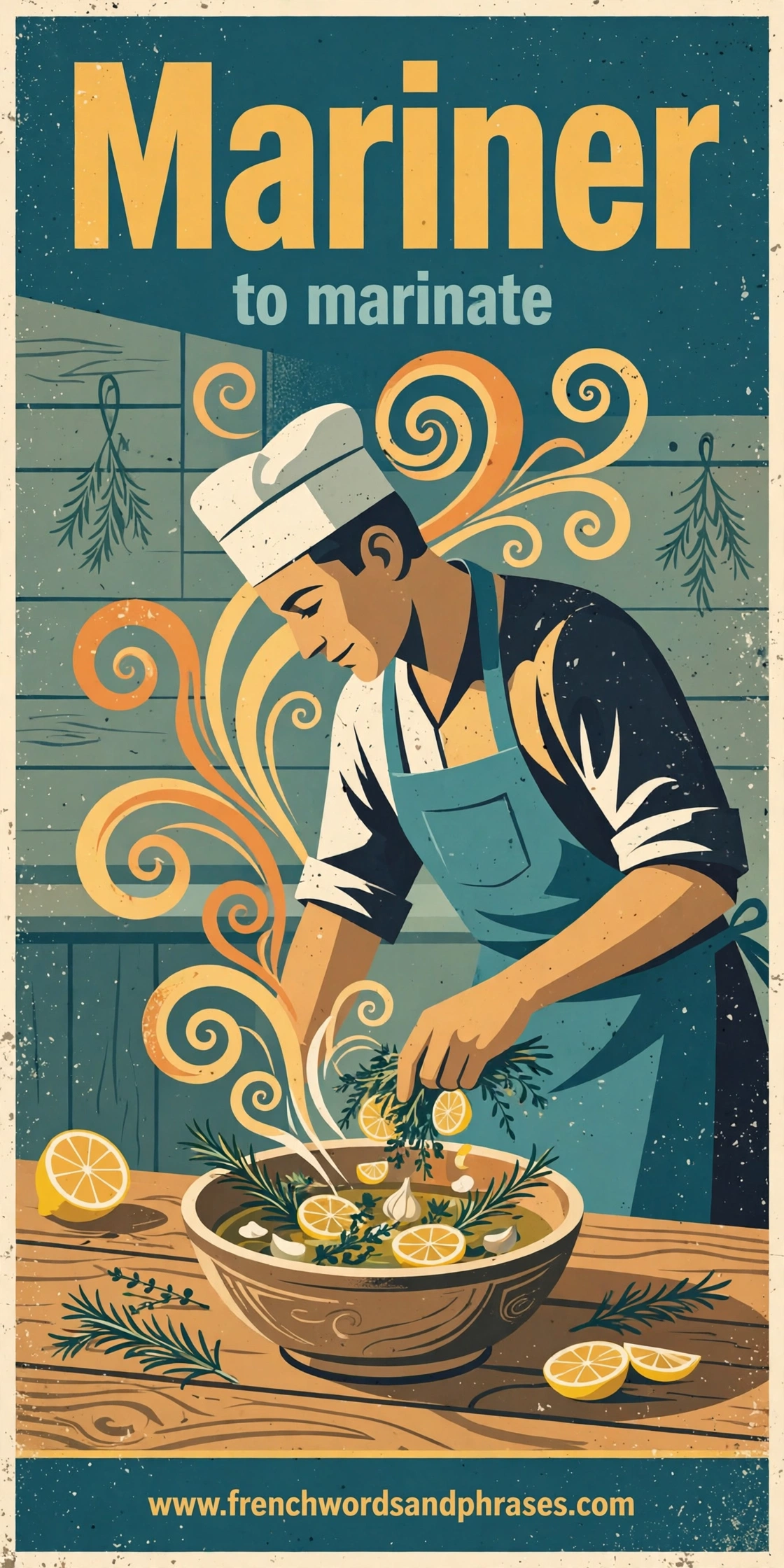
Mariner means to marinate — to soak food in a seasoned bath.
Chicken resting in lemon and herbs, onions turning pink in vinegar, a cook who knows that time is an ingredient — mariner is the verb of the patient bath, where flavour seeps slowly into food before it ever meets the heat.
In this guide, you’ll learn how to conjugate mariner in all the major French tenses and moods. Explore complete conjugation tables, French examples, English translations, and practice quizzes.
Understanding the French Verb Mariner
Mariner is a regular French verb belonging to the first group of verbs, those ending in -er.
It means to marinate. It is commonly used for meat, chicken and fish soaking in a marinade before grilling, for onions and vegetables pickling in vinegar, and figuratively for anyone left waiting — mariner dans l’attente, mariner dans son jus, to stew while time passes.
Verb classification: First group (-er)
Auxiliary verb: Avoir
Past participle: mariné
Present participle: marinant
English equivalents: To marinate; faire mariner — to leave to marinate; (figurative) mariner dans son jus — to stew, to wait idly in one’s own juice.
One important detail: mariner keeps company with la marinade, the bath itself — huile, citron, herbes, épices — and French cooks often say faire mariner or laisser mariner, to leave something marinating. Then the figurative gem: mariner dans son jus, to stew in your own juice — waiting around with nothing to do, like a student marining in a corridor before an exam result, getting more tender and more nervous by the hour.
Experience the Word
Mariner is the verb of flavour given time — nothing cooks, nothing sizzles, yet everything changes.
Imagine a summer kitchen the night before a barbecue. The chicken goes into its bath of oil, lemon and thyme, the cook closes the dish, and the real work happens in the dark of the fridge while everyone sleeps.
Nothing has been cooked. It has marinated — soaked up a personality before meeting the fire.
How to Conjugate Mariner: Complete French Conjugation Guide
Let’s explore every major conjugation of mariner, beginning with the indicative mood.
How to Conjugate Mariner in the Indicative Mood
The indicative mood is used to express facts, observations, actions, and events.
How to Conjugate Mariner in the Present Tense (Présent)
Used for actions happening now, habitual actions, and general truths.
| Subject | Conjugation |
|---|---|
| je | marine |
| tu | marines |
| il / elle | marine |
| nous | marinons |
| vous | marinez |
| ils / elles | marinent |
Example
Elle marine le poulet dans le citron et les herbes.
She marinates the chicken in lemon and herbs.
Quick Quiz 1
Complete the sentence:
Nous ______ le poulet dans les herbes.
Reveal the answer
marinons
Nous marinons le poulet dans les herbes.
We marinate the chicken in herbs.
How to Conjugate Mariner in the Passé Composé
Used for completed actions in the past. Mariner takes the auxiliary verb avoir.
| Subject | Conjugation |
|---|---|
| j’ | ai mariné |
| tu | as mariné |
| il / elle | a mariné |
| nous | avons mariné |
| vous | avez mariné |
| ils / elles | ont mariné |
Example
Il a mariné les oignons dans le vinaigre toute la nuit.
He marinated the onions in vinegar all night.
How to Conjugate Mariner in the Imparfait (Imperfect Tense)
Used for habitual past actions, descriptions, and ongoing situations in the past.
| Subject | Conjugation |
|---|---|
| je | marinais |
| tu | marinais |
| il / elle | marinait |
| nous | marinions |
| vous | mariniez |
| ils / elles | marinaient |
Example
Le dimanche, la viande marinait dès le matin dans la cuisine fraîche.
On Sundays, the meat used to marinate from the morning in the cool kitchen.
Quick Quiz 2
Choose the correct form:
He marinated the onions.
Il ______ les oignons. (a mariné / est mariné)
Reveal the answer
a mariné
Il a mariné les oignons.
Mariner takes avoir.
How to Conjugate Mariner in the Plus-que-parfait
Used to describe an action that had already been completed before another past event.
| Subject | Conjugation |
|---|---|
| j’ | avais mariné |
| tu | avais mariné |
| il / elle | avait mariné |
| nous | avions mariné |
| vous | aviez mariné |
| ils / elles | avaient mariné |
Example
Nous avions mariné le saumon avant l’arrivée des invités.
We had marinated the salmon before the guests arrived.
How to Conjugate Mariner in the Passé Simple
Primarily used in formal writing, literature, and historical narratives. It is rarely used in everyday conversation.
| Subject | Conjugation |
|---|---|
| je | marinai |
| tu | marinas |
| il / elle | marina |
| nous | marinâmes |
| vous | marinâtes |
| ils / elles | marinèrent |
Example
Elle marina le gibier deux jours, comme le voulait la recette.
She marinated the game for two days, as the recipe required.
How to Conjugate Mariner in the Passé Antérieur
A literary tense used to express an action completed immediately before another past action, generally in the passé simple.
| Subject | Conjugation |
|---|---|
| j’ | eus mariné |
| tu | eus mariné |
| il / elle | eut mariné |
| nous | eûmes mariné |
| vous | eûtes mariné |
| ils / elles | eurent mariné |
Example
Quand il eut mariné les brochettes, il prépara le feu.
When he had marinated the skewers, he prepared the fire.
How to Conjugate Mariner in the Future Tense (Futur Simple)
Used to describe actions that will take place in the future.
| Subject | Conjugation |
|---|---|
| je | marinerai |
| tu | marineras |
| il / elle | marinera |
| nous | marinerons |
| vous | marinerez |
| ils / elles | marineront |
Example
Demain, nous marinerons le tofu dans la sauce soja et le gingembre.
Tomorrow, we will marinate the tofu in soy sauce and ginger.
How to Conjugate Mariner in the Futur Antérieur (Future Perfect)
Used for an action that will have been completed before a particular point in the future.
| Subject | Conjugation |
|---|---|
| j’ | aurai mariné |
| tu | auras mariné |
| il / elle | aura mariné |
| nous | aurons mariné |
| vous | aurez mariné |
| ils / elles | auront mariné |
Example
À midi, elle aura mariné tous les légumes du barbecue.
By noon, she will have marinated all the barbecue vegetables.
How to Conjugate Mariner in the Near Future (Futur Proche)
Used to describe something that is going to happen soon. Formed with aller + infinitive.
| Subject | Conjugation |
|---|---|
| je | vais mariner |
| tu | vas mariner |
| il / elle | va mariner |
| nous | allons mariner |
| vous | allez mariner |
| ils / elles | vont mariner |
Example
Je vais mariner dans ce couloir encore une heure, je le sens.
I am going to stew in this corridor for another hour, I can feel it.
How to Conjugate Mariner in the Conditional Mood
The conditional mood expresses what would happen under certain circumstances. It is also frequently used to make polite requests or express wishes.
How to Conjugate Mariner in the Present Conditional
| Subject | Conjugation |
|---|---|
| je | marinerais |
| tu | marinerais |
| il / elle | marinerait |
| nous | marinerions |
| vous | marineriez |
| ils / elles | marineraient |
Example
Avec plus de temps, je marinerais le poulet une nuit entière.
With more time, I would marinate the chicken for a whole night.
How to Conjugate Mariner in the Past Conditional
| Subject | Conjugation |
|---|---|
| j’ | aurais mariné |
| tu | aurais mariné |
| il / elle | aurait mariné |
| nous | aurions mariné |
| vous | auriez mariné |
| ils / elles | auraient mariné |
Example
Elle aurait mariné le poisson moins longtemps, il était trop salé.
She would have marinated the fish for less time, it was too salty.
Mariner in the Literary Past Conditional Form
This less common literary form uses the imperfect subjunctive of avoir.
| Subject | Conjugation |
|---|---|
| j’ | eusse mariné |
| tu | eusses mariné |
| il / elle | eût mariné |
| nous | eussions mariné |
| vous | eussiez mariné |
| ils / elles | eussent mariné |
Example
Il eût mariné le gibier selon la méthode des anciens chasseurs.
He would have marinated the game by the method of the old hunters.
How to Conjugate Mariner in the Subjunctive Mood
The subjunctive is used to express wishes, emotions, doubts, necessity, and uncertainty. It frequently follows expressions such as il faut que (it is necessary that) or bien que (although).
How to Conjugate Mariner in the Present Subjunctive
| Subject | Conjugation |
|---|---|
| que je | marine |
| que tu | marines |
| qu’il / qu’elle | marine |
| que nous | marinions |
| que vous | mariniez |
| qu’ils / qu’elles | marinent |
Example
Il faut que tu marines la viande au moins deux heures.
You must marinate the meat for at least two hours.
Quick Quiz 3
Complete the sentence using the subjunctive:
Il faut que vous ______ la viande.
Reveal the answer
mariniez
Il faut que vous mariniez la viande.
You must marinate the meat.
How to Conjugate Mariner in the Imperfect Subjunctive
A literary tense, rarely encountered in modern spoken French.
| Subject | Conjugation |
|---|---|
| que je | marinasse |
| que tu | marinasses |
| qu’il / qu’elle | marinât |
| que nous | marinassions |
| que vous | marinassiez |
| qu’ils / qu’elles | marinassent |
Example
Je voulais qu’elle marinât les oignons dans le vinaigre de cidre.
I wanted her to marinate the onions in cider vinegar.
How to Conjugate Mariner in the Pluperfect Subjunctive
A literary construction used to express an action completed before another past action.
| Subject | Conjugation |
|---|---|
| que j’ | eusse mariné |
| que tu | eusses mariné |
| qu’il / qu’elle | eût mariné |
| que nous | eussions mariné |
| que vous | eussiez mariné |
| qu’ils / qu’elles | eussent mariné |
Example
Il regrettait que nous eussions mariné le poulet si peu de temps.
He regretted that we had marinated the chicken for so short a time.
How to Conjugate Mariner in the Past Subjunctive
| Subject | Conjugation |
|---|---|
| que j’ | aie mariné |
| que tu | aies mariné |
| qu’il / qu’elle | ait mariné |
| que nous | ayons mariné |
| que vous | ayez mariné |
| qu’ils / qu’elles | aient mariné |
Example
Je suis content que tu aies mariné les brochettes, elles sont parfumées.
I am glad you marinated the skewers, they are full of flavour.
How to Conjugate Mariner in the Imperative
The imperative is used to give commands, instructions, invitations, or suggestions. Subject pronouns are omitted.
How to Conjugate Mariner in the Present Imperative
| Person | Conjugation |
|---|---|
| (tu) | marine |
| (nous) | marinons |
| (vous) | marinez |
Example
Marine le poulet dès ce soir pour demain !
Marinate the chicken tonight for tomorrow!
Quick Quiz 4
How would you say Marinate the chicken (tu form)?
Reveal the answer
Marine le poulet !
French Participles of Mariner
Participles are verb forms that can be used in compound tenses and other grammatical constructions.
Present Participle of Mariner
marinant
En marinant dans son jus, l’étudiant relisait ses notes une dernière fois.
While stewing in his own juice, the student reread his notes one last time.
Past Participle of Mariner
mariné
Mariné une nuit, le poulet devient tendre et parfumé.
Marinated overnight, the chicken becomes tender and fragrant.
Mariner in Everyday French: Real-Life Examples
Now that you know the conjugations, let’s see how mariner appears in everyday French.
Example 1 — Present
Je marine toujours le poulet avant le barbecue.
I always marinate the chicken before the barbecue.
Example 2 — Passé composé
Elle a mariné les oignons pour la salade.
She marinated the onions for the salad.
Example 3 — Imparfait
Pendant l’attente, nous marinions dans la salle sans nouvelles.
While waiting, we stewed in the room with no news.
Example 4 — Future
Nous marinerons le saumon dans l’aneth et le citron.
We will marinate the salmon in dill and lemon.
Example 5 — Conditional
Tu marinerais la viande combien de temps, toi ?
How long would you marinate the meat?
Example 6 — Imperative
Marinez les brochettes dès ce soir !
Marinate the skewers tonight!
Beyond Translation: The Meaning of Mariner
English marinate mostly stays in the kitchen, with a recent borrowed sense of thinking things over. French mariner has been sending people to stew for centuries.
Mariner dans son jus is the waiting-room of French verbs.
The chicken in its marinade and the candidate in the corridor share the same fate: time, liquid, and nothing to do but absorb. When a French speaker says je marine, no food is involved — just patience wearing thin.
How to Remember the French Verb Mariner
Remember it this way: Mariner is about the patient bath — flavour by time, and people stewing in corridors.
- La marinade is the bath; mariner is the soaking; faire mariner is to leave something in it.
- Mariner dans son jus — to stew in your own juice, to wait idly with nothing to do.
- Regular -er: je marine, nous marinons, past participle mariné.
The key idea is the patient bath — flavour by time, and people stewing in corridors.
Test Your Knowledge of Mariner
Let’s see how much you’ve learned. Try answering these questions before revealing the answers.
Question 1
What does mariner dans son jus mean?
Reveal the answer
To stew in your own juice — to wait around idly, with nothing to do.
Question 2
How do you say You must marinate the meat in French?
Reveal the answer
Il faut que tu marines la viande.
Question 3
Translate: She marinated the onions for the salad.
Reveal the answer
Elle a mariné les oignons pour la salade.
Question 4
What is the past participle of mariner?
Reveal the answer
Mariné.
Question 5
Complete the sentence:
Il faut que vous ______ le saumon deux heures.
Reveal the answer
mariniez
Il faut que vous mariniez le saumon deux heures.
You must marinate the salmon for two hours.
Your Final Challenge
Can You Use It?
How would you say this in French?
The chicken marinates all night, and tomorrow the barbecue will be a celebration.
Reveal the answer
Le poulet marine toute la nuit, et demain le barbecue sera une fête.
The chicken marinates all night, and tomorrow the barbecue will be a celebration.
A little French. A little curiosity. A richer everyday life.
LEARN FRENCH ONE WORD AT A TIME




