A French Word to Live By
How to Conjugate Marbrer in French
/maʁ.bʁe/
Marbrer means to mottle — to marble.
Swirls of chocolate wandering through a vanilla cake, coloured veins floating on a bookbinder’s paper, winter hands pinked with cold — marbrer is the verb of patterns that imitate marble, veins and mottles spreading through a surface.
In this guide, you’ll learn how to conjugate marbrer in all the major French tenses and moods. Explore complete conjugation tables, French examples, English translations, and practice quizzes.
Understanding the French Verb Marbrer
Marbrer is a regular French verb belonging to the first group of verbs, those ending in -er.
It means to mottle. It is commonly used in baking for swirling two batters into a marbled cake, in crafts for marbling paper and book covers, for the veined look of stone and cheese, and for skin mottled pink and white by cold, fever or emotion.
Verb classification: First group (-er)
Auxiliary verb: Avoir
Past participle: marbré
Present participle: marbrant
English equivalents: To marble, to mottle, to vein; marbré — marbled, mottled; un marbré — a marble cake.
One important detail: marbrer is simply le marbre (marble) turned into a verb — to give something marble’s veined look. Its participle marbré is everywhere: un gâteau marbré is a marble cake, so loved that the noun alone, un marbré, orders one in a bakery; du papier marbré is the bookbinder’s marbled paper; and skin turns marbrée — mottled — with cold or fever. One verb for the cake, the paper and the gooseflesh.
Experience the Word
Marbrer is the verb of beautiful accidents — the pattern is guided, never fully controlled, and no two results are ever the same.
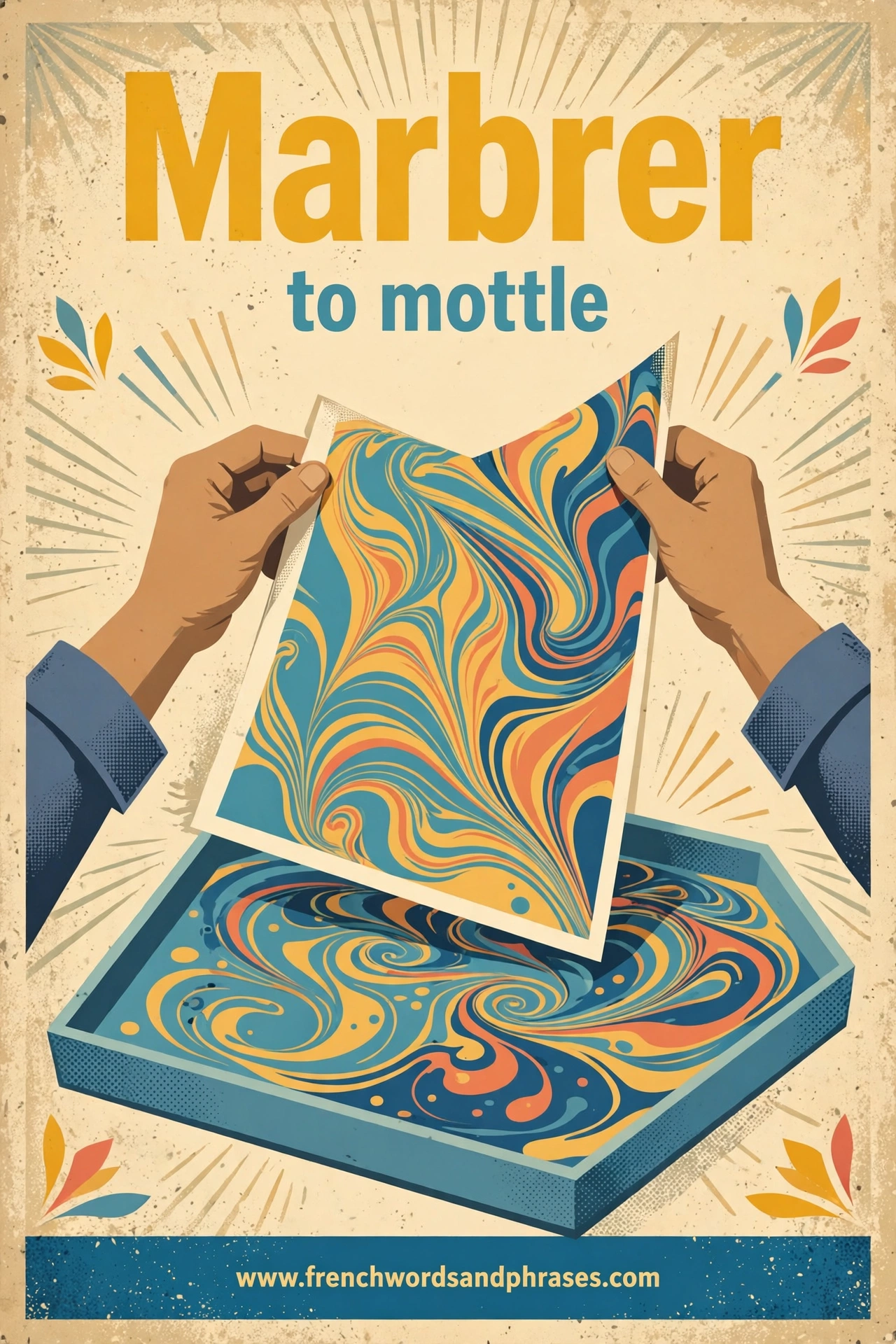
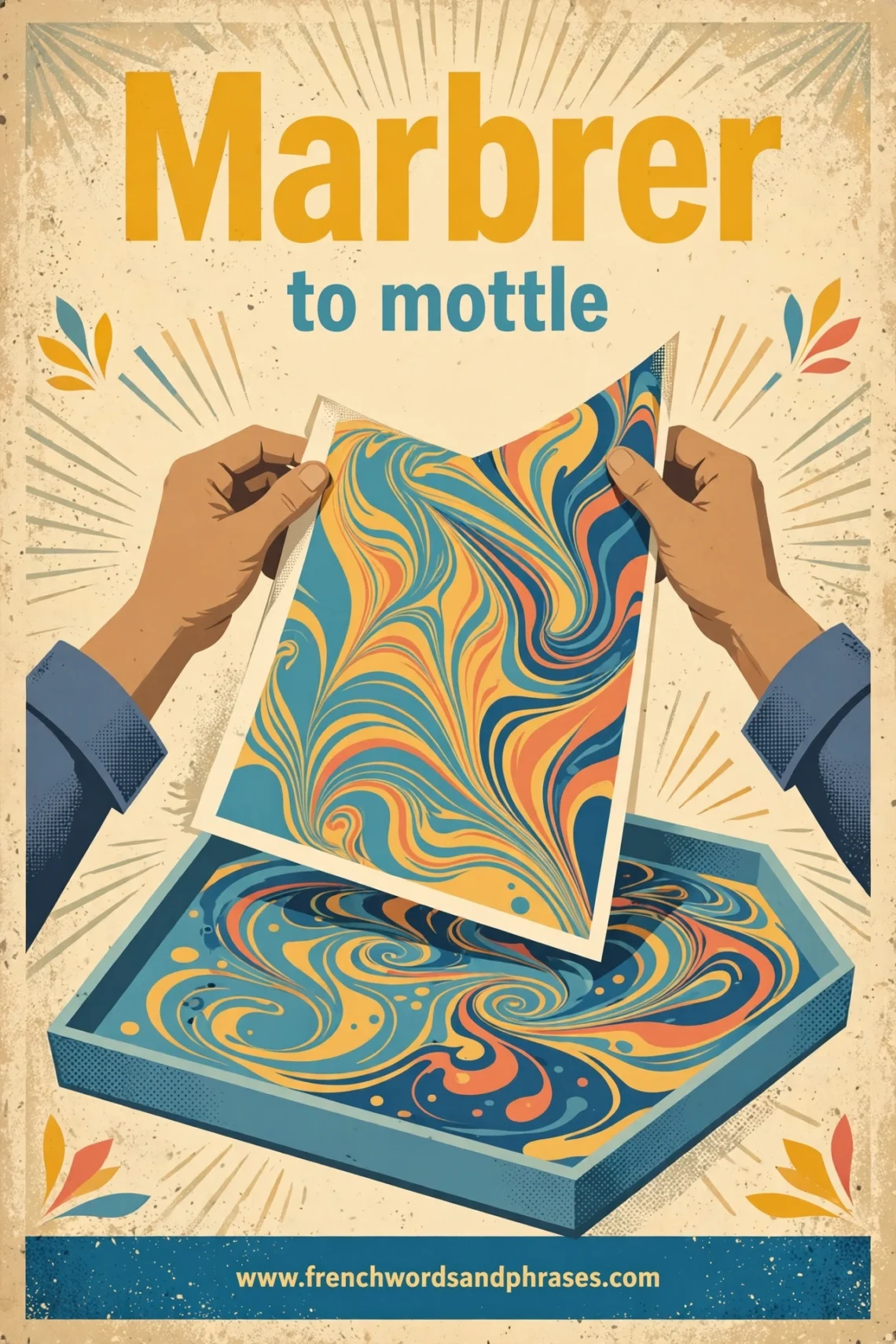
Imagine a bookbinder’s workshop. A tray of coloured water waits, the artisan drops inks on the surface, combs them into waves, and lays down a sheet of paper — which rises carrying a river of marble veins that exists nowhere else in the world.
The paper has not been painted. It has been marbled — veined by water, chance and a steady hand.
How to Conjugate Marbrer: Complete French Conjugation Guide
Let’s explore every major conjugation of marbrer, beginning with the indicative mood.
How to Conjugate Marbrer in the Indicative Mood
The indicative mood is used to express facts, observations, actions, and events.
How to Conjugate Marbrer in the Present Tense (Présent)
Used for actions happening now, habitual actions, and general truths.
| Subject | Conjugation |
|---|---|
| je | marbre |
| tu | marbres |
| il / elle | marbre |
| nous | marbrons |
| vous | marbrez |
| ils / elles | marbrent |
Example
Elle marbre la pâte avec une fourchette avant d’enfourner.
She marbles the batter with a fork before putting it in the oven.
Quick Quiz 1
Complete the sentence:
Nous ______ le gâteau au chocolat.
Reveal the answer
marbrons
Nous marbrons le gâteau au chocolat.
We marble the cake with chocolate.
How to Conjugate Marbrer in the Passé Composé
Used for completed actions in the past. Marbrer takes the auxiliary verb avoir.
| Subject | Conjugation |
|---|---|
| j’ | ai marbré |
| tu | as marbré |
| il / elle | a marbré |
| nous | avons marbré |
| vous | avez marbré |
| ils / elles | ont marbré |
Example
Le relieur a marbré les pages de garde à la main.
The bookbinder marbled the endpapers by hand.
How to Conjugate Marbrer in the Imparfait (Imperfect Tense)
Used for habitual past actions, descriptions, and ongoing situations in the past.
| Subject | Conjugation |
|---|---|
| je | marbrais |
| tu | marbrais |
| il / elle | marbrait |
| nous | marbrions |
| vous | marbriez |
| ils / elles | marbraient |
Example
Le froid marbrait ses mains de rose et de blanc.
The cold used to mottle her hands pink and white.
Quick Quiz 2
Choose the correct form:
The bookbinder marbled the paper.
Le relieur ______ le papier. (a marbré / est marbré)
Reveal the answer
a marbré
Le relieur a marbré le papier.
Marbrer takes avoir.
How to Conjugate Marbrer in the Plus-que-parfait
Used to describe an action that had already been completed before another past event.
| Subject | Conjugation |
|---|---|
| j’ | avais marbré |
| tu | avais marbré |
| il / elle | avait marbré |
| nous | avions marbré |
| vous | aviez marbré |
| ils / elles | avaient marbré |
Example
Ils avaient marbré le papier avant de relier le livre.
They had marbled the paper before binding the book.
How to Conjugate Marbrer in the Passé Simple
Primarily used in formal writing, literature, and historical narratives. It is rarely used in everyday conversation.
| Subject | Conjugation |
|---|---|
| je | marbrai |
| tu | marbras |
| il / elle | marbra |
| nous | marbrâmes |
| vous | marbrâtes |
| ils / elles | marbrèrent |
Example
Le peintre marbra le panneau pour imiter la pierre.
The painter marbled the panel to imitate stone.
How to Conjugate Marbrer in the Passé Antérieur
A literary tense used to express an action completed immediately before another past action, generally in the passé simple.
| Subject | Conjugation |
|---|---|
| j’ | eus marbré |
| tu | eus marbré |
| il / elle | eut marbré |
| nous | eûmes marbré |
| vous | eûtes marbré |
| ils / elles | eurent marbré |
Example
Quand elle eut marbré la pâte, elle versa le tout dans le moule.
When she had marbled the batter, she poured it all into the tin.
How to Conjugate Marbrer in the Future Tense (Futur Simple)
Used to describe actions that will take place in the future.
| Subject | Conjugation |
|---|---|
| je | marbrerai |
| tu | marbreras |
| il / elle | marbrera |
| nous | marbrerons |
| vous | marbrerez |
| ils / elles | marbreront |
Example
Demain, nous marbrerons le gâteau au chocolat.
Tomorrow, we will marble the cake with chocolate.
How to Conjugate Marbrer in the Futur Antérieur (Future Perfect)
Used for an action that will have been completed before a particular point in the future.
| Subject | Conjugation |
|---|---|
| j’ | aurai marbré |
| tu | auras marbré |
| il / elle | aura marbré |
| nous | aurons marbré |
| vous | aurez marbré |
| ils / elles | auront marbré |
Example
À la fin de l’atelier, les élèves auront marbré dix feuilles chacun.
By the end of the workshop, the pupils will have marbled ten sheets each.
How to Conjugate Marbrer in the Near Future (Futur Proche)
Used to describe something that is going to happen soon. Formed with aller + infinitive.
| Subject | Conjugation |
|---|---|
| je | vais marbrer |
| tu | vas marbrer |
| il / elle | va marbrer |
| nous | allons marbrer |
| vous | allez marbrer |
| ils / elles | vont marbrer |
Example
Je vais marbrer ce gâteau avec du cacao.
I am going to marble this cake with cocoa.
How to Conjugate Marbrer in the Conditional Mood
The conditional mood expresses what would happen under certain circumstances. It is also frequently used to make polite requests or express wishes.
How to Conjugate Marbrer in the Present Conditional
| Subject | Conjugation |
|---|---|
| je | marbrerais |
| tu | marbrerais |
| il / elle | marbrerait |
| nous | marbrerions |
| vous | marbreriez |
| ils / elles | marbreraient |
Example
Avec plus de cacao, tu marbrerais mieux la pâte.
With more cocoa, you would marble the batter better.
How to Conjugate Marbrer in the Past Conditional
| Subject | Conjugation |
|---|---|
| j’ | aurais marbré |
| tu | aurais marbré |
| il / elle | aurait marbré |
| nous | aurions marbré |
| vous | auriez marbré |
| ils / elles | auraient marbré |
Example
Elle aurait marbré le papier si les encres avaient été prêtes.
She would have marbled the paper if the inks had been ready.
Marbrer in the Literary Past Conditional Form
This less common literary form uses the imperfect subjunctive of avoir.
| Subject | Conjugation |
|---|---|
| j’ | eusse marbré |
| tu | eusses marbré |
| il / elle | eût marbré |
| nous | eussions marbré |
| vous | eussiez marbré |
| ils / elles | eussent marbré |
Example
L’artisan eût marbré les gardes du livre royal.
The craftsman would have marbled the endpapers of the royal book.
How to Conjugate Marbrer in the Subjunctive Mood
The subjunctive is used to express wishes, emotions, doubts, necessity, and uncertainty. It frequently follows expressions such as il faut que (it is necessary that) or bien que (although).
How to Conjugate Marbrer in the Present Subjunctive
| Subject | Conjugation |
|---|---|
| que je | marbre |
| que tu | marbres |
| qu’il / qu’elle | marbre |
| que nous | marbrions |
| que vous | marbriez |
| qu’ils / qu’elles | marbrent |
Example
Il faut que tu marbres la pâte sans trop mélanger.
You must marble the batter without mixing too much.
Quick Quiz 3
Complete the sentence using the subjunctive:
Il faut que vous ______ la pâte délicatement.
Reveal the answer
marbriez
Il faut que vous marbriez la pâte délicatement.
You must marble the batter delicately.
How to Conjugate Marbrer in the Imperfect Subjunctive
A literary tense, rarely encountered in modern spoken French.
| Subject | Conjugation |
|---|---|
| que je | marbrasse |
| que tu | marbrasses |
| qu’il / qu’elle | marbrât |
| que nous | marbrassions |
| que vous | marbrassiez |
| qu’ils / qu’elles | marbrassent |
Example
Je voulais qu’elle marbrât le gâteau en spirale.
I wanted her to marble the cake in a spiral.
How to Conjugate Marbrer in the Pluperfect Subjunctive
A literary construction used to express an action completed before another past action.
| Subject | Conjugation |
|---|---|
| que j’ | eusse marbré |
| que tu | eusses marbré |
| qu’il / qu’elle | eût marbré |
| que nous | eussions marbré |
| que vous | eussiez marbré |
| qu’ils / qu’elles | eussent marbré |
Example
Il regrettait que le froid eût marbré les joues de l’enfant.
He regretted that the cold had mottled the child’s cheeks.
How to Conjugate Marbrer in the Past Subjunctive
| Subject | Conjugation |
|---|---|
| que j’ | aie marbré |
| que tu | aies marbré |
| qu’il / qu’elle | ait marbré |
| que nous | ayons marbré |
| que vous | ayez marbré |
| qu’ils / qu’elles | aient marbré |
Example
Je suis contente que tu aies marbré le gâteau, il est magnifique.
I am glad you marbled the cake, it is magnificent.
How to Conjugate Marbrer in the Imperative
The imperative is used to give commands, instructions, invitations, or suggestions. Subject pronouns are omitted.
How to Conjugate Marbrer in the Present Imperative
| Person | Conjugation |
|---|---|
| (tu) | marbre |
| (nous) | marbrons |
| (vous) | marbrez |
Example
Marbre la pâte d’un seul geste, pas plus !
Marble the batter with a single stroke, no more!
Quick Quiz 4
How would you say Marble the batter (tu form)?
Reveal the answer
Marbre la pâte !
French Participles of Marbrer
Participles are verb forms that can be used in compound tenses and other grammatical constructions.
Present Participle of Marbrer
marbrant
En marbrant le papier, elle chantait doucement.
While marbling the paper, she hummed softly.
Past Participle of Marbrer
marbré
Marbré de chocolat, le gâteau disparaît en un goûter.
Marbled with chocolate, the cake disappears in one afternoon tea.
Marbrer in Everyday French: Real-Life Examples
Now that you know the conjugations, let’s see how marbrer appears in everyday French.
Example 1 — Present
Je marbre toujours le gâteau avec une fourchette.
I always marble the cake with a fork.
Example 2 — Passé composé
Elle a marbré le papier pour la couverture.
She marbled the paper for the cover.
Example 3 — Imparfait
Le froid marbrait nos jambes en sortant de l’eau.
The cold used to mottle our legs as we came out of the water.
Example 4 — Future
Nous marbrerons les œufs pour Pâques.
We will marble the eggs for Easter.
Example 5 — Conditional
Tu marbrerais la pâte avec du matcha ?
Would you marble the batter with matcha?
Example 6 — Imperative
Marbrez le gâteau avant de le mettre au four !
Marble the cake before putting it in the oven!
Beyond Translation: The Meaning of Marbrer
English mottle mostly sounds like a flaw; French marbrer keeps marble’s dignity in every use.
The cake, the paper, the skin — one family.
Order un marbré and you get a cake; touch du papier marbré and you hold a bookbinder’s art; come in from the snow with les mains marbrées and even your gooseflesh is described like stone.
How to Remember the French Verb Marbrer
Remember it this way: Marbrer is about marble’s veins — in cake batter, on paper, on cold skin.
- Le marbre is marble — marbrer gives any surface marble’s veins.
- Un marbré, alone, orders a marble cake in a bakery.
- Regular -er: je marbre, nous marbrons, past participle marbré.
The key idea is marble’s veins — in cake batter, on paper, on cold skin.
Test Your Knowledge of Marbrer
Let’s see how much you’ve learned. Try answering these questions before revealing the answers.
Question 1
How do you order a marble cake, in one word, in French?
Reveal the answer
Un marbré.
Question 2
How do you say marbled paper in French?
Reveal the answer
Du papier marbré.
Question 3
Translate: She marbled the batter with a fork.
Reveal the answer
Elle a marbré la pâte avec une fourchette.
Question 4
What is the past participle of marbrer?
Reveal the answer
Marbré.
Question 5
Complete the sentence:
Il faut que tu ______ la pâte sans trop mélanger.
Reveal the answer
marbres
Il faut que tu marbres la pâte sans trop mélanger.
You must marble the batter without mixing too much.
Your Final Challenge
Can You Use It?
How would you say this in French?
She marbles the batter with chocolate, and every slice of the cake becomes a little landscape.
Reveal the answer
Elle marbre la pâte au chocolat, et chaque tranche du gâteau devient un petit paysage.
She marbles the batter with chocolate, and every slice of the cake becomes a little landscape.
A little French. A little curiosity. A richer everyday life.
LEARN FRENCH ONE WORD AT A TIME