
A French Word to Live By
How to Conjugate Marchander in French
/maʁ.ʃɑ̃.de/
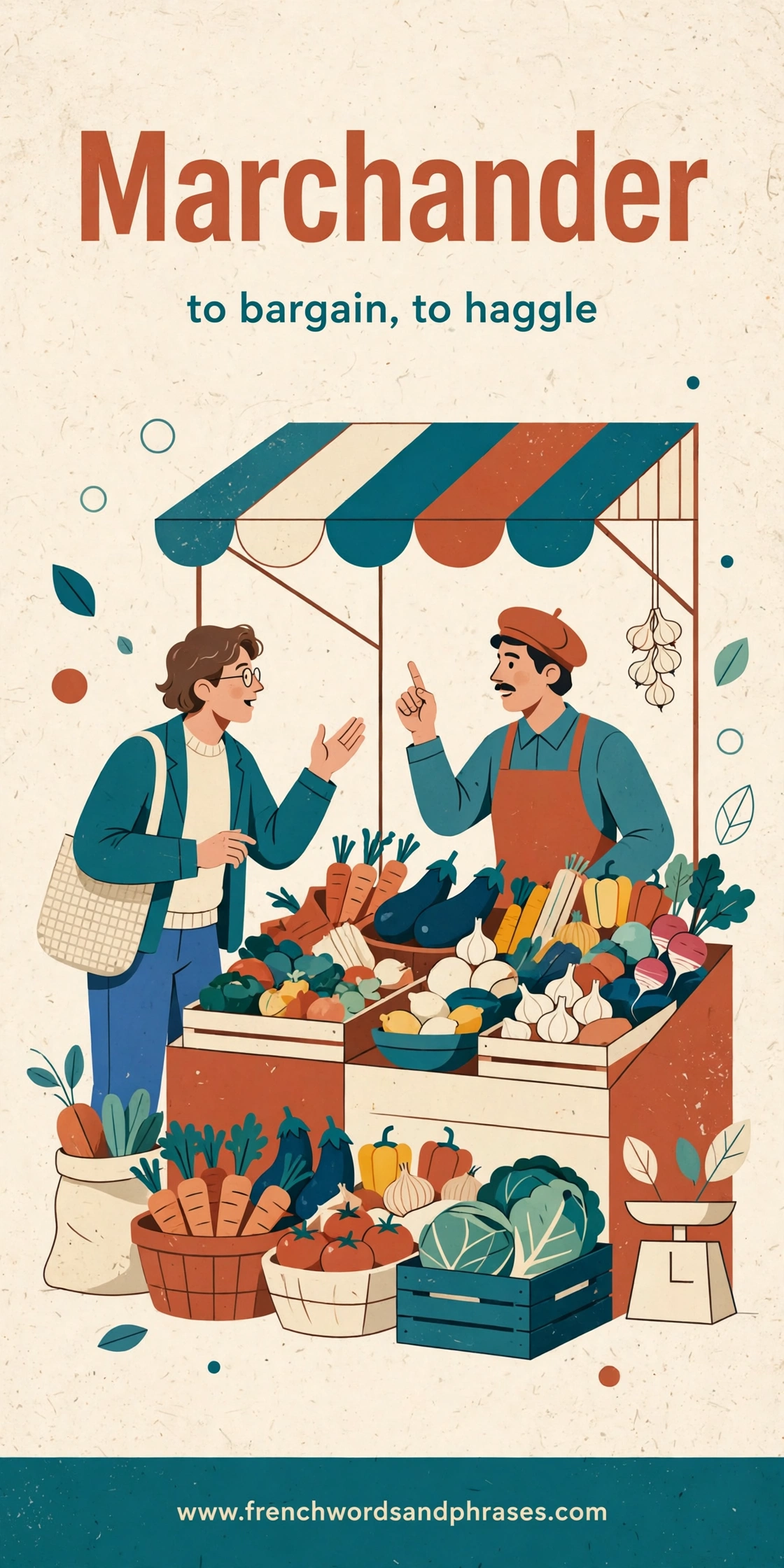
Marchander means to bargain, to haggle.
A rug rolled out in a souk, a flea-market table on a Sunday morning, a price that falls a little with every smile — marchander is the verb of the friendly negotiation, where buying begins long before money changes hands.
In this guide, you’ll learn how to conjugate marchander in all the major French tenses and moods. Explore complete conjugation tables, French examples, English translations, and practice quizzes.
Understanding the French Verb Marchander
Marchander is a regular French verb belonging to the first group of verbs, those ending in -er.
It means to bargain, to haggle. It is commonly used at markets, flea markets and in souks for negotiating prices, for buying cars and antiques second-hand, and figuratively for not sparing something — marchander son temps, marchander ses compliments, to be stingy with your time or your praise.
Verb classification: First group (-er)
Auxiliary verb: Avoir
Past participle: marchandé
Present participle: marchandant
English equivalents: To bargain, to haggle; to bargain over (marchander le prix); (figurative) to stint, to be sparing with (ne pas marchander ses efforts).
One important detail: marchander shares its root with le marchand, the merchant, and la marchandise, the goods — the whole market family in one word. You marchandez un prix or marchandez sur le prix; at the market you can also marchander un tapis, un vase, une voiture. Turned around, the figurative use praises generosity: il ne marchande pas ses efforts — he does not stint his efforts, he gives them freely.
Experience the Word
Marchander is the verb of the game before the purchase — the first price is never the price, and both sides know it.
Imagine a brocante in a village square. The stallholder names fifty euros for the old lamp; you offer twenty with a smile; ten minutes of theatre later, the lamp is yours for thirty-two and everyone is delighted.
You have not simply bought a lamp. You have bargained — and the story of the bargain travels home with it.
How to Conjugate Marchander: Complete French Conjugation Guide
Let’s explore every major conjugation of marchander, beginning with the indicative mood.
How to Conjugate Marchander in the Indicative Mood
The indicative mood is used to express facts, observations, actions, and events.
How to Conjugate Marchander in the Present Tense (Présent)
Used for actions happening now, habitual actions, and general truths.
| Subject | Conjugation |
|---|---|
| je | marchande |
| tu | marchandes |
| il / elle | marchande |
| nous | marchandons |
| vous | marchandez |
| ils / elles | marchandent |
Example
Elle marchande le prix du tapis avec le vendeur.
She bargains over the price of the rug with the seller.
Quick Quiz 1
Complete the sentence:
Nous ______ le prix au marché.
Reveal the answer
marchandons
Nous marchandons le prix au marché.
We bargain over the price at the market.
How to Conjugate Marchander in the Passé Composé
Used for completed actions in the past. Marchander takes the auxiliary verb avoir.
| Subject | Conjugation |
|---|---|
| j’ | ai marchandé |
| tu | as marchandé |
| il / elle | a marchandé |
| nous | avons marchandé |
| vous | avez marchandé |
| ils / elles | ont marchandé |
Example
Il a marchandé pendant dix minutes avant d’acheter la lampe.
He haggled for ten minutes before buying the lamp.
How to Conjugate Marchander in the Imparfait (Imperfect Tense)
Used for habitual past actions, descriptions, and ongoing situations in the past.
| Subject | Conjugation |
|---|---|
| je | marchandais |
| tu | marchandais |
| il / elle | marchandait |
| nous | marchandions |
| vous | marchandiez |
| ils / elles | marchandaient |
Example
Au marché, ma grand-mère marchandait chaque fromage.
At the market, my grandmother used to haggle over every cheese.
Quick Quiz 2
Choose the correct form:
He haggled before buying.
Il ______ avant d’acheter. (a marchandé / est marchandé)
Reveal the answer
a marchandé
Il a marchandé avant d’acheter.
Marchander takes avoir.
How to Conjugate Marchander in the Plus-que-parfait
Used to describe an action that had already been completed before another past event.
| Subject | Conjugation |
|---|---|
| j’ | avais marchandé |
| tu | avais marchandé |
| il / elle | avait marchandé |
| nous | avions marchandé |
| vous | aviez marchandé |
| ils / elles | avaient marchandé |
Example
Nous avions marchandé le prix de la voiture avant de signer.
We had negotiated the price of the car before signing.
How to Conjugate Marchander in the Passé Simple
Primarily used in formal writing, literature, and historical narratives. It is rarely used in everyday conversation.
| Subject | Conjugation |
|---|---|
| je | marchandai |
| tu | marchandas |
| il / elle | marchanda |
| nous | marchandâmes |
| vous | marchandâtes |
| ils / elles | marchandèrent |
Example
Elle marchanda le vase, puis le paya en souriant.
She bargained for the vase, then paid for it with a smile.
How to Conjugate Marchander in the Passé Antérieur
A literary tense used to express an action completed immediately before another past action, generally in the passé simple.
| Subject | Conjugation |
|---|---|
| j’ | eus marchandé |
| tu | eus marchandé |
| il / elle | eut marchandé |
| nous | eûmes marchandé |
| vous | eûtes marchandé |
| ils / elles | eurent marchandé |
Example
Quand il eut marchandé le prix, il serra la main du marchand.
When he had settled the price, he shook the merchant’s hand.
How to Conjugate Marchander in the Future Tense (Futur Simple)
Used to describe actions that will take place in the future.
| Subject | Conjugation |
|---|---|
| je | marchanderai |
| tu | marchanderas |
| il / elle | marchandera |
| nous | marchanderons |
| vous | marchanderez |
| ils / elles | marchanderont |
Example
Demain, nous marchanderons les meubles à la brocante.
Tomorrow, we will haggle over the furniture at the flea market.
How to Conjugate Marchander in the Futur Antérieur (Future Perfect)
Used for an action that will have been completed before a particular point in the future.
| Subject | Conjugation |
|---|---|
| j’ | aurai marchandé |
| tu | auras marchandé |
| il / elle | aura marchandé |
| nous | aurons marchandé |
| vous | aurez marchandé |
| ils / elles | auront marchandé |
Example
À midi, elle aura marchandé la moitié des stands du marché.
By noon, she will have bargained at half the stalls in the market.
How to Conjugate Marchander in the Near Future (Futur Proche)
Used to describe something that is going to happen soon. Formed with aller + infinitive.
| Subject | Conjugation |
|---|---|
| je | vais marchander |
| tu | vas marchander |
| il / elle | va marchander |
| nous | allons marchander |
| vous | allez marchander |
| ils / elles | vont marchander |
Example
Je vais marchander ce vieux vélo, il me plaît.
I am going to haggle over this old bicycle, I like it.
How to Conjugate Marchander in the Conditional Mood
The conditional mood expresses what would happen under certain circumstances. It is also frequently used to make polite requests or express wishes.
How to Conjugate Marchander in the Present Conditional
| Subject | Conjugation |
|---|---|
| je | marchanderais |
| tu | marchanderais |
| il / elle | marchanderait |
| nous | marchanderions |
| vous | marchanderiez |
| ils / elles | marchanderaient |
Example
Avec plus de temps, je marchanderais ce tapis jusqu’au bout.
With more time, I would bargain over this rug to the very end.
How to Conjugate Marchander in the Past Conditional
| Subject | Conjugation |
|---|---|
| j’ | aurais marchandé |
| tu | aurais marchandé |
| il / elle | aurait marchandé |
| nous | aurions marchandé |
| vous | auriez marchandé |
| ils / elles | auraient marchandé |
Example
Elle aurait marchandé plus fort si elle avait vraiment voulu le tableau.
She would have bargained harder if she had really wanted the painting.
Marchander in the Literary Past Conditional Form
This less common literary form uses the imperfect subjunctive of avoir.
| Subject | Conjugation |
|---|---|
| j’ | eusse marchandé |
| tu | eusses marchandé |
| il / elle | eût marchandé |
| nous | eussions marchandé |
| vous | eussiez marchandé |
| ils / elles | eussent marchandé |
Example
Il eût marchandé le prix avec l’aisance d’un vieux marchand.
He would have haggled over the price with the ease of an old merchant.
How to Conjugate Marchander in the Subjunctive Mood
The subjunctive is used to express wishes, emotions, doubts, necessity, and uncertainty. It frequently follows expressions such as il faut que (it is necessary that) or bien que (although).
How to Conjugate Marchander in the Present Subjunctive
| Subject | Conjugation |
|---|---|
| que je | marchande |
| que tu | marchandes |
| qu’il / qu’elle | marchande |
| que nous | marchandions |
| que vous | marchandiez |
| qu’ils / qu’elles | marchandent |
Example
Il faut que tu marchandes, le premier prix est toujours trop haut.
You must bargain, the first price is always too high.
Quick Quiz 3
Complete the sentence using the subjunctive:
Il faut que vous ______ le premier prix.
Reveal the answer
marchandiez
Il faut que vous marchandiez le premier prix.
You must bargain over the first price.
How to Conjugate Marchander in the Imperfect Subjunctive
A literary tense, rarely encountered in modern spoken French.
| Subject | Conjugation |
|---|---|
| que je | marchandasse |
| que tu | marchandasses |
| qu’il / qu’elle | marchandât |
| que nous | marchandassions |
| que vous | marchandassiez |
| qu’ils / qu’elles | marchandassent |
Example
Je voulais qu’elle marchandât le prix de la commode.
I wanted her to haggle over the price of the chest of drawers.
How to Conjugate Marchander in the Pluperfect Subjunctive
A literary construction used to express an action completed before another past action.
| Subject | Conjugation |
|---|---|
| que j’ | eusse marchandé |
| que tu | eusses marchandé |
| qu’il / qu’elle | eût marchandé |
| que nous | eussions marchandé |
| que vous | eussiez marchandé |
| qu’ils / qu’elles | eussent marchandé |
Example
Il regrettait que nous eussions marchandé si peu pour la maison.
He regretted that we had bargained so little for the house.
How to Conjugate Marchander in the Past Subjunctive
| Subject | Conjugation |
|---|---|
| que j’ | aie marchandé |
| que tu | aies marchandé |
| qu’il / qu’elle | ait marchandé |
| que nous | ayons marchandé |
| que vous | ayez marchandé |
| qu’ils / qu’elles | aient marchandé |
Example
Je suis content que tu aies marchandé, nous avons gagné vingt euros.
I am glad you haggled, we saved twenty euros.
How to Conjugate Marchander in the Imperative
The imperative is used to give commands, instructions, invitations, or suggestions. Subject pronouns are omitted.
How to Conjugate Marchander in the Present Imperative
| Person | Conjugation |
|---|---|
| (tu) | marchande |
| (nous) | marchandons |
| (vous) | marchandez |
Example
Marchande un peu, ce prix est une plaisanterie !
Haggle a little, this price is a joke!
Quick Quiz 4
How would you say Haggle a little (tu form)?
Reveal the answer
Marchande un peu !
French Participles of Marchander
Participles are verb forms that can be used in compound tenses and other grammatical constructions.
Present Participle of Marchander
marchandant
En marchandant, elle a appris toute l’histoire du vendeur.
While bargaining, she learned the seller’s whole story.
Past Participle of Marchander
marchandé
Marchandé avec le sourire, le prix devient presque un jeu.
Bargained over with a smile, the price becomes almost a game.
Marchander in Everyday French: Real-Life Examples
Now that you know the conjugations, let’s see how marchander appears in everyday French.
Example 1 — Present
Au souk, tout le monde marchande.
At the souk, everyone bargains.
Example 2 — Passé composé
J’ai marchandé le prix de la moto d’occasion.
I negotiated the price of the second-hand motorbike.
Example 3 — Imparfait
Les touristes marchandaient les souvenirs sur la place.
The tourists used to haggle over the souvenirs in the square.
Example 4 — Future
Nous marchanderons les tapis au marché samedi.
We will bargain for the rugs at the market on Saturday.
Example 5 — Conditional
Tu marchanderais à ma place, toi ?
Would you haggle, if you were me?
Example 6 — Imperative
Marchandez toujours le premier prix !
Always bargain over the first price!
Beyond Translation: The Meaning of Marchander
English haggle sounds faintly rude, a quarrel over pennies; French marchander is closer to a dance — expected, courteous, almost a compliment to the seller.
In many markets, not bargaining is the strange behaviour.
The first price is an invitation, not a verdict. Marchander well means smiling, walking away slowly, and coming back — the price follows the politeness down.
How to Remember the French Verb Marchander
Remember it this way: Marchander is about the friendly negotiation — the first price is never the price.
- Le marchand sells la marchandise — marchander is what you do between the two.
- Ne pas marchander ses efforts — to not stint your efforts: the figurative compliment.
- Regular -er: je marchande, nous marchandons, past participle marchandé.
The key idea is the friendly negotiation — the first price is never the price.
Test Your Knowledge of Marchander
Let’s see how much you’ve learned. Try answering these questions before revealing the answers.
Question 1
What is le marchand?
Reveal the answer
The merchant, the seller — the person you marchandez with.
Question 2
How do you say You must bargain in French?
Reveal the answer
Il faut que tu marchandes.
Question 3
Translate: She haggled over the price of the rug.
Reveal the answer
Elle a marchandé le prix du tapis.
Question 4
What is the past participle of marchander?
Reveal the answer
Marchandé.
Question 5
Complete the sentence:
Il faut que vous ______ le prix de la voiture.
Reveal the answer
marchandiez
Il faut que vous marchandiez le prix de la voiture.
You must negotiate the price of the car.
Your Final Challenge
Can You Use It?
How would you say this in French?
She bargains for the rug with a smile, and the seller ends up laughing too.
Reveal the answer
Elle marchande le tapis avec le sourire, et le vendeur finit par rire aussi.
She bargains for the rug with a smile, and the seller ends up laughing too.
A little French. A little curiosity. A richer everyday life.
LEARN FRENCH ONE WORD AT A TIME




