A French Word to Live By
How to Conjugate Battre in French
/batʁ/
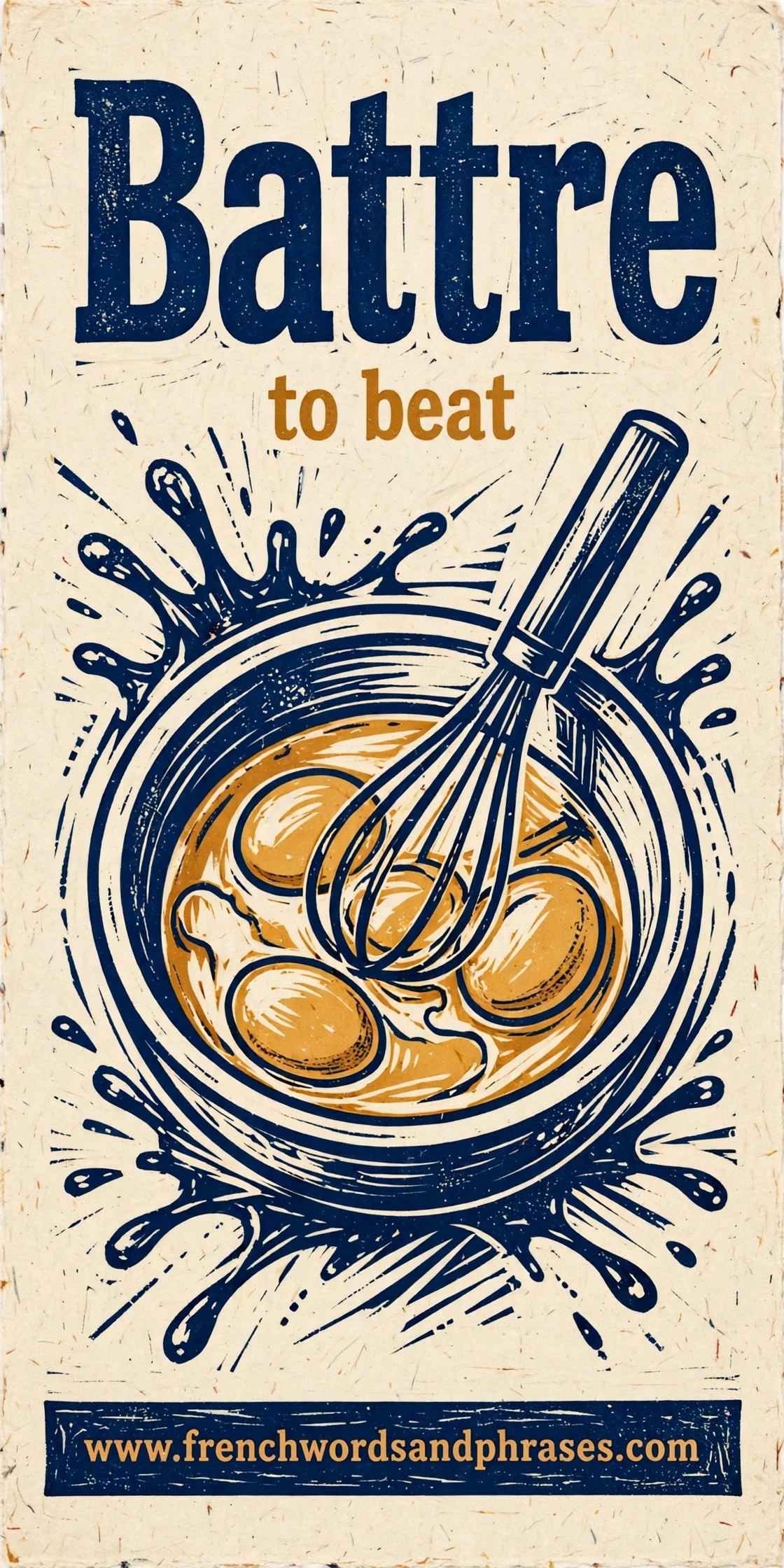
Battre means to beat, to whip, or to defeat.
Eggs whisked in a bowl, cream whipped into soft peaks, a heart thumping before big news, a champion beaten at last — battre is the verb of rhythmic striking, in the kitchen, in the body and on the field.
In this guide, you’ll learn how to conjugate battre in all the major French tenses and moods. Explore complete conjugation tables, French examples, English translations, and practice quizzes.
Understanding the French Verb Battre
Battre is an irregular French verb ending in -re.
It means to beat, to whip, or to defeat. It is commonly used in the kitchen (battre les œufs, battre la crème), for the heart beating (le cœur bat), for defeating an opponent or a record (battre un adversaire, battre un record), and for drums and rain striking (le tambour bat, la pluie bat les vitres).
Verb classification: Irregular (-re)
Auxiliary verb: Avoir
Past participle: battu
Present participle: battant
English equivalents: To beat, to whip (cream, eggs), to defeat, to strike; (le cœur) to beat, to thump.
One important detail: battre cannot decide how many t’s it wants. In the singular of the present tense it drops one — je bats, tu bats, il bat — but the plural keeps both: nous battons, vous battez, ils battent. The double t returns everywhere else too: the imperfect (je battais), the passé simple (je battis) and the subjunctive (que je batte). Only the past participle breaks ranks: battu, with the -u ending of the -re family.
Experience the Word
Battre is the verb of rhythm — the whisk against the bowl, the drum before the parade, the heart against the ribs.
Imagine a small kitchen on a Sunday morning. The whisk circles faster and faster, the egg whites climb into white mountains, and somewhere under your ribs your own heart keeps the same quick tempo.
You have not just struck something. You have set it in rhythm — foam, music, or a pulse.
How to Conjugate Battre: Complete French Conjugation Guide
Let’s explore every major conjugation of battre, beginning with the indicative mood.
How to Conjugate Battre in the Indicative Mood
The indicative mood is used to express facts, observations, actions, and events.
How to Conjugate Battre in the Present Tense (Présent)
Used for actions happening now, habitual actions, and general truths.
| Subject | Conjugation |
|---|---|
| je | bats |
| tu | bats |
| il / elle | bat |
| nous | battons |
| vous | battez |
| ils / elles | battent |
Example
Elle bat les œufs dans un grand saladier.
She beats the eggs in a large bowl.
Quick Quiz 1
Complete the sentence:
Nous ______ la crème en chantilly.
Reveal the answer
battons
Nous battons la crème en chantilly.
We are whipping the cream into chantilly.
How to Conjugate Battre in the Passé Composé
Used for completed actions in the past. Battre takes the auxiliary verb avoir.
| Subject | Conjugation |
|---|---|
| j’ | ai battu |
| tu | as battu |
| il / elle | a battu |
| nous | avons battu |
| vous | avez battu |
| ils / elles | ont battu |
Example
Il a battu la crème en chantilly.
He whipped the cream into chantilly.
How to Conjugate Battre in the Imparfait (Imperfect Tense)
Used for habitual past actions, descriptions, and ongoing situations in the past.
| Subject | Conjugation |
|---|---|
| je | battais |
| tu | battais |
| il / elle | battait |
| nous | battions |
| vous | battiez |
| ils / elles | battaient |
Example
Son cœur battait très fort avant l’examen.
His heart was beating very fast before the exam.
Quick Quiz 2
Choose the correct form:
He beat the record.
Il ______ le record. (a battu / est battu)
Reveal the answer
a battu
Il a battu le record.
Battre takes avoir in the passé composé.
How to Conjugate Battre in the Plus-que-parfait
Used to describe an action that had already been completed before another past event.
| Subject | Conjugation |
|---|---|
| j’ | avais battu |
| tu | avais battu |
| il / elle | avait battu |
| nous | avions battu |
| vous | aviez battu |
| ils / elles | avaient battu |
Example
Nous avions battu l’équipe adverse la semaine précédente.
We had beaten the opposing team the week before.
How to Conjugate Battre in the Passé Simple
Primarily used in formal writing, literature, and historical narratives. It is rarely used in everyday conversation.
| Subject | Conjugation |
|---|---|
| je | battis |
| tu | battis |
| il / elle | battit |
| nous | battîmes |
| vous | battîtes |
| ils / elles | battirent |
Example
Le tambour battit trois coups avant le lever du rideau.
The drum beat three times before the curtain rose.
How to Conjugate Battre in the Passé Antérieur
A literary tense used to express an action completed immediately before another past action, generally in the passé simple.
| Subject | Conjugation |
|---|---|
| j’ | eus battu |
| tu | eus battu |
| il / elle | eut battu |
| nous | eûmes battu |
| vous | eûtes battu |
| ils / elles | eurent battu |
Example
Quand elle eut battu les blancs en neige, elle les ajouta à la pâte.
When she had beaten the egg whites until stiff, she folded them into the batter.
How to Conjugate Battre in the Future Tense (Futur Simple)
Used to describe actions that will take place in the future.
| Subject | Conjugation |
|---|---|
| je | battrai |
| tu | battras |
| il / elle | battra |
| nous | battrons |
| vous | battrez |
| ils / elles | battront |
Example
Demain, nous battrons le record du tournoi.
Tomorrow, we will beat the tournament record.
How to Conjugate Battre in the Futur Antérieur (Future Perfect)
Used for an action that will have been completed before a particular point in the future.
| Subject | Conjugation |
|---|---|
| j’ | aurai battu |
| tu | auras battu |
| il / elle | aura battu |
| nous | aurons battu |
| vous | aurez battu |
| ils / elles | auront battu |
Example
À midi, tu auras battu la pâte à crêpes.
By noon, you will have beaten the pancake batter.
How to Conjugate Battre in the Near Future (Futur Proche)
Used to describe something that is going to happen soon. Formed with aller + infinitive.
| Subject | Conjugation |
|---|---|
| je | vais battre |
| tu | vas battre |
| il / elle | va battre |
| nous | allons battre |
| vous | allez battre |
| ils / elles | vont battre |
Example
Je vais battre les œufs pour l’omelette.
I am going to beat the eggs for the omelette.
How to Conjugate Battre in the Conditional Mood
The conditional mood expresses what would happen under certain circumstances. It is also frequently used to make polite requests or express wishes.
How to Conjugate Battre in the Present Conditional
| Subject | Conjugation |
|---|---|
| je | battrais |
| tu | battrais |
| il / elle | battrait |
| nous | battrions |
| vous | battriez |
| ils / elles | battraient |
Example
Avec un peu d’entraînement, ils battraient n’importe quelle équipe.
With a little training, they would beat any team.
How to Conjugate Battre in the Past Conditional
| Subject | Conjugation |
|---|---|
| j’ | aurais battu |
| tu | aurais battu |
| il / elle | aurait battu |
| nous | aurions battu |
| vous | auriez battu |
| ils / elles | auraient battu |
Example
Elle aurait battu le record si elle n’était pas tombée.
She would have beaten the record if she had not fallen.
Battre in the Literary Past Conditional Form
This less common literary form uses the imperfect subjunctive of avoir.
| Subject | Conjugation |
|---|---|
| j’ | eusse battu |
| tu | eusses battu |
| il / elle | eût battu |
| nous | eussions battu |
| vous | eussiez battu |
| ils / elles | eussent battu |
Example
Il eût battu son adversaire sans la blessure.
He would have beaten his opponent if not for the injury.
How to Conjugate Battre in the Subjunctive Mood
The subjunctive is used to express wishes, emotions, doubts, necessity, and uncertainty. It frequently follows expressions such as il faut que (it is necessary that) or bien que (although).
How to Conjugate Battre in the Present Subjunctive
| Subject | Conjugation |
|---|---|
| que je | batte |
| que tu | battes |
| qu’il / qu’elle | batte |
| que nous | battions |
| que vous | battiez |
| qu’ils / qu’elles | battent |
Example
Il faut que tu battes les œufs plus longtemps.
You need to beat the eggs for longer.
Quick Quiz 3
Complete the sentence using the subjunctive:
Il faut que vous ______ les blancs en neige.
Reveal the answer
battiez
Il faut que vous battiez les blancs en neige.
You must beat the egg whites until stiff.
How to Conjugate Battre in the Imperfect Subjunctive
A literary tense, rarely encountered in modern spoken French.
| Subject | Conjugation |
|---|---|
| que je | battisse |
| que tu | battisses |
| qu’il / qu’elle | battît |
| que nous | battissions |
| que vous | battissiez |
| qu’ils / qu’elles | battissent |
Example
Le chef voulait que nous battissions la crème à la main.
The chef wanted us to whip the cream by hand.
How to Conjugate Battre in the Pluperfect Subjunctive
A literary construction used to express an action completed before another past action.
| Subject | Conjugation |
|---|---|
| que j’ | eusse battu |
| que tu | eusses battu |
| qu’il / qu’elle | eût battu |
| que nous | eussions battu |
| que vous | eussiez battu |
| qu’ils / qu’elles | eussent battu |
Example
Elle doutait qu’ils eussent battu les champions.
She doubted that they had beaten the champions.
How to Conjugate Battre in the Past Subjunctive
| Subject | Conjugation |
|---|---|
| que j’ | aie battu |
| que tu | aies battu |
| qu’il / qu’elle | ait battu |
| que nous | ayons battu |
| que vous | ayez battu |
| qu’ils / qu’elles | aient battu |
Example
Je suis ravi que vous ayez battu votre propre record.
I am delighted that you have beaten your own record.
How to Conjugate Battre in the Imperative
The imperative is used to give commands, instructions, invitations, or suggestions. Subject pronouns are omitted.
How to Conjugate Battre in the Present Imperative
| Person | Conjugation |
|---|---|
| (tu) | bats |
| (nous) | battons |
| (vous) | battez |
Example
Bats les œufs, puis ajoute le sucre !
Beat the eggs, then add the sugar!
Quick Quiz 4
How would you say Beat the eggs, using the tu form?
Reveal the answer
Bats les œufs !
French Participles of Battre
Participles are verb forms that can be used in compound tenses and other grammatical constructions.
Present Participle of Battre
battant
En battant la crème, elle écoutait la radio.
While whipping the cream, she was listening to the radio.
Past Participle of Battre
battu
Les œufs, une fois battus, doivent être utilisés tout de suite.
The eggs, once beaten, must be used straight away.
Battre in Everyday French: Real-Life Examples
Now that you know the conjugations, let’s see how battre appears in everyday French.
Example 1 — Present
Mon cœur bat très fort quand je cours.
My heart beats very fast when I run.
Example 2 — Passé composé
Nous avons battu les blancs en neige ferme.
We beat the egg whites until stiff.
Example 3 — Imparfait
La pluie battait contre les fenêtres toute la nuit.
The rain beat against the windows all night.
Example 4 — Future
Elle battra son record personnel samedi.
She will beat her personal record on Saturday.
Example 5 — Conditional
Je battrais la crème avec un fouet électrique.
I would whip the cream with an electric whisk.
Example 6 — Imperative
Battez les œufs pendant deux minutes !
Beat the eggs for two minutes!
Beyond Translation: The Meaning of Battre
English splits this verb in two: you beat eggs and opponents, but you whip cream. French keeps one word for the whole family — battre — because the gesture is the same: a quick, repeated strike that changes what it touches.
And the body keeps the beat too.
Le cœur bat — the heart beats — uses the same verb, with the singular’s single t. From the whisk to the pulse, battre is French’s verb of rhythm.
How to Remember the French Verb Battre
Remember it this way: Battre is about rhythmic striking — one t in the singular, two in the plural, participle battu.
- Singular present drops a t — je bats, il bat — but the plural keeps both: nous battons.
- The kitchen is its home ground — battre les œufs, battre la crème, battre les blancs en neige.
- The heart and the champion take the same verb — le cœur bat, battre un record.
The key idea is rhythmic striking — one t in the singular, two in the plural, participle battu.
Test Your Knowledge of Battre
Let’s see how much you’ve learned. Try answering these questions before revealing the answers.
Question 1
How many t’s does battre have in je bats, and in nous battons?
Reveal the answer
One in the singular — je bats, il bat — and two in the plural — nous battons, vous battez.
Question 2
How do you say She whipped the cream in French?
Reveal the answer
Elle a battu la crème.
Question 3
Translate: My heart is beating fast.
Reveal the answer
Mon cœur bat vite.
Question 4
What is the past participle of battre?
Reveal the answer
Battu.
Question 5
Complete the sentence:
Il faut que tu ______ les œufs plus longtemps.
Reveal the answer
battes
Il faut que tu battes les œufs plus longtemps.
You need to beat the eggs for longer.
Your Final Challenge
Can You Use It?
How would you say this in French?
She beats the eggs, adds the sugar, and her heart beats with impatience.
Reveal the answer
Elle bat les œufs, ajoute le sucre, et son cœur bat d’impatience.
She beats the eggs, adds the sugar, and her heart beats with impatience.
A little French. A little curiosity. A richer everyday life.
LEARN FRENCH ONE WORD AT A TIME