
A French Word to Live By
How to Conjugate Poivrer in French
/pwa.vʁe/
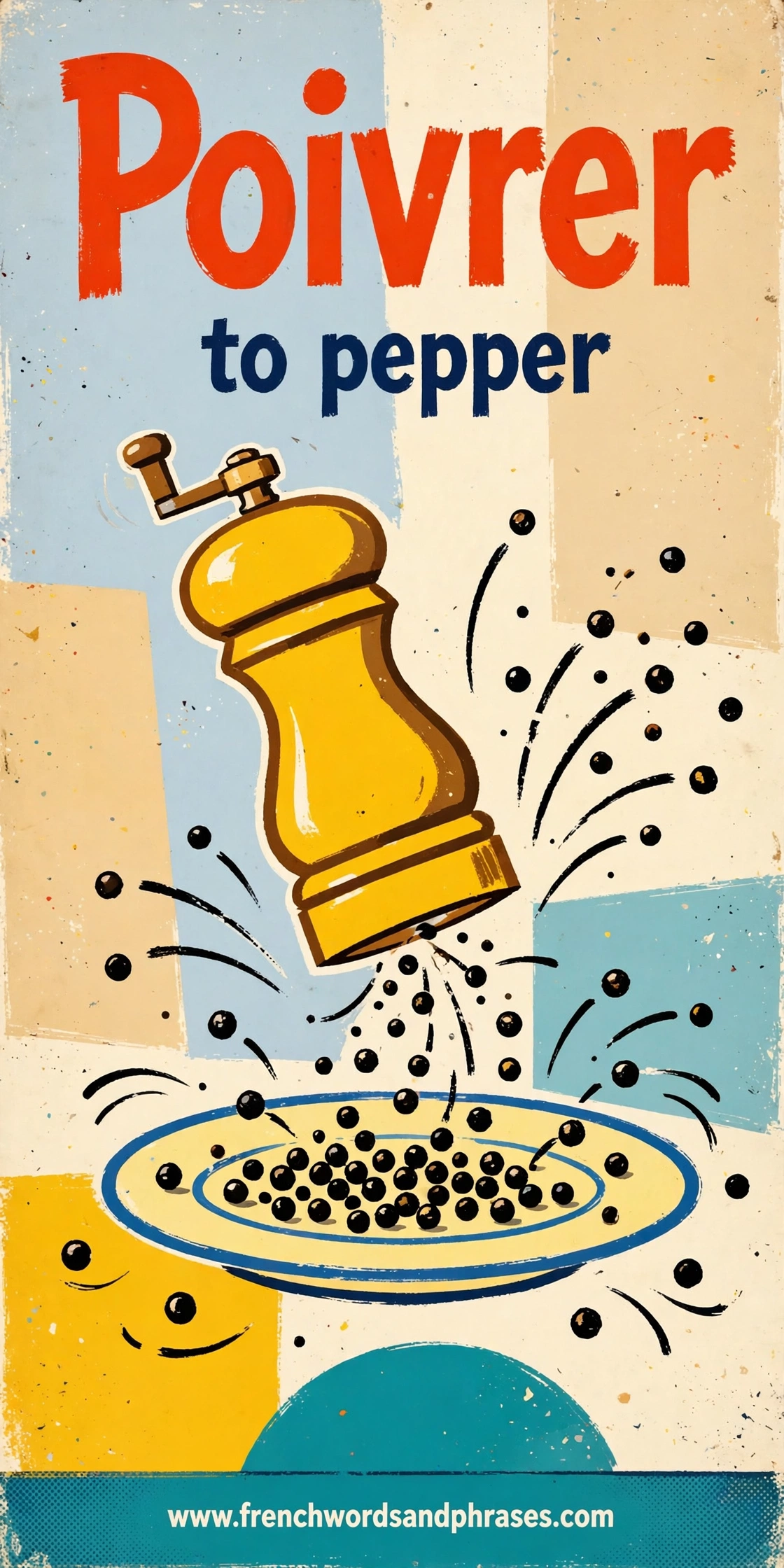
Poivrer means to pepper — to add pepper to a dish.
The mill turning over a steak, black specks falling on a salad, a soup waking up with a twist of heat — poivrer is saler’s inseparable partner, the verb of pepper freshly ground.
In this guide, you’ll learn how to conjugate poivrer in all the major French tenses and moods. Explore complete conjugation tables, French examples, English translations, and practice quizzes.
Understanding the French Verb Poivrer
Poivrer is a regular French verb belonging to the first group of verbs, those ending in -er.
It means to pepper, to add pepper to. It is commonly used for peppering steaks before grilling, salads and vinaigrettes, soups and eggs, always best au moulin — freshly ground — and in the recipe instruction that ends a thousand preparations: saler, poivrer, servir.
Verb classification: First group (-er)
Auxiliary verb: Avoir
Past participle: poivré
Present participle: poivrant
English equivalents: To pepper, to add pepper to; (figurative) to spice up — poivrer un récit, to spice up a story.
One important detail: poivrer almost always travels with its partner — saler et poivrer is the fixed order of every French recipe. The family stays at the table: le poivre is the pepper, le moulin à poivre the pepper mill, and poivre du moulin means freshly ground. Careful with the neighbour: un poivron is a bell pepper — a vegetable, not a spice. Figuratively, you can poivrer un récit, spice up a story, and a steep bill can be poivrée too.
Experience the Word
Poivrer is the verb of the final twist — the mill turns, the specks fall, and a polite dish suddenly has character.
Imagine a bistrot waiter with the giant pepper mill, the kind that needs two hands, asking the eternal question over your steak: poivre ? One nod, three turns, and the whole table smells of it.
Nothing has been cooked longer. It has been poivré — seasoned, sharpened, awake.
How to Conjugate Poivrer: Complete French Conjugation Guide
Let’s explore every major conjugation of poivrer, beginning with the indicative mood.
How to Conjugate Poivrer in the Indicative Mood
The indicative mood is used to express facts, observations, actions, and events.
How to Conjugate Poivrer in the Present Tense (Présent)
Used for actions happening now, habitual actions, and general truths.
| Subject | Conjugation |
|---|---|
| je | poivre |
| tu | poivres |
| il / elle | poivre |
| nous | poivrons |
| vous | poivrez |
| ils / elles | poivrent |
Example
Il poivre le steak juste avant de le griller.
He peppers the steak just before grilling it.
Quick Quiz 1
Complete the sentence:
Nous ______ le rôti avant de servir.
Reveal the answer
poivrons
Nous poivrons le rôti avant de servir.
We pepper the roast before serving.
How to Conjugate Poivrer in the Passé Composé
Used for completed actions in the past. Poivrer takes the auxiliary verb avoir.
| Subject | Conjugation |
|---|---|
| j’ | ai poivré |
| tu | as poivré |
| il / elle | a poivré |
| nous | avons poivré |
| vous | avez poivré |
| ils / elles | ont poivré |
Example
Elle a poivré la salade un peu trop fort.
She peppered the salad a little too strongly.
How to Conjugate Poivrer in the Imparfait (Imperfect Tense)
Used for habitual past actions, descriptions, and ongoing situations in the past.
| Subject | Conjugation |
|---|---|
| je | poivrais |
| tu | poivrais |
| il / elle | poivrait |
| nous | poivrions |
| vous | poivriez |
| ils / elles | poivraient |
Example
Grand-père poivrait sa soupe en tournant le moulin trois fois.
Grandfather used to pepper his soup by turning the mill three times.
Quick Quiz 2
Choose the correct form:
She peppered the salad.
Elle ______ la salade. (a poivré / est poivrée)
Reveal the answer
a poivré
Elle a poivré la salade.
Poivrer takes avoir.
How to Conjugate Poivrer in the Plus-que-parfait
Used to describe an action that had already been completed before another past event.
| Subject | Conjugation |
|---|---|
| j’ | avais poivré |
| tu | avais poivré |
| il / elle | avait poivré |
| nous | avions poivré |
| vous | aviez poivré |
| ils / elles | avaient poivré |
Example
Nous avions poivré le rôti avant de le mettre au four.
We had peppered the roast before putting it in the oven.
How to Conjugate Poivrer in the Passé Simple
Primarily used in formal writing, literature, and historical narratives. It is rarely used in everyday conversation.
| Subject | Conjugation |
|---|---|
| je | poivrai |
| tu | poivras |
| il / elle | poivra |
| nous | poivrâmes |
| vous | poivrâtes |
| ils / elles | poivrèrent |
Example
Le chef poivra le plat et le goûta en silence.
The chef peppered the dish and tasted it in silence.
How to Conjugate Poivrer in the Passé Antérieur
A literary tense used to express an action completed immediately before another past action, generally in the passé simple.
| Subject | Conjugation |
|---|---|
| j’ | eus poivré |
| tu | eus poivré |
| il / elle | eut poivré |
| nous | eûmes poivré |
| vous | eûtes poivré |
| ils / elles | eurent poivré |
Example
Quand elle eut poivré les œufs, elle les servit sur des tartines.
When she had peppered the eggs, she served them on toast.
How to Conjugate Poivrer in the Future Tense (Futur Simple)
Used to describe actions that will take place in the future.
| Subject | Conjugation |
|---|---|
| je | poivrerai |
| tu | poivreras |
| il / elle | poivrera |
| nous | poivrerons |
| vous | poivrerez |
| ils / elles | poivreront |
Example
Tu poivreras la vinaigrette au dernier moment.
You will pepper the vinaigrette at the last moment.
How to Conjugate Poivrer in the Futur Antérieur (Future Perfect)
Used for an action that will have been completed before a particular point in the future.
| Subject | Conjugation |
|---|---|
| j’ | aurai poivré |
| tu | auras poivré |
| il / elle | aura poivré |
| nous | aurons poivré |
| vous | aurez poivré |
| ils / elles | auront poivré |
Example
À table, il aura poivré chaque assiette selon les goûts de chacun.
At the table, he will have peppered each plate according to everyone’s taste.
How to Conjugate Poivrer in the Near Future (Futur Proche)
Used to describe something that is going to happen soon. Formed with aller + infinitive.
| Subject | Conjugation |
|---|---|
| je | vais poivrer |
| tu | vas poivrer |
| il / elle | va poivrer |
| nous | allons poivrer |
| vous | allez poivrer |
| ils / elles | vont poivrer |
Example
Je vais poivrer la soupe, elle est un peu fade.
I am going to pepper the soup, it is a little bland.
How to Conjugate Poivrer in the Conditional Mood
The conditional mood expresses what would happen under certain circumstances. It is also frequently used to make polite requests or express wishes.
How to Conjugate Poivrer in the Present Conditional
| Subject | Conjugation |
|---|---|
| je | poivrerais |
| tu | poivrerais |
| il / elle | poivrerait |
| nous | poivrerions |
| vous | poivreriez |
| ils / elles | poivreraient |
Example
Je poivrerais davantage, mais ta sœur déteste ça.
I would pepper more, but your sister hates it.
How to Conjugate Poivrer in the Past Conditional
| Subject | Conjugation |
|---|---|
| j’ | aurais poivré |
| tu | aurais poivré |
| il / elle | aurait poivré |
| nous | aurions poivré |
| vous | auriez poivré |
| ils / elles | auraient poivré |
Example
Elle aurait poivré le plat si le moulin n’avait pas été vide.
She would have peppered the dish if the mill had not been empty.
Poivrer in the Literary Past Conditional Form
This less common literary form uses the imperfect subjunctive of avoir.
| Subject | Conjugation |
|---|---|
| j’ | eusse poivré |
| tu | eusses poivré |
| il / elle | eût poivré |
| nous | eussions poivré |
| vous | eussiez poivré |
| ils / elles | eussent poivré |
Example
Il eût poivré son récit de détails croustillants.
He would have spiced up his story with juicy details.
How to Conjugate Poivrer in the Subjunctive Mood
The subjunctive is used to express wishes, emotions, doubts, necessity, and uncertainty. It frequently follows expressions such as il faut que (it is necessary that) or bien que (although).
How to Conjugate Poivrer in the Present Subjunctive
| Subject | Conjugation |
|---|---|
| que je | poivre |
| que tu | poivres |
| qu’il / qu’elle | poivre |
| que nous | poivrions |
| que vous | poivriez |
| qu’ils / qu’elles | poivrent |
Example
Il faut que tu poivres la viande des deux côtés.
You must pepper the meat on both sides.
Quick Quiz 3
Complete the sentence using the subjunctive:
Il faut que vous ______ la vinaigrette.
Reveal the answer
poivriez
Il faut que vous poivriez la vinaigrette.
You must pepper the vinaigrette.
How to Conjugate Poivrer in the Imperfect Subjunctive
A literary tense, rarely encountered in modern spoken French.
| Subject | Conjugation |
|---|---|
| que je | poivrasse |
| que tu | poivrasses |
| qu’il / qu’elle | poivrât |
| que nous | poivrassions |
| que vous | poivrassiez |
| qu’ils / qu’elles | poivrassent |
Example
Je craignais qu’elle poivrât trop la sauce.
I feared she might pepper the sauce too much.
How to Conjugate Poivrer in the Pluperfect Subjunctive
A literary construction used to express an action completed before another past action.
| Subject | Conjugation |
|---|---|
| que j’ | eusse poivré |
| que tu | eusses poivré |
| qu’il / qu’elle | eût poivré |
| que nous | eussions poivré |
| que vous | eussiez poivré |
| qu’ils / qu’elles | eussent poivré |
Example
Il regrettait que nous eussions poivré les fraises par erreur.
He regretted that we had peppered the strawberries by mistake.
How to Conjugate Poivrer in the Past Subjunctive
| Subject | Conjugation |
|---|---|
| que j’ | aie poivré |
| que tu | aies poivré |
| qu’il / qu’elle | ait poivré |
| que nous | ayons poivré |
| que vous | ayez poivré |
| qu’ils / qu’elles | aient poivré |
Example
Je suis content que tu aies poivré le steak, il est délicieux.
I am glad you peppered the steak, it is delicious.
How to Conjugate Poivrer in the Imperative
The imperative is used to give commands, instructions, invitations, or suggestions. Subject pronouns are omitted.
How to Conjugate Poivrer in the Present Imperative
| Person | Conjugation |
|---|---|
| (tu) | poivre |
| (nous) | poivrons |
| (vous) | poivrez |
Example
Poivre la salade, mais doucement !
Pepper the salad, but gently!
Quick Quiz 4
How would you say Pepper the salad (tu form)?
Reveal the answer
Poivre la salade !
French Participles of Poivrer
Participles are verb forms that can be used in compound tenses and other grammatical constructions.
Present Participle of Poivrer
poivrant
En poivrant la soupe, il a renversé le moulin sur la nappe.
While peppering the soup, he knocked the mill over on the tablecloth.
Past Participle of Poivrer
poivré
Poivré à point, le steak fut dévoré en cinq minutes.
Peppered just right, the steak was devoured in five minutes.
Poivrer in Everyday French: Real-Life Examples
Now that you know the conjugations, let’s see how poivrer appears in everyday French.
Example 1 — Present
Je poivre toujours mes œufs au plat.
I always pepper my fried eggs.
Example 2 — Passé composé
Elle a poivré la vinaigrette.
She peppered the vinaigrette.
Example 3 — Imparfait
Le cuisinier poivrait chaque plat avant de servir.
The cook used to pepper every dish before serving.
Example 4 — Future
Nous poivrerons le rôti à la sortie du four.
We will pepper the roast as it comes out of the oven.
Example 5 — Conditional
Tu poivrerais un peu plus, s’il te plaît ?
Would you pepper a little more, please?
Example 6 — Imperative
Poivrez la viande avant de la griller !
Pepper the meat before grilling it!
Beyond Translation: The Meaning of Poivrer
English pepper does double duty — you pepper a steak, and journalists pepper a minister with questions; French poivrer stays at the table and in the story (poivrer un récit), leaving questions to bombarder de questions.
Pepper was once worth more than gold.
Ships crossed oceans for the little black grains in your mill. Poivrer is a modest gesture with an epic past — three turns of the wrist, five centuries of trade routes.
How to Remember the French Verb Poivrer
Remember it this way: Poivrer is about peppering — steaks, salads and stories.
- The recipe order never changes — saler, poivrer: salt first, pepper second.
- Poivre du moulin — freshly ground pepper, the only kind a French cook respects.
- Regular -er: je poivre, nous poivrons, past participle poivré.
The key idea is peppering — steaks, salads and stories.
Test Your Knowledge of Poivrer
Let’s see how much you’ve learned. Try answering these questions before revealing the answers.
Question 1
How do you say He peppers the steak in French?
Reveal the answer
Il poivre le steak.
Question 2
What is the difference between le poivre and un poivron?
Reveal the answer
Le poivre is the spice, black pepper; un poivron is a bell pepper, the vegetable.
Question 3
Translate: She peppered the vinaigrette.
Reveal the answer
Elle a poivré la vinaigrette.
Question 4
What is the past participle of poivrer?
Reveal the answer
Poivré.
Question 5
Complete the sentence:
Il faut que tu ______ la viande des deux côtés.
Reveal the answer
poivres
Il faut que tu poivres la viande des deux côtés.
You must pepper the meat on both sides.
Your Final Challenge
Can You Use It?
How would you say this in French?
He peppers the steak, and the dinner takes on character.
Reveal the answer
Il poivre le steak, et le dîner prend du caractère.
He peppers the steak, and the dinner takes on character.
A little French. A little curiosity. A richer everyday life.
LEARN FRENCH ONE WORD AT A TIME




