
A French Word to Live By
How to Conjugate Fouetter in French
/fwɛ.te/
Fouetter means to whisk or to whip.
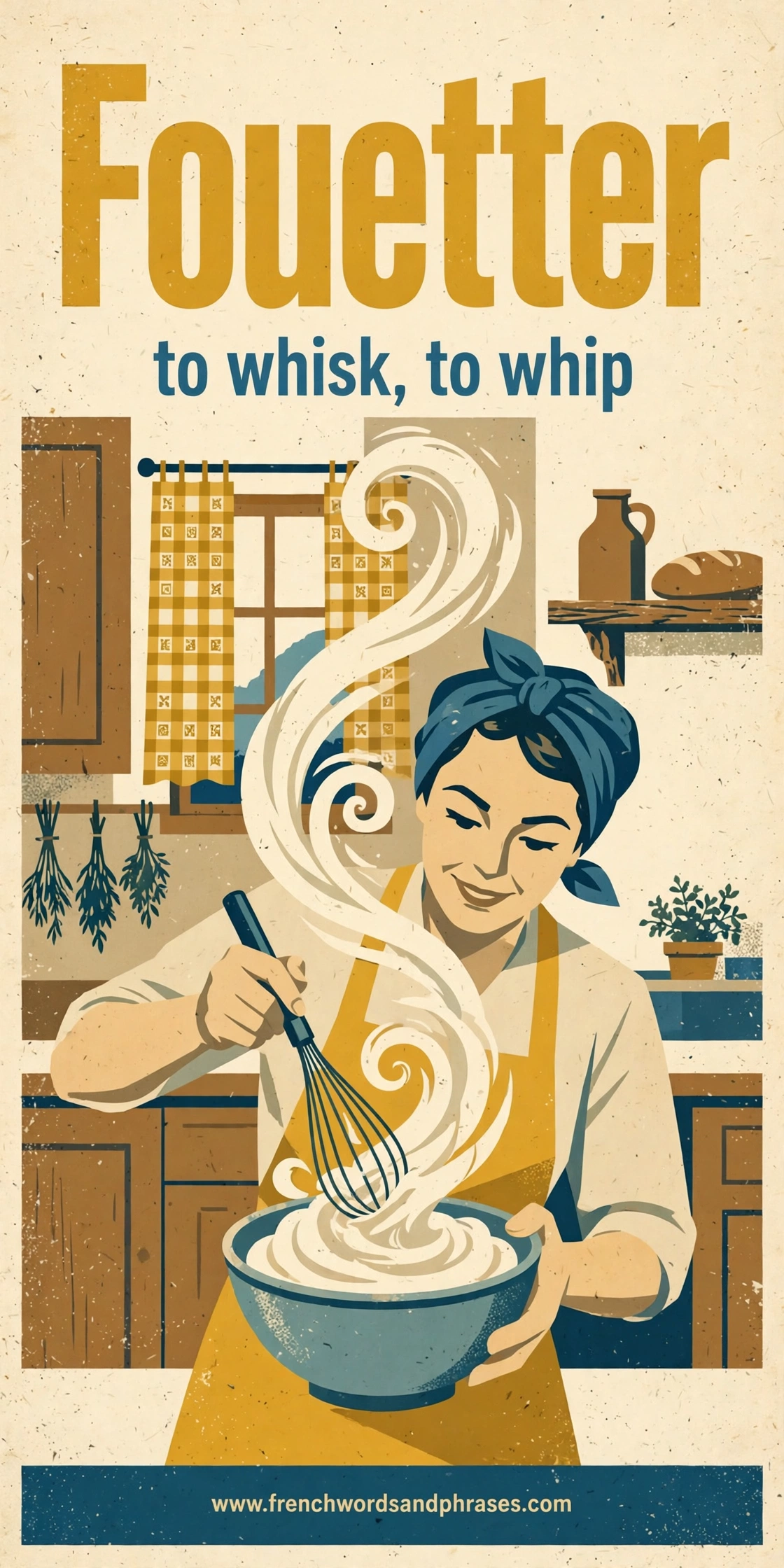
Egg whites rising into snow, cream standing up in soft peaks, a dressing coming together in seconds — fouetter is the verb of the whisk, of air beaten into food until it changes its nature.
In this guide, you’ll learn how to conjugate fouetter in all the major French tenses and moods. Explore complete conjugation tables, French examples, English translations, and practice quizzes.
Understanding the French Verb Fouetter
Fouetter is a regular French verb belonging to the first group of verbs, those ending in -er.
It means to whisk, to whip. It is commonly used for whisking egg whites into stiff peaks (en neige), whipping cream, whisking sauces and dressings smooth, and outside the kitchen for rain or branches lashing against a window.
Verb classification: First group (-er)
Auxiliary verb: Avoir
Past participle: fouetté
Present participle: fouettant
English equivalents: To whisk, to whip (cream, egg whites); to lash (of rain, of a whip).
One important detail: fouetter is a -eter verb whose stem doubles its t before a mute e: je fouette, tu fouettes, ils fouettent — but the t stays single where the ending is pronounced: nous fouettons, vous fouettez. The future doubles too: je fouetterai. Its tool is un fouet — the whisk, and also a whip, which is why rain can fouetter les vitres, lash the windows. The prize at the end: la crème fouettée, whipped cream, and les blancs fouettés en neige, whites whisked into snow.
Experience the Word
Fouetter is the verb of transformation — liquid goes in, cloud comes out, and the cook’s arm is the weather that makes it happen.
Imagine a pâtissier at dawn with a copper bowl and a balloon whisk, beating egg whites in great figure-of-eight sweeps. His apprentice counts the strokes; the whites climb, whiten, and suddenly stand up on their own: en neige.
The whites are not beaten into submission. They have been whisked into a cloud.
How to Conjugate Fouetter: Complete French Conjugation Guide
Let’s explore every major conjugation of fouetter, beginning with the indicative mood.
How to Conjugate Fouetter in the Indicative Mood
The indicative mood is used to express facts, observations, actions, and events.
How to Conjugate Fouetter in the Present Tense (Présent)
Used for actions happening now, habitual actions, and general truths.
| Subject | Conjugation |
|---|---|
| je | fouette |
| tu | fouettes |
| il / elle | fouette |
| nous | fouettons |
| vous | fouettez |
| ils / elles | fouettent |
Example
Elle fouette la crème jusqu’à ce qu’elle soit ferme.
She whips the cream until it is firm.
Quick Quiz 1
Complete the sentence:
Nous ______ la crème pour le dessert.
Reveal the answer
fouettons
Nous fouettons la crème pour le dessert.
We whip the cream for the dessert.
How to Conjugate Fouetter in the Passé Composé
Used for completed actions in the past. Fouetter takes the auxiliary verb avoir.
| Subject | Conjugation |
|---|---|
| j’ | ai fouetté |
| tu | as fouetté |
| il / elle | a fouetté |
| nous | avons fouetté |
| vous | avez fouetté |
| ils / elles | ont fouetté |
Example
Il a fouetté les blancs d’œufs en neige.
He whisked the egg whites into stiff peaks.
How to Conjugate Fouetter in the Imparfait (Imperfect Tense)
Used for habitual past actions, descriptions, and ongoing situations in the past.
| Subject | Conjugation |
|---|---|
| je | fouettais |
| tu | fouettais |
| il / elle | fouettait |
| nous | fouettions |
| vous | fouettiez |
| ils / elles | fouettaient |
Example
Le pâtissier fouettait la pâte avec énergie.
The pastry chef used to whisk the batter energetically.
Quick Quiz 2
Choose the correct form:
He whisked the egg whites.
Il ______ les blancs d’œufs. (a fouetté / est fouetté)
Reveal the answer
a fouetté
Il a fouetté les blancs d’œufs.
Fouetter takes avoir.
How to Conjugate Fouetter in the Plus-que-parfait
Used to describe an action that had already been completed before another past event.
| Subject | Conjugation |
|---|---|
| j’ | avais fouetté |
| tu | avais fouetté |
| il / elle | avait fouetté |
| nous | avions fouetté |
| vous | aviez fouetté |
| ils / elles | avaient fouetté |
Example
Nous avions fouetté la crème avant de servir le dessert.
We had whipped the cream before serving the dessert.
How to Conjugate Fouetter in the Passé Simple
Primarily used in formal writing, literature, and historical narratives. It is rarely used in everyday conversation.
| Subject | Conjugation |
|---|---|
| je | fouettai |
| tu | fouettas |
| il / elle | fouetta |
| nous | fouettâmes |
| vous | fouettâtes |
| ils / elles | fouettèrent |
Example
Elle fouetta la sauce jusqu’à la rendre lisse.
She whisked the sauce until it was smooth.
How to Conjugate Fouetter in the Passé Antérieur
A literary tense used to express an action completed immediately before another past action, generally in the passé simple.
| Subject | Conjugation |
|---|---|
| j’ | eus fouetté |
| tu | eus fouetté |
| il / elle | eut fouetté |
| nous | eûmes fouetté |
| vous | eûtes fouetté |
| ils / elles | eurent fouetté |
Example
Quand il eut fouetté les jaunes, il ajouta le sucre.
When he had whisked the yolks, he added the sugar.
How to Conjugate Fouetter in the Future Tense (Futur Simple)
Used to describe actions that will take place in the future.
| Subject | Conjugation |
|---|---|
| je | fouetterai |
| tu | fouetteras |
| il / elle | fouettera |
| nous | fouetterons |
| vous | fouetterez |
| ils / elles | fouetteront |
Example
Tu fouetteras la crème au moment de servir.
You will whip the cream at the moment of serving.
How to Conjugate Fouetter in the Futur Antérieur (Future Perfect)
Used for an action that will have been completed before a particular point in the future.
| Subject | Conjugation |
|---|---|
| j’ | aurai fouetté |
| tu | auras fouetté |
| il / elle | aura fouetté |
| nous | aurons fouetté |
| vous | aurez fouetté |
| ils / elles | auront fouetté |
Example
À la fin, nous aurons fouetté tous les blancs en neige ferme.
In the end, we will have whisked all the whites into firm peaks.
How to Conjugate Fouetter in the Near Future (Futur Proche)
Used to describe something that is going to happen soon. Formed with aller + infinitive.
| Subject | Conjugation |
|---|---|
| je | vais fouetter |
| tu | vas fouetter |
| il / elle | va fouetter |
| nous | allons fouetter |
| vous | allez fouetter |
| ils / elles | vont fouetter |
Example
Je vais fouetter la vinaigrette, sors la salade.
I am going to whisk the dressing, get the salad out.
How to Conjugate Fouetter in the Conditional Mood
The conditional mood expresses what would happen under certain circumstances. It is also frequently used to make polite requests or express wishes.
How to Conjugate Fouetter in the Present Conditional
| Subject | Conjugation |
|---|---|
| je | fouetterais |
| tu | fouetterais |
| il / elle | fouetterait |
| nous | fouetterions |
| vous | fouetteriez |
| ils / elles | fouetteraient |
Example
Sans fouet électrique, je fouetterais à la main.
Without an electric whisk, I would whisk by hand.
How to Conjugate Fouetter in the Past Conditional
| Subject | Conjugation |
|---|---|
| j’ | aurais fouetté |
| tu | aurais fouetté |
| il / elle | aurait fouetté |
| nous | aurions fouetté |
| vous | auriez fouetté |
| ils / elles | auraient fouetté |
Example
Elle aurait fouetté la crème plus longtemps pour la rendre ferme.
She would have whipped the cream longer to make it firm.
Fouetter in the Literary Past Conditional Form
This less common literary form uses the imperfect subjunctive of avoir.
| Subject | Conjugation |
|---|---|
| j’ | eusse fouetté |
| tu | eusses fouetté |
| il / elle | eût fouetté |
| nous | eussions fouetté |
| vous | eussiez fouetté |
| ils / elles | eussent fouetté |
Example
Il eût fouetté les œufs jusqu’à l’écume.
He would have whisked the eggs to a froth.
How to Conjugate Fouetter in the Subjunctive Mood
The subjunctive is used to express wishes, emotions, doubts, necessity, and uncertainty. It frequently follows expressions such as il faut que (it is necessary that) or bien que (although).
How to Conjugate Fouetter in the Present Subjunctive
| Subject | Conjugation |
|---|---|
| que je | fouette |
| que tu | fouettes |
| qu’il / qu’elle | fouette |
| que nous | fouettions |
| que vous | fouettiez |
| qu’ils / qu’elles | fouettent |
Example
Il faut que tu fouettes la crème bien froide.
You must whip the cream while it is really cold.
Quick Quiz 3
Complete the sentence using the subjunctive:
Il faut que vous ______ la sauce.
Reveal the answer
fouettiez
Il faut que vous fouettiez la sauce.
You must whisk the sauce.
How to Conjugate Fouetter in the Imperfect Subjunctive
A literary tense, rarely encountered in modern spoken French.
| Subject | Conjugation |
|---|---|
| que je | fouettasse |
| que tu | fouettasses |
| qu’il / qu’elle | fouettât |
| que nous | fouettassions |
| que vous | fouettassiez |
| qu’ils / qu’elles | fouettassent |
Example
Je voulais qu’elle fouettât la sauce sans s’arrêter.
I wanted her to whisk the sauce without stopping.
How to Conjugate Fouetter in the Pluperfect Subjunctive
A literary construction used to express an action completed before another past action.
| Subject | Conjugation |
|---|---|
| que j’ | eusse fouetté |
| que tu | eusses fouetté |
| qu’il / qu’elle | eût fouetté |
| que nous | eussions fouetté |
| que vous | eussiez fouetté |
| qu’ils / qu’elles | eussent fouetté |
Example
Il regrettait que nous eussions fouetté la crème trop tôt.
He regretted that we had whipped the cream too early.
How to Conjugate Fouetter in the Past Subjunctive
| Subject | Conjugation |
|---|---|
| que j’ | aie fouetté |
| que tu | aies fouetté |
| qu’il / qu’elle | ait fouetté |
| que nous | ayons fouetté |
| que vous | ayez fouetté |
| qu’ils / qu’elles | aient fouetté |
Example
Je suis content que tu aies fouetté les blancs en neige.
I am glad you whisked the whites into peaks.
How to Conjugate Fouetter in the Imperative
The imperative is used to give commands, instructions, invitations, or suggestions. Subject pronouns are omitted.
How to Conjugate Fouetter in the Present Imperative
| Person | Conjugation |
|---|---|
| (tu) | fouette |
| (nous) | fouettons |
| (vous) | fouettez |
Example
Fouette la crème jusqu’à ce qu’elle tienne !
Whip the cream until it holds!
Quick Quiz 4
How would you say Whip the cream (tu form)?
Reveal the answer
Fouette la crème !
French Participles of Fouetter
Participles are verb forms that can be used in compound tenses and other grammatical constructions.
Present Participle of Fouetter
fouettant
En fouettant la pâte, elle pensait à sa grand-mère.
While whisking the batter, she thought of her grandmother.
Past Participle of Fouetter
fouetté
Fouettée à la main, la crème gardait tout son goût.
Whipped by hand, the cream kept all its flavour.
Fouetter in Everyday French: Real-Life Examples
Now that you know the conjugations, let’s see how fouetter appears in everyday French.
Example 1 — Present
Je fouette les blancs d’œufs pour la mousse.
I whisk the egg whites for the mousse.
Example 2 — Passé composé
Elle a fouetté la crème en deux minutes.
She whipped the cream in two minutes.
Example 3 — Imparfait
La pluie fouettait les vitres toute la nuit.
The rain lashed the windows all night.
Example 4 — Future
Nous fouetterons la sauce avant de servir.
We will whisk the sauce before serving.
Example 5 — Conditional
Je fouetterais les œufs à la main, sans machine.
I would whisk the eggs by hand, without a machine.
Example 6 — Imperative
Fouettez la vinaigrette jusqu’à ce qu’elle soit lisse !
Whisk the dressing until it is smooth!
Beyond Translation: The Meaning of Fouetter
English splits the work between whisk (the gentle tool) and whip (the sterner one); French fouetter keeps them under one roof, because un fouet is both instruments at once.
The whisk is a whip that learned manners.
In the kitchen it raises cream into clouds; at the window, the same verb lets the rain lash the glass. Force, in fouetter’s world, is only ever a question of what is in the bowl.
How to Remember the French Verb Fouetter
Remember it this way: Fouetter is about the whisk — egg whites into snow, cream into clouds.
- The t doubles before a mute e — je fouette, ils fouettent — but stays single in nous fouettons.
- Les blancs en neige — whites whisked into snow: the cook’s favourite weather report.
- Un fouet is the whisk — and the whip: la pluie fouette les vitres.
The key idea is the whisk — egg whites into snow, cream into clouds.
Test Your Knowledge of Fouetter
Let’s see how much you’ve learned. Try answering these questions before revealing the answers.
Question 1
Why does je fouette have two t’s?
Reveal the answer
Because fouetter is a -eter verb — its stem doubles the t before a mute e: je fouette, tu fouettes, ils fouettent. The future doubles it too: je fouetterai.
Question 2
How do you say She whips the cream in French?
Reveal the answer
Elle fouette la crème.
Question 3
Translate: He whisked the egg whites into stiff peaks.
Reveal the answer
Il a fouetté les blancs d’œufs en neige.
Question 4
What is the past participle of fouetter?
Reveal the answer
Fouetté.
Question 5
Complete the sentence:
Il faut que tu ______ la crème bien froide.
Reveal the answer
fouettes
Il faut que tu fouettes la crème bien froide.
You must whip the cream while it is really cold.
Your Final Challenge
Can You Use It?
How would you say this in French?
Whisk the whites into peaks, the soufflé is waiting for us.
Reveal the answer
Fouette les blancs en neige, le soufflé nous attend.
Whisk the whites into peaks, the soufflé is waiting for us.
A little French. A little curiosity. A richer everyday life.
LEARN FRENCH ONE WORD AT A TIME




