A French Word to Live By
How to Conjugate Mélanger in French
/me.lɑ̃.ʒe/
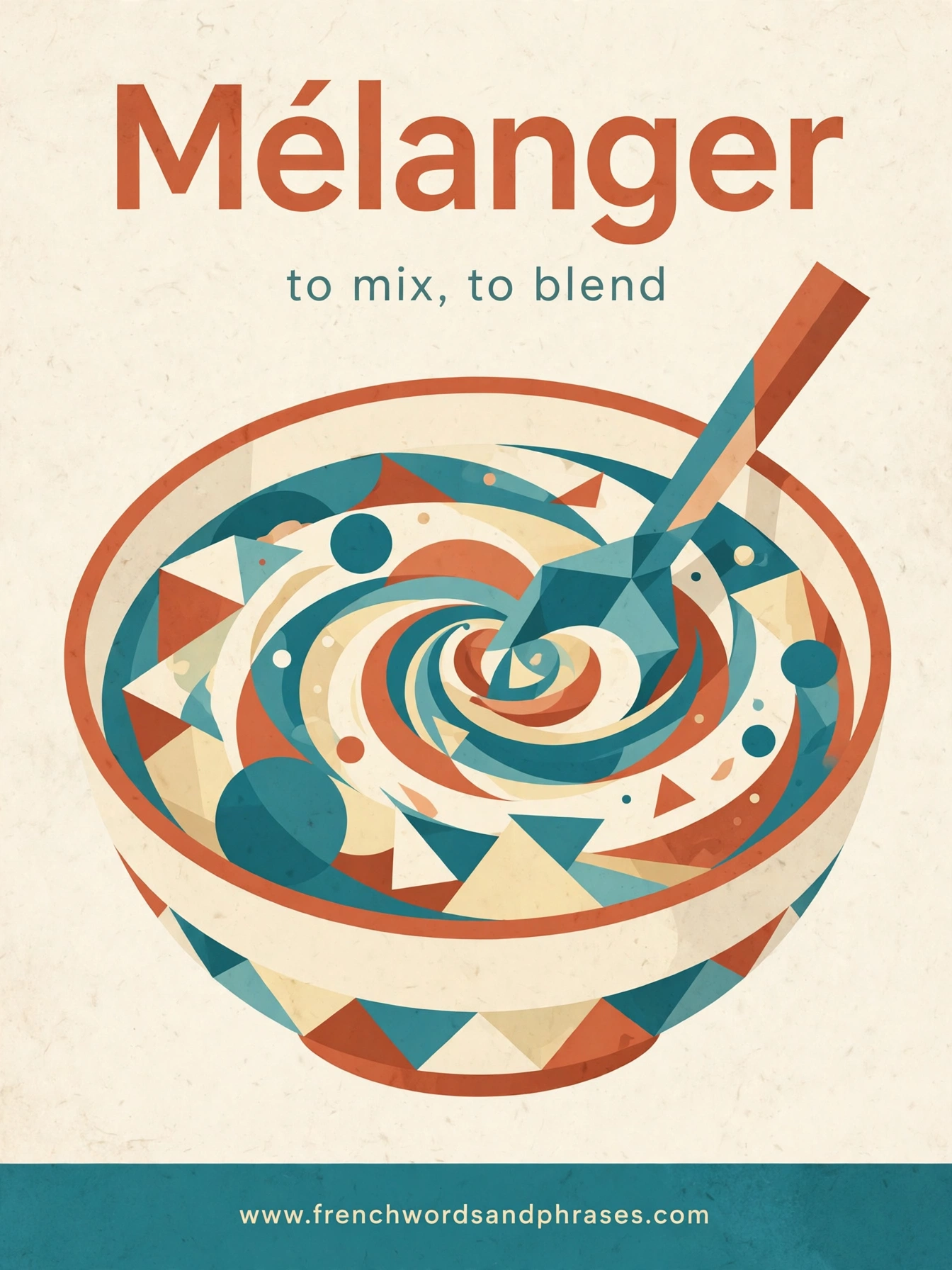
Mélanger means to mix or to blend.
Flour meeting sugar in a great bowl, spices folding into oil, colours swirling on a palette — mélanger is the verb of things becoming one thing, of separate ingredients agreeing to be a dish.
In this guide, you’ll learn how to conjugate mélanger in all the major French tenses and moods. Explore complete conjugation tables, French examples, English translations, and practice quizzes.
Understanding the French Verb Mélanger
Mélanger is a regular French verb belonging to the first group of verbs, those ending in -er.
It means to mix, to blend. It is commonly used for mixing dry ingredients, blending spices and sauces, tossing salads, shuffling cards before a game, and — as a gentle warning — for not mixing up two things: tu mélanges tout, you are getting everything mixed up.
Verb classification: First group (-er)
Auxiliary verb: Avoir
Past participle: mélangé
Present participle: mélangeant
English equivalents: To mix, to blend, to stir together; to shuffle (cards); (se) to mingle, to get mixed up.
One important detail: mélanger is a -ger verb — the g stays soft before a and o with an added e: nous mélangeons, je mélangeais — but before i, no e: nous mélangions, vous mélangiez. Beyond the bowl, it shuffles cards (mélanger les cartes), mixes up files, and in the reflexive it mingles: les parfums se mélangent, the scents blend together.
Experience the Word
Mélanger is the verb of the meeting point — the moment separate things stop being neighbours and become a mixture with a character of its own.
Imagine a market cook in Lyon with a bowl as big as a drum, folding a salade composée together with two wooden spoons, lifting and turning until every leaf has met the dressing. That lift-and-turn, patient and thorough, is mélanger at its best.
The ingredients are still themselves. But mixed, they have become something more.
How to Conjugate Mélanger: Complete French Conjugation Guide
Let’s explore every major conjugation of mélanger, beginning with the indicative mood.
How to Conjugate Mélanger in the Indicative Mood
The indicative mood is used to express facts, observations, actions, and events.
How to Conjugate Mélanger in the Present Tense (Présent)
Used for actions happening now, habitual actions, and general truths.
| Subject | Conjugation |
|---|---|
| je | mélange |
| tu | mélanges |
| il / elle | mélange |
| nous | mélangeons |
| vous | mélangez |
| ils / elles | mélangent |
Example
Elle mélange la farine et le sucre dans un grand bol.
She mixes the flour and sugar in a large bowl.
Quick Quiz 1
Complete the sentence:
Nous ______ la salade juste avant de servir.
Reveal the answer
mélangeons
Nous mélangeons la salade juste avant de servir.
We toss the salad just before serving. Note the soft-g e in mélangeons.
How to Conjugate Mélanger in the Passé Composé
Used for completed actions in the past. Mélanger takes the auxiliary verb avoir.
| Subject | Conjugation |
|---|---|
| j’ | ai mélangé |
| tu | as mélangé |
| il / elle | a mélangé |
| nous | avons mélangé |
| vous | avez mélangé |
| ils / elles | ont mélangé |
Example
Il a mélangé les épices avec l’huile d’olive.
He blended the spices with the olive oil.
How to Conjugate Mélanger in the Imparfait (Imperfect Tense)
Used for habitual past actions, descriptions, and ongoing situations in the past.
| Subject | Conjugation |
|---|---|
| je | mélangeais |
| tu | mélangeais |
| il / elle | mélangeait |
| nous | mélangions |
| vous | mélangiez |
| ils / elles | mélangeaient |
Example
Grand-père mélangeait les cartes avant chaque partie.
Grandfather used to shuffle the cards before every game.
Quick Quiz 2
Choose the correct form:
She tossed the salad.
Elle ______ la salade. (a mélangé / est mélangée)
Reveal the answer
a mélangé
Elle a mélangé la salade.
Mélanger takes avoir.
How to Conjugate Mélanger in the Plus-que-parfait
Used to describe an action that had already been completed before another past event.
| Subject | Conjugation |
|---|---|
| j’ | avais mélangé |
| tu | avais mélangé |
| il / elle | avait mélangé |
| nous | avions mélangé |
| vous | aviez mélangé |
| ils / elles | avaient mélangé |
Example
Nous avions mélangé la salade juste avant de servir.
We had tossed the salad just before serving.
How to Conjugate Mélanger in the Passé Simple
Primarily used in formal writing, literature, and historical narratives. It is rarely used in everyday conversation.
| Subject | Conjugation |
|---|---|
| je | mélangeai |
| tu | mélangeas |
| il / elle | mélangea |
| nous | mélangeâmes |
| vous | mélangeâtes |
| ils / elles | mélangeèrent |
Example
Le chef mélangea les ingrédients avec soin.
The chef mixed the ingredients carefully.
How to Conjugate Mélanger in the Passé Antérieur
A literary tense used to express an action completed immediately before another past action, generally in the passé simple.
| Subject | Conjugation |
|---|---|
| j’ | eus mélangé |
| tu | eus mélangé |
| il / elle | eut mélangé |
| nous | eûmes mélangé |
| vous | eûtes mélangé |
| ils / elles | eurent mélangé |
Example
Quand elle eut mélangé la pâte, elle la laissa reposer.
When she had mixed the dough, she let it rest.
How to Conjugate Mélanger in the Future Tense (Futur Simple)
Used to describe actions that will take place in the future.
| Subject | Conjugation |
|---|---|
| je | mélangerai |
| tu | mélangeras |
| il / elle | mélangera |
| nous | mélangerons |
| vous | mélangerez |
| ils / elles | mélangeront |
Example
Tu mélangeras les couleurs pour obtenir ce vert.
You will mix the colours to get that green.
How to Conjugate Mélanger in the Futur Antérieur (Future Perfect)
Used for an action that will have been completed before a particular point in the future.
| Subject | Conjugation |
|---|---|
| j’ | aurai mélangé |
| tu | auras mélangé |
| il / elle | aura mélangé |
| nous | aurons mélangé |
| vous | aurez mélangé |
| ils / elles | auront mélangé |
Example
À la fin du cours, les élèves auront mélangé toutes les teintes.
By the end of the class, the pupils will have mixed all the shades.
How to Conjugate Mélanger in the Near Future (Futur Proche)
Used to describe something that is going to happen soon. Formed with aller + infinitive.
| Subject | Conjugation |
|---|---|
| je | vais mélanger |
| tu | vas mélanger |
| il / elle | va mélanger |
| nous | allons mélanger |
| vous | allez mélanger |
| ils / elles | vont mélanger |
Example
Je vais mélanger la vinaigrette à la salade.
I am going to toss the salad with the dressing.
How to Conjugate Mélanger in the Conditional Mood
The conditional mood expresses what would happen under certain circumstances. It is also frequently used to make polite requests or express wishes.
How to Conjugate Mélanger in the Present Conditional
| Subject | Conjugation |
|---|---|
| je | mélangerais |
| tu | mélangerais |
| il / elle | mélangerait |
| nous | mélangerions |
| vous | mélangeriez |
| ils / elles | mélangeraient |
Example
Sans cuillère en bois, je mélangerais avec une fourchette.
Without a wooden spoon, I would mix with a fork.
How to Conjugate Mélanger in the Past Conditional
| Subject | Conjugation |
|---|---|
| j’ | aurais mélangé |
| tu | aurais mélangé |
| il / elle | aurait mélangé |
| nous | aurions mélangé |
| vous | auriez mélangé |
| ils / elles | auraient mélangé |
Example
Elle aurait mélangé les deux farines pour un pain plus léger.
She would have blended the two flours for a lighter loaf.
Mélanger in the Literary Past Conditional Form
This less common literary form uses the imperfect subjunctive of avoir.
| Subject | Conjugation |
|---|---|
| j’ | eusse mélangé |
| tu | eusses mélangé |
| il / elle | eût mélangé |
| nous | eussions mélangé |
| vous | eussiez mélangé |
| ils / elles | eussent mélangé |
Example
Il eût mélangé les genres avec bonheur.
He would have happily mixed genres.
How to Conjugate Mélanger in the Subjunctive Mood
The subjunctive is used to express wishes, emotions, doubts, necessity, and uncertainty. It frequently follows expressions such as il faut que (it is necessary that) or bien que (although).
How to Conjugate Mélanger in the Present Subjunctive
| Subject | Conjugation |
|---|---|
| que je | mélange |
| que tu | mélanges |
| qu’il / qu’elle | mélange |
| que nous | mélangions |
| que vous | mélangiez |
| qu’ils / qu’elles | mélangent |
Example
Il faut que tu mélanges bien avant d’ajouter les œufs.
You must mix well before adding the eggs.
Quick Quiz 3
Complete the sentence using the subjunctive:
Il faut que vous ______ les ingrédients.
Reveal the answer
mélangiez
Il faut que vous mélangiez les ingrédients.
You must mix the ingredients. No extra e before i in mélangiez.
How to Conjugate Mélanger in the Imperfect Subjunctive
A literary tense, rarely encountered in modern spoken French.
| Subject | Conjugation |
|---|---|
| que je | mélangasse |
| que tu | mélangasses |
| qu’il / qu’elle | mélangât |
| que nous | mélangassions |
| que vous | mélangassiez |
| qu’ils / qu’elles | mélangassent |
Example
Je voulais qu’il mélangeât la peinture plus lentement.
I wanted him to mix the paint more slowly.
How to Conjugate Mélanger in the Pluperfect Subjunctive
A literary construction used to express an action completed before another past action.
| Subject | Conjugation |
|---|---|
| que j’ | eusse mélangé |
| que tu | eusses mélangé |
| qu’il / qu’elle | eût mélangé |
| que nous | eussions mélangé |
| que vous | eussiez mélangé |
| qu’ils / qu’elles | eussent mélangé |
Example
Elle regrettait que nous eussions mélangé les dossiers.
She regretted that we had mixed up the files.
How to Conjugate Mélanger in the Past Subjunctive
| Subject | Conjugation |
|---|---|
| que j’ | aie mélangé |
| que tu | aies mélangé |
| qu’il / qu’elle | ait mélangé |
| que nous | ayons mélangé |
| que vous | ayez mélangé |
| qu’ils / qu’elles | aient mélangé |
Example
Je suis content que tu aies mélangé les épices toi-même.
I am glad you blended the spices yourself.
How to Conjugate Mélanger in the Imperative
The imperative is used to give commands, instructions, invitations, or suggestions. Subject pronouns are omitted.
How to Conjugate Mélanger in the Present Imperative
| Person | Conjugation |
|---|---|
| (tu) | mélange |
| (nous) | mélangeons |
| (vous) | mélangez |
Example
Mélange la pâte jusqu’à ce qu’elle soit lisse !
Mix the batter until it is smooth!
Quick Quiz 4
How would you say Mix the batter (tu form)?
Reveal the answer
Mélange la pâte !
French Participles of Mélanger
Participles are verb forms that can be used in compound tenses and other grammatical constructions.
Present Participle of Mélanger
mélangeant
En mélangeant les cartes, il racontait une histoire.
While shuffling the cards, he told a story.
Past Participle of Mélanger
mélangé
Mélangés aux légumes, les pois chiches faisaient un plat complet.
Mixed with the vegetables, the chickpeas made a complete dish.
Mélanger in Everyday French: Real-Life Examples
Now that you know the conjugations, let’s see how mélanger appears in everyday French.
Example 1 — Present
Je mélange les ingrédients secs d’abord.
I mix the dry ingredients first.
Example 2 — Passé composé
Elle a mélangé la salade au dernier moment.
She tossed the salad at the last moment.
Example 3 — Imparfait
On mélangeait les cartes et la partie commençait.
We used to shuffle the cards and the game would begin.
Example 4 — Future
Nous mélangerons les deux farines ce soir.
We will blend the two flours this evening.
Example 5 — Conditional
Je mélangerais les épices à la main.
I would blend the spices by hand.
Example 6 — Imperative
Mélangez bien avant de servir !
Mix well before serving!
Beyond Translation: The Meaning of Mélanger
English mix and blend divide the work by smoothness; French mélanger does both, and then wanders off to shuffle cards, mingle crowds and muddle files.
Its noun is a whole world.
Un mélange is any mixture at all — of spices, of feelings, of peoples — and French uses it with pride: le mélange des cultures, the mixing of cultures, is a richness, not a confusion.
How to Remember the French Verb Mélanger
Remember it this way: Mélanger is about mixing — flour and sugar, spices and cards.
- The -ger spelling keeps the g soft: nous mélangeons, je mélangeais — but nous mélangions without the e.
- Mélanger les cartes — to shuffle the cards: the same verb, at the card table.
- Regular -er: je mélange, nous mélangeons, past participle mélangé.
The key idea is mixing — flour and sugar, spices and cards.
Test Your Knowledge of Mélanger
Let’s see how much you’ve learned. Try answering these questions before revealing the answers.
Question 1
How do you write we mix with mélanger, keeping the g soft?
Reveal the answer
Nous mélangeons
— the extra e keeps the g soft before o.
Question 2
How do you say She mixes the flour and sugar in French?
Reveal the answer
Elle mélange la farine et le sucre.
Question 3
Translate: He blended the spices with the olive oil.
Reveal the answer
Il a mélangé les épices avec l’huile d’olive.
Question 4
What is the past participle of mélanger?
Reveal the answer
Mélangé.
Question 5
Complete the sentence:
Il faut que tu ______ bien avant d’ajouter les œufs.
Reveal the answer
mélanges
Il faut que tu mélanges bien avant d’ajouter les œufs.
You must mix well before adding the eggs.
Your Final Challenge
Can You Use It?
How would you say this in French?
Blend the spices slowly, the dish will keep all their fragrances.
Reveal the answer
Mélange les épices lentement, le plat gardera tous leurs parfums.
Blend the spices slowly, the dish will keep all their fragrances.
A little French. A little curiosity. A richer everyday life.
LEARN FRENCH ONE WORD AT A TIME