A French Word to Live By
Translate Bonheur to English
/bɔ.nœʁ/
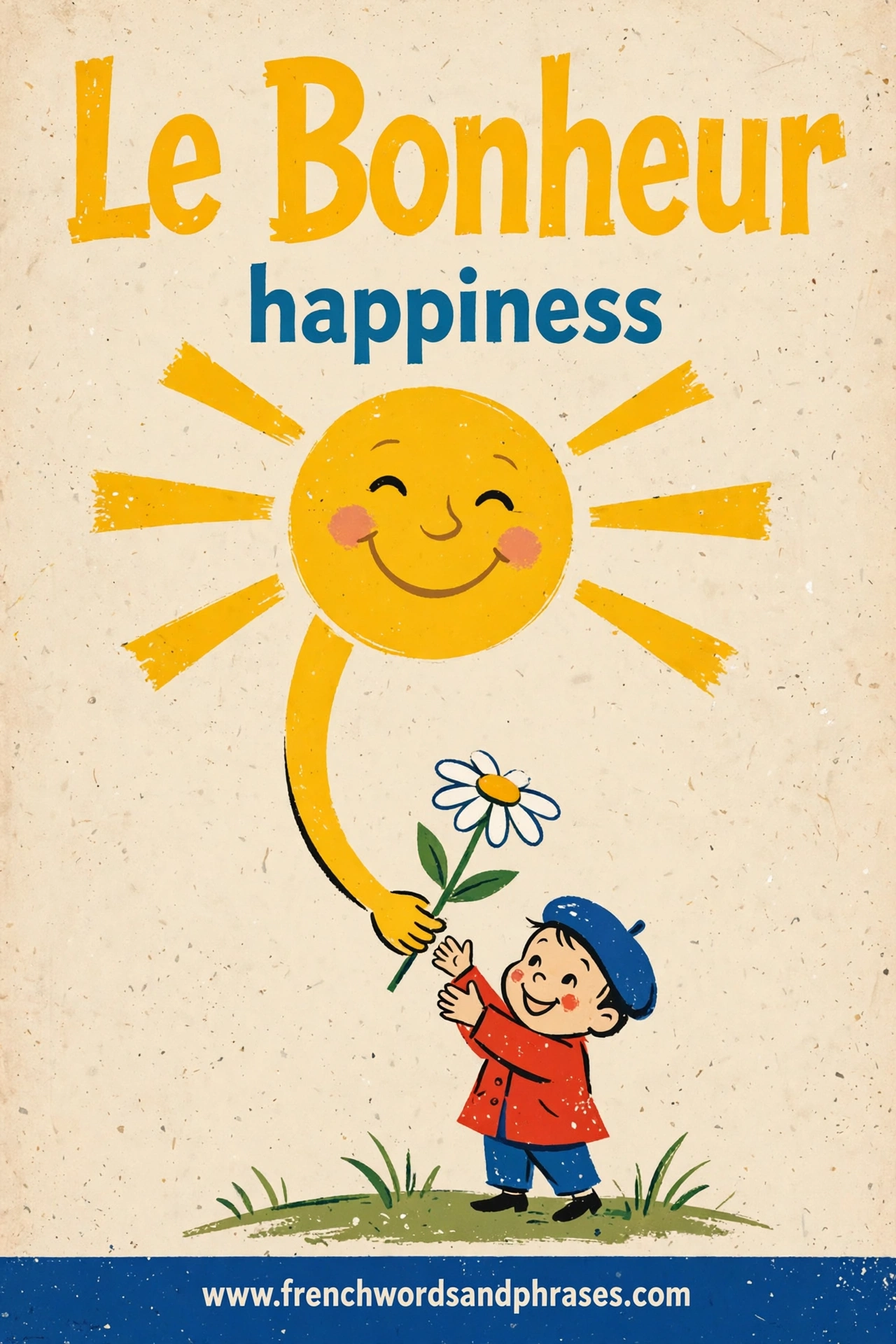
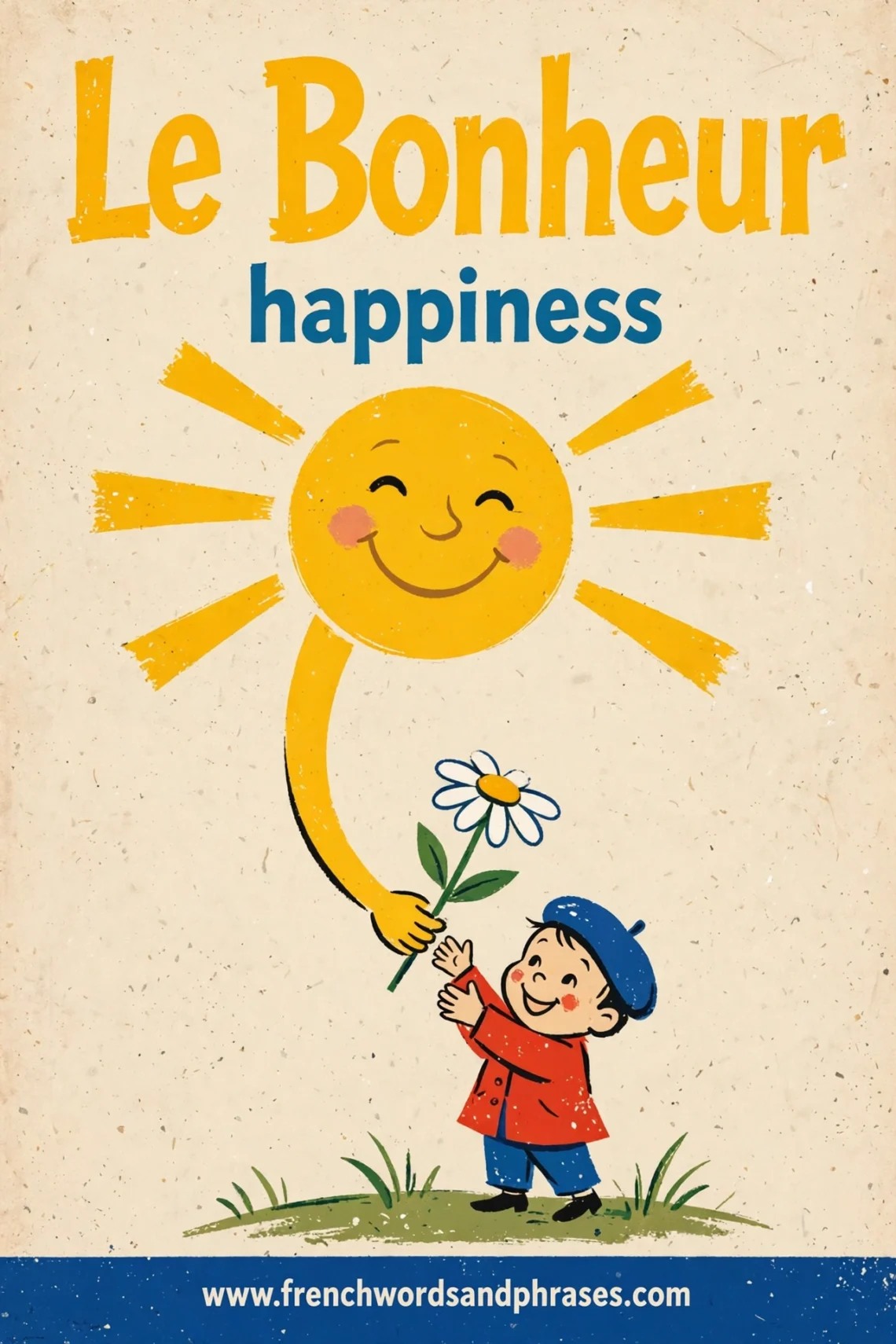
Le bonheur means happiness.
A small house at the edge of a village, a garden full of tomatoes, and an old man who whistles while he waters them. Ask him his secret and he shrugs, smiling: there is no secret. This, all of this, is simply le bonheur.
In this guide, you’ll learn what bonheur means in English, how to use it with its articles, how to form its plural, and how it appears in everyday French. Explore French examples, English translations, and practice quizzes.
Understanding the French Noun Bonheur
Bonheur is a masculine French noun. It is learned together with its article: le bonheur, un bonheur. Built from bon (good) and the old word heur (luck, fortune), it means happiness — but luck still lives inside it, which is why bonheur can also bring fortune: porter bonheur, to bring luck.
It means happiness — deep, settled happiness, more durable than a moment of joy: le bonheur en famille, chercher le bonheur, to look for happiness. Counted, it becomes a delight: c’est un bonheur de vous voir, it is a joy to see you. And in its luck sense, it gives French its lucky charms: un porte-bonheur.
Gender: Masculine
Definite article: le — le bonheur (happiness)
Indefinite article: un — un bonheur (a joy, a delight)
Plural: les bonheurs — rare and literary
English equivalents: Happiness; a joy, a delight; luck in set phrases like porter bonheur.
One important usage detail: bonheur works both as a mass and as a delight. Le bonheur is happiness itself, uncountable. But un bonheur names one concrete joy — quel bonheur de te revoir !, what a joy to see you again! The same word holds the philosophy and the exclamation.
Experience the Word
Bonheur is more than a good mood. It is the state whole lives are organised around — the garden, the family table, the work you would not trade — happiness not as a spark but as a climate.
Imagine the wedding toast in a village hall: glasses raised, an uncle searching for words, and finally saying only this — je vous souhaite tout le bonheur du monde, I wish you all the happiness in the world. Nobody needs more.
You have not just felt glad. You have touched le bonheur — the good life, recognised while you are living it.
How to Use Bonheur in French: Complete Guide
Let’s explore how bonheur works in French, beginning with its articles.
Bonheur with the Definite Article (Le, Les)
Used for happiness itself — the great subject of philosophers and wedding speeches.
| Number | French |
|---|---|
| Singular | le bonheur |
| Plural | les bonheurs (rare, literary) |
Example
Le bonheur ne s’achète pas.
Happiness cannot be bought.
Bonheur with the Indefinite Article (Un, Des)
Used when happiness becomes one concrete delight — a moment, a reunion, a piece of news.
| Number | French |
|---|---|
| Singular | un bonheur |
| Plural | des bonheurs |
Example
C’est un bonheur de travailler avec elle.
It is a joy to work with her.
Shades of Bonheur
Joy, pleasure and bliss — bonheur is the deepest word of a happy family.
| French | In English |
|---|---|
| la joie | joy |
| le plaisir | pleasure |
| la chance | luck |
| le contentement | contentment |
| la félicité | bliss (literary) |
| le bien-être | well-being |
Example
La joie des enfants remplit toute la maison.
The children’s joy fills the whole house.
Quick Quiz 1
What is the difference between le bonheur and la joie?
Reveal the answer
Le bonheur lasts; la joie flashes — bonheur is settled happiness, joie is a burst of joy.
Sa joie était immense, et son bonheur a duré toute sa vie.
Her joy was immense, and her happiness lasted her whole life.
The Plural of Bonheur
Bonheur adds an -s in the plural, but the plural is rare — happiness usually comes as one great whole.
| Number | French |
|---|---|
| Singular | le bonheur |
| Plural | les bonheurs (literary) |
Example
Les petits bonheurs du quotidien comptent autant que les grands.
The small everyday happinesses count as much as the great ones.
Bonheur with Possessive Adjectives (Mon, Ton, Son…)
Possessives agree with the noun, not with the owner — and bonheur is masculine, so it takes mon, ton, son.
| Owner | French |
|---|---|
| my | mon bonheur |
| your (tu) | ton bonheur |
| his / her | son bonheur |
| our | notre bonheur |
| your (vous) | votre bonheur |
| their | leur bonheur |
Example
Mon bonheur, c’est ma famille et mon jardin.
My happiness is my family and my garden.
Quick Quiz 2
Complete the sentence:
______ bonheur à elle, ce sont ses petits-enfants. (Her)
Reveal the answer
Son
Son bonheur à elle, ce sont ses petits-enfants.
Her happiness is her grandchildren — son, because bonheur is masculine, whoever owns it.
Bonheur with Demonstrative Adjectives (Ce, Ces)
Used to point: this happiness here — the one in this room, on this day.
| Number | French |
|---|---|
| Singular | ce bonheur |
| Plural | ces bonheurs |
Example
Ce bonheur simple vaut tous les trésors.
This simple happiness is worth all the treasures in the world.
Bonheur with Adjectives
Adjectives agree with bonheur, masculine — simple, vrai, immense.
| Adjective | With Bonheur |
|---|---|
| simple (simple) | un bonheur simple |
| vrai (true) | le vrai bonheur |
| immense (immense) | un bonheur immense |
| parfait (perfect) | un bonheur parfait |
| durable (lasting) | un bonheur durable |
Example
Un bonheur simple vaut mieux qu’une fortune compliquée.
A simple happiness is worth more than a complicated fortune.
Quick Quiz 3
Complete the sentence:
Quel ______ de te revoir enfin ! (happiness / what a joy)
Reveal the answer
bonheur
Quel bonheur de te revoir enfin !
What a joy to see you again at last!
Everyday Expressions with Bonheur
Lucky charms and wedding wishes — the bonheur phrases of daily life.
| Expression | In English |
|---|---|
| porter bonheur | to bring luck |
| un porte-bonheur | a lucky charm |
| au petit bonheur | haphazardly, trusting to luck |
| faire le bonheur de quelqu’un | to make someone happy |
| c’est un bonheur de… | it is a joy to… |
| tout le bonheur du monde | all the happiness in the world |
Example
Ce trèfle à quatre feuilles va te porter bonheur.
This four-leaf clover will bring you luck.
Words from the Same Family as Bonheur
Happiness and its shadow — the words that travel with bonheur.
| French | In English |
|---|---|
| heureux | happy |
| le malheur | misfortune, unhappiness |
| heureusement | fortunately, happily |
| un porte-bonheur | a lucky charm |
| la chance | luck |
| joyeux | joyful, merry |
Example
Heureusement, le malheur n’a pas duré.
Fortunately, the misfortune did not last.
Quick Quiz 4
A friend gives you a little horseshoe « pour te porter bonheur ». What is it for?
Reveal the answer
To bring you luck — porter bonheur means to bring luck, and the horseshoe is un porte-bonheur, a lucky charm.
Garde ce fer à cheval, il va te porter bonheur.
Keep this horseshoe, it will bring you luck.
Bonheur in Everyday French: Real-Life Examples
Now that you know the word, let’s see how bonheur appears in everyday French.
Example 1 — A wedding toast
Je vous souhaite tout le bonheur du monde.
I wish you all the happiness in the world.
Example 2 — A lucky charm
Elle porte toujours son porte-bonheur en argent.
She always wears her silver lucky charm.
Example 3 — A reunion
Quel bonheur de vous revoir après tant d’années !
What a joy to see you again after so many years!
Example 4 — In the garden
Son bonheur, c’est son potager au printemps.
His happiness is his vegetable garden in spring.
Example 5 — A child’s laugh
Le bonheur des enfants est contagieux.
Children’s happiness is contagious.
Example 6 — A quiet philosophy
Le vrai bonheur est dans les choses simples.
True happiness is in simple things.
Beyond Translation: The Meaning of Bonheur
Bonheur is the French pursuit of happiness — with luck baked into the word itself, since heur, its second half, once meant fortune. Where English separates happiness from luck, French keeps them married: the same word wishes a couple a lifetime of joy and blesses the charm in a bride’s pocket.
To say bonheur is to wish someone the good life — and a little fortune with it.
It evokes wedding toasts and four-leaf clovers, the film title Le bonheur est dans le pré, and a national conviction that happiness is not a luxury but a craft, practised daily, in gardens and at long tables.
How to Remember the French Noun Bonheur
Remember it this way: Bonheur is happiness — masculine, deeper than a moment’s joy, with luck still living inside it.
- You wish it — tout le bonheur du monde, all the happiness in the world.
- You carry it — un porte-bonheur, a lucky charm ; porter bonheur, to bring luck.
- You keep it simple — le vrai bonheur est dans les choses simples.
The key idea is le bonheur lasts — la joie flashes.
Test Your Knowledge of Bonheur
Let’s see how much you’ve learned. Try answering these questions before revealing the answers.
Question 1
Is bonheur masculine or feminine?
Reveal the answer
Masculine — le bonheur, un bonheur.
Question 2
What does porter bonheur mean?
Reveal the answer
To bring luck — the luck hidden inside the word for happiness.
Question 3
Translate: True happiness is in the simple things.
Reveal the answer
Le vrai bonheur est dans les choses simples.
Question 4
What is un porte-bonheur?
Reveal the answer
A lucky charm — a small object carried to bring luck.
Question 5
Complete the sentence:
Je te souhaite tout ______ bonheur du monde. (the)
Reveal the answer
le
Je te souhaite tout le bonheur du monde.
I wish you all the happiness in the world.
Your Final Challenge
Can You Use It?
How would you say this in French?
“True happiness is in the simple things.”
Reveal the answer
Le vrai bonheur est dans les choses simples.
True happiness is in the simple things.
A little French. A little curiosity. A richer everyday life.
LEARN FRENCH ONE WORD AT A TIME