A French Word to Live By
Translate Sagesse to English
/sa.ʒɛs/
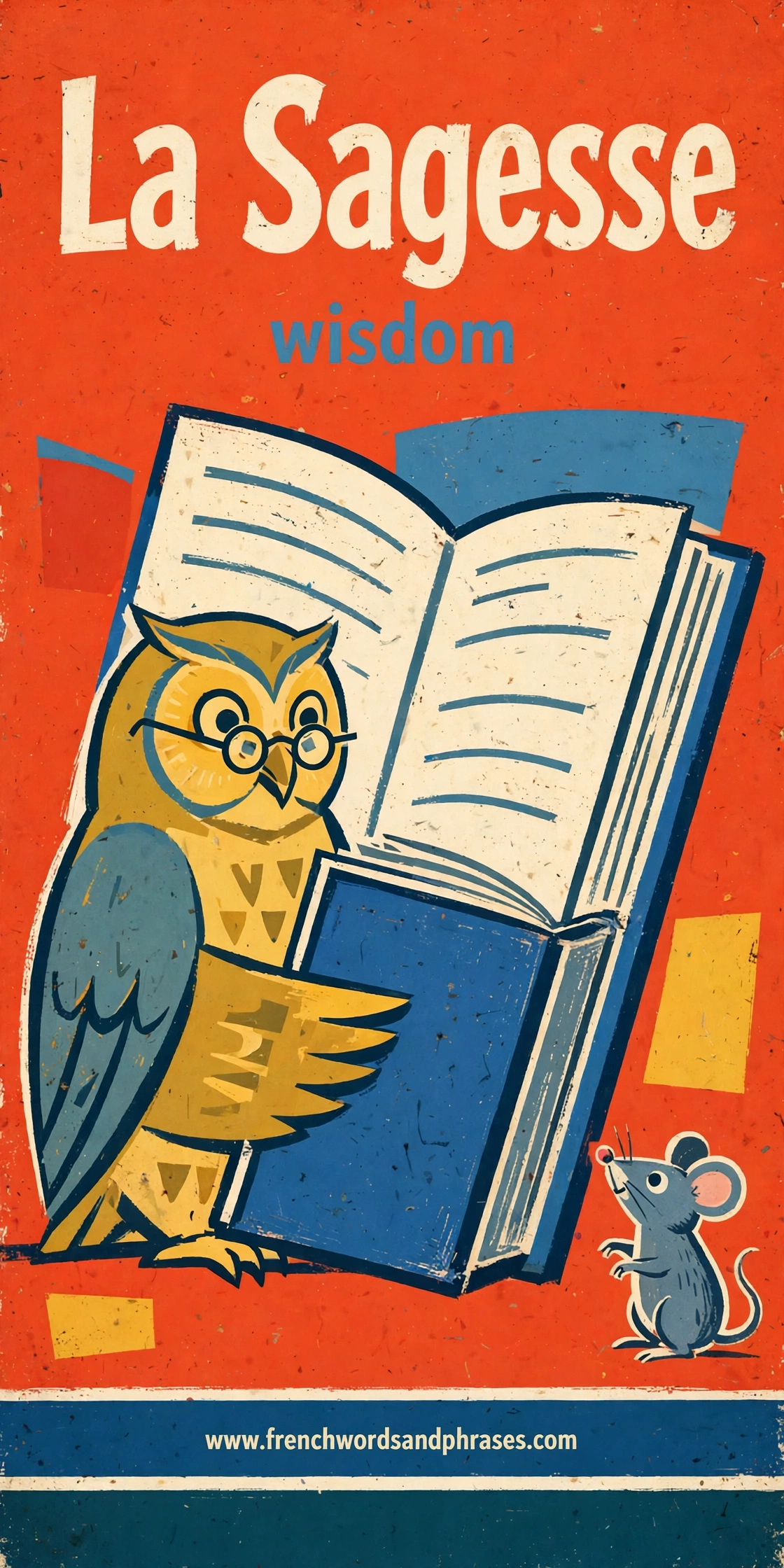
La sagesse means wisdom.
The grandmother tastes the soup, adds one pinch of salt — no more — and nods. Seventy years of kitchens live in that gesture. Nobody taught her from a book; this is la sagesse, wisdom earned one day at a time.
In this guide, you’ll learn what sagesse means in English, how to use it with its articles, how to form its plural, and how it appears in everyday French. Explore French examples, English translations, and practice quizzes.
Understanding the French Noun Sagesse
Sagesse is a feminine French noun. It is learned together with its article: la sagesse, une sagesse. It is the noun of the adjective sage, wise — and, in the mouths of parents everywhere, sage also describes a child who behaves: the same word covers the philosopher and the well-behaved toddler.
It means wisdom — the deep good sense that comes from experience: la sagesse populaire, folk wisdom; des paroles de sagesse, words of wisdom. In family life it also means good behaviour: la sagesse d’un enfant is a child’s quiet good conduct, and a parent asks, tu seras sage ? — will you be good? And it hides in the mouth itself: les dents de sagesse are wisdom teeth.
Gender: Feminine
Definite article: la — la sagesse (wisdom)
Indefinite article: une — une sagesse (a wisdom)
Plural: les sagesses
English equivalents: Wisdom; also good behaviour (of a child). Sage = wise, well-behaved.
One important usage detail: the adjective sage does double duty. Said of an elder or a decision, it means wise. Said of a child — sois sage ! — it means be good, behave yourself. Context decides, and French children hear the second meaning long before they meet the first.
Experience the Word
Sagesse is more than intelligence. French distinguishes the clever from the wise: intelligence solves the problem, sagesse knows whether the problem deserved solving. It is knowledge that has survived experience.
Imagine the old fisherman watching the clouds while the young sailors argue about the weather. He says nothing, then quietly brings his boat in an hour before the storm. Nobody applauds. That silence, timed exactly right, is sagesse at work.
You have not just learned something. You have gained la sagesse — knowledge ripened into judgement.
How to Use Sagesse in French: Complete Guide
Let’s explore how sagesse works in French, beginning with its articles.
Sagesse with the Definite Article (La, Les)
Used for wisdom itself — the quality everyone praises and few claim to have.
| Number | French |
|---|---|
| Singular | la sagesse |
| Plural | les sagesses |
Example
La sagesse vient avec l’âge, dit-on.
Wisdom comes with age, they say.
Sagesse with the Indefinite Article (Une, Des)
Used for one tradition of wisdom among others — the wisdom of a people, a grandmother, a village.
| Number | French |
|---|---|
| Singular | une sagesse |
| Plural | des sagesses |
Example
Il y a une sagesse ancienne dans ces proverbes.
There is an ancient wisdom in these proverbs.
Sagesse: Wisdom and Good Behaviour
The philosopher’s wisdom on one side, the well-behaved child on the other — and the teeth in between.
| French | In English |
|---|---|
| la sagesse populaire | folk wisdom |
| des paroles de sagesse | words of wisdom |
| la sagesse d’un enfant | a child’s good behaviour |
| les dents de sagesse | wisdom teeth |
| avec sagesse | wisely |
| la sagesse des anciens | the wisdom of the elders |
Example
On lui retire les dents de sagesse vendredi.
He is having his wisdom teeth out on Friday.
Quick Quiz 1
A mother says to her son: « Sois sage ! » Is she asking him to be wise?
Reveal the answer
Not exactly — for a child, sage means good, well-behaved: she is asking him to behave.
Sois sage et écoute ta sœur.
Be good and listen to your sister.
The Plural of Sagesse
Sagesse adds an -s in the plural — les sagesses, the wisdoms of different peoples and ages.
| Number | French |
|---|---|
| Singular | la sagesse |
| Plural | les sagesses |
Example
Les sagesses du monde entier se rejoignent souvent.
The wisdoms of the whole world often agree.
Sagesse with Possessive Adjectives (Ma, Ta, Sa…)
Possessives agree with the noun, not with the owner — and sagesse is feminine, so it takes ma, ta, sa.
| Owner | French |
|---|---|
| my | ma sagesse |
| your (tu) | ta sagesse |
| his / her | sa sagesse |
| our | notre sagesse |
| your (vous) | votre sagesse |
| their | leur sagesse |
Example
Sa sagesse impressionne toute la famille.
His wisdom impresses the whole family.
Quick Quiz 2
Complete the sentence:
______ sagesse de cette décision est évidente. (The)
Reveal the answer
La
La sagesse de cette décision est évidente.
The wisdom of this decision is obvious.
Sagesse with Demonstrative Adjectives (Cette, Ces)
Used to point: this wisdom here, those traditions of wisdom there.
| Number | French |
|---|---|
| Singular | cette sagesse |
| Plural | ces sagesses |
Example
Cette sagesse tranquille vient de sa grand-mère.
This quiet wisdom comes from her grandmother.
Sagesse with Adjectives
Adjectives agree with sagesse, feminine — populaire, grande, ancienne.
| Adjective | With Sagesse |
|---|---|
| populaire (folk) | la sagesse populaire |
| grande (great) | une grande sagesse |
| ancienne (ancient) | une sagesse ancienne |
| profonde (deep) | une sagesse profonde |
| traditionnelle (traditional) | la sagesse traditionnelle |
Example
Elle parle avec une grande sagesse.
She speaks with great wisdom.
Quick Quiz 3
Complete the sentence:
Les ______ de sagesse arrivent vers vingt ans. (teeth)
Reveal the answer
dents
Les dents de sagesse arrivent vers vingt ans.
Wisdom teeth arrive around the age of twenty.
Everyday Expressions with Sagesse
Proverbs, grandparents and dentists — the sagesse phrases of daily life.
| Expression | In English |
|---|---|
| la sagesse populaire | folk wisdom |
| des paroles de sagesse | words of wisdom |
| les dents de sagesse | wisdom teeth |
| agir avec sagesse | to act wisely |
| un conseil de sagesse | a piece of wise advice |
| être d’une grande sagesse | to be very wise |
Example
Écoute les conseils de sagesse de ton grand-père.
Listen to your grandfather’s wise advice.
Words from the Same Family as Sagesse
Wise people, quiet children and good judgement — the words that travel with sagesse.
| French | In English |
|---|---|
| sage | wise; well-behaved |
| un sage | a wise man, a sage |
| sagement | wisely, sensibly |
| la prudence | caution, prudence |
| le bon sens | common sense |
| l’expérience | experience |
Example
Le vieux sage du village écoute avant de parler.
The old sage of the village listens before speaking.
Quick Quiz 4
What two English words do you need for the French word sage?
Reveal the answer
Wise and well-behaved — sage describes the wise elder and the good child alike.
Un enfant sage écoute les paroles de sagesse.
A well-behaved child listens to words of wisdom.
Sagesse in Everyday French: Real-Life Examples
Now that you know the word, let’s see how sagesse appears in everyday French.
Example 1 — At the dentist’s
On doit lui enlever deux dents de sagesse.
He needs two wisdom teeth taken out.
Example 2 — Praising a grandmother
Sa sagesse calme toute la famille.
Her wisdom calms the whole family.
Example 3 — To a child
Sois sage pendant que je téléphone.
Be good while I am on the phone.
Example 4 — Folk wisdom
La sagesse populaire dit : lentement mais sûrement.
Folk wisdom says: slow but sure.
Example 5 — A wise decision
Il a accepté avec sagesse la décision du médecin.
He wisely accepted the doctor’s decision.
Example 6 — Words of wisdom
Ses paroles de sagesse ont marqué les étudiants.
His words of wisdom left a mark on the students.
Beyond Translation: The Meaning of Sagesse
Sagesse is the word French uses for what remains when cleverness has finished showing off. It lives in proverbs repeated at kitchen tables, in the silence of people who have seen enough to wait, and — with a smile — in the surgery of the dentist, where the dents de sagesse arrive just as a young adult is supposed to become wise.
To say sagesse is to honour knowledge that experience has ripened.
It evokes the grandmother’s pinch of salt, the fisherman’s early return, and the child sitting still, being sage, earning the word in its smallest form.
How to Remember the French Noun Sagesse
Remember it this way: Sagesse is wisdom — feminine, the ripened form of knowledge, and the word parents use for a child who behaves.
- You honour it — la sagesse vient avec l’âge et l’expérience.
- You ask for it — sois sage ! sois gentil, comporte-toi bien.
- You feel it in the jaw — les dents de sagesse, vers vingt ans.
The key idea is la sagesse is wisdom — sage is wise for elders, good for children.
Test Your Knowledge of Sagesse
Let’s see how much you’ve learned. Try answering these questions before revealing the answers.
Question 1
Is sagesse masculine or feminine?
Reveal the answer
Feminine — la sagesse, une sagesse.
Question 2
What are les dents de sagesse?
Reveal the answer
Wisdom teeth — the last teeth, arriving around the age of twenty.
Question 3
Translate: Be good and sit down.
Reveal the answer
Sois sage et assieds-toi.
Question 4
What does la sagesse populaire mean?
Reveal the answer
Folk wisdom — the good sense stored in a people’s proverbs.
Question 5
Complete the sentence:
Elle a répondu avec ______. (wisdom)
Reveal the answer
sagesse
Elle a répondu avec sagesse.
She answered with wisdom.
Your Final Challenge
Can You Use It?
How would you say this in French?
“Wisdom comes with age and experience.”
Reveal the answer
La sagesse vient avec l’âge et l’expérience.
Wisdom comes with age and experience.
A little French. A little curiosity. A richer everyday life.
LEARN FRENCH ONE WORD AT A TIME