A French Word to Live By
Translate Monnaie to English
/mɔ.nɛ/
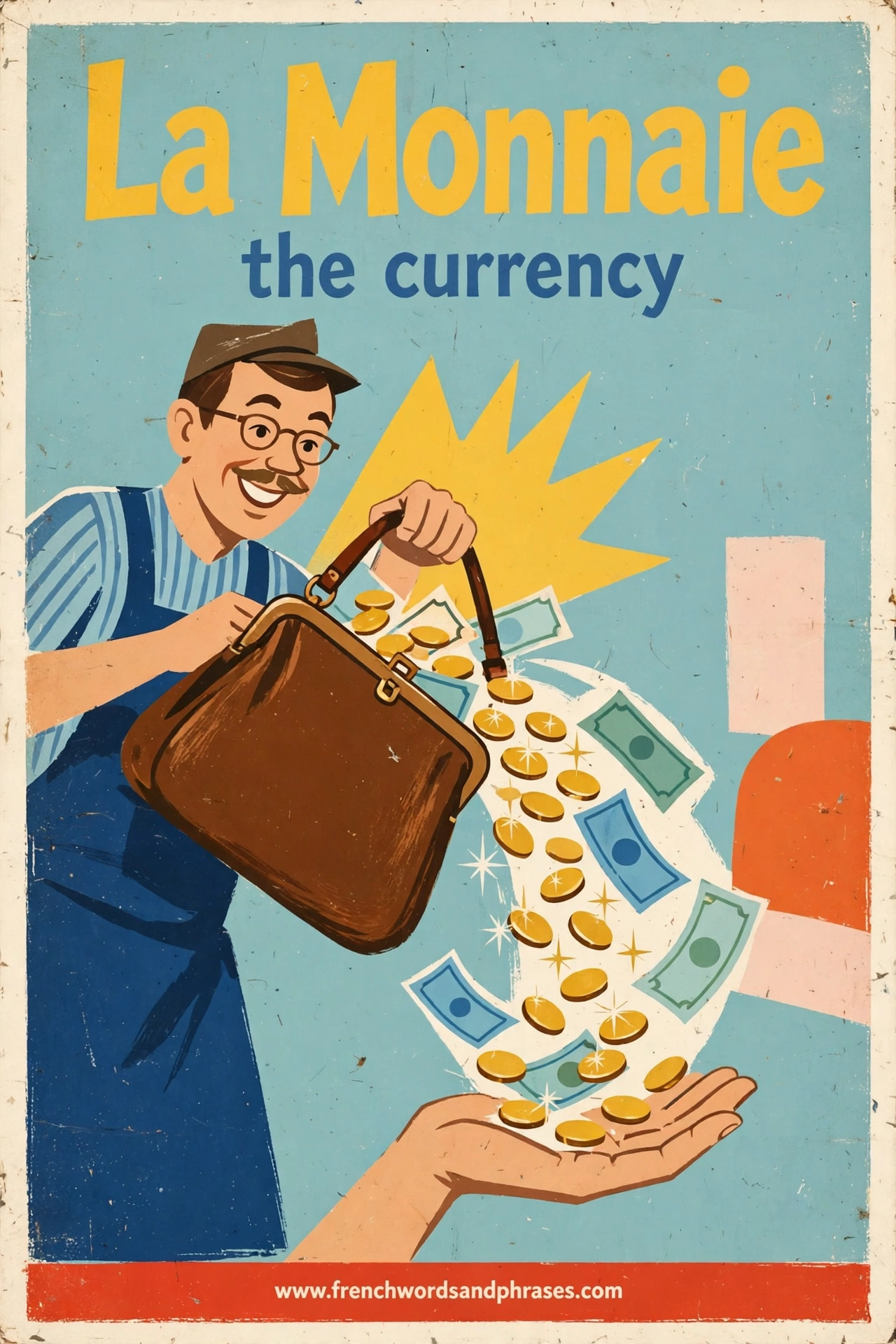
La monnaie means currency.
A café terrace in Paris: the waiter brings the bill, your friend pulls out a five-euro note and asks the question every traveller in France learns by heart — « Vous avez de la monnaie ? » Do you have any change? Behind that little question stands a big word: la monnaie.
In this guide, you’ll learn what monnaie means in English, how to use it with its articles, how to form its plural, and how it appears in everyday French. Explore French examples, English translations, and practice quizzes.
Understanding the French Noun Monnaie
Monnaie is a feminine French noun. It is learned together with its article: la monnaie, une monnaie. It is the word for the money a country uses — its currency — and, in everyday speech, for the coins jingling in your pocket: the change.
It means currency — the official money of a country: la monnaie de la France, c’est l’euro, the currency of France is the euro. But monnaie does a second, very French job: it is also the small change you ask for at the baker’s, la petite monnaie, the coins. Money in general — wealth, cash, what you earn — is a different word: l’argent.
Gender: Feminine
Definite article: la — la monnaie (the currency)
Indefinite article: une — une monnaie (a currency)
Plural: les monnaies
English equivalents: Currency; also small change, coins.
One important usage detail: keep monnaie and argent apart. L’argent is money in general — what you earn, save and spend. La monnaie is a country’s currency, or the coins in your hand. So you earn de l’argent, you pay with la monnaie du pays, and at the café you ask: « Vous avez de la monnaie ? » — have you got any change?
Experience the Word
Monnaie is more than coins. It is the money that carries a country’s name — printed, minted and recognised from one border to the other.
Imagine the moment the euro arrived: old francs handed in at the bank, new coins warm from the mint, a whole country learning new prices overnight. A monnaie is a promise everyone agrees to trust.
You have not just named some coins. You have named the money of a nation — la monnaie.
How to Use Monnaie in French: Complete Guide
Let’s explore how monnaie works in French, beginning with its articles.
Monnaie with the Definite Article (La, Les)
Used for the currency everyone in the conversation knows — the money of this country.
| Number | French |
|---|---|
| Singular | la monnaie |
| Plural | les monnaies |
Example
La monnaie de la France, c’est l’euro.
The currency of France is the euro.
Monnaie with the Indefinite Article (Une, Des)
Used for a currency in general — one money among the many moneys of the world.
| Number | French |
|---|---|
| Singular | une monnaie |
| Plural | des monnaies |
Example
Le dollar est une monnaie très utilisée dans le monde.
The dollar is a currency used all over the world.
Monnaie at the Café: Coins and Change
The second life of the word — the small money of everyday errands.
| French | In English |
|---|---|
| la petite monnaie | small change |
| une pièce de monnaie | a coin |
| avoir de la monnaie | to have some change |
| rendre la monnaie | to give change |
| un porte-monnaie | a purse, a wallet for coins |
| payer en monnaie | to pay in coins |
Example
Je n’ai pas de monnaie pour le parcmètre.
I have no change for the parking meter.
Quick Quiz 1
At the baker’s, you hand over a ten-euro note and the baker asks: « Vous avez de la monnaie ? » What is she asking for?
Reveal the answer
Change — small coins. In everyday speech, la monnaie is the coins in your pocket.
Non, je n’ai que des billets.
No, I only have notes.
The Plural of Monnaie
Monnaie adds an -s in the plural — les monnaies, the currencies of different countries.
| Number | French |
|---|---|
| Singular | la monnaie |
| Plural | les monnaies |
Example
L’euro et le dollar sont des monnaies fortes.
The euro and the dollar are strong currencies.
Monnaie with Possessive Adjectives (Ma, Ta, Sa…)
Possessives agree with the noun, not with the owner — and monnaie is feminine, so it takes ma, ta, sa.
| Owner | French |
|---|---|
| my | ma monnaie |
| your (tu) | ta monnaie |
| his / her | sa monnaie |
| our | notre monnaie |
| your (vous) | votre monnaie |
| their | leur monnaie |
Example
Chaque pays protège sa monnaie.
Every country protects its currency.
Quick Quiz 2
Complete the sentence:
La Suisse a ______ propre monnaie, le franc suisse. (its)
Reveal the answer
sa
La Suisse a sa propre monnaie, le franc suisse.
Switzerland has its own currency, the Swiss franc.
Monnaie with Demonstrative Adjectives (Cette, Ces)
Used to point: this currency here, those currencies there.
| Number | French |
|---|---|
| Singular | cette monnaie |
| Plural | ces monnaies |
Example
Cette monnaie existe depuis plus de vingt ans.
This currency has existed for more than twenty years.
Monnaie with Adjectives
Adjectives agree with monnaie, feminine — forte, unique, étrangère.
| Adjective | With Monnaie |
|---|---|
| unique (single) | la monnaie unique |
| forte (strong) | une monnaie forte |
| faible (weak) | une monnaie faible |
| étrangère (foreign) | une monnaie étrangère |
| stable (stable) | une monnaie stable |
Example
L’euro est la monnaie unique de vingt pays.
The euro is the single currency of twenty countries.
Quick Quiz 3
What is la monnaie unique?
Reveal the answer
The single currency — one money shared by several countries, like the euro.
La monnaie unique a remplacé le franc en 2002.
The single currency replaced the franc in 2002.
Everyday Expressions with Monnaie
At the bank and at the bakery — the monnaie phrases of the week.
| Expression | In English |
|---|---|
| changer de la monnaie | to change money |
| la monnaie électronique | electronic money |
| une fausse monnaie | counterfeit money |
| le cours d’une monnaie | the exchange rate of a currency |
| payer en petites monnaies | to pay in small coins |
| la Monnaie de Paris | the Paris Mint |
Example
Avant le voyage, je vais changer de la monnaie à la banque.
Before the trip, I am going to change some money at the bank.
Words from the Same Family as Monnaie
Coins, banks and money in general — the words that travel with monnaie.
| French | In English |
|---|---|
| l’argent | money (in general) |
| la devise | a foreign currency (on the markets) |
| un billet | a banknote |
| une pièce | a coin |
| monétaire | monetary |
| le porte-monnaie | the purse, the coin wallet |
Example
Il garde ses pièces dans un petit porte-monnaie.
He keeps his coins in a small purse.
Quick Quiz 4
Your friend says: « J’ai gagné beaucoup de monnaie ce mois-ci. » What is the trap?
Reveal the answer
Money you earn is l’argent, not la monnaie — monnaie is a currency, or coins for change.
J’ai gagné beaucoup d’argent ce mois-ci.
I earned a lot of money this month.
Monnaie in Everyday French: Real-Life Examples
Now that you know the word, let’s see how monnaie appears in everyday French.
Example 1 — At the baker’s
Vous avez de la monnaie pour un billet de vingt ?
Do you have change for a twenty note?
Example 2 — Before a trip
Quelle est la monnaie du Japon ?
What is the currency of Japan?
Example 3 — At the bank
Je voudrais changer des euros en monnaie suisse.
I would like to change euros into Swiss currency.
Example 4 — In the car
Il me faut de la monnaie pour le péage.
I need some change for the toll.
Example 5 — In the news
La monnaie européenne est stable cette semaine.
The European currency is stable this week.
Example 6 — At the market
Le marchand me rend la monnaie avec un sourire.
The stallholder gives me my change with a smile.
Beyond Translation: The Meaning of Monnaie
Monnaie carries France’s history in its pocket: the word once named the Paris Mint itself — la Monnaie — the royal workshop where coins were struck, and the institution still exists today as la Monnaie de Paris. When the euro replaced the franc in 2002, France changed its monnaie for the first time in two centuries.
To say monnaie is to hold a country’s promise in your hand.
It evokes the coins warmed in a palm at the market, the banknotes counted at the bureau de change, and that small daily question — vous avez de la monnaie ? — that every visitor to France learns before almost any other.
How to Remember the French Noun Monnaie
Remember it this way: Monnaie is the currency — feminine, the money of a country, and in the street, the coins you call change.
- You name the country’s money — la monnaie de la France, c’est l’euro.
- You ask at the café — vous avez de la monnaie ? — for coins.
- You dodge the trap — money you earn is l’argent, jamais la monnaie.
The key idea is la monnaie is the currency — l’argent is money.
Test Your Knowledge of Monnaie
Let’s see how much you’ve learned. Try answering these questions before revealing the answers.
Question 1
Is monnaie masculine or feminine?
Reveal the answer
Feminine — la monnaie, une monnaie.
Question 2
How do you say small change in French?
Reveal the answer
La petite monnaie — the coins in your pocket.
Question 3
Translate: The currency of Japan is the yen.
Reveal the answer
La monnaie du Japon, c’est le yen.
Question 4
What is un porte-monnaie?
Reveal the answer
A purse, a coin wallet — the little wallet that carries la monnaie.
Question 5
Complete the sentence:
Le marchand me rend ______ monnaie.
Reveal the answer
la
Le marchand me rend la monnaie.
The stallholder gives me the change.
Your Final Challenge
Can You Use It?
How would you say this in French?
“Do you have change for a ten-euro note?”
Reveal the answer
Vous avez de la monnaie pour un billet de dix euros ?
Do you have change for a ten-euro note?
A little French. A little curiosity. A richer everyday life.
LEARN FRENCH ONE WORD AT A TIME