A French Word to Live By
Translate Récession to English
/ʁe.se.sjɔ̃/
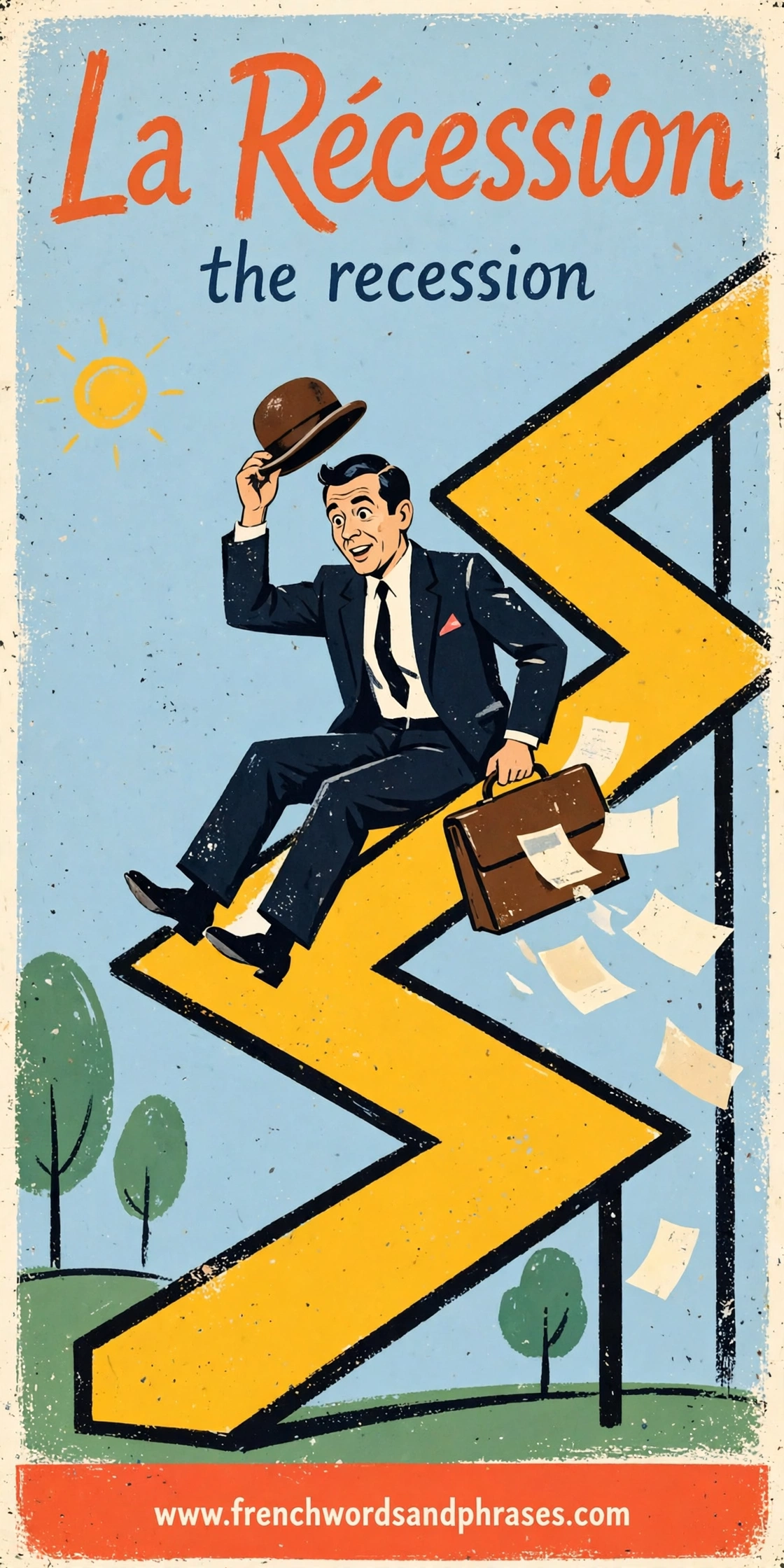
La récession means a recession.
Two quarters in a row, the figures have gone backwards. The radio says it carefully, the way you announce bad weather: the country has entered une récession. In the cafés, the word does the rounds before the coffee does.
In this guide, you’ll learn what récession means in English, how to use it with its articles, how to form its plural, and how it appears in everyday French. Explore French examples, English translations, and practice quizzes.
Understanding the French Noun Récession
Récession is a feminine French noun. It is learned together with its article: la récession, une récession. It comes from the Latin recessio, a going back — and that is exactly what it describes: an economy stepping backwards.
It means a recession — a period when the economy shrinks instead of growing. Technicians define it precisely: deux trimestres consécutifs de baisse du PIB, two quarters in a row of falling GDP. For everyone else it means factories slowing, le chômage rising, and shops emptying — la croissance in reverse.
Gender: Feminine
Definite article: la — la récession (the recession)
Indefinite article: une — une récession (a recession)
Plural: les récessions
English equivalents: A recession; an economic downturn.
One important usage detail: récession is the measured, technical word. Everyday French often prefers la crise, the crisis, for the same hard times — but la crise is wider and vaguer, while une récession has a definition: two falling quarters. And mind the neighbour: la régression means going backwards in general, not an economic recession.
Experience the Word
Récession is more than a statistic. It is the word that changes the mood of a whole country — the pause in the café conversation when the news comes on.
Imagine a small factory town in the north: the orders slow, the overtime stops, and the bakery on the corner starts closing on Mondays. Nobody has seen a graph, but everyone knows the word for it.
You have not just described two quarters of figures. You have named the weather of an economy.
How to Use Récession in French: Complete Guide
Let’s explore how récession works in French, beginning with its articles.
Récession with the Definite Article (La, Les)
Used for the recession everyone knows — the one in the news, the one the country is living through.
| Number | French |
|---|---|
| Singular | la récession |
| Plural | les récessions |
Example
La récession de 2009 a touché toute l’Europe.
The 2009 recession affected the whole of Europe.
Récession with the Indefinite Article (Une, Des)
Used for a recession in general — the one economists fear, the one a headline predicts.
| Number | French |
|---|---|
| Singular | une récession |
| Plural | des récessions |
Example
Les économistes craignent une récession l’année prochaine.
Economists fear a recession next year.
Anatomy of a Récession
Growth backwards, jobs disappearing — the signs by which a recession is recognised.
| French | In English |
|---|---|
| la baisse du PIB | the fall in GDP |
| deux trimestres de recul | two quarters of decline |
| la hausse du chômage | rising unemployment |
| la baisse de la consommation | falling consumption |
| les faillites d’entreprises | business bankruptcies |
| sortir de la récession | to come out of the recession |
Example
La hausse du chômage est le signe le plus visible de la récession.
Rising unemployment is the most visible sign of the recession.
Quick Quiz 1
How is a recession technically defined in French?
Reveal the answer
Two quarters in a row of falling GDP — deux trimestres consécutifs de baisse du PIB.
Après deux trimestres de recul, le pays entre en récession.
After two quarters of decline, the country enters a recession.
The Plural of Récession
Récession adds an -s in the plural — les récessions, the hard years of the history books.
| Number | French |
|---|---|
| Singular | la récession |
| Plural | les récessions |
Example
Les récessions du passé ont toutes fini par se terminer.
The recessions of the past all came to an end eventually.
Récession with Possessive Adjectives (Ma, Ta, Sa…)
Possessives agree with the noun, not with the owner — and récession is feminine, so it takes ma, ta, sa.
| Owner | French |
|---|---|
| my | ma récession |
| your (tu) | ta récession |
| his / her | sa récession |
| our | notre récession |
| your (vous) | votre récession |
| their | leur récession |
Example
Le pays voisin traverse sa récession la plus grave depuis trente ans.
The neighbouring country is going through its worst recession in thirty years.
Quick Quiz 2
Complete the sentence:
______ récession touche surtout les petites entreprises. (This)
Reveal the answer
Cette
Cette récession touche surtout les petites entreprises.
This recession is hitting small businesses hardest.
Récession with Demonstrative Adjectives (Cette, Ces)
Used to point: this recession here, those recessions of the past.
| Number | French |
|---|---|
| Singular | cette récession |
| Plural | ces récessions |
Example
Cette récession est plus courte que la précédente.
This recession is shorter than the previous one.
Récession with Adjectives
Adjectives agree with récession, feminine — grave, longue, mondiale.
| Adjective | With Récession |
|---|---|
| grave (serious) | une récession grave |
| longue (long) | une longue récession |
| courte (short) | une récession courte |
| mondiale (worldwide) | une récession mondiale |
| technique (technical) | une récession technique |
Example
Une récession mondiale touche les exportations de tous les pays.
A worldwide recession affects every country’s exports.
Quick Quiz 3
Complete the sentence:
C’est la récession la plus ______ depuis dix ans. (serious)
Reveal the answer
grave
C’est la récession la plus grave depuis dix ans.
It is the most serious recession in ten years.
Everyday Expressions with Récession
Entering, crossing and leaving — the récession phrases of the news.
| Expression | In English |
|---|---|
| entrer en récession | to enter a recession |
| traverser une récession | to go through a recession |
| sortir de la récession | to come out of the recession |
| éviter la récession | to avoid recession |
| la reprise économique | the economic recovery |
| en pleine récession | in the depths of recession |
Example
Après deux ans, le pays commence enfin à sortir de la récession.
After two years, the country is finally starting to come out of the recession.
Words from the Same Family as Récession
Growth, decline and recovery — the words that travel with récession.
| French | In English |
|---|---|
| la croissance | growth |
| le recul | the decline, the step back |
| le PIB | GDP |
| la reprise | the recovery |
| la crise | the crisis |
| récessif | recessionary (adjective) |
Example
Après la récession vient la reprise, lentement mais sûrement.
After the recession comes the recovery, slowly but surely.
Quick Quiz 4
What is the difference between la récession and la crise?
Reveal the answer
La récession has a precise definition — two quarters of falling GDP — while la crise is the wider, vaguer word for hard times.
Toute récession est une crise, mais toute crise n’est pas une récession.
Every recession is a crisis, but not every crisis is a recession.
Récession in Everyday French: Real-Life Examples
Now that you know the word, let’s see how récession appears in everyday French.
Example 1 — In the news
Le pays est entré en récession, annonce le journal de vingt heures.
The country has entered a recession, the eight o’clock news announces.
Example 2 — At the factory
Depuis la récession, l’usine tourne au ralenti.
Since the recession, the factory has been running slowly.
Example 3 — Job hunting
En pleine récession, trouver un emploi prend plus de temps.
In the depths of a recession, finding a job takes longer.
Example 4 — In the café
On parle de la récession comme on parle de la météo.
People talk about the recession the way they talk about the weather.
Example 5 — Better news
Les chiffres montrent que la récession touche à sa fin.
The figures show the recession is coming to an end.
Example 6 — History lesson
Nos grands-parents ont connu la grande récession des années trente.
Our grandparents lived through the great recession of the 1930s.
Beyond Translation: The Meaning of Récession
Récession is a word borrowed from the astronomers before the economists claimed it: a recessio was a body moving backwards in the sky. The image still fits — a whole economy appearing to retreat, quarter by quarter, while everyone watches the figures.
To say récession is to say the economy has taken two steps back.
It evokes the slowed factory and the quiet high street, the careful household budget and the long job queue — and, at the end of the tunnel, the word everyone waits for: la reprise, the recovery.
How to Remember the French Noun Récession
Remember it this way: Récession is a recession — feminine, the economy stepping back for two quarters in a row.
- You see the step back — la récession, c’est l’économie qui recule.
- You keep the definition — deux trimestres de baisse du PIB.
- You wait for the way out — après la récession, la reprise.
The key idea is la récession = two quarters of the economy going backwards.
Test Your Knowledge of Récession
Let’s see how much you’ve learned. Try answering these questions before revealing the answers.
Question 1
Is récession masculine or feminine?
Reveal the answer
Feminine — la récession, une récession.
Question 2
How do you say to come out of the recession in French?
Reveal the answer
Sortir de la récession — the phrase everyone waits to hear.
Question 3
Translate: The country has entered a recession.
Reveal the answer
Le pays est entré en récession.
Question 4
What word names what comes after a recession?
Reveal the answer
La reprise — the economic recovery.
Question 5
Complete the sentence:
Cette ______ est la plus grave depuis trente ans.
Reveal the answer
récession
Cette récession est la plus grave depuis trente ans.
This recession is the most serious for thirty years.
Your Final Challenge
Can You Use It?
How would you say this in French?
“After two difficult years, the country is coming out of the recession.”
Reveal the answer
Après deux années difficiles, le pays sort de la récession.
After two difficult years, the country is coming out of the recession.
A little French. A little curiosity. A richer everyday life.
LEARN FRENCH ONE WORD AT A TIME