A French Word to Live By
Translate Marché to English
/maʁ.ʃe/
Le marché means a market.
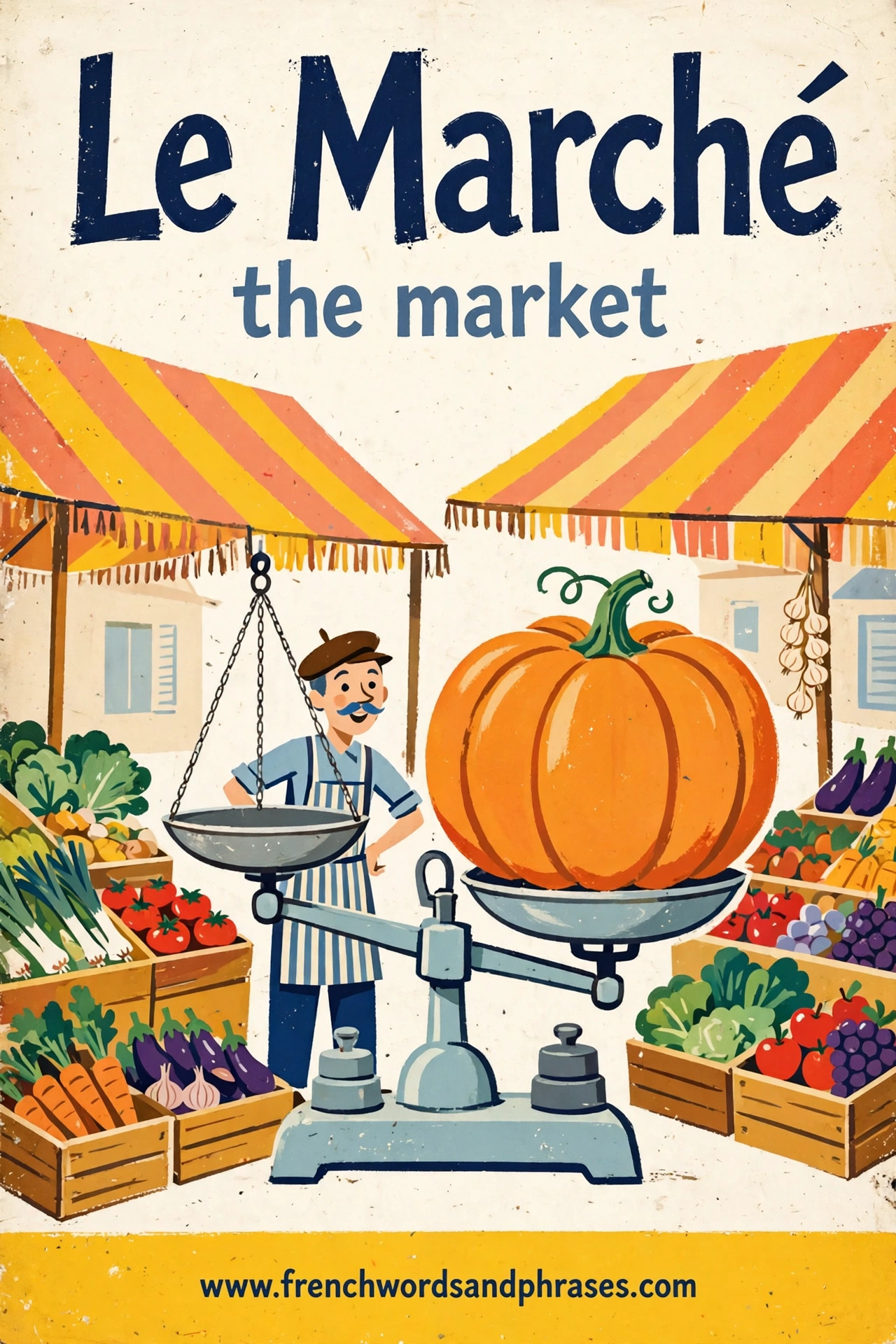
Saturday, eight o’clock, the square is already loud: crates of peaches, a wall of cheeses, the fishmonger’s ice glittering in the sun. Strings of lights, canvas roofs, a hundred conversations — le marché has taken over the town, as it does every week.
In this guide, you’ll learn what marché means in English, how to use it with its articles, how to form its plural, and how it appears in everyday French. Explore French examples, English translations, and practice quizzes.
Understanding the French Noun Marché
Marché is a masculine French noun. It is learned together with its article: le marché, un marché. It is one of French’s great double-duty words: it names the open-air market of the town square, and, in the language of economics, any market where buyers and sellers meet — le marché du travail, the labour market.
It means a market. In its first life, it is the weekly open-air market: stalls — les étals — of fruit, vegetables, cheese, flowers and clothes, where you shop with a basket and greet the merchants by name. In its second life, it is the economist’s market: le marché immobilier (the property market), le marché de l’emploi (the job market) — any arena where l’offre meets la demande and a price is born.
Gender: Masculine
Definite article: le — le marché (the market)
Indefinite article: un — un marché (a market)
Plural: les marchés
English equivalents: A market — the open-air market, and any economic market: labour, property, stock.
One important usage detail: to go shopping at the market, French says faire le marché — literally, to do the market. And beware the near-twin: la marche, with an -e and no accent, is a step, a walk, a march — a completely different word. Attention à la marche means mind the step, not mind the market.
Experience the Word
Marché is more than a place to shop. It is the town’s weekly festival of food — the square turned into a larder, a meeting place and a theatre, all before lunch.
Imagine arriving with an empty basket and a short list, and leaving an hour later with cheese you never planned, flowers you could not resist, and three conversations you did not expect. The market has fed you in every sense.
You have not just done the shopping. You have taken part in the oldest ritual of French town life.
How to Use Marché in French: Complete Guide
Let’s explore how marché works in French, beginning with its articles.
Marché with the Definite Article (Le, Les)
Used for the market everyone knows — the one in this town, the one on Saturdays.
| Number | French |
|---|---|
| Singular | le marché |
| Plural | les marchés |
Example
Le marché a lieu tous les samedis sur la place.
The market takes place every Saturday on the square.
Marché with the Indefinite Article (Un, Des)
Used for a market in general — the one in the guidebook, the one you are looking for.
| Number | French |
|---|---|
| Singular | un marché |
| Plural | des marchés |
Example
C’est un marché célèbre pour ses fromages.
It is a market famous for its cheeses.
The Markets of France
Fleas, Christmas and careers — the marchés of the year, in the square and in the economy.
| French | In English |
|---|---|
| le marché aux puces | the flea market |
| le marché de Noël | the Christmas market |
| le marché du travail | the labour market |
| le marché immobilier | the property market |
| un marché couvert | a covered market |
| le jour de marché | market day |
Example
Le marché de Noël ouvre à la fin du mois de novembre.
The Christmas market opens at the end of November.
Quick Quiz 1
What is le marché aux puces?
Reveal the answer
The flea market — the market of second-hand treasures, named after the fleas, les puces, of old furniture.
Au marché aux puces, j’ai trouvé une vieille lampe magnifique.
At the flea market, I found a beautiful old lamp.
The Plural of Marché
Marché adds an -s in the plural — les marchés, the markets of many towns.
| Number | French |
|---|---|
| Singular | le marché |
| Plural | les marchés |
Example
Les marchés de Provence sont célèbres dans le monde entier.
The markets of Provence are famous all over the world.
Marché with Possessive Adjectives (Mon, Ton, Son…)
Possessives agree with the noun, not with the owner — and marché is masculine, so it takes mon, ton, son.
| Owner | French |
|---|---|
| my | mon marché |
| your (tu) | ton marché |
| his / her | son marché |
| our | notre marché |
| your (vous) | votre marché |
| their | leur marché |
Example
Mon marché préféré a lieu le dimanche matin.
My favourite market takes place on Sunday morning.
Quick Quiz 2
Complete the sentence:
______ marché du samedi est très animé. (Our)
Reveal the answer
Notre
Notre marché du samedi est très animé.
Our Saturday market is very lively.
Marché with Demonstrative Adjectives (Ce, Ces)
Used to point: this market here, those markets there.
| Number | French |
|---|---|
| Singular | ce marché |
| Plural | ces marchés |
Example
Ce marché existe depuis deux cents ans.
This market has existed for two hundred years.
Marché with Adjectives
Adjectives agree with marché, masculine — grand, animé, hebdomadaire.
| Adjective | With Marché |
|---|---|
| grand (big) | un grand marché |
| animé (lively) | un marché animé |
| couvert (covered) | un marché couvert |
| hebdomadaire (weekly) | un marché hebdomadaire |
| local (local) | un marché local |
Example
Un marché animé attire tout le quartier.
A lively market attracts the whole neighbourhood.
Quick Quiz 3
Complete the sentence:
Le samedi, le marché est très ______. (lively)
Reveal the answer
animé
Le samedi, le marché est très animé.
On Saturdays, the market is very lively.
Everyday Expressions with Marché
Shopping, dealing and black markets — the marché phrases of the week.
| Expression | In English |
|---|---|
| faire le marché | to do the market shopping |
| le jour de marché | market day |
| passer un marché | to strike a deal |
| le marché noir | the black market |
| être sur le marché | to be on the market |
| un produit lancé sur le marché | a product launched on the market |
Example
Le dimanche, nous faisons le marché tôt le matin.
On Sundays, we do the market shopping early in the morning.
Words from the Same Family as Marché
Merchants, goods and stalls — the words that travel with marché.
| French | In English |
|---|---|
| le marchand | the merchant, the stallholder |
| la marchandise | the goods, the merchandise |
| l’étal | the market stall |
| acheter | to buy |
| vendre | to sell |
| le commerçant | the trader, the shopkeeper |
Example
Le marchand arrange ses pommes sur l’étal.
The stallholder arranges his apples on the stall.
Quick Quiz 4
On the train you hear: « Attention à la marche ! » Are they warning you about a market?
Reveal the answer
No — la marche is the step. Marché (market) and marche (step, walk) are different words that sound alike.
Attention à la marche en descendant du train !
Mind the step when you get off the train!
Marché in Everyday French: Real-Life Examples
Now that you know the word, let’s see how marché appears in everyday French.
Example 1 — Saturday morning
Nous faisons le marché tôt pour éviter la foule.
We do the market shopping early to avoid the crowd.
Example 2 — Job hunting
Le marché du travail est difficile pour les jeunes cette année.
The labour market is difficult for young people this year.
Example 3 — Christmas time
Le marché de Noël sent la cannelle et le vin chaud.
The Christmas market smells of cinnamon and mulled wine.
Example 4 — A flea-market find
Au marché aux puces, elle a trouvé une table ancienne.
At the flea market, she found an antique table.
Example 5 — Property news
Le marché immobilier ralentit dans les grandes villes.
The property market is slowing down in the big cities.
Example 6 — Describing a town
Le jour de marché, la place est pleine de monde.
On market day, the square is full of people.
Beyond Translation: The Meaning of Marché
The marché is where France’s two economies shake hands. In the square, it is the oldest economy of all — a farmer, a stall, a basket, a price agreed face to face. In the newspaper, it is the abstract economy — du travail, immobilier, des actions — where the same ancient dance of offre and demande moves houses and careers instead of cheeses.
To say marché is to watch buyers and sellers meet, as they have met for a thousand years.
It evokes canvas roofs and crates of peaches, the marchand who keeps your cheese aside, and the headlines that borrow the same word for the fate of nations.
How to Remember the French Noun Marché
Remember it this way: Marché is a market — masculine, the open-air market of the square and every market of the economy.
- You shop there — tu fais le marché le samedi matin.
- You widen the word — le marché du travail, le marché immobilier.
- You dodge the twin — la marche is the step, le marché is the market.
The key idea is le marché sells — la marche is the step.
Test Your Knowledge of Marché
Let’s see how much you’ve learned. Try answering these questions before revealing the answers.
Question 1
Is marché masculine or feminine?
Reveal the answer
Masculine — le marché, un marché.
Question 2
How do you say to do the market shopping in French?
Reveal the answer
Faire le marché — literally, to do the market.
Question 3
Translate: The labour market is difficult this year.
Reveal the answer
Le marché du travail est difficile cette année.
Question 4
What is le marché aux puces?
Reveal the answer
The flea market — the second-hand market, named after les puces, fleas.
Question 5
Complete the sentence:
Nous allons ______ marché le samedi matin.
Reveal the answer
au
Nous allons au marché le samedi matin.
We go to the market on Saturday morning.
Your Final Challenge
Can You Use It?
How would you say this in French?
“On Saturday morning, we do our shopping at the market.”
Reveal the answer
Le samedi matin, nous faisons nos courses au marché.
On Saturday morning, we do our shopping at the market.
A little French. A little curiosity. A richer everyday life.
LEARN FRENCH ONE WORD AT A TIME