A French Word to Live By
Translate Décevant to English
/de.sə.vɑ̃/
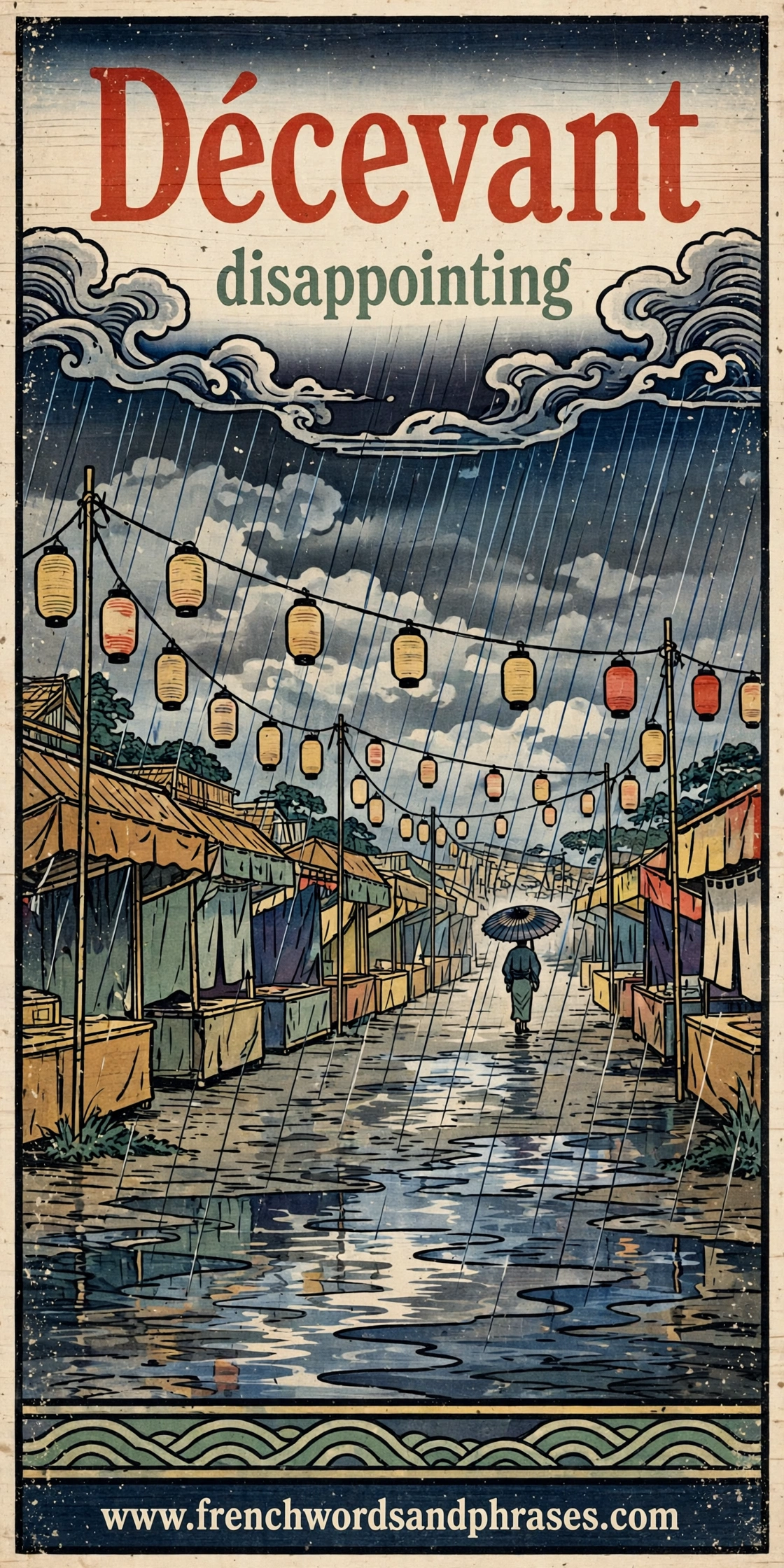
Décevant means disappointing.
The sequel everyone waited two years for. The cinema is full, the lights go down — and by the middle, people are checking the time. Nobody boos. They do something quieter and worse: they shrug. The film is, in the word the reviews will use tomorrow, décevant.
In this guide, you’ll learn what décevant means in English, its four forms, and the great split at its heart — décevant for the disappointing thing, déçu for the disappointed person — plus a famous false friend in its family. Explore French examples, English translations, and practice quizzes.
Understanding the French Adjective Décevant
Décevant is a French adjective of quality — an adjective of judgement, born from the verb décevoir (to disappoint), which conjugates like recevoir. Its -ant ending marks the cause: the thing that lets you down. It agrees fully: décevant, décevante, décevants, décevantes.
It means disappointing — falling short of what was hoped. Un film décevant, a disappointing film; un résultat décevant, a disappointing result. The person who feels it is not décevant but déçu: je suis déçu, I am disappointed. Thing décevant, person déçu — the same split as boring and bored.
Type: Adjective of quality — judgement (from the verb décevoir)
Answers the question: What is it like? — disappointing
Changes form: Yes — décevant, décevante, décevants, décevantes
English equivalents: Disappointing; a let-down.
One important usage detail: décevant describes the thing that disappoints, never the person who feels disappointed. The film is décevant; you are déçu. Say je suis décevant and you have announced that you are a disappointment to others — a very different confession.
Experience the Word
Décevant is the adjective of the gap — the space between the poster and the film, the menu photo and the plate, the promise and the day itself.
Imagine the famous restaurant booked a month ahead: the celebrated dish arrives, small and tired on the plate. Nobody complains loudly. The table goes quiet, and someone says it softly: « c’est décevant, quand même ».
You have not just criticised a meal. You have measured the distance between hope and reality.
How to Use Décevant in French: Complete Guide
Let’s explore how décevant works in French, beginning with the whole word on one card.
Décevant at a Glance
Before the details, here is the whole word on one card.
The Whole Word on One Card
Meaning, type, position and forms — décevant in four lines.
| Point | Décevant |
|---|---|
| Meaning | disappointing |
| Type | adjective of quality — judgement |
| Usual position | after the noun — un film décevant |
| Form | décevant / décevante / décevants / décevantes |
Example
Le film était décevant, la fin surtout.
The film was disappointing, the ending especially.
The Four Forms of Décevant
Décevant agrees like a present participle turned adjective: the feminine swaps -ant for -ante, and the plurals add -s.
| Form | Décevant | Example |
|---|---|---|
| Masculine singular | décevant | un film décevant — a disappointing film |
| Feminine singular | décevante | une fin décevante — a disappointing ending |
| Masculine plural | décevants | des résultats décevants — disappointing results |
| Feminine plural | décevantes | des vacances décevantes — a disappointing holiday |
Example
Des vacances décevantes, il a plu toute la semaine.
A disappointing holiday, it rained all week.
Quick Quiz 1
Which form of décevant goes with fin (feminine) — décevant or décevante?
Reveal the answer
décevante
Une fin décevante.
A disappointing ending.
Where Décevant Goes: On Things, Not People
Décevant sticks to things, events and results — the causes of disappointment. People take déçu instead.
| Pattern | Example |
|---|---|
| After the noun | un film décevant — a disappointing film |
| After être | ce résultat est décevant — this result is disappointing |
| The person instead | je suis déçu — I am disappointed (the feeling takes déçu, never décevant) |
| Before the noun | un décevant film — unusual; décevant follows |
Example
Le match était décevant, et les supporters étaient déçus.
The match was disappointing, and the fans were disappointed.
More Disappointing: Comparing with Décevant
Décevant compares the regular way, with plus, moins and aussi — a scale of let-downs.
| Degree | Example |
|---|---|
| As disappointing as | aussi décevant que — as disappointing as |
| More disappointing | plus décevant — plus décevant que prévu |
| Less disappointing | moins décevant — less disappointing |
| The most disappointing | le plus décevant — le plus décevant de l’année |
| Intensified | très décevant — very disappointing |
Example
La suite est encore plus décevante que le premier film.
The sequel is even more disappointing than the first film.
Quick Quiz 2
You hoped for more from the exam results. Are you décevant or déçu?
Reveal the answer
déçu — the person is déçu; the results are décevants.
Les résultats sont décevants, je suis déçu.
The results are disappointing, I am disappointed.
Everyday Expressions with Décevant
Around décevant stands its whole family — the verb, the person-word, and a noun with a double identity.
| Expression | In English |
|---|---|
| décevoir | to disappoint — the verb, conjugated like recevoir |
| être déçu | to be disappointed — the person’s word |
| la déception | the disappointment — la déception était grande |
| décevant mais prévisible | disappointing but predictable |
| une attente déçue | a dashed hope — literally ‘a disappointed expectation’ |
| ne pas être à la hauteur | to not live up to it — to fall short of expectations |
Example
La déception était grande après le match.
The disappointment was great after the match.
Décevant and Its Neighbours
Disappointment keeps company with the other words of falling short — and one shining opposite.
| French | In English |
|---|---|
| déçu | disappointed — the person, not the thing |
| médiocre | mediocre — never good to begin with |
| raté | failed, a flop — un film raté |
| quelconque | nothing special, run-of-the-mill |
| prometteur | promising — the hopeful opposite |
| à la hauteur | up to expectations — être à la hauteur |
Example
Le film n’était pas raté, juste décevant.
The film wasn’t a flop, just disappointing.
Quick Quiz 3
What does la déception mean — deception, or disappointment?
Reveal the answer
Disappointment
La déception était grande.
The disappointment was great.
Décevant at the Box Office: A Tour of Let-Downs
Décevant has its natural habitats — anywhere a promise was made in advance. A tour of its favourite hunting grounds.
| Place | Example |
|---|---|
| The sequel | une suite décevante après un premier film magnifique — a disappointing sequel after a magnificent first film |
| The famous restaurant | un plat décevant dans un restaurant célèbre — a disappointing dish in a famous restaurant |
| The match | un match décevant pour les supporters — a disappointing match for the fans |
| The holiday | des vacances décevantes sous la pluie — a disappointing holiday in the rain |
Example
Après des mois d’attente, le concert était un peu décevant.
After months of waiting, the concert was a bit disappointing.
Watch Out: The Traps Around Décevant
Four traps surround décevant — the person-thing split, the famous false friend, the verb’s shape, and the word that goes too far.
| Trap | The truth |
|---|---|
| je suis décevant | that says you disappoint others — for your own feeling, say je suis déçu |
| la déception | means disappointment, NOT deception — deception in French is la tromperie or la duperie |
| décevoir | conjugated like recevoir: je déçois, nous décevons, past participle déçu |
| un désastre | too strong — décevant is a let-down, not a catastrophe |
Example
Je suis déçu : le film était vraiment décevant.
I am disappointed: the film was really disappointing.
Quick Quiz 4
How do you say ‘I am disappointed’ — je suis décevant or je suis déçu?
Reveal the answer
je suis déçu
Décevant is for the thing that disappoints.
Je suis déçu par ce résultat.
I am disappointed by this result.
Décevant in Everyday French: Real-Life Examples
Now that you know the word, let’s see how décevant appears in everyday French.
Example 1 — At the cinema
Le film était décevant, surtout la fin.
The film was disappointing, especially the ending.
Example 2 — Exam results
Ses résultats sont décevants ce trimestre, elle est déçue.
Her results are disappointing this term, she is disappointed.
Example 3 — The restaurant
Le plat célèbre était décevant, petit et froid.
The famous dish was disappointing, small and cold.
Example 4 — The match
Quel match décevant ! L’équipe n’a pas joué.
What a disappointing match! The team didn’t play.
Example 5 — The sequel
J’attendais la suite, mais elle est très décevante.
I was waiting for the sequel, but it is very disappointing.
Example 6 — Being honest
Je suis déçu, je m’attendais à mieux.
I am disappointed, I expected better.
Beyond Translation: The Meaning of Décevant
English says disappointing for the meaning of décevant — but French builds the word on décevoir, to disappoint, a verb whose root carries the idea of hopes being quietly undone.
Décevant is never about disaster — it is the exact word for the gap between what was promised and what arrived.
And mind the family noun: la déception means disappointment, not deception. The English speaker who announces a ‘grande déception’ after a bad film is perfectly correct in French — and would be saying something quite different in English.
How to Remember the French Adjective Décevant
Remember it this way: Décevant points at the thing, déçu points at the person — learn the pair once and the whole family falls into place.
- You see the -ant ending aimed at the cause — un film décevant, un résultat décevant.
- You keep the feeling for déçu — je suis déçu, elle est déçue.
- You translate la déception as disappointment — never as deception.
The key idea is décevant = the disappointing thing, déçu = the disappointed person, la déception = disappointment.
Test Your Knowledge of Décevant
Let’s see how much you’ve learned. Try answering these questions before revealing the answers.
Question 1
What does décevant mean?
Reveal the answer
Disappointing — falling short of what was hoped.
Question 2
What are the forms of décevant?
Reveal the answer
décevant, décevante, décevants, décevantes.
Question 3
Translate: a disappointing film.
Reveal the answer
Un film décevant.
Question 4
What does la déception mean?
Reveal the answer
Disappointment — not deception.
Une grande déception.
A great disappointment.
Question 5
Complete the sentence:
Le match était ______, et nous étions tous déçus.
Reveal the answer
décevant
Le match était décevant, et nous étions tous déçus.
The match was disappointing, and we were all disappointed.
Your Final Challenge
Can You Use It?
How would you say this in French?
“The film was disappointing, and I was really disappointed.”
Reveal the answer
Le film était décevant, et j’étais vraiment déçu.
The film was disappointing, and I was really disappointed.
A little French. A little curiosity. A richer everyday life.
LEARN FRENCH ONE WORD AT A TIME