A French Word to Live By
Translate Stressé to English
/stʁɛ.se/
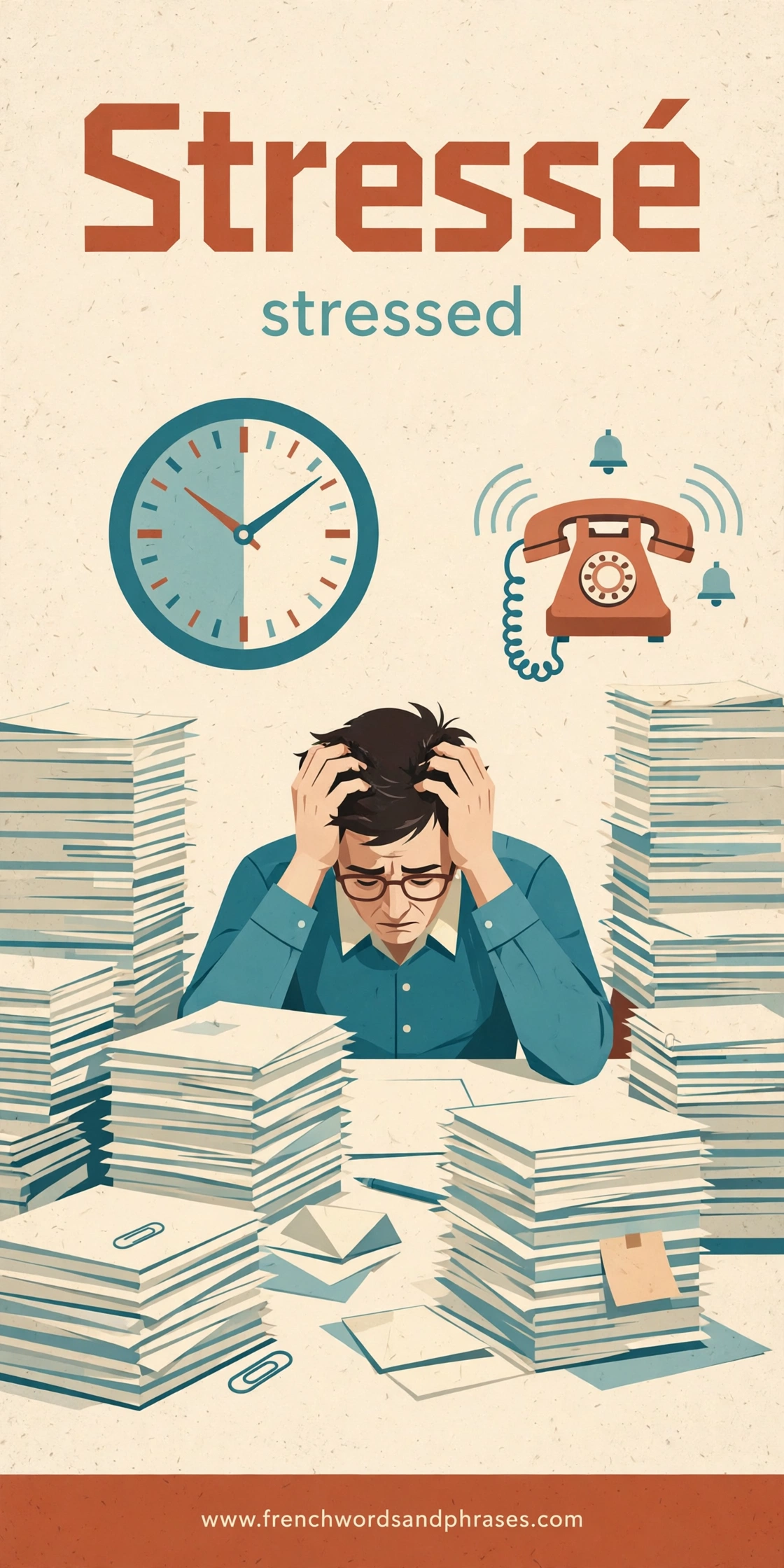
Stressé means stressed.
Late September in Paris: the métro is packed, the inbox is full, the phone will not stop buzzing, and the coffee has gone cold for the third time. One word is on everybody’s lips, usually with a sigh: stressé.
In this guide, you’ll learn what stressé means in English, how it is built from the noun le stress, how its four forms work, and the French difference between the person who feels the pressure and the thing that causes it. Explore French examples, English translations, and practice quizzes.
Understanding the French Adjective Stressé
Stressé is a French adjective of state — it describes how a person feels under pressure. It is the past participle of the verb stresser used as an adjective, so it agrees like a regular -é adjective: stressé, stressée, stressés, stressées.
It means stressed — under pressure, tense, wound up. Un étudiant stressé avant l’examen, a stressed student before the exam; elle est stressée par son travail, she is stressed by her work. The cause of the pressure often follows with par: stressé par les délais, stressed by the deadlines. If French had to keep one word for the modern condition, this would be a strong candidate.
Type: Adjective of state — feelings under pressure (past participle of stresser)
Answers the question: How does he/she feel? — stressed
Changes form: Yes — stressé, stressée, stressés, stressées
English equivalents: Stressed; under pressure; tense.
One important usage detail: stressé describes the person who FEELS the pressure, while stressant describes the thing that CAUSES it — un examen stressant, a stressful exam, makes un étudiant stressé. Keep the -é for the sufferer and the -ant for the cause.
Experience the Word
Stressé is the adjective of the held breath — shoulders up near the ears, jaw tight, and a third coffee going cold on the desk.
Imagine the last evening before a big exam in a small student room in Lyon: notes everywhere, a phone buzzing with messages, a mother texting « tu as bien dormi ? » You have not slept well. You are, completely and officially, stressé.
You have not just described nerves. You have named the weather inside a person.
How to Use Stressé in French: Complete Guide
Let’s explore how stressé works in French, beginning with the whole word on one card.
Stressé at a Glance
Before the details, here is the whole word on one card.
The Whole Word on One Card
Meaning, type, position and forms — stressé in four lines.
| Point | Stressé |
|---|---|
| Meaning | stressed |
| Type | adjective of state — feelings under pressure |
| Usual position | after the noun, and after être — un étudiant stressé |
| Form | stressé / stressée / stressés / stressées |
Example
Il est très stressé avant l’examen.
He is very stressed before the exam.
The Four Forms of Stressé
Stressé agrees like a regular -é adjective: the feminine adds an -e, and both plurals add an -s. The double s of le stress stays in every form.
| Form | Stressé | Example |
|---|---|---|
| Masculine singular | stressé | un étudiant stressé — a stressed student |
| Feminine singular | stressée | une étudiante stressée — a stressed student |
| Masculine plural | stressés | des étudiants stressés — stressed students |
| Feminine plural | stressées | des étudiantes stressées — stressed students |
Example
Les étudiants sont stressés, les étudiantes aussi.
The boys are stressed, the girls too.
Quick Quiz 1
Which form of stressé goes with étudiante (feminine)?
Reveal the answer
stressée
Une étudiante stressée.
A stressed student.
Where Stressé Goes: After the Noun, and After Être
Stressé follows the noun like most French adjectives, and its favourite home is after être, often with the cause of the pressure attached by par.
| Pattern | Example |
|---|---|
| noun + stressé | un candidat stressé — a stressed candidate |
| After être | elle est stressée — she is stressed |
| With the cause | stressé par le travail — stressed by work |
| Before the noun | un stressé candidat — never; stressé goes after |
Example
Stressée par les délais, elle travaille même le dimanche.
Stressed by the deadlines, she works even on Sundays.
More Stressed: Comparing with Stressé
Stressé compares the regular way, with plus, moins and aussi — and the superlative keeps the agreement: le plus stressé, la plus stressée.
| Degree | Example |
|---|---|
| As stressed as | aussi stressé que — as stressed as |
| More stressed | plus stressé — plus stressé que l’année dernière |
| Less stressed | moins stressé — less stressed |
| The most stressed (masc.) | le plus stressé — le plus stressé de la classe |
| The most stressed (fem.) | la plus stressée — la plus stressée du bureau |
Example
Après les vacances, je suis beaucoup moins stressé.
After the holidays, I am much less stressed.
Quick Quiz 2
Which word describes the EXAM that causes the feeling — stressé or stressant?
Reveal the answer
stressant
Un examen stressant rend les étudiants stressés.
A stressful exam makes students stressed.
Everyday Expressions with Stressé
Stressé belongs to a whole family built on le stress — the verb for calming a friend, the noun for a spike of pressure, and the lovely verb for letting it all go.
| Expression | In English |
|---|---|
| être stressé | to be stressed |
| stresser quelqu’un | to stress someone out |
| ne stresse pas ! | don’t stress! don’t worry! |
| stressé par le travail | stressed by work |
| un coup de stress | a spike of stress, a stressful moment |
| déstresser | to unwind, to de-stress |
Example
Ne stresse pas, tout va bien se passer.
Don’t stress, everything will be fine.
Stressé and Its Neighbours
French owns a whole shelf of pressure words. Stressé is the everyday one; its neighbours shade the feeling finer — and its opposites wait at the other end.
| French | In English |
|---|---|
| tendu | tense |
| anxieux | anxious |
| débordé | overwhelmed, snowed under |
| préoccupé | worried, preoccupied |
| calme | calm — the opposite |
| détendu | relaxed — the opposite |
Example
Il est tendu et un peu anxieux avant les résultats.
He is tense and a little anxious before the results.
Quick Quiz 3
What does ne stresse pas ! mean?
Reveal the answer
Don’t stress! / Don’t worry!
Ne stresse pas, l’examen est facile.
Don’t stress, the exam is easy.
Stressé Through the Week: A Tour of Pressure
Stressé keeps a timetable: it peaks on Monday morning, stalks the exam hall and the airport, and — with luck — takes the holidays off. A tour of its week.
| Moment | Example |
|---|---|
| Monday morning | le lundi matin, tout le bureau est stressé — on Monday morning, the whole office is stressed |
| Before the exam | les étudiants stressés devant la salle — the stressed students outside the hall |
| At the airport | des passagers stressés par le retard — passengers stressed by the delay |
| After the holidays | après les vacances, personne n’est stressé — after the holidays, nobody is stressed |
Example
Le vendredi soir, enfin, il n’est plus stressé.
On Friday evening, at last, he is no longer stressed.
Watch Out: The Traps Around Stressé
Three traps wait around this word — the swapped endings, the English ‘out’ that French never adds, and the missing s.
| Trap | The truth |
|---|---|
| stressé / stressant | the person feels it (stressé), the thing causes it (stressant) — un examen stressant, un étudiant stressé |
| stressed out | English adds ‘out’; French doesn’t — je suis stressé, never ‘stressé dehors’ |
| stresé | never drop an s — stressé keeps the double s of le stress in every form |
| le stress | an English borrowing that became a whole French family: stresser, stressant, déstresser |
Example
Un travail stressant rend tout le monde stressé.
A stressful job makes everyone stressed.
Quick Quiz 4
How do you say ‘a stressful day’ — une journée stressée or une journée stressante?
Reveal the answer
une journée stressante
The day causes the stress, so it takes -ant.
Une journée stressante — a stressful day.
Stressé in Everyday French: Real-Life Examples
Now that you know the word, let’s see how stressé appears in everyday French.
Example 1 — Before the exam
Je suis stressé, l’examen est demain matin.
I’m stressed, the exam is tomorrow morning.
Example 2 — At the office
Elle est stressée par tous ces délais.
She is stressed by all these deadlines.
Example 3 — Reassuring a friend
Ne stresse pas, tu as bien révisé.
Don’t stress, you’ve revised well.
Example 4 — At the doctor’s
Vous semblez stressé, il faut dormir davantage.
You seem stressed, you need to sleep more.
Example 5 — In traffic
Il arrive toujours stressé à cause des embouteillages.
He always arrives stressed because of the traffic jams.
Example 6 — After the storm
Après une semaine de vacances, je ne suis plus stressé du tout.
After a week of holiday, I’m not stressed at all any more.
Beyond Translation: The Meaning of Stressé
English says stressed for the meaning of stressé — and here the two languages are cousins, because French borrowed the English word ‘stress’ and built a whole French family on it: le stress, stresser, stressant, déstresser.
But French keeps one distinction English often blurs: the -é ending for the person who suffers, the -ant ending for the thing that causes it.
Learn that one small difference and you will never call an exam ‘stressed’ or a student ‘stressful’ again.
How to Remember the French Adjective Stressé
Remember it this way: Stressé is le stress dressed as an adjective — and it always points at the person who feels the pressure, never at the thing that causes it.
- You see the sufferer wearing -é — l’étudiant stressé — and the cause wearing -ant — l’examen stressant.
- You keep the double s of le stress in every form — stressé, stressée, stressés, stressées.
- You calm a friend with the family verb: ne stresse pas !
The key idea is stressé describes the person under pressure; stressant describes the cause — stressé, stressée, stressés, stressées.
Test Your Knowledge of Stressé
Let’s see how much you’ve learned. Try answering these questions before revealing the answers.
Question 1
What does stressé mean?
Reveal the answer
Stressed — under pressure, tense.
Question 2
What are the forms of stressé?
Reveal the answer
stressé, stressée, stressés, stressées — it agrees like a regular -é adjective.
Question 3
Translate: a stressed student (female).
Reveal the answer
Une étudiante stressée.
Question 4
Which word describes the cause — the exam — stressé or stressant?
Reveal the answer
stressant
Un examen stressant.
A stressful exam.
Question 5
Complete the sentence:
Ne ______ pas, tout va bien se passer.
Reveal the answer
stresse
Ne stresse pas, tout va bien se passer.
Don’t stress, everything will be fine.
Your Final Challenge
Can You Use It?
How would you say this in French?
“Don’t stress, the exam is tomorrow but you are ready.”
Reveal the answer
Ne stresse pas, l’examen est demain mais tu es prêt.
Don’t stress, the exam is tomorrow but you are ready.
A little French. A little curiosity. A richer everyday life.
LEARN FRENCH ONE WORD AT A TIME