
A French Word to Live By
Translate Curieux to English
/ky.ʁjø/
Curieux means curious.
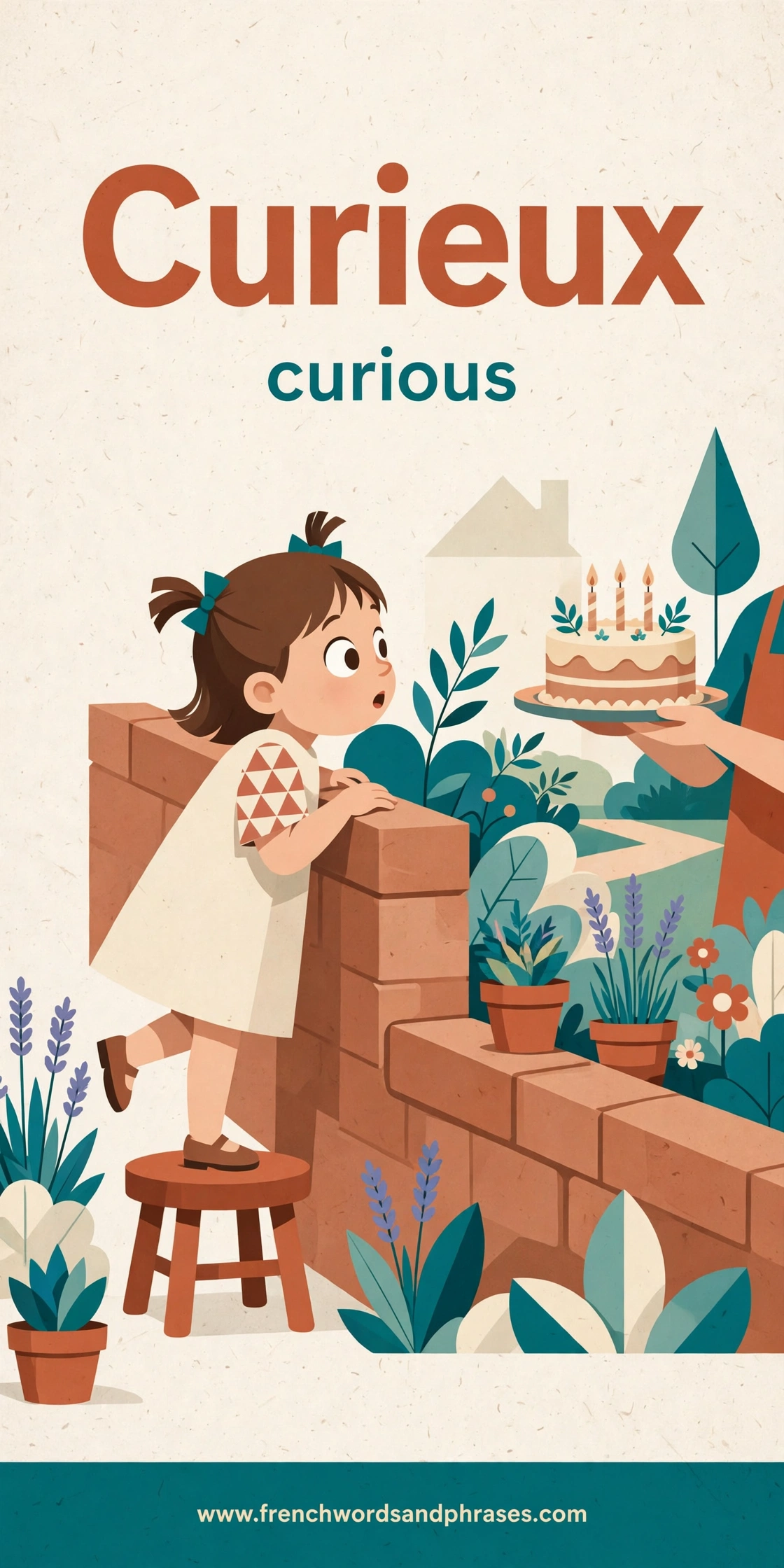
The little boy at the garden fence has asked forty questions since breakfast — about the postman, the moon, and why the neighbour’s dog has spots. His grandmother laughs and shakes her head: he is, magnificently, curieux.
In this guide, you’ll learn what curieux means in English — both of its meanings, the curious mind and the curious, odd thing — how its feminine curieuse is built, and where it stands around the noun. Explore French examples, English translations, and practice quizzes.
Understanding the French Adjective Curieux
Curieux is a French adjective of quality with two lives: it describes a mind that wants to know, and a thing that is strange to see. It agrees like the other -eux adjectives: curieux, curieuse, curieux, curieuses.
It means curious — eager to know: un enfant curieux, a curious child; je suis curieux de voir ça, I’m curious to see that. But point it at a thing and it turns: c’est curieux means that’s odd, that’s strange. Un bruit curieux is a strange noise, not an inquisitive one. Context decides which curieux you are meeting.
Type: Adjective of quality — curiosity, and strangeness
Answers the question: What is it like? — curious, or odd
Changes form: Yes — curieux, curieuse, curieux, curieuses; the masculine plural is unchanged
English equivalents: Curious; inquisitive; strange, odd.
One important usage detail: curieux de + infinitive means eager to — je suis curieux de voir ça, I’m curious to see that. And c’est curieux, said of a thing or a fact, almost always carries the second sense: that’s odd.
Experience the Word
Curieux is the adjective of the raised hand and the lifted lid — the word for every mind that cannot leave a question alone.
Imagine the boy at the fence again, watching the postman’s van disappear round the corner. « Pourquoi les chiens ont des taches ? » His grandmother has no answer, and she doesn’t need one: the question itself is the treasure. Il est curieux — and it is praise.
You have not just described a nosy child. You have praised the engine of all learning.
How to Use Curieux in French: Complete Guide
Let’s explore how curieux works in French, beginning with the whole word on one card.
Curieux at a Glance
Before the details, here is the whole word on one card.
The Whole Word on One Card
Meaning, type, position and forms — curieux in four lines.
| Point | Curieux |
|---|---|
| Meaning | curious — also strange, odd, for things |
| Type | adjective of quality — curiosity |
| Usual position | after the noun — un enfant curieux |
| Form | curieux / curieuse / curieux / curieuses — the masculine plural doesn’t change |
Example
C’est un enfant très curieux.
He’s a very curious child.
The Four Forms of Curieux
Curieux agrees with the noun it describes. The feminine swaps -eux for -euse, the feminine plural adds -s — and the masculine plural keeps the same spelling.
| Form | Curieux | Example |
|---|---|---|
| Masculine singular | curieux | un garçon curieux — a curious boy |
| Feminine singular | curieuse | une fille curieuse — a curious girl |
| Masculine plural | curieux | des garçons curieux — curious boys |
| Feminine plural | curieuses | des filles curieuses — curious girls |
Example
Les enfants curieux posent mille questions.
Curious children ask a thousand questions.
Quick Quiz 1
What is the feminine of curieux — curieuxe or curieuse?
Reveal the answer
curieuse
Une fille curieuse.
A curious girl.
Where Curieux Goes: After the Noun
Curieux follows the noun, like most French adjectives. After être it describes a person — and with de + infinitive it leans forward, eager.
| Pattern | Example |
|---|---|
| noun + curieux | un enfant curieux — a curious child |
| With an adverb | un enfant très curieux — a very curious child |
| After être | elle est curieuse — she is curious |
| Before the noun | un curieux enfant — never; curieux goes after |
Example
Je suis curieux de connaître la suite.
I’m curious to know what happens next.
More Curious: Comparing with Curieux
Curieux compares the regular way, with plus, moins and aussi — and the superlative keeps the agreement: le plus curieux, la plus curieuse.
| Degree | Example |
|---|---|
| As curious as | aussi curieux que — as curious as |
| More curious | plus curieux — plus curieux que sa sœur |
| Less curious | moins curieux — less curious |
| The most curious (masc.) | le plus curieux — le plus curieux de la classe |
| The most curious (fem.) | la plus curieuse — la plus curieuse de la famille |
Example
C’est l’enfant le plus curieux de la classe.
He’s the most curious child in the class.
Quick Quiz 2
You hear a strange noise in the engine and say c’est curieux. Which sense is it — inquisitive, or odd?
Reveal the answer
Odd — said of a thing, curieux means strange.
C’est curieux, ce bruit dans le moteur.
That’s odd, that noise in the engine.
Everyday Expressions with Curieux
Curieux works both sides of its double life — in the classroom with the question-askers, and at the fence with the crowd that gathers to watch.
| Expression | In English |
|---|---|
| curieux de nature | curious by nature |
| curieux de + infinitive | eager to, curious to — curieux de voir |
| c’est curieux | that’s odd, that’s strange |
| un curieux personnage | a strange character |
| un regard curieux | a curious look |
| les curieux | the onlookers, the curious crowd — a noun |
Example
Une foule de curieux regardait la scène.
A crowd of onlookers was watching the scene.
Curieux and Its Neighbours
French shades curiosity carefully. Curieux is warm praise; indiscret is the same habit with its manners missing — and for things, the neighbours take over the strange sense.
| French | In English |
|---|---|
| indiscret | nosy, tactless — the negative shade of curieux |
| intéressé | interested |
| avide de savoir | eager to know |
| étrange | strange — for things |
| bizarre | weird, odd |
| fouineur | nosy, a snoop — informal |
Example
Il est curieux, pas indiscret: il pose des questions, il n’écoute pas aux portes.
He’s curious, not nosy: he asks questions, he doesn’t listen at doors.
Quick Quiz 3
Which neighbour of curieux is the negative one — intéressé or indiscret?
Reveal the answer
Indiscret — nosy, the curiosity that forgets its manners.
Ne sois pas indiscret, ce n’est pas ton affaire.
Don’t be nosy, it’s none of your business.
Curieux Everywhere: A Tour of Curiosity
Curieux follows its nose through the whole day: the child’s questions, the cat at the door, the traveller in a new town — and the odd object nobody can explain. A quick tour.
| Scene | Example |
|---|---|
| The child | un enfant curieux — a curious child |
| The cat | un chat curieux devant la porte — a curious cat at the door |
| The traveller | un voyageur curieux — a curious traveller |
| The strange thing | un objet curieux — a strange object |
Example
Le chat, curieux, regarde dans le sac.
The cat, curious, looks in the bag.
Watch Out: The Traps Around Curieux
Four traps wait around this double-lived word — the inquisitive noise, the wandering feminine, the eager de, and the crowd at the fence.
| Trap | The truth |
|---|---|
| curieux for a noise | things can’t be inquisitive: un bruit curieux is a strange noise |
| curieuse for a boy | the feminine is only for feminine nouns: un garçon curieux, une fille curieuse |
| curieux de + verb | it means eager to: curieux de savoir, curious to know |
| les curieux | with an article it’s a noun: the onlookers at an accident or a show |
Example
C’est curieux, ce bruit dans le moteur.
That’s odd, that noise in the engine.
Quick Quiz 4
How do you say ‘a curious girl’ — une fille curieux or une fille curieuse?
Reveal the answer
une fille curieuse
The feminine swaps -eux for -euse.
Une fille curieuse — a curious girl.
Curieux in Everyday French: Real-Life Examples
Now that you know the word, let’s see how curieux appears in everyday French.
Example 1 — The child
Mon fils est curieux, il pose des questions toute la journée.
My son is curious, he asks questions all day.
Example 2 — A strange noise
C’est curieux, j’entends un bruit dans le grenier.
That’s odd, I hear a noise in the attic.
Example 3 — Eager to see
Je suis curieux de voir ton nouveau jardin.
I’m curious to see your new garden.
Example 4 — The cat
Le chat curieux regarde par la fenêtre.
The curious cat looks out of the window.
Example 5 — The onlookers
Les curieux s’arrêtent pour regarder les musiciens.
The onlookers stop to watch the musicians.
Example 6 — Praise
Elle est curieuse de tout, c’est une qualité.
She is curious about everything, it’s a quality.
Beyond Translation: The Meaning of Curieux
English says curious for the meaning of curieux — and here the two languages shake hands, because English curious leads the same double life: inquisitive for people, odd for things. French keeps exactly the same arrangement.
The line to watch is the company it keeps: a person who is curieux wants to know; a thing that is curieux makes you frown.
And when a crowd gathers at a fence, French names it with the plural noun: les curieux — the curious ones, watching the world go by.
How to Remember the French Adjective Curieux
Remember it this way: Curieux wears the -eux uniform of the question-askers: one form for him, curieuse for her — and a second meaning, strange, whenever it describes a thing.
- You swap -eux for -euse for a woman — curieuse — like heureuse and paresseuse.
- You split the meanings by company: people are curious, things are odd — c’est curieux.
- You add de for eagerness: curieux de voir, curious to see.
The key idea is curieux means curious for people and strange for things — curieuse in the feminine, and curieux de + verb means eager to.
Test Your Knowledge of Curieux
Let’s see how much you’ve learned. Try answering these questions before revealing the answers.
Question 1
What does curieux mean?
Reveal the answer
Curious — and, for things, strange or odd.
Question 2
What is the feminine of curieux?
Reveal the answer
curieuse — the -eux ending becomes -euse.
Question 3
Translate: that’s odd.
Reveal the answer
C’est curieux.
Question 4
What does je suis curieux de voir ça mean?
Reveal the answer
I’m curious to see that — curieux de + infinitive means eager to.
Question 5
Complete the sentence:
Les enfants ______ posent mille questions.
Reveal the answer
curieux
Les enfants curieux posent mille questions.
Curious children ask a thousand questions.
Your Final Challenge
Can You Use It?
How would you say this in French?
“The children are curious, they ask a thousand questions.”
Reveal the answer
Les enfants sont curieux, ils posent mille questions.
The children are curious, they ask a thousand questions.
A little French. A little curiosity. A richer everyday life.
LEARN FRENCH ONE WORD AT A TIME




