A French Word to Live By
Translate Impoli to English
/ɛ̃.pɔ.li/
Impoli means rude, impolite.
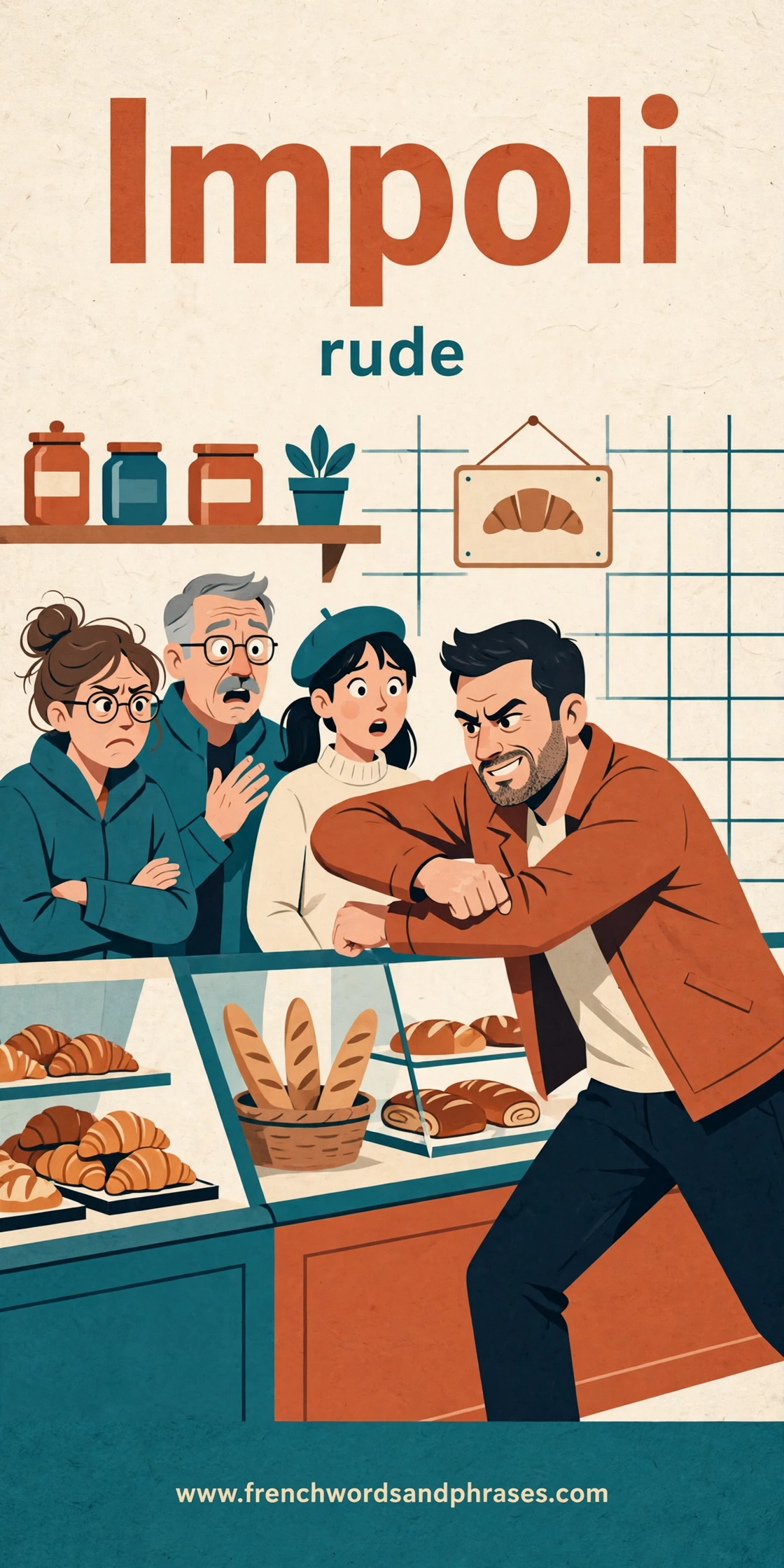
A small café near a station in Lyon: the waiter weaves between tables with three plates balanced on one arm. A customer clicks his fingers and whistles for attention. The whole room winces at once — that small, sharp sound is the sound of impoli.
In this guide, you’ll learn what impoli means in English, how its feminine impolie is built, where it stands around the noun, and how the French use it for children, gestures and dinner guests alike. Explore French examples, English translations, and practice quizzes.
Understanding the French Adjective Impoli
Impoli is a French adjective of quality — poli wearing the negative prefix im-, the exact mirror of polite. It agrees like a regular adjective: the feminine adds -e (impolie), and both plurals add -s.
It means rude and impolite — said of a person, a gesture, a remark, anything that breaks the small rules of living together. Un enfant impoli, a rude child; une remarque impolie, an impolite remark; c’est impoli de regarder, it’s rude to stare. In a country that treats politeness as a daily craft, impoli is a serious little verdict.
Type: Adjective of quality — rudeness (poli + negative prefix im-)
Answers the question: What is it like? — rude, impolite
Changes form: Yes — impoli, impolie, impolis, impolies; the feminine adds -e
English equivalents: Rude; impolite; discourteous.
One important usage detail: impoli usually stands AFTER the noun, like most French adjectives — un enfant impoli. With a verb, French says c’est impoli de + infinitive: c’est impoli de téléphoner pendant le repas, it’s rude to use your phone during the meal.
Experience the Word
Impoli is the adjective of the raised eyebrow — the word French adults keep ready for every small social crime.
Imagine a dinner in a quiet apartment in Bordeaux: a guest arrives forty minutes late, does not apologise, and answers his phone at the table. Nobody raises their voice. Somebody simply murmurs, later, in the kitchen: « très impoli ».
You have not just described a person. You have marked them down in the great French ledger of manners.
How to Use Impoli in French: Complete Guide
Let’s explore how impoli works in French, beginning with the whole word on one card.
Impoli at a Glance
Before the details, here is the whole word on one card.
The Whole Word on One Card
Meaning, type, position and forms — impoli in four lines.
| Point | Impoli |
|---|---|
| Meaning | rude, impolite |
| Type | adjective of quality — the negative of poli |
| Usual position | after the noun — un enfant impoli |
| Form | impoli / impolie / impolis / impolies |
Example
Cet enfant est très impoli.
That child is very rude.
The Four Forms of Impoli
Impoli agrees the regular way: the feminine adds -e, and both plurals add -s. Only the feminine changes the sound, opening the final syllable.
| Form | Impoli | Example |
|---|---|---|
| Masculine singular | impoli | un garçon impoli — a rude boy |
| Feminine singular | impolie | une remarque impolie — an impolite remark |
| Masculine plural | impolis | des garçons impolis — rude boys |
| Feminine plural | impolies | des remarques impolies — impolite remarks |
Example
Elle a fait une remarque impolie.
She made an impolite remark.
Quick Quiz 1
Which form of impoli goes with remarque (feminine)?
Reveal the answer
impolie
Une remarque impolie.
An impolite remark.
Where Impoli Goes: After the Noun, and After C’est
Impoli follows the noun like most French adjectives — and it has a second home in the pattern c’est impoli de + verb, where it judges whole actions.
| Pattern | Example |
|---|---|
| noun + impoli | un élève impoli — a rude pupil |
| After être | cet élève est impoli — this pupil is rude |
| c’est impoli de + verb | c’est impoli de couper la parole — it’s rude to interrupt |
| Before the noun | un impoli élève — never; impoli goes after |
Example
C’est impoli de regarder les gens comme ça.
It’s rude to stare at people like that.
More Rude: Comparing with Impoli
Impoli compares the regular way, with plus, moins and aussi — and the superlative keeps the agreement: le plus impoli, la plus impolie.
| Degree | Example |
|---|---|
| As rude as | aussi impoli que — as rude as |
| More rude | plus impoli — plus impoli que son frère |
| Less rude | moins impoli — less rude |
| The rudest (masc.) | le plus impoli — le plus impoli de la classe |
| The rudest (fem.) | la plus impolie — la plus impolie du groupe |
Example
C’est l’élève le plus impoli de la classe.
He’s the rudest pupil in the class.
Quick Quiz 2
Impoli is built from which adjective, plus a prefix?
Reveal the answer
Poli — with the negative prefix im-, the shape the prefix in- takes before p.
Poli devient impoli.
Polite becomes impolite.
Everyday Expressions with Impoli
Impoli turns up wherever manners are judged — at the table, in the classroom, and in one very French apology.
| Expression | In English |
|---|---|
| être impoli | to be rude — il a été impoli avec la serveuse |
| c’est impoli de + verb | it’s rude to… — c’est impoli de pointer du doigt |
| un geste impoli | a rude gesture |
| répondre impoliment | to answer rudely — the adverb |
| un enfant impoli | a rude child |
| pardon, je ne voulais pas être impoli | sorry, I didn’t mean to be rude |
Example
Pardon, je ne voulais pas être impoli.
Sorry, I didn’t mean to be rude.
Impoli and Its Neighbours
French grades its rudeness carefully. Impoli is the everyday word; its neighbours are stronger, older-fashioned, or about upbringing rather than single acts.
| French | In English |
|---|---|
| poli | polite — the opposite |
| grossier | crude, coarse — stronger than impoli |
| mal élevé | badly brought up — about a person’s upbringing |
| insolent | insolent, cheeky — with defiance added |
| discourtois | discourteous — formal and rare |
| malpoli | impolite — an older-fashioned synonym of impoli |
Example
Il n’est pas méchant, juste un peu impoli.
He isn’t nasty, just a little rude.
Quick Quiz 3
What does c’est impoli de couper la parole mean?
Reveal the answer
It’s rude to interrupt
C’est impoli de couper la parole, laisse-la finir.
It’s rude to interrupt, let her finish.
Impoli Moments: Rudeness in Daily Life
Impoli appears wherever people share space: the dinner table, the train, the queue, the telephone. A tour of its hunting grounds.
| Moment | Example |
|---|---|
| At the table | un invité impoli au téléphone — a rude guest on his phone |
| On the train | parler fort, c’est impoli — talking loudly is rude |
| In the queue | passer devant tout le monde, très impoli — pushing in, very rude |
| With elders | répondre impoliment à sa grand-mère — answering his grandmother rudely |
Example
Dans le train, il parle fort au téléphone, c’est impoli.
On the train, he’s talking loudly on the phone, it’s rude.
Watch Out: The Traps Around Impoli
Three traps wait around this word — the missing -e, the missing de, and the confusion with dirtiness.
| Trap | The truth |
|---|---|
| impoli for a woman | the feminine is impolie: elle est impolie |
| c’est impoli + verb | the de is compulsory: c’est impoli de partir sans dire au revoir |
| impoli vs sale | impoli judges manners; sale means dirty — a muddy child is sale, not impoli |
| impoliment | the adverb is regular: il répond impoliment, he answers rudely |
Example
C’est impoli de partir sans dire merci.
It’s rude to leave without saying thank you.
Quick Quiz 4
How do you say ‘a rude child’ — un impoli enfant or un enfant impoli?
Reveal the answer
un enfant impoli
Impoli stands after the noun.
Un enfant impoli — a rude child.
Impoli in Everyday French: Real-Life Examples
Now that you know the word, let’s see how impoli appears in everyday French.
Example 1 — At dinner
Il a répondu au téléphone pendant le repas, très impoli.
He answered his phone during the meal, very rude.
Example 2 — In the classroom
Cet élève est impoli avec la maîtresse.
That pupil is rude to the teacher.
Example 3 — On the train
C’est impoli de mettre ses pieds sur le siège.
It’s rude to put your feet on the seat.
Example 4 — An apology
Pardonnez-moi, je ne voulais pas être impolie.
Forgive me, I didn’t mean to be rude.
Example 5 — A remark
Elle a fait une remarque impolie sur son accent.
She made an impolite remark about his accent.
Example 6 — Teaching manners
On ne coupe pas la parole, c’est impoli.
We don’t interrupt, it’s rude.
Beyond Translation: The Meaning of Impoli
English says rude for the meaning of impoli — but impoli is really a word about a contract. French politeness is a set of small daily ceremonies — bonjour, merci, pardon — and impoli names the person who skips them.
To call someone impoli is not to say they are wicked; it is to say they have broken the small rules that let strangers share a city.
That is why the word stings out of proportion to its size, and why its parent pair — poli, impoli — teaches the whole French trick of the negative prefix in a single step.
How to Remember the French Adjective Impoli
Remember it this way: Impoli is poli with a small im- locked on the front — and before p, the prefix in- puts on its m costume, just as in im-possible.
- You see the parent inside the child — im- + poli — polite flipped into rude.
- You add -e for her — impolie — and -s when there are several.
- You judge actions with the full frame: c’est impoli de + verb.
The key idea is impoli means rude — im- + poli — stands after the noun, and its feminine is impolie.
Test Your Knowledge of Impoli
Let’s see how much you’ve learned. Try answering these questions before revealing the answers.
Question 1
What does impoli mean?
Reveal the answer
Rude, impolite — the negative of poli.
Question 2
How is impoli built?
Reveal the answer
Im- + poli — the negative prefix, in its im- shape before p.
Question 3
Translate: it’s rude to interrupt.
Reveal the answer
C’est impoli de couper la parole.
Question 4
What is the feminine of impoli?
Reveal the answer
impolie
Elle est impolie.
She is rude.
Question 5
Complete the sentence:
Cet enfant est très ______, il ne dit jamais bonjour.
Reveal the answer
impoli
Cet enfant est très impoli, il ne dit jamais bonjour.
That child is very rude, he never says hello.
Your Final Challenge
Can You Use It?
How would you say this in French?
“It’s rude to answer your phone during the meal.”
Reveal the answer
C’est impoli de répondre au téléphone pendant le repas.
It’s rude to answer your phone during the meal.
A little French. A little curiosity. A richer everyday life.
LEARN FRENCH ONE WORD AT A TIME